KYC and AML Requirements for IPTV Payment Processing
- August 11, 2026
- Soham Guchait
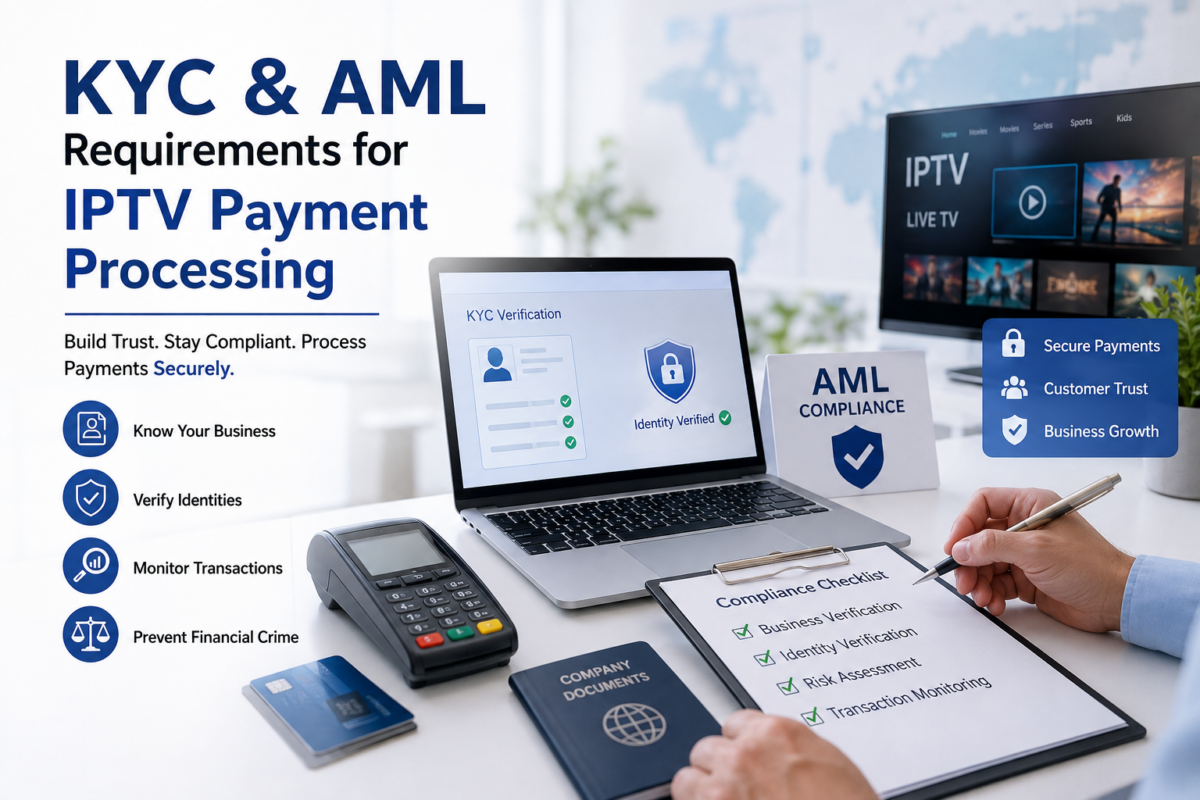
Getting an IPTV business approved for payment processing involves more than submitting a merchant account application and waiting for approval. Payment providers need to understand who owns the business, what services it provides, where its customers are located, how transactions are expected to flow, and whether the business presents an acceptable level of financial and compliance risk.
This is where KYC and AML requirements for IPTV payment processing become important.
KYC, or Know Your Customer, is the process of verifying the identity and business information of a merchant. AML, or Anti-Money Laundering, refers to controls designed to identify and prevent transactions or business activity associated with financial crime.
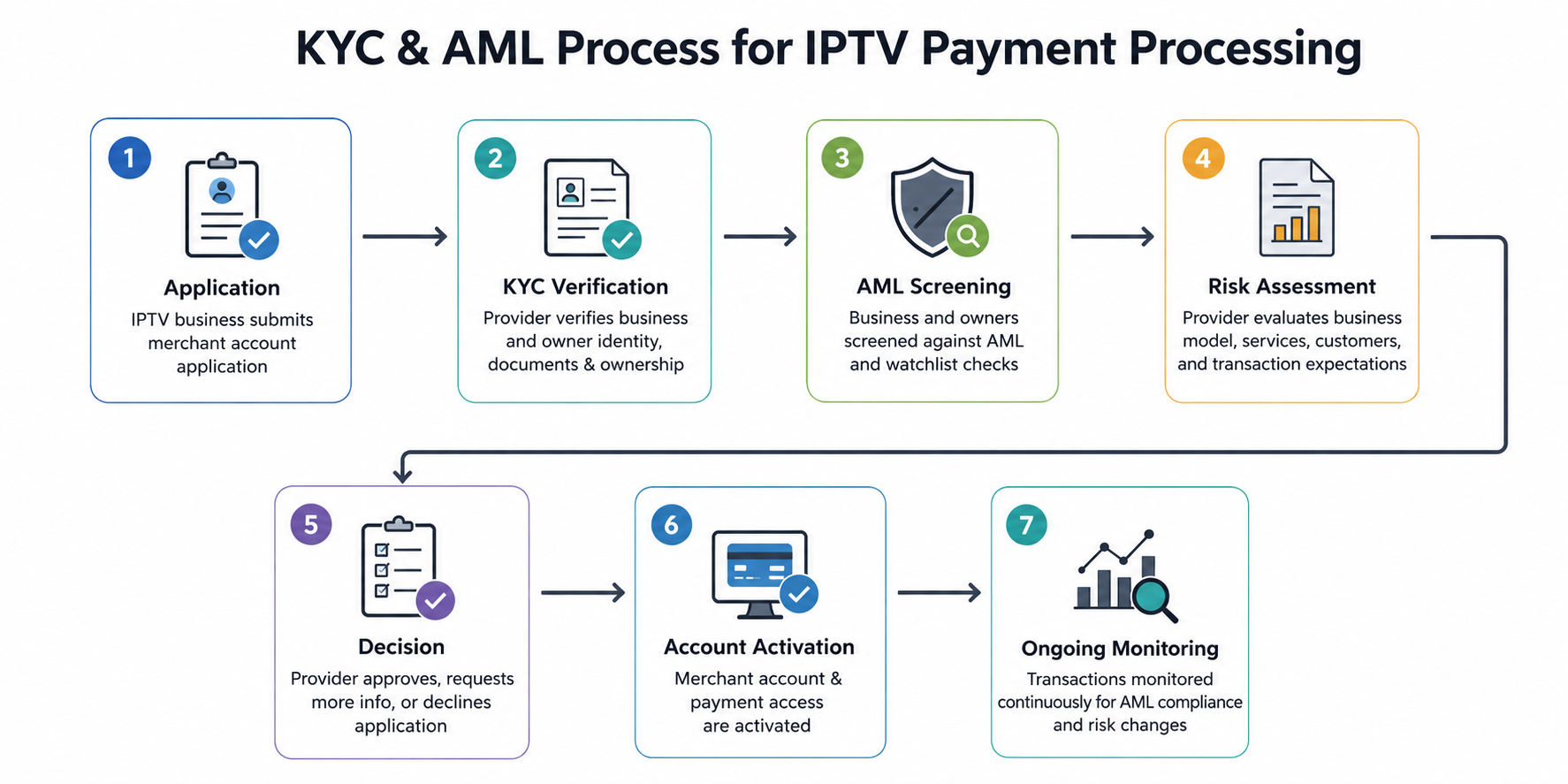
For an IPTV business, these processes can be part of merchant underwriting and ongoing payment monitoring. Understanding what providers are likely to ask for can make the application process more straightforward and help businesses avoid delays caused by incomplete or inconsistent information.
What Is KYC in IPTV Payment Processing?
KYC means Know Your Customer. In merchant payment processing, it generally involves verifying the identity of the business and the people responsible for it.A payment provider needs to know that the company applying for payment processing actually exists and that the individuals representing it are authorized to operate the business. The exact requirements vary by provider and jurisdiction, but an IPTV business may be asked for information such as:
- Business registration and incorporation details.
- Identification documents for owners or authorized representatives.
- Business address and contact information.
- Ownership structure and beneficial-owner information.
- Bank account information.
- Website and details about the services being sold.
For example, an IPTV company may have three shareholders but only one person completing the merchant application. The payment provider may still need information about the company’s ownership structure and the individuals who ultimately own or control the business.
KYC is therefore not simply about verifying the person submitting the application. It can involve understanding the business and its ownership structure as a whole.
Why Do Payment Providers Require KYC?
Payment processing creates financial relationships between merchants, payment providers, acquiring institutions, card networks, and customers. Providers need to know who they are processing payments for because they can face financial, regulatory, and reputational exposure if a merchant’s activities are not properly understood.
For an IPTV business, this means the provider may want to establish:
- Who operates the business: The provider needs to verify the company and relevant owners or representatives.
- What the business sells: The provider needs to understand the actual IPTV service, subscription model, and customer offering.
- How the business receives payments: Expected transaction volume, payment methods, customer locations, and billing frequency can all help establish the merchant’s transaction profile.
This is particularly important for IPTV businesses because subscription payments can continue for months or years. The payment provider needs an accurate understanding of the business before establishing a processing relationship.
What Is AML in IPTV Payment Processing?
AML stands for Anti-Money Laundering. AML controls are designed to help financial institutions and payment businesses identify suspicious activity and prevent their services from being used for money laundering or other forms of financial crime. For an IPTV business, AML considerations can extend beyond the initial merchant application. A provider may monitor transaction activity to determine whether actual payment behavior remains consistent with the merchant’s expected business profile.
For example, suppose an IPTV company tells a provider that it expects to process approximately $50,000 per month from customers primarily in one market.
Several months later, the business suddenly processes $500,000 from numerous unrelated countries. That change does not automatically mean anything improper has occurred. Rapid growth, a successful marketing campaign, or international expansion could explain it. However, the difference between expected and actual activity may cause the provider to request additional information or conduct further review.
KYC Documents an IPTV Business May Need
There is no universal document list that applies to every IPTV business because requirements vary according to the provider, jurisdiction, ownership structure, and risk profile.
However, businesses should generally be prepared to provide documentation that establishes their identity and explains their operations.
This may include business formation documents, government-issued identification for relevant individuals, proof of business address, bank information, ownership details, and information about the company’s website and services.
The website itself can also become an important part of the review. A payment provider may want to understand what customers are actually purchasing, how subscription plans work, what customers are charged, and what policies govern refunds and cancellations.
For example, an IPTV website that clearly displays subscription pricing, billing frequency, service information, customer support details, and applicable terms gives a provider considerably more information to work with than a website containing only a payment button.
Beneficial Ownership and IPTV Merchant Accounts
Beneficial ownership is an important part of many KYC processes. A beneficial owner is generally an individual who ultimately owns or controls a business, although the exact definition and threshold can depend on the applicable regulatory framework and provider. This matters when an IPTV company is owned through multiple entities.
For example, Company A may operate the IPTV service, but Company B may own Company A, while several individuals ultimately control Company B.
The payment provider may need to understand this ownership chain rather than relying solely on the name of the operating company. Providing accurate ownership information is therefore important during merchant account onboarding. Attempting to simplify or obscure the ownership structure can create additional questions and potentially delay the review.
Source of Funds and Business Activity
Depending on the payment provider and merchant profile, a business may also be asked to provide information that helps explain the source and movement of funds.
For an IPTV business, this can involve explaining how customers are acquired, what subscription plans are sold, expected payment volume, and where revenue is generated. For an established company, previous processing statements or financial information may help demonstrate the existing transaction history.
As a newly established IPTV business, there may be no significant processing history. In that case, the provider may rely more heavily on business documentation, projected transaction activity, ownership information, and the overall business model.
The important principle is consistency.
If the business application states one expected transaction profile while the company’s actual activity looks substantially different, the provider may need additional information.
AML Monitoring Does Not End After Approval
Passing KYC during onboarding does not mean compliance review stops once the merchant account is activated. Payment providers can continue monitoring merchant activity. This may include reviewing transaction volume, geographic patterns, unusual activity, dispute levels, refunds, and other changes in payment behavior.
For example, an IPTV business may start with $10,000 in monthly processing and gradually grow to $100,000 as its subscriber base expands.
That type of growth may be perfectly legitimate. However, if the growth is substantially different from the original expectations, communicating the reason for the change and maintaining accurate business information can help explain the new transaction profile. This is one reason businesses should treat payment compliance as an ongoing operational responsibility rather than a one-time application requirement.
What Can Delay KYC Approval for an IPTV Business?
KYC delays often occur because information is incomplete, inconsistent, outdated, or difficult to verify. Common problems can include:
- Business names that differ between documents and the website.
- Missing ownership information.
- Expired or unclear identification documents.
- Incomplete business addresses.
- A website that does not clearly explain the service.
- Transaction expectations that do not match the proposed business model.
For example, an IPTV business might apply under one company name while its website displays a completely different brand without explaining the relationship between the two.
This does not necessarily make the business unacceptable, but the provider may need additional documentation to understand the structure. Preparing consistent information before submitting the application can reduce unnecessary back-and-forth.
How IPTV Businesses Can Prepare for KYC and AML Review?
The best approach is to treat payment onboarding as a business-verification process rather than simply a form-filling exercise.
Before applying for payment processing, an IPTV business should have a clear record of its legal entity, ownership, services, customer markets, subscription structure, expected transaction volume, and banking information. The business should also make sure its website accurately reflects what it actually sells. If the business expects international customers, recurring payments, or significant transaction growth, those characteristics should be represented accurately in the payment application.
Transparency is particularly important.
A business should not attempt to hide its industry, change the description of its service to obtain approval, or provide unrealistic transaction estimates. Doing so can create greater problems if actual payment activity later contradicts the information supplied during onboarding.
KYC, AML and the IPTV Payment Processing Journey
KYC and AML requirements are part of the broader payment-processing journey.
The merchant account establishes the business’s relationship with the payment infrastructure. The payment gateway connects the customer’s checkout with that infrastructure. Recurring billing manages future subscription payments, while ongoing monitoring helps providers identify changes in transaction behavior.
Each component affects the stability of the overall payment operation. For an IPTV business, understanding KYC and AML requirements before applying can make it easier to prepare the necessary information and avoid preventable onboarding delays.
As IPTV businesses grow, some companies may also explore a white-label payment processing solution to create a more customized payment infrastructure that can better align with their brand, subscription model, and operational requirements.
It also helps explain why payment providers may ask questions that appear unrelated to the actual checkout process. They are not only evaluating whether a customer can make a payment; they are evaluating the business receiving those payments.
Building a Payment-Ready IPTV Business
A payment-ready IPTV business should be able to clearly explain who owns the company, what services it provides, how customers subscribe, where those customers are located, and how the business expects its payment activity to develop.
Strong documentation and transparent operations do not guarantee approval, because each provider applies its own underwriting and compliance requirements. They do, however, give the provider the information necessary to evaluate the business accurately.
KYC and AML should therefore be viewed as part of building a sustainable payment infrastructure rather than simply another obstacle to merchant-account approval.
Once a business understands its compliance and verification requirements, the next challenge is maintaining reliable payment operations after approval. That includes dealing with common payment processing challenges for IPTV businesses, from transaction failures and settlement issues to recurring billing problems, account reviews, and changing processing requirements.

Categories
- ACH Payments (10)
- adult payment processing (11)
- AI (9)
- Altcoins (10)
- Banking (10)
- Bitcoin (133)
- Bitcoin ETF (11)
- Bitcoin Price (30)
- Blockchain (50)
- Brokering World Hunger Away (16)
- Business (17)
- card payment processing (10)
- CBD (11)
- CBDC (11)
- Chargeback (8)
- coaching business (11)
- COVID-19 (3)
- Crypto ATMs (1)
- Crypto Banking (17)
- Crypto Bill (1)
- Crypto business owner platform (31)
- Crypto Investment (3)
- Crypto Markets (5)
- Crypto Payment (35)
- Crypto Payment Processor (4)
- Crypto Prices (1)
- Crypto Trading (92)
- Cryptocurrency (402)
- Cryptocurrency Exchange (108)
- Data Visualization (2)
- dating platforms (11)
- debt collection payment processing (10)
- Decentralized Finance (7)
- DeFi Payment (9)
- DEX (3)
- Digital Currency (23)
- dropshipping payment processing (12)
- Ethereum (2)
- FAQ (7)
- file sharing payment processing (11)
- Finance (25)
- Financial Equality (4)
- Financial Freedom (8)
- Forex (35)
- hemp (1)
- ICO (2)
- Investment (11)
- IPTV (11)
- Merchant Account (10)
- Mining (3)
- News (66)
- NFTs (2)
- online gambling (11)
- P2P (1)
- Paybito (147)
- PayBitoPro (693)
- PayBitoPro Coin Listing (6)
- PayBitoPro Exchange (2)
- Payment Gateway (48)
- peptide (10)
- Post COVID Digital Transformation (1)
- Press Release (130)
- Privacy & Security (3)
- Real Estate (1)
- Stablecoin (5)
- Technology (15)
- Travel (11)
- Uncategorized (10)
- US Presidential Election (2)
- Utility Coin (1)
- Web3 business (4)
- Web3 Wallets (2)
- White Label Crypto Exchange (8)
Recent Posts
- Payment Gateway vs. Payment Orchestration: What’s the Difference?
- What Is Smart Payment Routing? Strategies to Optimize Payment Performance
- How to Improve Payment Approval Rates for High-Risk Businesses?
- Why Are Online Payments Failing? Common Causes and How to Fix Them
- How to Use Multiple Payment Processors to Reduce Business Disruptions?