International Payment Processing for IPTV Businesses: How to Accept Payments Globally?
- August 11, 2026
- Soham Guchait
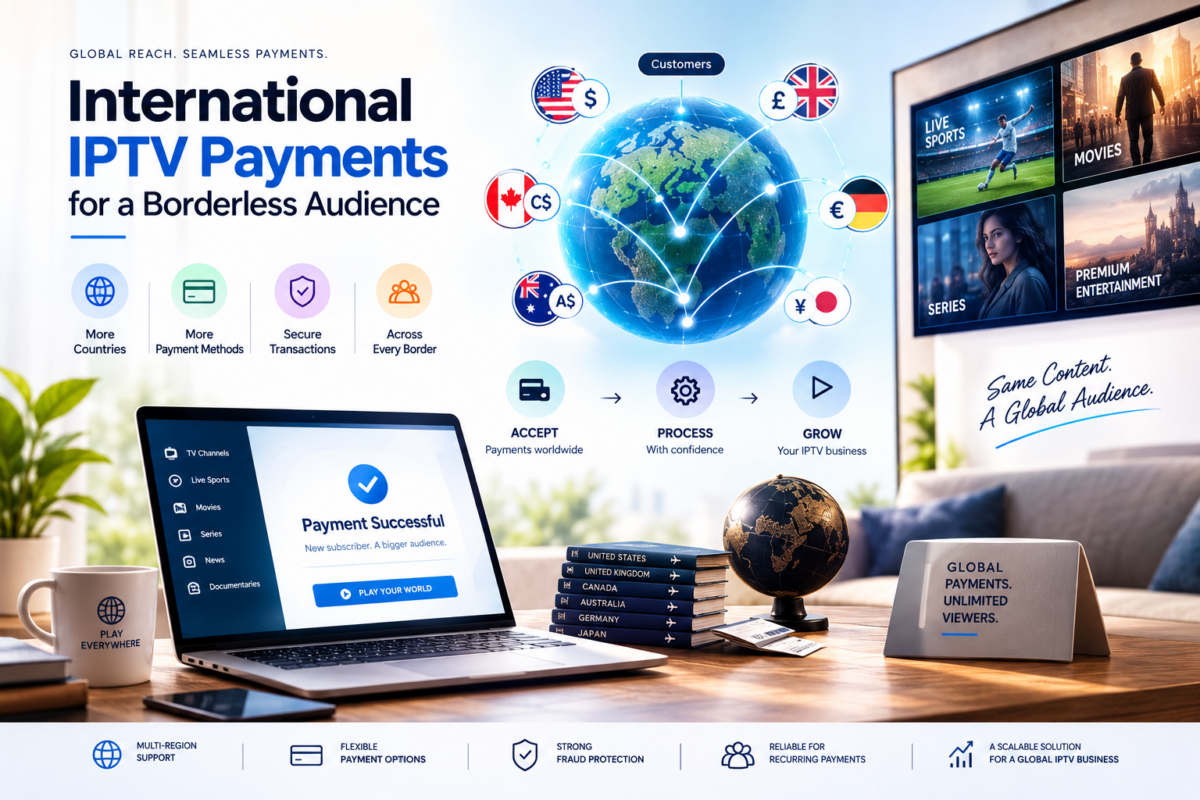
An IPTV business can have customers in multiple countries, but accepting payments internationally is not as simple as putting a subscription plan on a website and allowing customers from anywhere to purchase it.
Cross-border transactions introduce additional considerations involving currencies, payment methods, customer locations, transaction authorization, settlement, recurring billing, and payment risk. For an IPTV provider trying to expand beyond its domestic market, international payment processing can therefore become an important part of the overall payment infrastructure.
A customer in the United States may want to pay with a U.S.-issued card, while another customer in Europe may use a different currency or payment method. Both customers may be purchasing the same IPTV subscription, but the underlying payment transactions can be handled differently.
Understanding how international payment processing works can help IPTV businesses build a payment setup that supports overseas customers without creating unnecessary payment friction.
What Is International Payment Processing?
International payment processing refers to the ability of a business to accept and process payments from customers located in different countries or using payment methods issued in different regions.
For an IPTV business, this can mean accepting subscriptions from customers whose cards, bank accounts, or digital payment accounts are outside the merchant’s home country. For example, an IPTV provider based in the United States may have subscribers in Canada, the United Kingdom, Germany, and Australia. The business may charge every customer the same subscription price, but the payment infrastructure still needs to handle transactions originating from different countries.
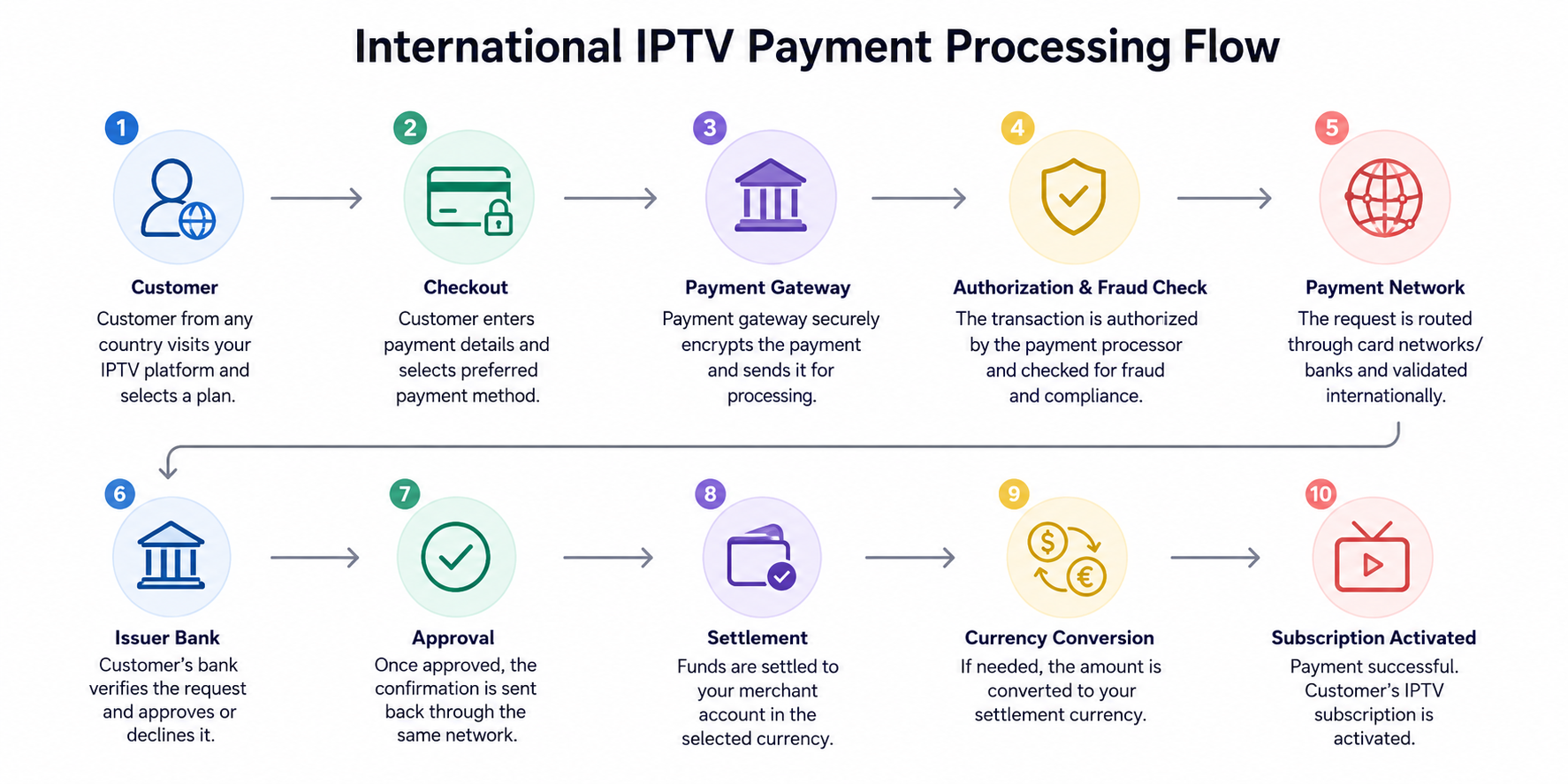
International payment processing can involve several connected elements, including payment authorization, currency conversion, cross-border transaction handling, fraud controls, settlement, and recurring billing.
Why Do International Payments Matter for IPTV Businesses?
Many IPTV businesses operate on a subscription model, which means international customers can represent recurring revenue rather than one-time sales.
Suppose an IPTV provider charges $20 per month and has 5,000 domestic subscribers. It later expands into several international markets and acquires another 2,000 subscribers. The business has not simply added 2,000 new customers. It has added another group of recurring transactions that may involve different currencies, card issuers, payment methods, and transaction patterns. This makes international payment infrastructure particularly important as an IPTV business grows.
A payment setup that works well for domestic customers may not necessarily provide the same experience for international subscribers.
Can IPTV Businesses Accept International Card Payments?
International card payments are possible when the merchant account, payment processor, gateway, and applicable payment networks support the relevant transaction types and markets.
A customer does not necessarily need to have a card issued in the same country where the IPTV business operates. For example, a U.S.-based IPTV business may accept a subscription payment from a customer whose card was issued in the United Kingdom. However, the transaction can be affected by factors such as the card issuer, currency, cross-border processing arrangements, merchant configuration, and risk controls.
The fact that a gateway accepts cards does not automatically mean every international card transaction will be approved. This distinction is important when evaluating an IPTV payment gateway for an internationally focused business.
Currency Considerations for IPTV Subscriptions
Currency is one of the first issues an IPTV business needs to address when accepting international payments. A business may choose to display subscription prices in one primary currency or offer customers pricing in local currencies where supported.
For example, an IPTV provider might advertise a subscription at $15 USD. A customer in another country may see the transaction converted into their local currency by their card issuer or payment provider.
Alternatively, the business may have infrastructure that supports local-currency pricing. Each approach can affect the customer experience.
Showing a customer a familiar currency can make the checkout process easier to understand, while using a single currency can simplify pricing and accounting for the merchant. The business should also understand who handles currency conversion and where applicable conversion costs are applied.
Local Payment Methods Can Improve International Checkout
Cards are important for international ecommerce, but they are not the only payment option customers may expect. Payment preferences vary significantly between countries.
A payment method that is common in one market may have little relevance in another. This means an IPTV business expanding internationally may need to consider regional payment methods in addition to cards, ACH where applicable, and digital wallets.
For example, a payment strategy designed entirely around U.S. customers may not provide the same checkout experience for customers in European or other international markets. The goal should not be to add every possible payment method. Instead, the business should identify where its customers are located and determine which payment methods are actually relevant to those markets.
This builds on the payment-method strategy discussed in the guide to the best payment methods for IPTV businesses.
Why Can International IPTV Payments Be Declined?
International transactions can sometimes experience higher payment friction because more variables are involved. A transaction can be declined because of:
- The customer’s issuing bank or card restrictions.
- Cross-border transaction controls.
- Currency or merchant configuration issues.
- Fraud or risk screening.
- Incorrect customer payment information.
- Restrictions associated with a particular payment method or market.
For example, a customer may successfully use their card for domestic purchases but have an international transaction declined by their bank. The IPTV business may not be able to control the issuer’s decision. However, if a large percentage of international customers consistently experience declines, the business should investigate whether the problem is concentrated in a particular country, payment method, currency, or transaction route. Patterns are often more useful than individual failed transactions.
International Recurring Payments Require Additional Planning
International subscriptions create another layer of complexity because the payment is not made only once. Consider an IPTV customer who subscribes from another country using a foreign-issued card. The initial payment succeeds, but the next month’s renewal fails. The business now needs to understand why the recurring transaction failed and how the customer can recover the subscription.
Potential issues can include expired cards, changed payment details, issuer restrictions, insufficient funds, or recurring payment rules. This is why international payment processing should be evaluated together with recurring billing.
A payment infrastructure that supports international one-time payments but struggles with recurring international transactions may create problems as the subscriber base grows. The business should test the complete lifecycle rather than only the initial checkout.
Settlement and Receiving International Payments
Accepting an international payment is only one part of the process. The business also needs to understand how and where funds are settled. Depending on the payment arrangement, the merchant may receive settlement in its primary currency or another supported currency.
For example, an IPTV company may charge customers in different currencies but ultimately receive settlement in one operating currency. The business should understand:
- Which currencies can be processed ?
- Which currencies can be used for settlement ?
- How is currency conversion handled ?
- How long do international transactions take to settle ?
- What fees or additional costs may apply ?
Settlement considerations become increasingly important as transaction volume grows because small differences in conversion costs or settlement terms can have a meaningful impact on revenue.
International Payments and Fraud Risk
Cross-border transactions can also require careful fraud management.
A payment originating from a foreign country is not automatically fraudulent. However, international transaction patterns can contain additional variables that payment systems may evaluate.
For example, an IPTV business may normally receive payments from customers in five countries. If transaction activity suddenly appears from several unrelated regions at unusually high volumes, the payment infrastructure may treat the change differently from normal activity.
Businesses should therefore monitor transaction patterns rather than automatically rejecting international customers. Fraud controls should balance security with legitimate payment acceptance. Overly aggressive controls can create unnecessary declines, while insufficient controls can expose the business to fraudulent transactions and disputes.
Compliance and Business Information Matter
International payment processing also requires the business to provide accurate information about its operations. Payment providers may need to understand where the business operates, where customers are located, what services are being provided, expected transaction volumes, and how payments are collected.
A business expanding internationally should ensure that its payment profile reflects its actual operations.
For example, if an IPTV business originally expects 80% of its transactions to come from domestic customers but later receives most of its revenue from international markets, its payment profile has materially changed. Keeping payment providers informed about significant changes can help avoid situations where transaction activity appears inconsistent with the merchant’s approved profile.
How to Choose International Payment Processing for IPTV?
An IPTV business should evaluate international payment infrastructure based on its actual markets rather than simply choosing a provider that advertises global processing. Important considerations include:
- Countries and regions supported.
- International card acceptance.
- Supported currencies.
- Local and regional payment methods.
- Recurring international payments.
- Settlement currencies and timelines.
- Transaction and currency-conversion costs.
- Fraud and risk controls.
- Reporting for international transactions.
- Integration with the existing IPTV subscription system.
The provider should also be able to accommodate the business’s expected transaction volume. A company processing a few hundred international subscriptions has different requirements from one processing tens of thousands of recurring payments across multiple countries.
Building an International IPTV Payment Strategy
International payment processing can open new markets, but expansion should be approached as a payment infrastructure decision rather than simply a marketing decision. Before entering a new country, an IPTV business should understand how customers in that market prefer to pay, which currencies are relevant, how recurring payments will work, and how international transactions will be settled.
For example, adding customers from three new countries may require changes to payment methods, currency handling, fraud controls, customer communication, and transaction reporting.
Planning these requirements before expansion is generally easier than rebuilding the payment system after international sales have already grown. A strong international payment setup should allow customers to pay conveniently while giving the IPTV business sufficient control and visibility over its transactions.
As the business expands, another important question emerges: How much will IPTV payment processing actually cost? Transaction fees, cross-border charges, currency conversion, chargebacks, and other expenses can directly affect subscription margins, making payment processing costs an important part of choosing the right payment infrastructure.

Categories
- ACH Payments (10)
- adult payment processing (11)
- AI (9)
- Altcoins (10)
- Banking (10)
- Bitcoin (133)
- Bitcoin ETF (11)
- Bitcoin Price (30)
- Blockchain (50)
- Brokering World Hunger Away (16)
- Business (17)
- card payment processing (10)
- CBD (11)
- CBDC (11)
- Chargeback (8)
- coaching business (11)
- COVID-19 (3)
- Crypto ATMs (1)
- Crypto Banking (17)
- Crypto Bill (1)
- Crypto business owner platform (31)
- Crypto Investment (3)
- Crypto Markets (5)
- Crypto Payment (35)
- Crypto Payment Processor (4)
- Crypto Prices (1)
- Crypto Trading (92)
- Cryptocurrency (402)
- Cryptocurrency Exchange (108)
- Data Visualization (2)
- dating platforms (11)
- debt collection payment processing (10)
- Decentralized Finance (7)
- DeFi Payment (9)
- DEX (3)
- Digital Currency (23)
- dropshipping payment processing (12)
- Ethereum (2)
- FAQ (7)
- file sharing payment processing (11)
- Finance (25)
- Financial Equality (4)
- Financial Freedom (8)
- Forex (35)
- hemp (1)
- ICO (2)
- Investment (11)
- IPTV (11)
- Merchant Account (10)
- Mining (3)
- News (66)
- NFTs (2)
- online gambling (11)
- P2P (1)
- Paybito (147)
- PayBitoPro (693)
- PayBitoPro Coin Listing (6)
- PayBitoPro Exchange (2)
- Payment Gateway (48)
- peptide (10)
- Post COVID Digital Transformation (1)
- Press Release (130)
- Privacy & Security (3)
- Real Estate (1)
- Stablecoin (5)
- Technology (15)
- Travel (11)
- Uncategorized (10)
- US Presidential Election (2)
- Utility Coin (1)
- Web3 business (4)
- Web3 Wallets (2)
- White Label Crypto Exchange (8)
Recent Posts
- Payment Gateway vs. Payment Orchestration: What’s the Difference?
- What Is Smart Payment Routing? Strategies to Optimize Payment Performance
- How to Improve Payment Approval Rates for High-Risk Businesses?
- Why Are Online Payments Failing? Common Causes and How to Fix Them
- How to Use Multiple Payment Processors to Reduce Business Disruptions?