White-Label Payment Platform for IPTV Businesses: A Complete Guide
- August 11, 2026
- Soham Guchait

As an IPTV business grows, payment processing can become more complicated than simply adding a checkout page to a website. A larger subscriber base can create the need for recurring billing, multiple payment methods, international transactions, payment reporting, automated subscription management, and a more controlled customer payment experience.
This is where a white-label payment platform for IPTV businesses can become relevant.
A white-label payment platform allows a business to use payment infrastructure developed by another provider while presenting parts of the payment experience under its own brand. Instead of building an entire payment system internally, the business can use an existing infrastructure and integrate it with its own website, subscription platform, or customer management system.
For some IPTV businesses, this can provide greater flexibility than using a basic payment gateway.
What Is a White-Label Payment Platform?
A white-label payment platform is payment infrastructure that can be branded and presented as part of another company’s own service.
The underlying provider may handle payment processing technology, transaction management, integrations, reporting, and other infrastructure, while the business using the platform controls the customer-facing experience to the extent permitted by the arrangement.
For example, an IPTV company called StreamTV could use a white-label platform to create a payment experience that appears under the StreamTV brand. A customer subscribing to a $20 monthly plan may see StreamTV throughout the checkout process rather than being redirected to an unrelated payment interface. The exact level of branding and customization depends on the platform and agreement.
Why Would an IPTV Business Use a White-Label Payment Platform?
A small IPTV business may only need a merchant account and payment gateway to accept subscription payments. As the business grows, however, payment requirements can become more complex.
A company may need to manage thousands of recurring subscriptions, multiple payment methods, international customers, failed payments, refunds, transaction reporting, and automated communication between its payment system and IPTV platform.
Building all of this internally can require significant development and maintenance. A white-label platform can provide existing payment infrastructure that can be integrated into the business rather than requiring every component to be developed from scratch.
For example, an IPTV provider with 500 subscribers may have little need for advanced payment infrastructure. A company managing 50,000 subscribers may have very different requirements. The decision therefore depends on the business’s scale, technical requirements, payment volume, and long-term plans.
How Does a White-Label Payment Platform Work?
The process generally connects the IPTV business’s customer interface with the underlying payment infrastructure.
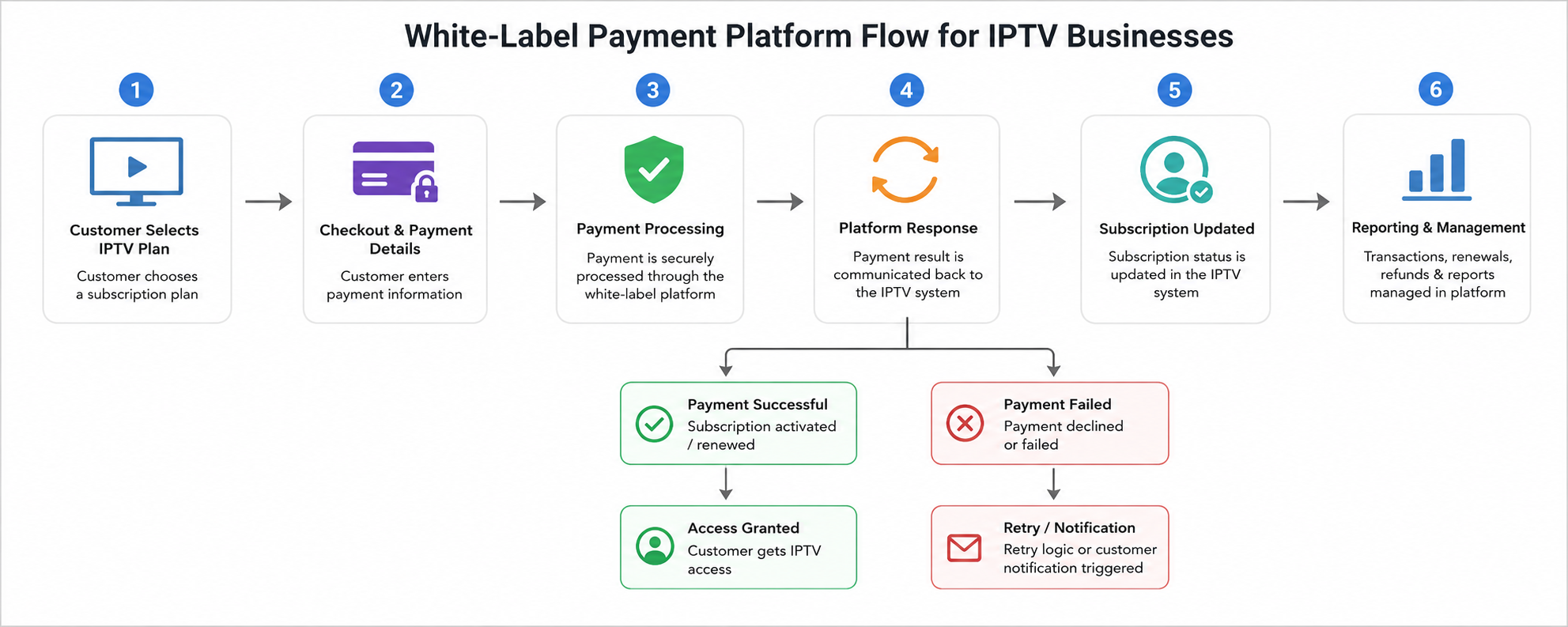
A customer first selects an IPTV subscription and proceeds to checkout. The payment information is submitted through the payment interface and processed through the applicable payment infrastructure. The result is then communicated back to the IPTV system.
For example, a customer purchases a $15 monthly subscription. If the payment succeeds, the IPTV platform can receive the successful payment status and activate the customer’s subscription.
At the next billing date, the recurring payment can be processed according to the subscription arrangement. If the renewal succeeds, access continues. If it fails, the IPTV system can apply its failed-payment policy. This connection between payments and subscription management is particularly important for IPTV businesses because payment status can directly affect customer access.
White-Label Payment Platform vs. Standard Payment Gateway
A standard payment gateway primarily gives a business the ability to accept online payments. A white-label payment platform can provide a broader payment infrastructure layer that may include branding, transaction management, recurring billing, reporting, integrations, and other capabilities.
For example, an IPTV business with a small customer base may only need a straightforward gateway.
A larger IPTV operator may want greater control over the payment experience and more centralized management of transactions and subscriptions. A technology company operating multiple IPTV brands may have an even greater need for centralized payment infrastructure. This does not mean a white-label platform is automatically better. If a business only needs basic payment acceptance, additional infrastructure may create unnecessary complexity.
Important Features to Look For
When evaluating a white-label payment platform for an IPTV business, the most important features should be connected to the actual subscription model and customer base.
Recurring Billing
Recurring billing is essential for subscription-based IPTV businesses.
The platform should support the required billing schedules and provide appropriate functionality for renewals, failed payments, payment-method updates, cancellations, and refunds. A business should confirm exactly how recurring payments work instead of assuming that every payment platform supports subscriptions in the same way. This is particularly important because failed recurring payments can directly affect subscriber retention and monthly revenue.
Multiple Payment Methods
Customers may prefer different ways to pay.
Depending on the markets served, an IPTV business may want to support cards, ACH, digital payment methods, and other relevant options. The important question is not how many payment methods the platform offers. It is whether the available methods are useful for the business’s customers and support the required subscription and settlement processes.
Branded Checkout
Branding is one of the main reasons a business may consider white-label infrastructure. Depending on the platform, businesses may be able to customize elements of the checkout experience, such as branding, payment pages, customer communications, and other interface components. A consistent branded experience can make payment feel like a natural part of the IPTV service.
Reporting and Transaction Management
A growing IPTV business needs visibility into its payment activity. Useful reporting can help track successful payments, failed transactions, refunds, recurring payments, disputes, and settlement activity.
For example, if an IPTV company notices that payment failures have increased significantly among customers in one country, transaction reporting can help identify the pattern and investigate its cause.
Integration
The payment platform should be able to communicate effectively with the IPTV website or subscription management system. APIs and other integration options can allow payment events to trigger automated actions.
A successful payment might activate or extend a subscription, while a confirmed cancellation can prevent future billing. The exact integration process depends on the platform and the IPTV system being used.
White-Label Payment Platforms for International IPTV Businesses
International IPTV businesses may have additional requirements.
Customers may use foreign-issued cards, different currencies, or payment methods that are popular in their local markets. A white-label platform should therefore be evaluated according to the countries it supports, currencies available, international payment capabilities, settlement options, and recurring-payment functionality.
For example, an IPTV company serving customers in the United States, United Kingdom, Canada, and Australia may need a broader payment infrastructure than a company serving customers in only one country.
International support should be verified rather than assumed simply because a provider describes its service as global.
KYC, AML and Compliance Still Apply
Using a white-label payment platform does not eliminate payment-related compliance requirements. The businesses involved may still need to satisfy applicable KYC, AML, merchant underwriting, transaction-monitoring, and other requirements. An IPTV business should understand which entity is responsible for merchant onboarding, transaction processing, compliance checks, disputes, and settlement.
White-label technology changes how payment infrastructure is delivered and branded. It does not remove the underlying responsibilities associated with payment processing.
How Much Does a White-Label Payment Platform Cost?
There is no standard price for white-label payment infrastructure.
Costs can depend on transaction volume, payment methods, geographic coverage, customization, integrations, platform features, and commercial terms. A provider may charge setup fees, platform fees, transaction-based fees, integration costs, or a combination of these. An IPTV business should compare the total cost against the cost and resources required to build and maintain similar infrastructure independently.
For example, developing payment integrations, subscription billing, reporting, transaction management, and customer-payment functionality internally can require considerable technical resources. A white-label platform may reduce some of that development burden, but the business still needs to evaluate the pricing and contractual terms carefully.
How to Choose the Right White-Label Payment Platform
Before selecting a platform, an IPTV business should evaluate three broad areas:
- Payment capabilities: Supported payment methods, recurring billing, currencies, international transactions, refunds, and settlements.
- Technology: APIs, integrations, customization, reporting, scalability, and compatibility with the existing IPTV system.
- Operations: Merchant onboarding, KYC and AML requirements, transaction monitoring, disputes, customer support, and responsibility for different parts of the payment process.
The platform should also be capable of handling future growth. A solution that works for 1,000 subscribers may not be suitable when the business reaches 50,000 subscribers or begins operating across multiple markets.
Is a White-Label Payment Platform Right for Every IPTV Business?
Not necessarily.
A small IPTV business with straightforward payment requirements may be better served by a conventional merchant account and payment gateway.
A larger IPTV operator, IPTV technology provider, or business managing multiple brands may have stronger reasons to use white-label payment infrastructure.
The decision should therefore be based on actual business requirements rather than simply choosing the most advanced option available.
Building Scalable Payment Infrastructure for IPTV
Payment processing becomes increasingly important as an IPTV business grows.
Recurring subscriptions, payment failures, international customers, multiple payment methods, chargebacks, compliance, reporting, and integration all become part of the payment operation. A white-label payment platform can provide an infrastructure layer that brings many of these functions together while allowing a business to maintain a more consistent branded payment experience.
The right solution is not necessarily the one with the most features. It is the one that can process payments reliably, support recurring revenue, integrate with the IPTV business, serve its target markets, and scale as the subscriber base grows.

Categories
- ACH Payments (10)
- adult payment processing (11)
- AI (9)
- Altcoins (10)
- Banking (10)
- Bitcoin (133)
- Bitcoin ETF (11)
- Bitcoin Price (30)
- Blockchain (50)
- Brokering World Hunger Away (16)
- Business (17)
- card payment processing (10)
- CBD (11)
- CBDC (11)
- Chargeback (8)
- coaching business (11)
- COVID-19 (3)
- Crypto ATMs (1)
- Crypto Banking (17)
- Crypto Bill (1)
- Crypto business owner platform (31)
- Crypto Investment (3)
- Crypto Markets (5)
- Crypto Payment (35)
- Crypto Payment Processor (4)
- Crypto Prices (1)
- Crypto Trading (92)
- Cryptocurrency (402)
- Cryptocurrency Exchange (108)
- Data Visualization (2)
- dating platforms (11)
- debt collection payment processing (10)
- Decentralized Finance (7)
- DeFi Payment (9)
- DEX (3)
- Digital Currency (23)
- dropshipping payment processing (12)
- Ethereum (2)
- FAQ (7)
- file sharing payment processing (11)
- Finance (25)
- Financial Equality (4)
- Financial Freedom (8)
- Forex (35)
- hemp (1)
- ICO (2)
- Investment (11)
- IPTV (11)
- Merchant Account (10)
- Mining (3)
- News (66)
- NFTs (2)
- online gambling (11)
- P2P (1)
- Paybito (147)
- PayBitoPro (693)
- PayBitoPro Coin Listing (6)
- PayBitoPro Exchange (2)
- Payment Gateway (48)
- peptide (10)
- Post COVID Digital Transformation (1)
- Press Release (130)
- Privacy & Security (3)
- Real Estate (1)
- Stablecoin (5)
- Technology (15)
- Travel (11)
- Uncategorized (10)
- US Presidential Election (2)
- Utility Coin (1)
- Web3 business (4)
- Web3 Wallets (2)
- White Label Crypto Exchange (8)
Recent Posts
- Payment Gateway vs. Payment Orchestration: What’s the Difference?
- What Is Smart Payment Routing? Strategies to Optimize Payment Performance
- How to Improve Payment Approval Rates for High-Risk Businesses?
- Why Are Online Payments Failing? Common Causes and How to Fix Them
- How to Use Multiple Payment Processors to Reduce Business Disruptions?