White Label Payment Platform for File Sharing Businesses: What It Is and Who Needs One?
- August 12, 2026
- Soham Guchait
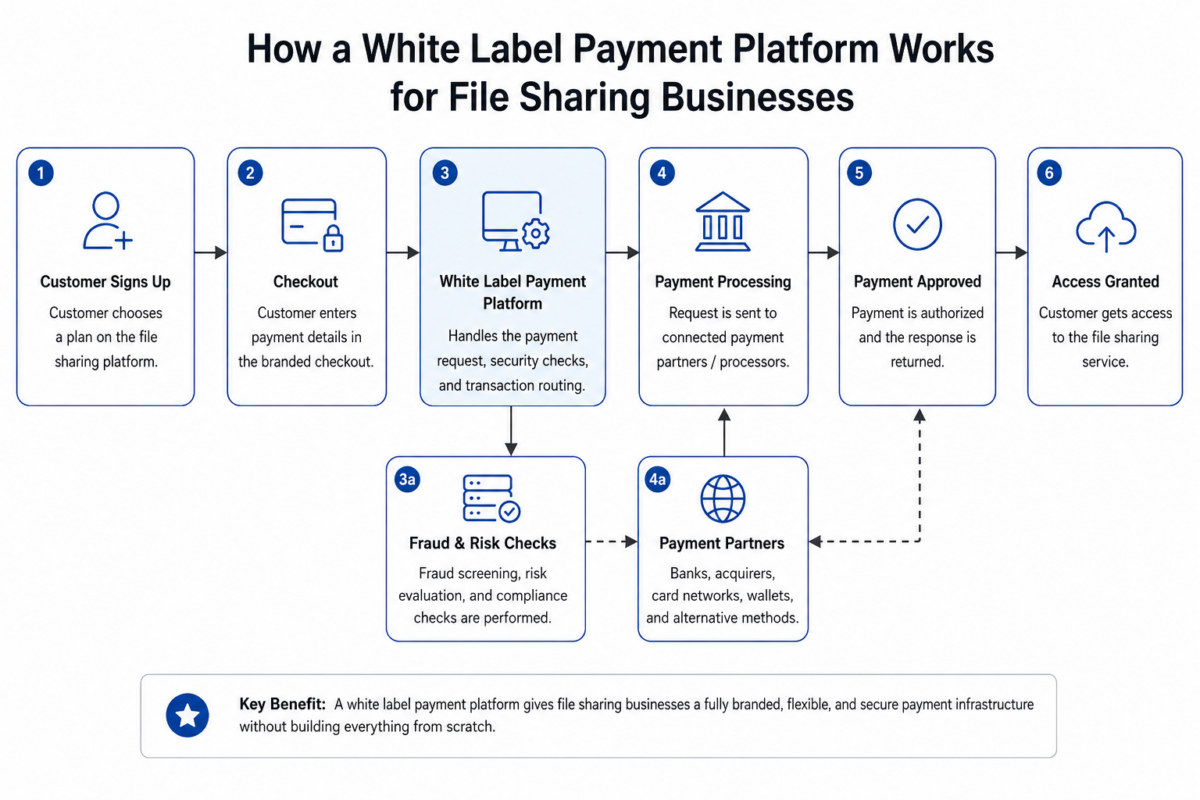
A file-sharing business can start with a simple payment setup. A customer chooses a storage plan, enters payment details, completes the transaction, and receives access to the service. For a small platform with a limited number of plans and customers, this may be enough.
The situation changes when the business grows.
A larger file-sharing platform may need recurring billing, multiple payment methods, international payments, automated subscription management, fraud controls, reporting, customer dashboards, and integrations with its own software. If the platform also manages payments for multiple brands, merchants, or business customers, a basic payment gateway may no longer provide enough control.
This is where a white label payment platform for file sharing businesses can become relevant.
A white-label payment platform provides payment infrastructure that can operate under a business’s own brand while the underlying technology is supplied and maintained by another provider. Depending on the arrangement, the platform can include branded checkout, APIs, payment management, reporting, merchant or sub-merchant management, and integrations with payment providers.
The important question is not whether every file-sharing business needs one. Most do not. The real question is when the additional infrastructure becomes useful.
What Is a White Label Payment Platform?
A white-label payment platform is a pre-built payment infrastructure layer that a business can use under its own branding instead of developing an entire payment system from scratch.
It is broader than a traditional payment gateway.
A payment gateway primarily facilitates the communication involved in submitting payment information and receiving transaction responses. A broader payment platform can include additional capabilities such as payment management, merchant onboarding, reporting, recurring billing, risk controls, APIs, and connections to multiple payment providers.
For a file-sharing business, this distinction matters.
Imagine a company operates a cloud-storage service with 100,000 subscribers. Its customers see the company’s branding when they subscribe, manage their payment methods, upgrade plans, or view billing information. Behind that experience, the payment platform can handle communication with the underlying payment infrastructure.
White-label does not mean that the business automatically becomes a bank, card network, or payment processor. The exact responsibilities depend on the platform structure, payment partners, licensing arrangements, and jurisdiction.
Why Would a File Sharing Business Need a White Label Payment Platform?
A small file-sharing company selling one monthly storage plan may have little reason to introduce advanced payment infrastructure. A platform becomes more likely to benefit from it when payment operations themselves become complicated. For example, a file-sharing business may offer:
- Personal monthly subscriptions
- Annual storage plans
- Business and enterprise accounts
- Different pricing by customer region
- Multiple payment methods
- Free trials that convert into paid subscriptions
- Plan upgrades and downgrades
Managing all of these through a basic payment setup can become difficult as transaction volume increases. A white-label platform can provide a centralized layer for managing these payment activities rather than requiring the business to build every function independently.
White Label Payment Platform vs. Payment Gateway
These terms are sometimes used interchangeably, but they describe different levels of infrastructure.
A payment gateway is generally focused on connecting a checkout or application to payment processing.
A white-label payment platform can sit at a broader operational level. Depending on the implementation, it may provide:
Branded payment experience: Customers interact with checkout or payment-management interfaces carrying the file-sharing company’s branding.
Payment management: The business can manage transactions, subscriptions, refunds, payment methods, and related activity from a centralized environment.
API and integration capabilities: The payment system can connect with the file-sharing platform’s existing application, billing system, customer database, or other software.
Reporting and monitoring: The business can obtain information about transactions, payment performance, settlements, disputes, and other operational activity.
The exact capabilities vary between platforms. A business should evaluate what is actually included rather than assuming that every white-label solution provides the same functions.
How Could It Work for a File Sharing Platform?
Consider a file-sharing company called CloudVault that offers storage subscriptions to individuals and businesses. A customer signs up for a $12 monthly plan. The file-sharing application creates the customer account, while the payment platform handles the payment request and communicates with the relevant payment infrastructure.
When the customer renews the following month, the billing system initiates the recurring transaction. If the payment succeeds, the subscription remains active. If the payment fails, the billing system can identify the failed renewal and trigger the appropriate customer notification or payment-recovery process, depending on the capabilities of the setup.
Now suppose CloudVault introduces a $120 annual plan, business accounts, additional payment methods, and customers in several countries. The payment operation now has considerably more moving parts.
A centralized payment platform can help connect these activities while keeping the payment experience integrated with the company’s own product.
White Label Payment Platforms and Subscription Billing
Subscription billing is particularly relevant to file-sharing businesses because storage services commonly charge customers on a monthly or annual basis. A subscription payment system needs to handle more than the first transaction. It may need to manage:
- Initial subscription payment
- Recurring renewals
- Failed payments
- Payment-method updates
- Plan upgrades
- Plan downgrades
- Cancellations
- Refunds
- Subscription status
Some white-label payment platforms are specifically designed to support recurring billing, payment retries, tokenized payment information, and subscription management. However, these features vary by platform and payment method.
For example, if a customer’s card expires before the next renewal, the file-sharing platform needs a process for identifying the failed payment and allowing the customer to update their payment information. Without proper integration between billing and payment systems, the customer could lose access even though they intend to continue paying.
Managing Multiple Payment Providers
As a file-sharing company expands internationally, it may want access to different payment methods or processing relationships. A single payment provider may not support every payment method, currency, country, or business requirement that the company eventually needs.
Some payment infrastructure platforms can connect businesses with multiple payment providers and provide a centralized layer for routing, reporting, or transaction management. This can be useful for a growing file-sharing platform because changing the entire checkout experience every time a new payment provider is added can create unnecessary technical work.
However, connecting multiple providers also introduces additional operational and compliance considerations. The business needs to understand who processes the transaction, who handles settlement, which entity is responsible for customer onboarding, and how disputes and risk controls are managed.
White Label Platforms and Merchant or Sub-Merchant Management
A more advanced use case occurs when the file-sharing business is itself operating as a platform for other businesses.
For example, imagine a software company provides branded file-sharing infrastructure to 500 independent businesses. Each business has its own customers, subscription plans, and payment activity. At that point, the software company may need more than payment acceptance for its own account.
It may need separate merchant profiles, dashboards, reporting, onboarding workflows, and payment management for different businesses.
Some white-label payment platforms support sub-merchant structures and centralized management, although the exact legal and operational model depends on the provider and applicable payment rules. This is a much stronger reason to consider white-label infrastructure than simply wanting a branded checkout page.
KYC, AML, Fraud, and Payment Risk
Advanced payment infrastructure does not remove the business’s compliance responsibilities.
If a platform manages multiple merchants or payment relationships, it may need appropriate processes for business verification, ownership information, transaction monitoring, fraud management, and ongoing risk review. The exact requirements depend on the business model, jurisdiction, payment partners, and regulatory structure.
A file-sharing company should therefore ask how a prospective white-label platform handles merchant onboarding, KYC/KYB, fraud controls, chargebacks, transaction monitoring, and access to payment records. This becomes especially important when the platform manages payments for businesses other than itself.
When Is a White Label Payment Platform Actually Necessary?
Not every file-sharing business needs white-label payment infrastructure.
A small business with a few subscription plans and relatively straightforward payment requirements may be better served by a conventional merchant account and payment gateway.
A white-label platform becomes more relevant when the business needs greater control or has more complex payment operations. Typical indicators include:
- A large or rapidly growing subscriber base
- Multiple payment providers or payment methods
- Complex recurring billing requirements
- A need for customized payment experiences
- Multiple brands or merchant accounts
- Extensive API integration requirements
- Advanced payment reporting and management
- A business model involving multiple merchants or clients
The decision should be based on operational requirements rather than the size of the company alone.
What Should a File Sharing Business Evaluate?
Before selecting a white-label payment platform, the business should understand exactly what sits behind the branded experience. Important questions include:
Payment coverage: Which payment methods, currencies, countries, and processing partners are supported?
Subscription capabilities: Can the system manage recurring billing, failed renewals, refunds, plan changes, and payment-method updates?
Integration: Does the platform provide APIs, webhooks, documentation, and the integration flexibility required by the existing file-sharing software?
Risk and compliance: What tools exist for fraud prevention, KYC/KYB, transaction monitoring, and chargeback management?
Reporting: Can the business reconcile transactions, refunds, fees, and settlements accurately?
Scalability: Can the infrastructure support increased subscribers, transaction volume, payment methods, and operational complexity?
These questions are more important than simply asking whether a platform is “white label.”
Building Payment Infrastructure That Can Scale
A white-label payment platform should solve a real operational problem, not simply add another layer of technology. For a small file-sharing business, a standard payment setup may be sufficient. As the company introduces more subscription plans, international customers, payment methods, and complex billing workflows, however, payment infrastructure can become a core part of the product.
The right setup should allow the business to manage the complete payment lifecycle – from checkout and recurring billing to refunds, fraud monitoring, disputes, reporting, and settlement – without creating unnecessary complexity for customers.
For businesses operating multiple brands or supporting other merchants, the need can go further. In those cases, white-label infrastructure may provide the centralized payment management, branded experience, integrations, and merchant-level controls required to operate at scale.
The key is to choose infrastructure according to the actual payment model. A conventional merchant account and gateway may be enough for a straightforward subscription business, while a growing platform with complex payment operations may need a broader white-label payment infrastructure.

Categories
- ACH Payments (10)
- adult payment processing (11)
- AI (9)
- Altcoins (10)
- Banking (10)
- Bitcoin (133)
- Bitcoin ETF (11)
- Bitcoin Price (30)
- Blockchain (50)
- Brokering World Hunger Away (16)
- Business (17)
- card payment processing (10)
- CBD (11)
- CBDC (11)
- Chargeback (8)
- coaching business (11)
- COVID-19 (3)
- Crypto ATMs (1)
- Crypto Banking (17)
- Crypto Bill (1)
- Crypto business owner platform (31)
- Crypto Investment (3)
- Crypto Markets (5)
- Crypto Payment (35)
- Crypto Payment Processor (4)
- Crypto Prices (1)
- Crypto Trading (92)
- Cryptocurrency (402)
- Cryptocurrency Exchange (108)
- Data Visualization (2)
- dating platforms (11)
- debt collection payment processing (10)
- Decentralized Finance (7)
- DeFi Payment (9)
- DEX (3)
- Digital Currency (23)
- dropshipping payment processing (12)
- Ethereum (2)
- FAQ (7)
- file sharing payment processing (11)
- Finance (25)
- Financial Equality (4)
- Financial Freedom (8)
- Forex (35)
- hemp (1)
- ICO (2)
- Investment (11)
- IPTV (11)
- Merchant Account (10)
- Mining (3)
- News (66)
- NFTs (2)
- online gambling (11)
- P2P (1)
- Paybito (147)
- PayBitoPro (693)
- PayBitoPro Coin Listing (6)
- PayBitoPro Exchange (2)
- Payment Gateway (48)
- peptide (10)
- Post COVID Digital Transformation (1)
- Press Release (130)
- Privacy & Security (3)
- Real Estate (1)
- Stablecoin (5)
- Technology (15)
- Travel (11)
- Uncategorized (10)
- US Presidential Election (2)
- Utility Coin (1)
- Web3 business (4)
- Web3 Wallets (2)
- White Label Crypto Exchange (8)
Recent Posts
- Payment Gateway vs. Payment Orchestration: What’s the Difference?
- What Is Smart Payment Routing? Strategies to Optimize Payment Performance
- How to Improve Payment Approval Rates for High-Risk Businesses?
- Why Are Online Payments Failing? Common Causes and How to Fix Them
- How to Use Multiple Payment Processors to Reduce Business Disruptions?