File Sharing Merchant Account Requirements: Documents and Approval Factors
- August 12, 2026
- Soham Guchait
Getting a merchant account for a file-sharing business involves more than submitting a company registration document and bank account. Payment providers need to verify who owns the business, understand what it sells, evaluate its expected transaction activity, and determine whether the business fits their underwriting requirements.
For a file-sharing platform, preparation is especially important because many businesses operate through monthly or annual subscriptions. A provider may need to understand the subscription model, customer base, refund and cancellation policies, expected transaction volume, and how the service is delivered.
Requirements vary by provider, country, business structure, and risk profile. However, preparing the main information in advance can make the application more complete and easier to review.
What Are the Main File Sharing Merchant Account Requirements?
There is no universal checklist that applies to every file-sharing business. A newly established company may provide different information from an established platform with years of processing history.
Generally, a payment provider needs to establish three things:
- Who owns the business?
- What does the business do?
- How it expects to process payments?
Business Registration and Company Information
The application will usually require basic information proving that the business exists and identifying its legal structure.
Depending on the jurisdiction and business type, this may include:
- Business registration or incorporation documents
- Tax information
- Business address and contact details
- Details of owners, directors, or beneficial owners
- Business banking information
- Relevant licenses or authorizations where applicable
The information should be consistent across the application, company documents, website, and bank account.
For example, if a file-sharing platform is legally operated by ABC Storage Ltd., the payment application should accurately identify that company rather than using only the name of its consumer-facing website.
Owner and Beneficial Owner Verification
Payment providers generally need to establish who owns or controls the business. This can involve identification documents and information about owners, directors, partners, or beneficial owners.
Consider a file-sharing company owned by three individuals. If the application only identifies one owner without clearly explaining the company’s ownership structure, the provider may request additional information. Preparing ownership information in advance can make this part of the review easier.
This verification is also connected to KYC and AML requirements for file-sharing businesses, although the exact requirements depend on the provider, jurisdiction, and business circumstances.
Website Requirements for a File Sharing Business
For an online business, the website helps demonstrate what customers are actually purchasing.
A payment provider should be able to understand the service, pricing, and billing model without having to guess. A file-sharing website should clearly explain its plans, features, prices, and customer terms. If the business operates on subscriptions, customers should also be able to understand when they will be charged and how they can cancel.
Important information may include:
- Terms and conditions
- Privacy policy
- Refund policy
- Cancellation policy
- Subscription and renewal terms
- Customer support information
- Clear pricing and plan descriptions
For example, suppose a file-sharing service advertises a $9.99 introductory offer that automatically becomes a $19.99 monthly subscription. That renewal should be clearly disclosed during signup and explained in the applicable terms. Clear information helps customers understand their purchase and gives the payment provider a more accurate picture of the business.
Subscription and Billing Information
Recurring billing deserves particular attention because it is common among file-sharing businesses.
A platform might offer a $9.99 personal plan, a $24.99 professional plan, and a $199 annual business plan. The payment application should accurately describe the billing structure and expected transaction activity.
If the company offers free trials, introductory pricing, automatic renewals, upgrades, or downgrades, those practices should also be clearly explained. This becomes important later when managing recurring payments for a file-sharing business because the payment system needs to handle renewals, failed payments, cancellations, refunds, and payment-method updates.
Bank and Financial Information
Payment providers may request information about the business bank account used for settlement. Depending on the provider and the business, they may also request bank statements, financial statements, tax information, or other evidence of financial activity.
An established file-sharing business may have previous processing statements available. These can show actual transaction volume, average transaction values, refunds, and payment history. A new business will not have the same history. Instead, it may need to provide a realistic explanation of its expected sales and transaction volume.
Expected Processing Volume
Expected processing volume is another important part of merchant-account preparation.
Imagine a new file-sharing platform expects 1,000 subscribers paying an average of $15 per month. Its projected monthly processing volume would be very different from an enterprise platform expecting thousands of business customers. The estimate should therefore be based on a realistic business plan.
Artificially increasing the expected volume does not make a company appear more established. It can create a mismatch between the application and actual transaction activity later. If transaction volume grows substantially after approval, the provider may also want to understand the reason for the change.
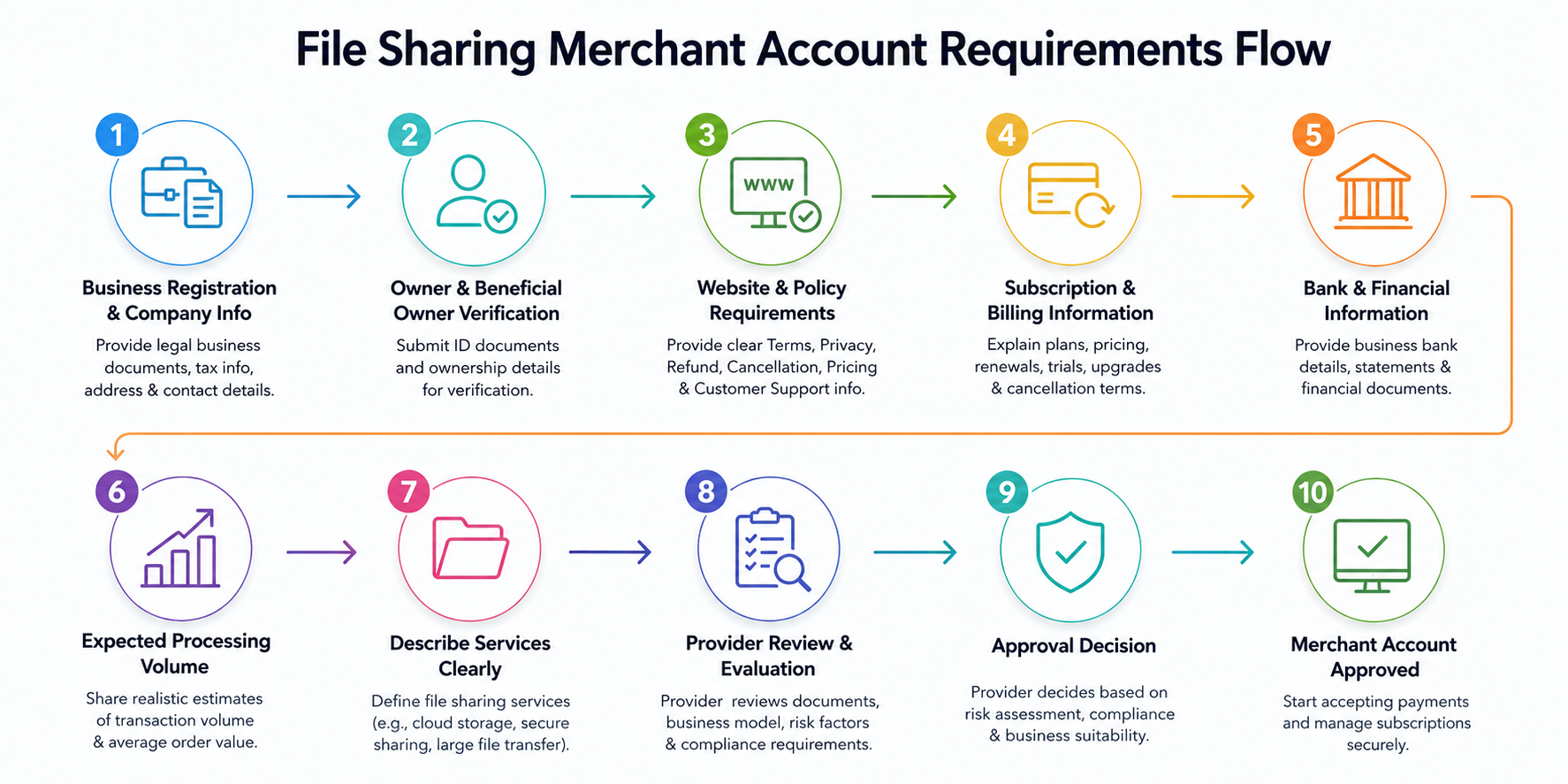
What Services Does the Business Actually Provide?
A file-sharing company should describe its service specifically rather than simply calling itself a technology company. The business might provide:
- Personal cloud storage
- Business file storage
- Secure document sharing
- Large-file transfer
- Team collaboration
- Digital file delivery
- Subscription-based storage
The description should match what customers see on the website and what appears in actual transactions.
For example, a platform selling monthly cloud storage should not describe its business differently during payment onboarding just to fit another category. Accurate disclosure is important throughout the payment relationship.
What Factors Affect Approval?
Submitting documents does not automatically guarantee approval. Payment providers can evaluate the broader business and payment profile. Factors may include:
- Business model and ownership
- Expected transaction volume
- Processing history
- Customer locations
- Refund and cancellation practices
- Chargeback and fraud exposure
- Website transparency
- Financial information
- Applicable compliance requirements
This is why merchant-account approval is more than a document checklist. The provider is trying to understand the business and determine whether its payment activity can be supported within its risk and compliance requirements.
A Practical Example
Consider a file-sharing startup preparing to launch a $12 monthly storage plan.
Before applying, the company registers its business, opens a business bank account, prepares ownership documents, publishes its pricing and subscription terms, and clearly explains its refund and cancellation policies. The founders also estimate their expected processing volume based on their planned customer base.
During the application, the payment provider asks for additional ownership information and clarification about expected transaction activity. Because the company has already prepared its records and its website clearly explains the service, it can provide the information without changing its business model.
The lesson is simple: Merchant account preparation should begin before the application is submitted.
Common Problems That Delay Approval
Approval can be delayed when information is incomplete or inconsistent.
For example, the legal business name in the application may not match the company documents. The website may advertise subscriptions without explaining recurring billing. Expected transaction volume may differ significantly from the business plan. Ownership information may also be incomplete.
These issues do not necessarily mean the business cannot be approved, but they can lead to additional questions or documentation requests.
The best approach is to make the business easy to understand and ensure that its documents, website, banking information, and payment application tell the same story.
Preparing for Payment Processing
A file-sharing business should treat merchant-account requirements as part of its broader payment strategy.
Once the business is prepared for approval, the next questions involve which payment methods a file-sharing business should accept, how recurring billing should work, and how common payment processing challenges such as payment failures, chargebacks, and fraud should be managed.. As the business grows, it may eventually require more advanced payment infrastructure, reporting, integrations, and risk controls.
The objective is not simply to collect documents and obtain approval. It is to build a payment operation that accurately reflects the business and can support its customers, subscriptions, and growth.

Categories
- ACH Payments (10)
- adult payment processing (11)
- AI (9)
- Altcoins (10)
- Banking (10)
- Bitcoin (133)
- Bitcoin ETF (11)
- Bitcoin Price (30)
- Blockchain (50)
- Brokering World Hunger Away (16)
- Business (17)
- card payment processing (10)
- CBD (11)
- CBDC (11)
- Chargeback (8)
- coaching business (11)
- COVID-19 (3)
- Crypto ATMs (1)
- Crypto Banking (17)
- Crypto Bill (1)
- Crypto business owner platform (31)
- Crypto Investment (3)
- Crypto Markets (5)
- Crypto Payment (35)
- Crypto Payment Processor (4)
- Crypto Prices (1)
- Crypto Trading (92)
- Cryptocurrency (402)
- Cryptocurrency Exchange (108)
- Data Visualization (2)
- dating platforms (11)
- debt collection payment processing (10)
- Decentralized Finance (7)
- DeFi Payment (9)
- DEX (3)
- Digital Currency (23)
- dropshipping payment processing (12)
- Ethereum (2)
- FAQ (7)
- file sharing payment processing (11)
- Finance (25)
- Financial Equality (4)
- Financial Freedom (8)
- Forex (35)
- hemp (1)
- ICO (2)
- Investment (11)
- IPTV (11)
- Merchant Account (10)
- Mining (3)
- News (66)
- NFTs (2)
- online gambling (11)
- P2P (1)
- Paybito (147)
- PayBitoPro (693)
- PayBitoPro Coin Listing (6)
- PayBitoPro Exchange (2)
- Payment Gateway (48)
- peptide (10)
- Post COVID Digital Transformation (1)
- Press Release (130)
- Privacy & Security (3)
- Real Estate (1)
- Stablecoin (5)
- Technology (15)
- Travel (11)
- Uncategorized (10)
- US Presidential Election (2)
- Utility Coin (1)
- Web3 business (4)
- Web3 Wallets (2)
- White Label Crypto Exchange (8)
Recent Posts
- Payment Gateway vs. Payment Orchestration: What’s the Difference?
- What Is Smart Payment Routing? Strategies to Optimize Payment Performance
- How to Improve Payment Approval Rates for High-Risk Businesses?
- Why Are Online Payments Failing? Common Causes and How to Fix Them
- How to Use Multiple Payment Processors to Reduce Business Disruptions?