Best Payment Methods for File Sharing Businesses
- August 12, 2026
- Soham Guchait
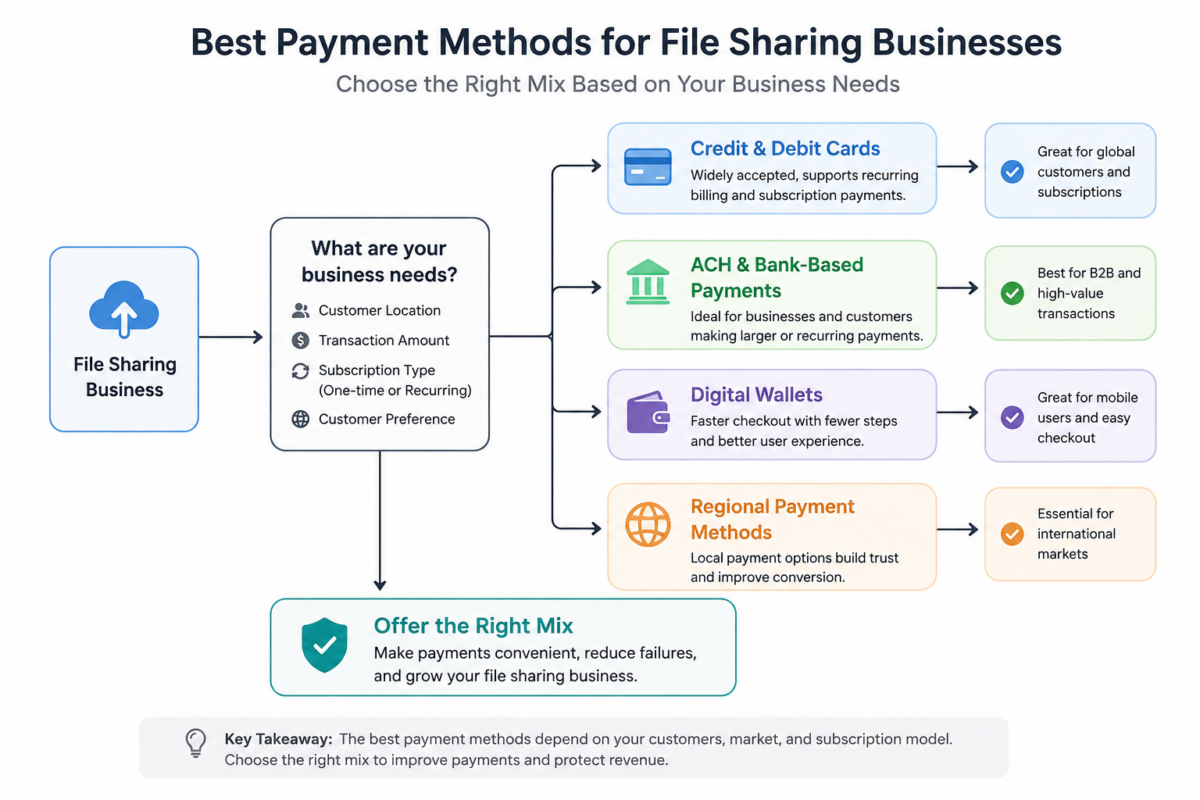
Choosing payment methods for a file-sharing business is not simply about giving customers as many options as possible. The right payment mix depends on where customers are located, how much they pay, whether subscriptions are recurring, and how easily each method can support renewals, refunds, and payment recovery.
A consumer file-sharing platform with low-cost monthly plans may have different needs from a business-focused storage service charging hundreds of dollars per year. Similarly, a company serving customers in one country may need a different payment mix from a platform selling subscriptions internationally.
The goal is to make payment convenient without creating unnecessary complexity for the business.
Which Payment Methods Can File Sharing Businesses Accept?
File-sharing businesses, being of higher risk may use several types of payment methods, depending on what is supported by their payment provider and the markets they serve. Common options include:
- Credit and debit cards
- ACH and other bank-based payments
- Digital wallets
- Regional or alternative payment methods
The availability and capabilities of these methods vary by country, provider, currency, transaction type, and whether the payment is one-time or recurring.
For subscription businesses, this distinction matters. A payment method that works well for a one-time purchase may not necessarily support automatic recurring billing in the same way.
Credit and Debit Cards
Cards are often a practical starting point for online file-sharing businesses because customers are already familiar with using them for digital subscriptions.
A customer can enter their card details during signup, complete the initial payment, and, where supported, authorize future recurring charges.
For example, a cloud-storage platform may offer a $12 monthly plan. The customer pays the first $12 at signup, and the billing system attempts to charge the saved payment method when the next billing date arrives. However, recurring card payments can fail later even when the initial transaction was successful. Cards expire, get replaced, become temporarily unavailable, or may be declined by the issuing bank. This means a file-sharing business should not evaluate card processing only by asking whether customers can pay at checkout. It should also consider how the system handles recurring payments, failed renewals, payment-method updates, and customer authentication.
For some recurring card transactions, additional authentication requirements can also affect the payment flow. Whether authentication is required depends on the transaction, customer location, applicable rules, and the card issuer.
ACH and Bank-Based Payments
Bank-based payments can be useful for file-sharing businesses, particularly those serving business customers or customers making larger payments.
ACH, for example, allows payments to move through the U.S. banking system rather than through a card network. It can be useful for scheduled or recurring payments, although availability and specific capabilities depend on the payment provider and business setup.
Consider a business file-storage platform charging $500 annually for a team account. Some customers may prefer paying directly from a bank account rather than using a corporate card. Bank-based payments can therefore complement card payments rather than necessarily replacing them. The business should consider settlement timing, payment confirmation, refund procedures, recurring-payment capabilities, and the markets in which the method is available before adding it to the checkout.
Digital Wallets
Digital wallets can reduce the amount of payment information customers need to manually enter during checkout.
This can be useful for file-sharing businesses where customers are purchasing a relatively straightforward digital subscription. A customer who already has a supported wallet configured on their device may be able to complete payment with fewer checkout steps. However, the business should examine whether the wallet supports the specific billing model it uses.
A payment method might work perfectly for a one-time transaction but have different requirements for recurring payments. The provider’s supported features should therefore be checked before assuming that every wallet can be used for automatic subscription renewals.
Regional Payment Methods
International file-sharing businesses may need to look beyond cards and globally recognized wallets. Customers in different countries can have different payment preferences. A payment method that is common in one market may have little relevance in another.
For example, a file-sharing platform serving customers in several European markets may find that customers expect locally familiar bank-based or alternative payment methods, while customers in another market may rely more heavily on cards or digital wallets.
Supporting regional methods can make the checkout more relevant to local customers, but each additional method also introduces another payment flow that the business needs to monitor and reconcile. This is why international payment processing for file-sharing businesses should be considered as part of the overall payment strategy rather than simply adding every available payment method.
Which Payment Method Is Best for Monthly Subscriptions?
For many file-sharing businesses, the most important question is not which method is most popular but which method fits the subscription model.
A monthly storage business needs a payment method that can support the full customer lifecycle:
Signup → Initial payment → Renewal → Failed payment → Recovery → Cancellation or continuation
Cards and certain bank-based payment methods can support recurring billing, but the exact functionality depends on the provider and payment method. Subscription systems can store an eligible payment method and use it for future billing, subject to applicable authentication and payment rules.
For example, imagine a customer subscribes to a $19.99 monthly storage plan. The first payment succeeds, but the customer’s card expires before the fourth renewal. The payment system should be able to identify the failed renewal, notify the customer, provide a way to update the payment method, and follow the business’s rules for retrying the payment or restricting account access.
A payment method that looks convenient during signup is therefore only part of the solution.
Choosing Payment Methods for Different File Sharing Customers
Different customer groups can have different payment needs.
A consumer-focused file-sharing platform may prioritize fast checkout and familiar payment methods because customers are making relatively small recurring purchases.
A business-focused platform may need to support larger annual payments and bank-based methods because corporate customers may have different purchasing processes.
An international platform may need a broader combination of cards, wallets, and regional payment methods.
The payment mix should therefore reflect the actual customer base rather than the theoretical maximum number of payment options.
More Payment Methods Do Not Always Mean Better Payments
Adding more payment methods can improve customer choice, but it also increases operational complexity. Each method may have different:
- Recurring-payment capabilities
- Refund procedures
- Settlement timing
- Authentication requirements
- Geographic availability
- Transaction reporting
- Integration requirements
A file-sharing business should therefore evaluate the entire payment lifecycle before adding a new method.
For example, if 95% of customers use cards, adding a rarely used payment method may not be worthwhile if it creates significant technical and operational work. The better question is:
Will this payment method solve a meaningful customer or business problem?
What Should a File Sharing Business Look for?
When evaluating payment methods, the business should look beyond the checkout button. A useful payment setup should fit the company’s subscription model, customer locations, transaction sizes, and growth plans.
It should also work with the business’s approach to payment fraud prevention, refunds, chargebacks, reporting, and customer account management.
For recurring businesses, payment recovery is particularly important. A customer whose renewal fails may still want the service. Recovering that payment can be one of the common payment processing challenges for file-sharing businesses because subscription failures require proper recovery workflows. The business should also understand how each method handles refunds and disputes before making it available to customers.
A Practical Payment Mix
Suppose a file-sharing platform serves individual customers in several countries and offers a $10 monthly plan and a $100 annual plan.
It might begin with cards as its primary method, add supported digital wallets to simplify checkout, and introduce relevant regional or bank-based methods when customer demand justifies them. A business-focused storage platform with higher-value plans might place greater emphasis on bank-based payments alongside cards.
Neither setup is universally better. The appropriate mix depends on the company’s customers, markets, pricing, and billing model.
Building the Right Payment Setup
The best payment strategy for a file-sharing business is not necessarily the one with the longest list of payment options. It is the one that gives the target customers convenient ways to pay while allowing the business to manage billing, renewals, refunds, disputes, fraud, and settlement effectively.
Before selecting payment methods, a business should understand why file-sharing payments can be declined, because payment-method availability does not guarantee successful authorization.
As transaction volume grows, the business may also need to evaluate more advanced payment infrastructure, integrations, reporting, and payment management capabilities, including whether a white label payment platform for file-sharing businesses fits its long-term growth plans. The right approach is to start with payment methods that genuinely fit the customer base and billing model, then expand the payment mix when customer demand, international growth, or business requirements justify it.

Categories
- ACH Payments (10)
- adult payment processing (11)
- AI (9)
- Altcoins (10)
- Banking (10)
- Bitcoin (133)
- Bitcoin ETF (11)
- Bitcoin Price (30)
- Blockchain (50)
- Brokering World Hunger Away (16)
- Business (17)
- card payment processing (10)
- CBD (11)
- CBDC (11)
- Chargeback (8)
- coaching business (11)
- COVID-19 (3)
- Crypto ATMs (1)
- Crypto Banking (17)
- Crypto Bill (1)
- Crypto business owner platform (31)
- Crypto Investment (3)
- Crypto Markets (5)
- Crypto Payment (35)
- Crypto Payment Processor (4)
- Crypto Prices (1)
- Crypto Trading (92)
- Cryptocurrency (402)
- Cryptocurrency Exchange (108)
- Data Visualization (2)
- dating platforms (11)
- debt collection payment processing (10)
- Decentralized Finance (7)
- DeFi Payment (9)
- DEX (3)
- Digital Currency (23)
- dropshipping payment processing (12)
- Ethereum (2)
- FAQ (7)
- file sharing payment processing (11)
- Finance (25)
- Financial Equality (4)
- Financial Freedom (8)
- Forex (35)
- hemp (1)
- ICO (2)
- Investment (11)
- IPTV (11)
- Merchant Account (10)
- Mining (3)
- News (66)
- NFTs (2)
- online gambling (11)
- P2P (1)
- Paybito (147)
- PayBitoPro (693)
- PayBitoPro Coin Listing (6)
- PayBitoPro Exchange (2)
- Payment Gateway (48)
- peptide (10)
- Post COVID Digital Transformation (1)
- Press Release (130)
- Privacy & Security (3)
- Real Estate (1)
- Stablecoin (5)
- Technology (15)
- Travel (11)
- Uncategorized (10)
- US Presidential Election (2)
- Utility Coin (1)
- Web3 business (4)
- Web3 Wallets (2)
- White Label Crypto Exchange (8)
Recent Posts
- Payment Gateway vs. Payment Orchestration: What’s the Difference?
- What Is Smart Payment Routing? Strategies to Optimize Payment Performance
- How to Improve Payment Approval Rates for High-Risk Businesses?
- Why Are Online Payments Failing? Common Causes and How to Fix Them
- How to Use Multiple Payment Processors to Reduce Business Disruptions?