Why Forex Payments Get Declined and How Brokers Can Fix Failed Transactions?
- August 13, 2026
- Soham Guchait
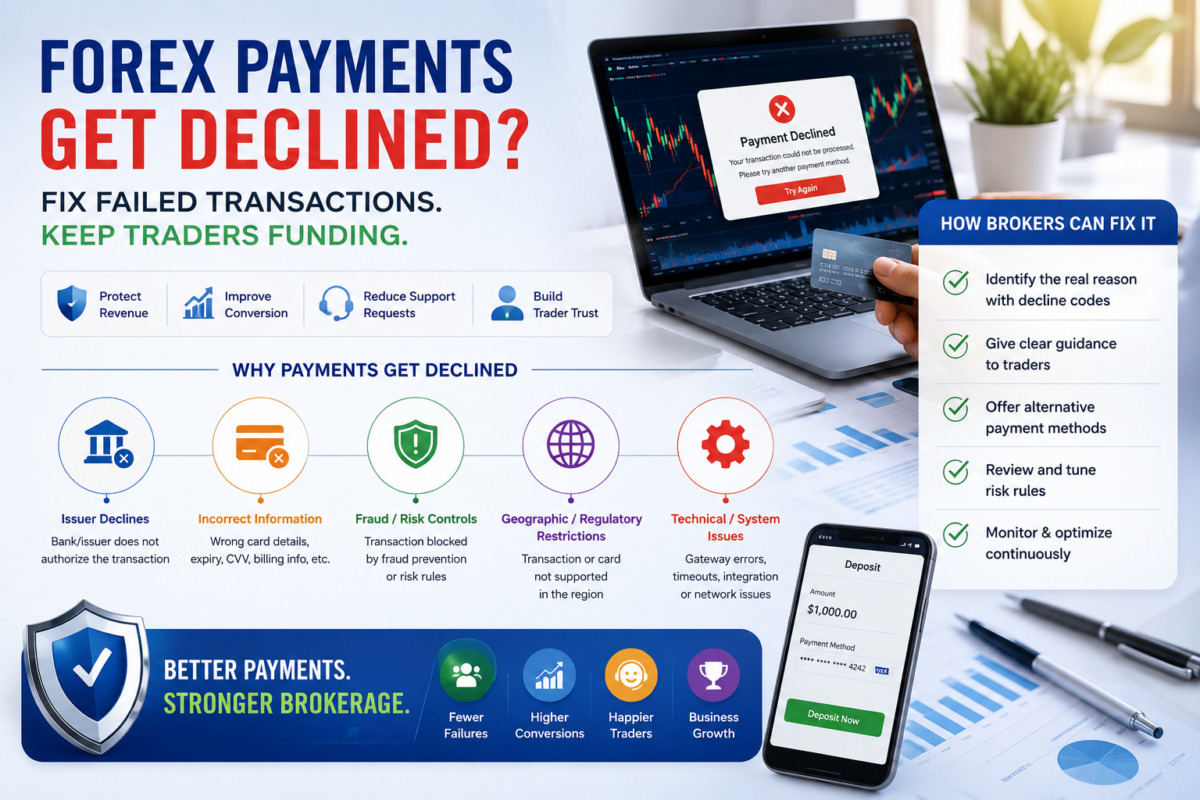
A trader can have sufficient funds, enter the correct card details, and still see a Forex deposit fail.
For a Forex broker, repeated payment failures are more than a customer-service problem. Failed deposits can interrupt account funding, reduce conversion from registered traders to active customers, create additional support requests, and make it harder to understand the true performance of the payment infrastructure.
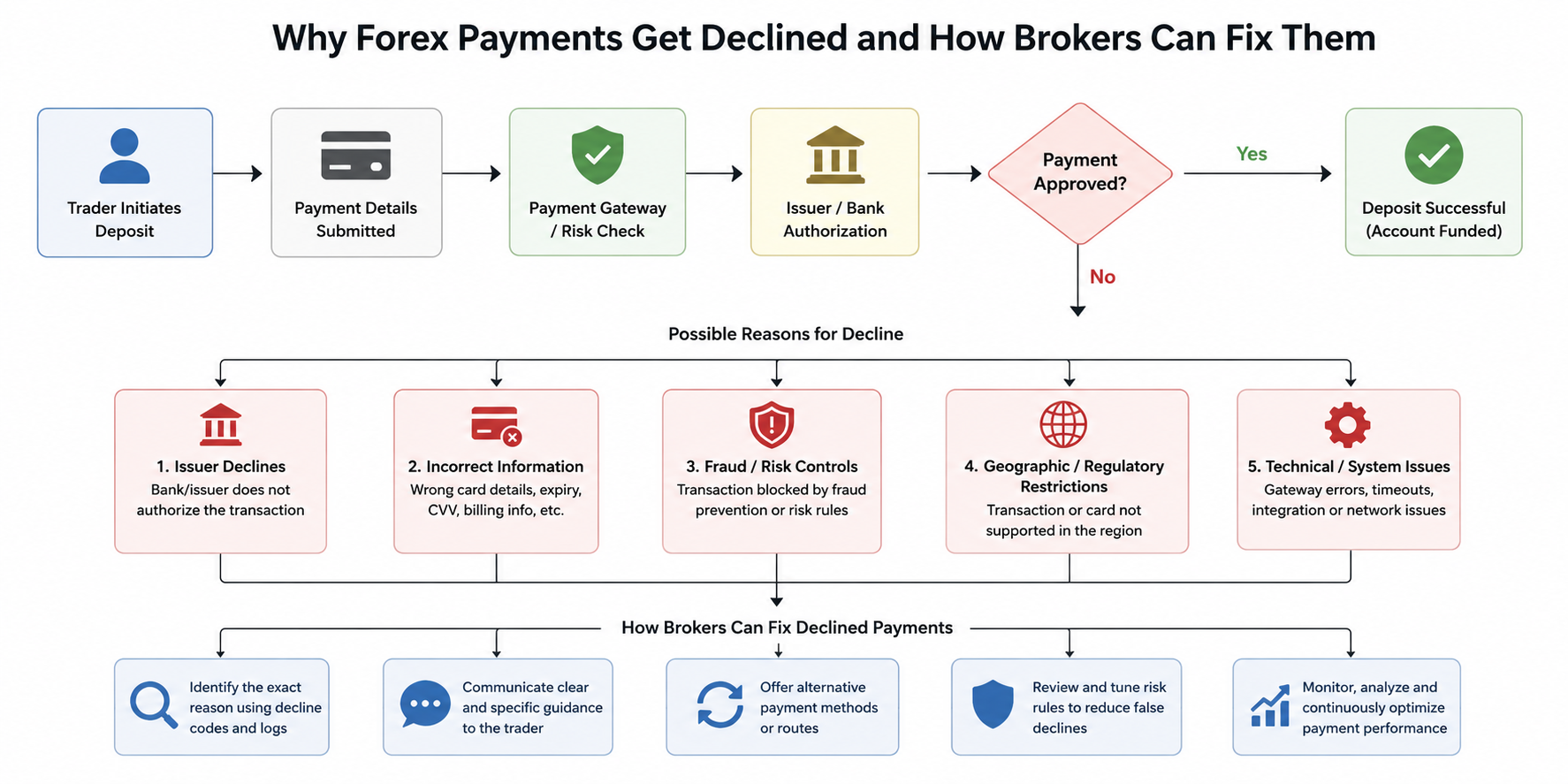
The important point is that a Forex payment declined message does not identify a single problem. A transaction can fail because of the customer’s bank, payment information, fraud controls, geographic restrictions, technical issues, payment-provider rules, or the payment route itself. Payment systems can also distinguish between transactions declined by an issuer and transactions blocked by fraud-prevention controls.
For Forex brokers, the solution is therefore not simply to “retry the payment”. The first step is identifying what happened, why it happened, and what response is appropriate.
What Does a Declined Forex Payment Mean?
A declined payment means that the attempted transaction was not authorized or otherwise could not proceed successfully through the payment flow.
For card transactions, the card issuer may return a decline response. In other cases, a payment can be blocked by fraud-prevention systems before it reaches the issuer. Technical or integration problems can also prevent a transaction from being completed. This distinction matters because the broker does not control every decision in the payment lifecycle.
For example, if a trader attempts to deposit $1,000 and the issuing bank declines the transaction, changing something on the broker’s website may not solve the problem. Conversely, if the payment is being blocked by the broker’s risk rules, the broker may need to review its transaction controls.
Why Do Forex Payments Get Declined?
There are several potential causes, and they should be investigated individually rather than treated as one generic “payment failure”.
1. Card Issuer Declines
The customer’s bank or card issuer may decline a transaction for reasons that are not fully visible to the broker.
Banks can use internal authorization and risk systems to evaluate transactions. The issuer may consider the transaction unusual, outside expected customer behavior, subject to a restriction, or otherwise unsuitable for authorization.
Payment providers generally receive a response or decline code from the issuer, although the information available to the merchant can be limited.
What happens: The broker submits the deposit and receives an issuer decline.
Why it happens: The customer’s bank does not authorize the transaction.
How the broker can respond: Record the decline reason, avoid treating every issuer decline as a technical failure, and where appropriate provide the customer with a clear message to contact their card issuer or use another supported payment method.
Repeatedly retrying the same transaction without understanding the decline can create an inefficient payment experience.
2. Incorrect Payment Information
A transaction can fail because the information submitted by the customer does not match what the payment system or issuer expects.
This can include an incorrect card number, expiration date, security code, billing information, or other transaction details. Incorrect information is also a recognized cause of legitimate transactions being rejected by payment systems.
What happens: The payment request reaches the processing stage but fails validation.
Why it happens: Information entered by the customer does not match the relevant payment records or required transaction data.
How the broker can respond: Make payment fields clear, validate information where technically appropriate, and provide useful error messages instead of displaying only a generic “payment failed” notification.
For example, if a trader repeatedly enters an incorrect expiration date, telling them only that their deposit failed does not help. A more specific message can allow the customer to correct the problem immediately.
3. Fraud and Risk Controls
Not every declined payment is a problem with the payment system. Sometimes the payment is stopped because a risk-control mechanism is working as intended.
Fraud systems can block transactions that match suspicious characteristics or predefined risk rules. Payment platforms explicitly distinguish some blocked payments from issuer declines because these controls are designed to reduce potentially fraudulent transactions and future disputes.
Forex brokers have additional reasons to pay attention to this area because trading accounts can become targets for stolen payment credentials, fraudulent identities, account takeover, or suspicious deposits.
What happens: A transaction is flagged and prevented from continuing.
Why it happens: The payment or customer activity matches a fraud or risk signal.
How the broker can respond: Review the risk signal rather than automatically disabling legitimate customers. Appropriate authentication, customer verification, transaction monitoring, and manual review can help distinguish legitimate activity from suspicious behavior.
This is closely connected to fraud prevention in Forex payment processing, because reducing fraud cannot be separated from maintaining a healthy payment-authorization rate.
4. Geographic Restrictions
International Forex businesses, which is considered as high-risk, frequently serve customers across multiple markets. A payment method available in one country may not work in another.
Geographic restrictions can exist at different levels: The Customer’s Bank, Card Issuer, Payment Method, Processor, Acquiring Arrangement, or the Broker’s own Risk Policy.
Consider a broker that accepts deposits from customers in several countries. A card that works successfully for a trader in one market may be declined for another customer because the transaction involves a different issuing country, currency, payment route, or risk profile.
What happens: A customer attempts a payment that appears valid but is rejected based on geographic or cross-border conditions.
Why it happens: The payment route or financial institution does not support that particular combination of merchant, customer, country, currency, or transaction type.
How the broker can respond: Analyze payment performance by country, payment method, and currency rather than looking only at an overall decline rate.
This also explains why selecting appropriate payment methods for Forex brokers and trading platforms is a strategic decision rather than simply a matter of offering more options.
5. Insufficient Funds or Transaction Limits
A straightforward reason for a failed deposit is that the customer’s available balance or transaction limit does not support the requested amount. This can become particularly relevant for Forex brokers because deposits can vary considerably in size.
For example, a customer who successfully deposits $500 may later attempt to deposit $20,000. The second transaction can encounter a different authorization outcome because of account limits, issuer controls, or transaction-risk rules.
The broker should distinguish these situations from technical failures. Otherwise, payment reports can incorrectly suggest that the processing infrastructure is unreliable when the actual cause is customer or issuer-side authorization.
6. Technical and Integration Failures
Payment processing involves several interconnected systems. A failure can occur even when the customer’s payment details and funds are valid.
Network problems, timeouts, incorrect API requests, configuration errors, or communication failures between systems can prevent a transaction from completing. Technical errors are among the recognized causes of payment failures.
For a Forex broker, this can become especially important when the payment environment connects with a trading platform, customer portal, cashier, fraud system, and internal accounting tools.
For example, a payment may receive authorization but fail to reach the broker’s account-management system correctly. If the transaction status is not synchronized, the customer could see a failed deposit even though another part of the payment lifecycle has already progressed.
7. Payment Provider Restrictions and Risk Policies
A transaction can also fail because of restrictions associated with the payment provider or processing arrangement.
This is particularly relevant to Forex businesses because payment providers assess merchants according to their individual business and risk profiles. A provider may have restrictions relating to certain countries, payment methods, transaction patterns, or business activities.
A broker should therefore avoid assuming that every payment method available in the market will automatically be available to its business.
This connects directly with how to get a Forex merchant account, because the broker’s underwriting profile can influence which payment arrangements are available in the first place.
How Can Forex Brokers Reduce Failed Payments?
The objective should not be to approve every transaction. Some declines protect customers, payment providers, and brokers from fraud or unauthorized activity.
Instead, the objective is to improve the success rate of legitimate transactions while retaining appropriate risk controls.
A broker can start by analyzing payment failures at a granular level. Instead of reporting only “30% of payments failed,” the business should understand which failures came from issuer declines, fraud controls, incorrect information, technical errors, geographic restrictions, and other causes.
Payment data should ideally be compared across:
- Payment method, country, currency, transaction value, and customer type.
- Decline and failure reasons rather than only overall success rates.
- First-time deposits versus repeat funding transactions.
This makes it easier to identify patterns.
Suppose a broker discovers that first-time card deposits from one country have an unusually high decline rate while repeat deposits from the same market perform normally. That pattern points toward a specific part of the payment or customer journey rather than a general infrastructure failure.
Why Blindly Retrying Declined Payments Can Be a Problem?
A common reaction to a failed transaction is to immediately retry it. That is not always appropriate.
If the issuer has already declined the transaction, repeated attempts may not change the underlying decision. If the transaction was blocked because of suspected fraud, repeatedly submitting the same payment can also work against the broker’s risk-management objectives.
Payment networks also have specific rules around authorization. Visa’s merchant dispute guidance, for example, warns about processing transactions after a decline or pickup response rather than obtaining the required authorization.
The correct response depends on the reason for the failure.
The Role of Payment Routing and Multiple Methods
A broker serving international customers may benefit from supporting more than one appropriate payment route. However, simply adding payment methods does not automatically solve payment failures. Each additional method introduces its own integration, settlement, reconciliation, customer-support, and risk considerations.
The better approach is to understand which payment methods perform reliably for each target market.
For example, a broker may discover that cards work well for smaller retail deposits in one market, while bank transfers are more suitable for larger transactions. Another market may have strong demand for a local payment method.
Payment performance should therefore influence payment-method strategy, rather than the broker choosing methods solely because they are popular.
Final Thoughts
A Forex payment declined message is only the starting point of an investigation. The actual cause could be an issuer decision, incorrect payment information, insufficient funds, fraud controls, geographic restrictions, technical problems, or payment-provider policies.
The goal is not to eliminate every decline. Some declines are necessary to prevent unauthorized or fraudulent transactions. The goal is to make legitimate deposits as reliable as possible without weakening the controls that protect the broker and its customers.
Once payment failures are understood, the next stage is managing what happens when transactions are completed but later disputed – which makes chargeback prevention for Forex brokers and trading platforms a critical part of the payment lifecycle.

Categories
- ACH Payments (10)
- adult payment processing (11)
- AI (9)
- Altcoins (10)
- Banking (10)
- Bitcoin (133)
- Bitcoin ETF (11)
- Bitcoin Price (30)
- Blockchain (50)
- Brokering World Hunger Away (16)
- Business (17)
- card payment processing (10)
- CBD (11)
- CBDC (11)
- coaching business (11)
- COVID-19 (3)
- Crypto ATMs (1)
- Crypto Banking (17)
- Crypto Bill (1)
- Crypto business owner platform (31)
- Crypto Investment (3)
- Crypto Markets (5)
- Crypto Payment (35)
- Crypto Payment Processor (4)
- Crypto Prices (1)
- Crypto Trading (92)
- Cryptocurrency (402)
- Cryptocurrency Exchange (108)
- Data Visualization (2)
- dating platforms (11)
- debt collection payment processing (10)
- Decentralized Finance (7)
- DeFi Payment (9)
- DEX (3)
- Digital Currency (23)
- dropshipping payment processing (12)
- Ethereum (2)
- FAQ (7)
- file sharing payment processing (11)
- Finance (25)
- Financial Equality (4)
- Financial Freedom (8)
- Forex (35)
- hemp (1)
- ICO (2)
- Investment (11)
- IPTV (11)
- Merchant Account (10)
- Mining (3)
- News (66)
- NFTs (2)
- online gambling (11)
- P2P (1)
- Paybito (139)
- PayBitoPro (693)
- PayBitoPro Coin Listing (6)
- PayBitoPro Exchange (2)
- Payment Gateway (40)
- peptide (10)
- Post COVID Digital Transformation (1)
- Press Release (130)
- Privacy & Security (3)
- Real Estate (1)
- Stablecoin (5)
- Technology (15)
- Travel (11)
- Uncategorized (9)
- US Presidential Election (2)
- Utility Coin (1)
- Web3 business (4)
- Web3 Wallets (2)
- White Label Crypto Exchange (8)
Recent Posts
- ACH vs Wire Transfer: Which Payment Method Is Better for Businesses?
- ACH Fraud Prevention: How Businesses Can Secure Bank Account Payments?
- ACH Credit vs ACH Debit: What’s the Difference? With Real Examples
- ACH vs Credit Card: Which Payment Method Is Better for Businesses?
- How Long Do ACH Payments Take? Processing Times, Settlement, and Same Day ACH