Forex Payment Processing: Complete Guide for Forex Brokers and Trading Platforms
- August 13, 2026
- Soham Guchait
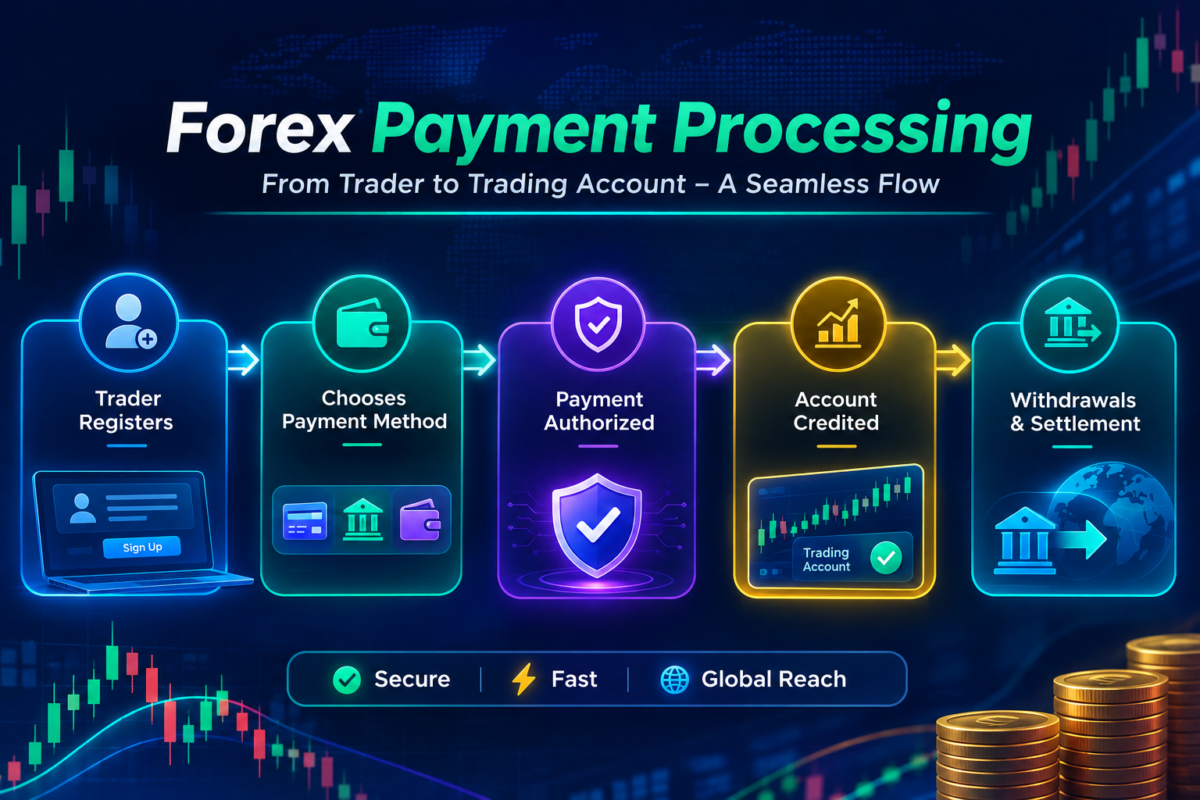
A trader can open a brokerage account in minutes, complete verification online, and be ready to fund the account. But the experience can quickly break down when a deposit is declined, a withdrawal takes too long, or a payment provider places restrictions on the transaction.
For a Forex broker, payment processing is therefore much more than simply accepting money online. It connects customer onboarding, KYC, trading-account funding, payment authorization, fraud controls, withdrawals, settlement, and reconciliation.
This guide explains how Forex payment processing works, what components are involved, why payment operations can be challenging for brokers, and what businesses should consider when building a reliable payment infrastructure.
What Is Forex Payment Processing?
Forex payment processing is the infrastructure that allows Forex brokers and trading platforms to accept, verify, process, and settle payments from traders.
The process typically begins when a customer chooses a payment method to fund a trading account. The payment request passes through the relevant payment infrastructure for authorization and risk checks. Once the transaction is approved and confirmed, the broker’s systems can update the customer’s available balance according to their internal procedures.
The same infrastructure may also support withdrawals, transaction monitoring, reconciliation, and reporting.
Unlike a simple online purchase, Forex payment operations involve a continuing relationship between the trader and the brokerage. A customer may deposit funds several times, withdraw profits, change payment methods, or trade across different currencies and jurisdictions. Payment infrastructure therefore needs to support an ongoing financial workflow rather than a single checkout transaction.
How Does Forex Payment Processing Work?
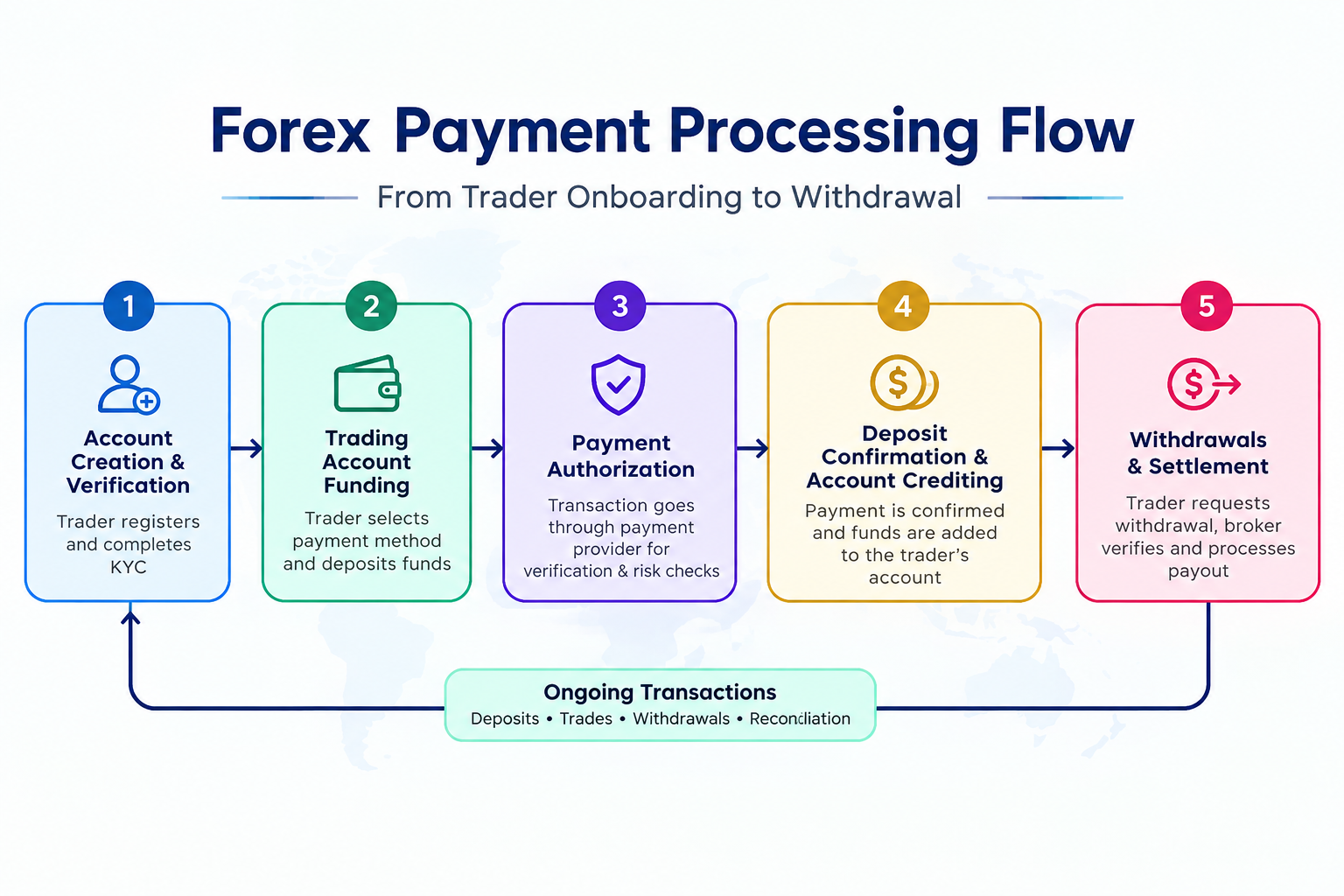
A typical Forex payment lifecycle can be understood through several connected stages.
1. Customer account and verification
The trader first creates an account with the broker. Depending on the broker’s business model and applicable regulatory framework, identity and other customer information may need to be verified before certain financial activities are permitted.
This is where payment processing and compliance begin to overlap. A payment system cannot be viewed separately from the broker’s customer-verification process.
2. Trading account funding
After the customer is eligible to fund the account, they select an available payment method. Depending on the broker’s target markets, this could include cards, bank transfers, digital wallets, or other locally supported methods.
The payment method should match the customer’s location, currency, transaction requirements, and the broker’s operational capabilities.
3. Payment authorization
The payment request is transmitted through the relevant payment infrastructure. Depending on the payment method, the transaction may undergo authentication, issuer checks, fraud screening, and other risk controls.
An approved authorization does not necessarily mean the entire payment lifecycle is finished. The broker still needs accurate confirmation before treating the transaction as successfully completed.
4. Deposit confirmation and account crediting
Once the payment is confirmed, the broker’s payment and back-office systems need to reconcile the transaction with the correct customer account.
For example, imagine a trader deposits $2,000 to fund a USD trading account. The payment may be successfully authorized, but the brokerage still needs to associate that transaction with the correct customer, confirm its status, record the transaction, and update the appropriate account balance according to its internal controls.
Poor synchronization between payment systems and brokerage software can create manual work, delayed account funding, or reconciliation problems.
5. Withdrawals and settlement
Payment processing does not end when traders deposit money. Withdrawals are equally important. A broker may need to verify the withdrawal request, confirm that the destination is permitted, perform applicable risk or compliance checks, and then initiate the payout through the appropriate payment rail.
Settlement and reconciliation then allow the business to compare payment records with its internal accounting and transaction data.
What Payment Methods Can Forex Brokers Use?
There is no universally best payment method for every Forex broker. The appropriate mix depends on the broker’s markets, customer preferences, currencies, regulatory environment, transaction values, and provider availability.
Common options can include:
- Credit and debit cards: Familiar to many retail traders and useful for online deposits, although authorization and dispute considerations need to be managed.
- Bank transfers: Often suitable for larger deposits and markets where customers prefer direct bank payments, but processing speed and local banking infrastructure can vary.
- Digital wallets and local payment methods: Can be useful when a broker serves customers across multiple countries with different payment preferences.
A broker expanding internationally may therefore need a multi-method strategy rather than relying on a single payment channel.
This also connects closely with the broader question of the best payment methods for Forex brokers and trading platforms, particularly when balancing customer convenience, transaction reliability, geographic coverage, and operational complexity.
Why Is Forex Payment Processing More Complex?
Forex businesses operate in an environment where financial transactions, customer verification, international payments, and trading activity intersect.
A broker may serve customers in several countries while accepting deposits in different currencies and supporting multiple payment methods. At the same time, payment providers may assess the business according to factors such as its business model, jurisdictions served, transaction profile, regulatory position, processing history, and expected volumes.
This is one reason Forex businesses may encounter additional underwriting or risk controls. However, Forex should not automatically be treated as having identical risk characteristics in every jurisdiction or business model. Requirements and provider decisions can vary considerably. For a deeper explanation of these considerations, brokers should understand why Forex brokers are considered high risk for payment processing.
What Causes Forex Payment Failures?
A successful payment experience depends on more than having a payment button on a website.
Transactions can fail because of issuer decisions, incorrect payment information, insufficient funds, geographic restrictions, fraud controls, technical problems, payment-provider policies, or limitations associated with a particular payment route.
Consider a Forex broker whose first-time deposits have a much higher failure rate than deposits from existing customers. The problem might not be the broker’s website itself. The broker may need to determine whether the failures are caused by card-issuer restrictions, authentication requirements, fraud controls, customer information, or the payment route being used.
Understanding the specific reason for a decline is essential because different causes require different responses. Brokers should therefore monitor payment outcomes rather than simply measuring the number of successful transactions. For a detailed breakdown, see why Forex payments get declined and how brokers can fix failed transactions.
Fraud, Chargebacks, and Payment Risk
Payment risk is another important part of Forex payment processing.
A fraudulent deposit may involve stolen payment credentials, identity fraud, fake accounts, or account takeover. A separate problem occurs when a legitimate customer later disputes a transaction.
Forex businesses also need to consider disputes involving trading-account deposits. For example, a customer could fund an account, use the money for trading, and later challenge the original payment. The resulting dispute can create operational and financial complications for the broker.
Effective payment operations therefore need appropriate transaction monitoring, customer verification, authentication, record keeping, and dispute-management processes. Brokers should also understand chargeback prevention for Forex brokers and trading platforms and how payment controls interact with the wider customer lifecycle.
How KYC and AML Connect to Payment Processing?
KYC and AML are not separate from payment operations. They can directly influence how a broker accepts, reviews, and processes transactions.
Customer identity verification helps establish who is using the brokerage account. Depending on the applicable regulatory framework and risk profile, additional information may be relevant to understanding transactions, monitoring unusual activity, or assessing source-of-funds considerations.
Requirements vary by jurisdiction and business model, so brokers should not assume that one compliance process applies universally.
The practical connection is straightforward: Payment infrastructure needs to work alongside the broker’s compliance and customer-management systems rather than operating as an isolated checkout function.
What Should Forex Brokers Look for in Payment Infrastructure?
When evaluating Forex payment processing infrastructure, brokers should look beyond the number of payment methods advertised.
Important considerations include:
- Payment-method coverage: Does the infrastructure support the countries and currencies the broker actually serves?
- Reliability: How consistently are legitimate transactions processed, and how clearly are failed payments reported?
- Integration: Can the payment environment connect effectively with the broker’s website, CRM, trading platform, and back-office systems?
- Risk and compliance controls: Can the business manage authentication, fraud monitoring, customer verification, and transaction reviews appropriately?
- Settlement and reconciliation: Can payment records be matched accurately with internal transaction and accounting records?
- Scalability: Can the infrastructure handle increasing transaction volumes and additional markets without creating unnecessary operational complexity?
These factors become particularly important when a broker evaluates how to choose a payment processor for a Forex broker.
Scaling Forex Payment Operations
Payment infrastructure that works for a small Forex startup may become inadequate as transaction volume, geographic coverage, and payment methods increase.
A growing broker may need multiple payment routes, better transaction reporting, automated reconciliation, stronger fraud controls, and more structured withdrawal workflows. Integration between the payment environment and the brokerage’s internal systems becomes increasingly important because manual processing does not scale efficiently.
Some businesses may eventually consider white-label payment platforms for Forex brokers when they need greater control over payment operations, multiple brands, markets, or payment workflows. However, white-label infrastructure is not automatically necessary for every broker. Its value depends on the complexity and scale of the business.
Final Thoughts
Forex payment processing sits at the intersection of payments, brokerage operations, compliance, risk management, and customer experience.
A reliable system must do more than accept a deposit. It needs to support the complete payment lifecycle – from customer verification and account funding through authorization, transaction monitoring, withdrawals, settlement, and reconciliation.
For Forex brokers, the most important question is not simply whether customers can pay. It is whether the payment infrastructure can reliably support how, where, and why those customers move money throughout their trading relationship.
As a broker grows, payment methods, fraud controls, compliance processes, processor relationships, and infrastructure all become interconnected. Understanding those connections is the foundation for building a payment operation that can support both current requirements and future expansion.

Categories
- ACH Payments (10)
- adult payment processing (11)
- AI (9)
- Altcoins (10)
- Banking (10)
- Bitcoin (133)
- Bitcoin ETF (11)
- Bitcoin Price (30)
- Blockchain (50)
- Brokering World Hunger Away (16)
- Business (17)
- card payment processing (10)
- CBD (11)
- CBDC (11)
- coaching business (11)
- COVID-19 (3)
- Crypto ATMs (1)
- Crypto Banking (17)
- Crypto Bill (1)
- Crypto business owner platform (31)
- Crypto Investment (3)
- Crypto Markets (5)
- Crypto Payment (35)
- Crypto Payment Processor (4)
- Crypto Prices (1)
- Crypto Trading (92)
- Cryptocurrency (402)
- Cryptocurrency Exchange (108)
- Data Visualization (2)
- dating platforms (11)
- debt collection payment processing (10)
- Decentralized Finance (7)
- DeFi Payment (9)
- DEX (3)
- Digital Currency (23)
- dropshipping payment processing (12)
- Ethereum (2)
- FAQ (7)
- file sharing payment processing (11)
- Finance (25)
- Financial Equality (4)
- Financial Freedom (8)
- Forex (35)
- hemp (1)
- ICO (2)
- Investment (11)
- IPTV (11)
- Merchant Account (10)
- Mining (3)
- News (66)
- NFTs (2)
- online gambling (11)
- P2P (1)
- Paybito (139)
- PayBitoPro (693)
- PayBitoPro Coin Listing (6)
- PayBitoPro Exchange (2)
- Payment Gateway (40)
- peptide (10)
- Post COVID Digital Transformation (1)
- Press Release (130)
- Privacy & Security (3)
- Real Estate (1)
- Stablecoin (5)
- Technology (15)
- Travel (11)
- Uncategorized (9)
- US Presidential Election (2)
- Utility Coin (1)
- Web3 business (4)
- Web3 Wallets (2)
- White Label Crypto Exchange (8)
Recent Posts
- ACH vs Wire Transfer: Which Payment Method Is Better for Businesses?
- ACH Fraud Prevention: How Businesses Can Secure Bank Account Payments?
- ACH Credit vs ACH Debit: What’s the Difference? With Real Examples
- ACH vs Credit Card: Which Payment Method Is Better for Businesses?
- How Long Do ACH Payments Take? Processing Times, Settlement, and Same Day ACH