Why Are Forex Brokers Considered High Risk for Payment Processing?
- August 13, 2026
- Soham Guchait
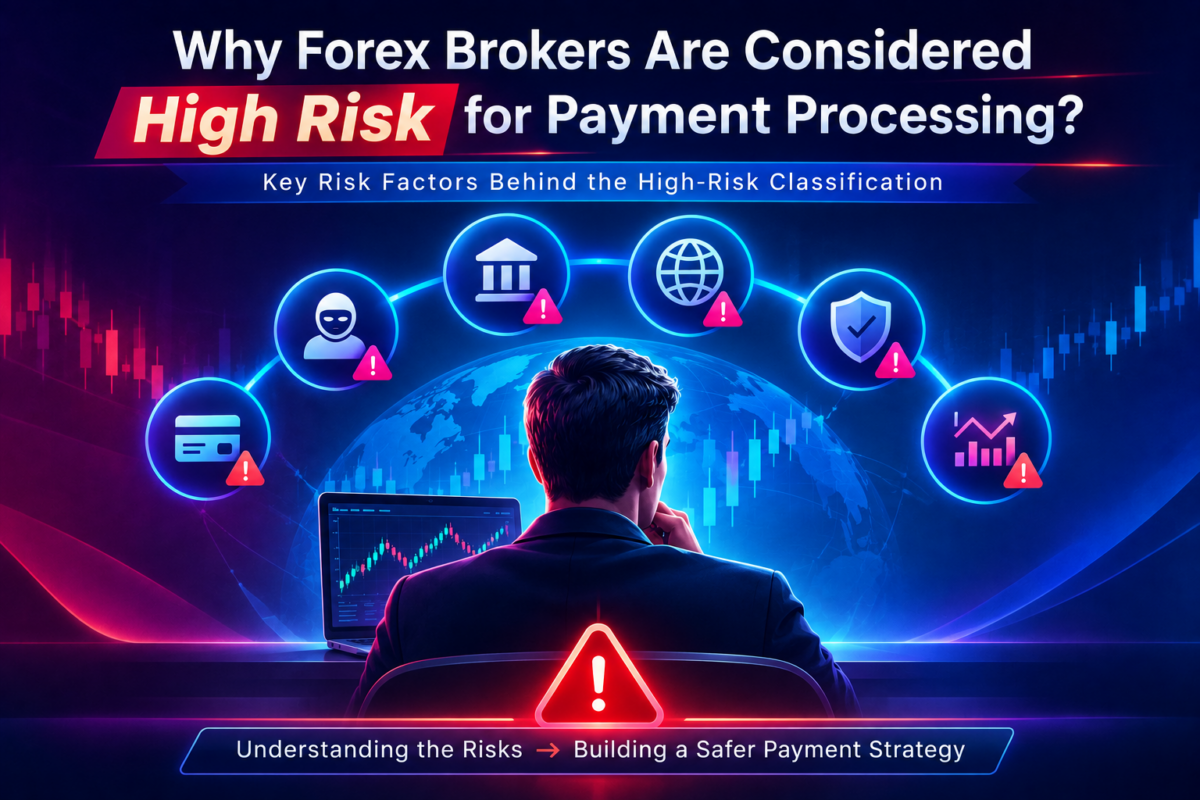
A Forex broker can have a legitimate business model, verified customers, established operations, and a strong trading platform – and still face more scrutiny when applying for payment processing.
The reason is not simply that Forex involves financial markets. Payment providers and acquiring institutions assess the risk created by the entire business model, including customer deposits, international transactions, disputes, fraud exposure, regulatory obligations, and the potential financial impact of a payment problem.
For brokers, understanding why Forex payment processing is considered high risk is important because the classification can influence underwriting, payment availability, transaction monitoring, reserves, pricing, and the overall structure of the payment relationship.
What Does “High Risk” Mean in Forex Payment Processing?
In payment processing, “high risk” is primarily an underwriting and risk-management classification. It does not automatically mean that a Forex broker is fraudulent, unreliable, or operating illegally.
Payment providers assess whether a merchant could create elevated exposure through chargebacks, fraud, regulatory issues, operational problems, or financial losses. The resulting assessment can affect whether a provider accepts the business and what terms it offers.
Forex businesses can attract additional scrutiny because several of these risk factors can exist at the same time.
A broker may accept deposits from customers in multiple countries, process different currencies, handle recurring account activity, support withdrawals, and operate in jurisdictions with different regulatory frameworks. This creates a more complicated payment environment than a straightforward online retail transaction.
Why Is Forex Considered High Risk for Payment Processing?
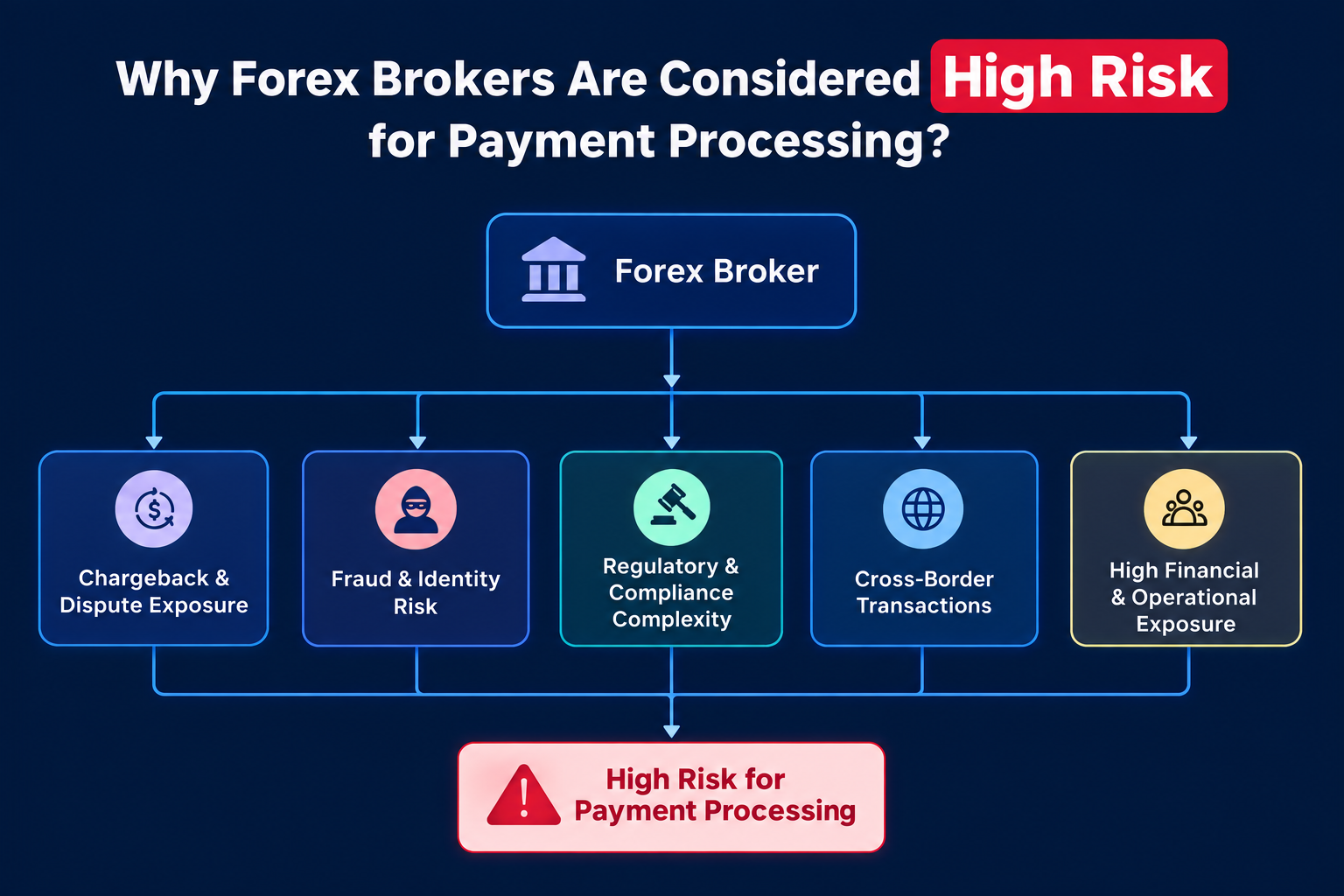
There is no single reason that explains the classification. Instead, payment providers typically look at several interconnected characteristics of the Forex business.
1. Chargeback and Dispute Exposure
One of the most important concerns is the possibility of payment disputes.
A trader may deposit money into a trading account, use those funds for trading, experience losses, and subsequently dispute the original transaction. The circumstances of each dispute are different, and a dispute does not automatically mean that the customer or broker acted improperly.
However, from a payment-risk perspective, transactions connected to trading activity can create a different dispute environment from conventional retail purchases.
Consider a broker whose customer deposits $1,500 and subsequently loses part of the trading balance. If the customer later claims that the card transaction was unauthorized or otherwise disputes the payment, the broker may have to respond to the dispute while also maintaining records showing how the transaction was authorized and how the account was used.
This is why chargeback prevention for Forex brokers and trading platforms is an important part of payment risk management rather than a separate administrative issue.
2. Fraud and Identity Risk
Forex payment processing can also involve several forms of financial fraud. A broker may need to deal with stolen card details, synthetic or fraudulent identities, account takeover, fake accounts, or attempts to use one person’s payment credentials to fund another person’s trading account.
The risk becomes more complicated when payment activity crosses borders. A customer may reside in one country, hold an account in another jurisdiction, use a payment method issued elsewhere, and transact in a different currency.
Payment providers therefore have an interest in understanding not only the transaction itself but also the customer, payment method, geography, and broader transaction pattern. For this reason, fraud prevention in Forex payment processing is closely connected to the broker’s wider account-opening and transaction-monitoring processes.
3. Regulatory and Compliance Complexity
Forex businesses operate within financial-services environments where regulatory requirements can differ substantially between jurisdictions.
A broker may serve customers in several markets, and the rules applicable to its activities can depend on factors such as where the business operates, where customers are located, what products are offered, and which regulatory framework applies.
Payment providers therefore need to consider whether the broker’s business model, target markets, documentation, and compliance controls are consistent with the proposed processing arrangement.
Requirements are not universal. A regulatory framework that applies to a broker in one jurisdiction should not automatically be treated as applicable to another. This is also why KYC and AML requirements for Forex payment processing are closely connected to payment onboarding. Customer verification, transaction monitoring, record keeping, and risk-based controls can all influence how payment activity is managed.
4. Cross-Border Transactions
International payment activity introduces another layer of operational risk. A Forex broker may have customers using different currencies and payment methods across several markets. Each payment route can have its own authorization process, settlement timeline, geographic availability, currency considerations, and risk controls.
For example, suppose a broker expands from serving customers in one market to accepting deposits from customers across five additional countries. Transaction volume may increase, but the payment operation also becomes more diverse. A payment method that performs well in one market may have limited availability or different transaction characteristics elsewhere.
This makes Forex payment processing fundamentally different from simply adding a payment button to a website.
The broker needs to understand where customers are located, which payment methods they prefer, how transactions are authorized, and how funds are ultimately settled and reconciled.
5. The Financial Nature of the Customer Relationship
A conventional e-commerce transaction generally involves an exchange: The customer pays for a product or service.
Forex operates differently.
The customer deposits money into a trading account and then uses that balance in a financial-market environment. Funds may subsequently be withdrawn, transferred through different payment routes, or remain in the account while trading activity continues. This creates a longer and more complex relationship between the customer, broker, and payment infrastructure.
Payment providers therefore have to consider the complete movement of funds rather than viewing every transaction as an isolated purchase.
6. Business Model and Operational Risk
Not every Forex broker presents the same level of payment risk.
Underwriters can consider factors such as the company’s business model, ownership, operating history, target markets, expected transaction volumes, processing history, website information, and risk controls. Payment underwriting generally seeks to determine whether the business can process transactions sustainably while managing potential financial and compliance exposure.
This distinction is important.
Two Forex brokers can operate in the same broad industry but receive different underwriting decisions because their individual business profiles are different.
A newly established broker with limited processing history and an unclear market strategy may present a different risk profile from an established broker with documented operations, transparent ownership, consistent transaction records, and mature compliance processes.
How Does High-Risk Classification Affect Forex Brokers?
Being categorized as high risk can influence the commercial and operational structure of payment processing. Depending on the provider and the broker’s individual risk profile, the business may encounter:
- More detailed underwriting and documentation requirements.
- Different pricing, settlement arrangements, or reserve requirements.
- Greater scrutiny of transaction activity, chargebacks, fraud, and geographic exposure.
These conditions are not automatic or identical for every Forex business. The exact arrangement depends on the provider, acquiring setup, jurisdictions, business model, processing history, and other risk factors. The important point is that high-risk classification is not the same as automatic rejection. It means the payment relationship may require a more detailed assessment.
What Can Forex Brokers Do to Manage Payment Risk?
A broker cannot remove every risk associated with payment processing, but it can make its payment operation easier to assess and manage.
The first step is transparency. The business should be able to clearly explain what it does, where it operates, who its customers are, which markets it targets, how customers fund accounts, and how withdrawals work.
The second is consistency between the broker’s actual operations and the information presented during payment onboarding. Unexpected changes in transaction volume, geography, payment patterns, or business activity can create additional scrutiny.
The third is maintaining effective controls around customer verification, fraud monitoring, transaction records, and dispute management. These controls help the broker understand what happened when a payment is questioned or flagged.
Final Thoughts
Forex brokers are considered higher risk for payment processing because their business model can combine financial transactions, cross-border activity, customer disputes, fraud exposure, and regulatory complexity.
The classification is not simply a judgment about Forex itself. It is an assessment of the potential exposure created by processing payments for a particular business.
For brokers, the practical objective should therefore be to understand and manage the factors that make payment providers cautious. Clear business information, appropriate customer controls, reliable transaction records, effective fraud and dispute management, and a payment structure suited to the broker’s markets can all contribute to a more sustainable payment operation.
Once a broker understands why payment providers assess Forex differently, the next question becomes practical: What does it take to obtain a merchant account and successfully move from underwriting to live payment processing?
Categories
- ACH Payments (10)
- adult payment processing (11)
- AI (9)
- Altcoins (10)
- Banking (10)
- Bitcoin (133)
- Bitcoin ETF (11)
- Bitcoin Price (30)
- Blockchain (50)
- Brokering World Hunger Away (16)
- Business (17)
- card payment processing (10)
- CBD (11)
- CBDC (11)
- coaching business (11)
- COVID-19 (3)
- Crypto ATMs (1)
- Crypto Banking (17)
- Crypto Bill (1)
- Crypto business owner platform (31)
- Crypto Investment (3)
- Crypto Markets (5)
- Crypto Payment (35)
- Crypto Payment Processor (4)
- Crypto Prices (1)
- Crypto Trading (92)
- Cryptocurrency (402)
- Cryptocurrency Exchange (108)
- Data Visualization (2)
- dating platforms (11)
- debt collection payment processing (10)
- Decentralized Finance (7)
- DeFi Payment (9)
- DEX (3)
- Digital Currency (23)
- dropshipping payment processing (12)
- Ethereum (2)
- FAQ (7)
- file sharing payment processing (11)
- Finance (25)
- Financial Equality (4)
- Financial Freedom (8)
- Forex (35)
- hemp (1)
- ICO (2)
- Investment (11)
- IPTV (11)
- Merchant Account (10)
- Mining (3)
- News (66)
- NFTs (2)
- online gambling (11)
- P2P (1)
- Paybito (139)
- PayBitoPro (693)
- PayBitoPro Coin Listing (6)
- PayBitoPro Exchange (2)
- Payment Gateway (40)
- peptide (10)
- Post COVID Digital Transformation (1)
- Press Release (130)
- Privacy & Security (3)
- Real Estate (1)
- Stablecoin (5)
- Technology (15)
- Travel (11)
- Uncategorized (9)
- US Presidential Election (2)
- Utility Coin (1)
- Web3 business (4)
- Web3 Wallets (2)
- White Label Crypto Exchange (8)
Recent Posts
- ACH vs Wire Transfer: Which Payment Method Is Better for Businesses?
- ACH Fraud Prevention: How Businesses Can Secure Bank Account Payments?
- ACH Credit vs ACH Debit: What’s the Difference? With Real Examples
- ACH vs Credit Card: Which Payment Method Is Better for Businesses?
- How Long Do ACH Payments Take? Processing Times, Settlement, and Same Day ACH