What are Payment Gateways? How Does It Work and Why Do Businesses Use One?
- August 17, 2026
- Soham Guchait
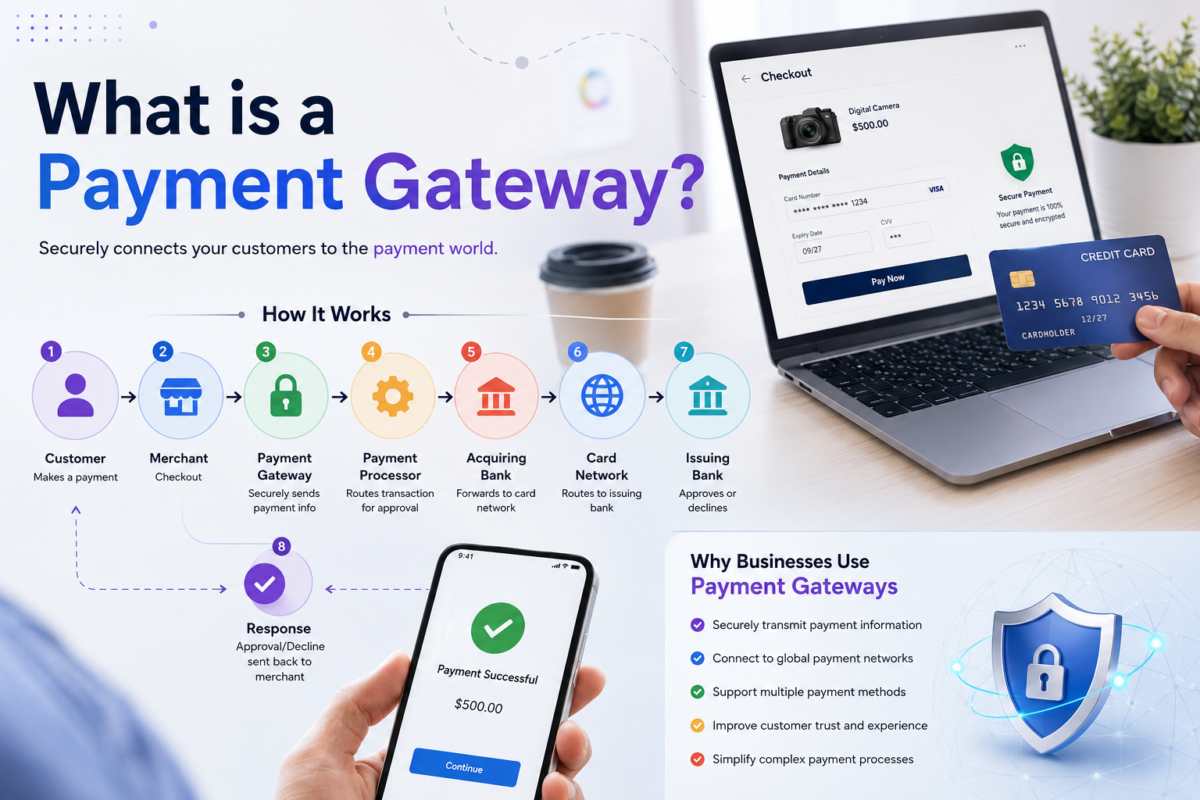
A customer can enter card details on an online checkout and receive a payment result within seconds, but that apparently simple action can involve several different systems. A payment gateway is one of the key components connecting the customer’s checkout experience with the infrastructure that handles the transaction.
Understanding what a payment gateway actually does is useful because it is often confused with a payment processor, merchant account, or even the entire payment-processing system. These are related components, but they perform different jobs.
What Is a Payment Gateway?
A payment gateway is a technology layer that securely captures or receives payment information from a customer and passes the transaction into the payment-processing flow. It also communicates the resulting response back to the merchant’s website, application, or checkout system.
In simple terms, the gateway acts as a bridge between the payment experience a customer sees and the systems that handle the transaction behind the scenes.
For example, imagine an online store selling a $500 camera. The customer enters their card information and clicks Pay. The checkout needs a way to securely submit that payment request and receive a response indicating whether the transaction was approved, declined, or requires further action. The payment gateway facilitates that communication.
However, it is important not to think of the gateway as the institution deciding whether the customer has enough money or whether the transaction should ultimately be approved. That decision involves other participants in the payment ecosystem. This distinction is the foundation for understanding how online payments work.
Where Does a Payment Gateway Fit Into Payment Processing?
An online card payment typically involves several parties, each with a different responsibility.
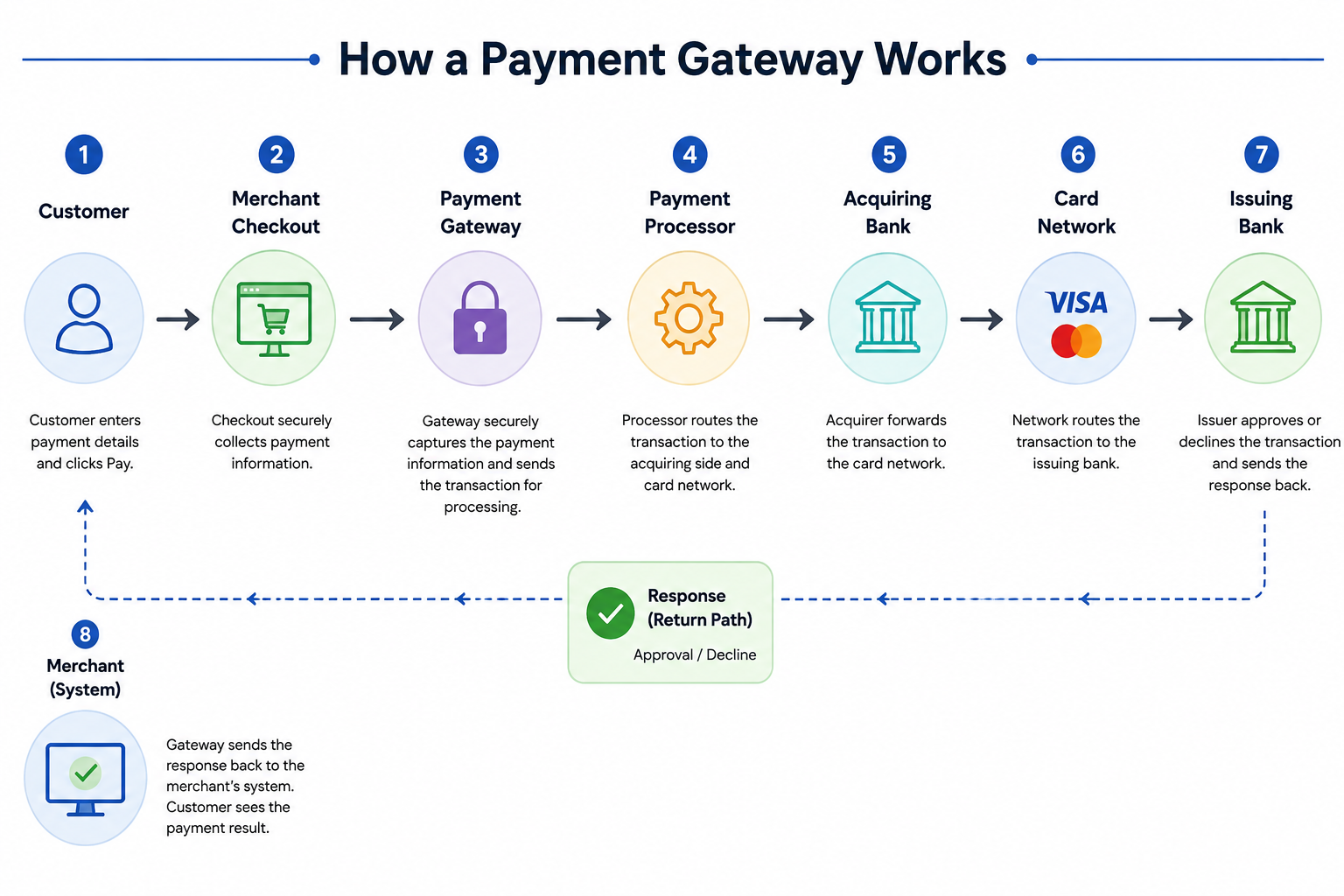
A simplified model looks like this:
Customer → Merchant Checkout → Payment Gateway → Payment Processor → Acquiring Side → Card Network → Issuing Bank
The exact architecture can vary depending on the payment method, provider, geography, and integration model, but the basic relationships are useful for understanding the system.
The Customer
The customer initiates the transaction by entering payment information and submitting the purchase.
The Merchant
The merchant is the business selling the product or service. Its website or application needs to communicate the customer’s payment request to the appropriate payment infrastructure.
The Payment Gateway
The gateway handles the payment-data and transaction-communication layer between the merchant’s checkout environment and downstream payment systems. Depending on the implementation, the customer may interact with a hosted payment page, embedded checkout fields, or another payment interface connected to the gateway.
The Payment Processor
The processor handles transaction-processing functions and communication with the relevant financial and payment infrastructure. The gateway and processor may be provided by separate companies or exist within a broader integrated payment setup.
The Acquiring Side
The acquiring institution or acquirer represents the merchant side of the card-payment ecosystem and facilitates the merchant’s acceptance of card transactions.
The Card Network
Networks such as Visa or Mastercard provide the infrastructure through which card transactions are routed between relevant participants.
The Issuing Bank
The issuer is the financial institution that issued the customer’s card. It evaluates the authorization request according to factors such as the account status, available funds or credit, transaction information, and applicable security controls.
The important point is that the payment gateway is one component in this chain, not the entire payment system.
What Does a Payment Gateway Actually Do?
The gateway’s role becomes clearer when we look at what happens when someone clicks the payment button.
Suppose a customer purchases a $500 product from an ecommerce store. The checkout collects the required payment information and submits the transaction through the configured payment flow. The gateway securely handles that payment information and passes the transaction into the appropriate processing infrastructure.
The transaction is then routed through the relevant systems toward the customer’s issuing institution. The issuer evaluates the authorization request and returns a response. That response travels back through the payment infrastructure, eventually allowing the merchant’s system to know whether the payment was approved or declined.
The customer’s screen might simply change from:
“Pay $500”
to:
“Payment successful.”
Behind that message, however, multiple systems have communicated with one another. The gateway is responsible for facilitating an important part of that communication.
Why Do Businesses Use Payment Gateways?
Businesses need a reliable way to connect their customer-facing payment experience with payment infrastructure without building every component of that infrastructure themselves.
A gateway can provide that connection while supporting different checkout and integration approaches.
- For an ecommerce business, this might mean allowing customers to enter card details through an online checkout.
- For a SaaS company, the gateway may be part of a subscription-payment flow where customers authorize recurring charges.
- For a marketplace or software application, payment functionality may be integrated more deeply into the application’s own interface.
The gateway therefore isn’t valuable simply because it “accepts payments.” Its value comes from helping the merchant’s technology communicate with the systems required to process those payments.
What a Payment Gateway Does Not Do?
One of the easiest ways to understand a payment gateway is to understand what it is not. A payment gateway is not necessarily:
- The customer’s bank that approves or declines a transaction.
- The merchant’s bank or merchant account.
- The card network through which a card transaction travels.
- The payment processor, although a provider may offer both gateway and processing functions.
- The entire settlement system that ultimately moves funds to the merchant.
These distinctions matter because payment infrastructure is often presented as though one company or one technology performs every function. In reality, a payment transaction can involve several interconnected layers.
A merchant account, for example, serves a different purpose from the technology used to transmit payment information. The two are often discussed together, but they handle different parts of the payment process.
What Happens to Payment Information?
Payment gateways also play an important role in how payment information moves through a transaction.
The exact process depends on the checkout and integration architecture, but payment information generally needs to be transmitted securely rather than simply passed between systems as ordinary website data.
Technologies and controls such as encryption, tokenization, secure communication, and PCI DSS requirements can be relevant to the way payment information is handled. Tokenization, for example, can replace sensitive payment information with a token that can be used to represent the payment credential without exposing the original data in every subsequent transaction flow.
Hosted checkout environments can also change how payment information is collected and handled by the merchant’s own systems. Security is therefore not a single feature switched on by the gateway. It involves technology, configuration, compliance requirements, access controls, and responsibilities shared across the payment ecosystem.
How Payment Gateways Affect the Customer Experience?
Payment infrastructure is largely invisible when everything works correctly, but the gateway can still influence what the customer experiences.
Consider two online stores.
One sends the customer to a separate hosted payment page with a simple form. Another keeps the customer inside the merchant’s website and uses embedded payment fields. Both can ultimately connect to payment-processing infrastructure, but the implementation and customer experience are different.
The choice of implementation model can affect checkout control, development requirements, security responsibilities, and the overall payment experience. This is why choosing or evaluating a gateway is not purely a technical decision. Businesses also need to consider how payment functionality fits into their customer journey and operating model.
A Simple Way to Think About a Payment Gateway
A useful mental model is to think of the payment gateway as the secure communication layer connecting a merchant’s payment experience with the systems involved in processing a transaction. It helps move a payment request into the appropriate processing flow, receives the resulting response, and communicates that outcome back to the merchant’s technology.
But the gateway does not operate in isolation. The processor, acquiring side, card network, issuing institution, merchant, and customer all have different roles. Understanding these relationships makes it much easier to understand everything that comes next in payment infrastructure.
Once the basic role of the gateway is clear, the next questions become more specific: How exactly does a transaction move through these systems, how does a gateway differ from a processor, what implementation models are available, and how is payment data protected?
Those distinctions are what turn the simple idea of a “payment gateway” into an accurate understanding of online payment infrastructure.
Categories
- ACH Payments (10)
- adult payment processing (11)
- AI (9)
- Altcoins (10)
- Banking (10)
- Bitcoin (133)
- Bitcoin ETF (11)
- Bitcoin Price (30)
- Blockchain (50)
- Brokering World Hunger Away (16)
- Business (17)
- card payment processing (10)
- CBD (11)
- CBDC (11)
- Chargeback (8)
- coaching business (11)
- COVID-19 (3)
- Crypto ATMs (1)
- Crypto Banking (17)
- Crypto Bill (1)
- Crypto business owner platform (31)
- Crypto Investment (3)
- Crypto Markets (5)
- Crypto Payment (35)
- Crypto Payment Processor (4)
- Crypto Prices (1)
- Crypto Trading (92)
- Cryptocurrency (402)
- Cryptocurrency Exchange (108)
- Data Visualization (2)
- dating platforms (11)
- debt collection payment processing (10)
- Decentralized Finance (7)
- DeFi Payment (9)
- DEX (3)
- Digital Currency (23)
- dropshipping payment processing (12)
- Ethereum (2)
- FAQ (7)
- file sharing payment processing (11)
- Finance (25)
- Financial Equality (4)
- Financial Freedom (8)
- Forex (35)
- hemp (1)
- ICO (2)
- Investment (11)
- IPTV (11)
- Merchant Account (10)
- Mining (3)
- News (66)
- NFTs (2)
- online gambling (11)
- P2P (1)
- Paybito (147)
- PayBitoPro (693)
- PayBitoPro Coin Listing (6)
- PayBitoPro Exchange (2)
- Payment Gateway (48)
- peptide (10)
- Post COVID Digital Transformation (1)
- Press Release (130)
- Privacy & Security (3)
- Real Estate (1)
- Stablecoin (5)
- Technology (15)
- Travel (11)
- Uncategorized (10)
- US Presidential Election (2)
- Utility Coin (1)
- Web3 business (4)
- Web3 Wallets (2)
- White Label Crypto Exchange (8)
Recent Posts
- Payment Gateway vs. Payment Orchestration: What’s the Difference?
- What Is Smart Payment Routing? Strategies to Optimize Payment Performance
- How to Improve Payment Approval Rates for High-Risk Businesses?
- Why Are Online Payments Failing? Common Causes and How to Fix Them
- How to Use Multiple Payment Processors to Reduce Business Disruptions?