How to Choose a Payment Gateway for Your Business?
- August 17, 2026
- Soham Guchait
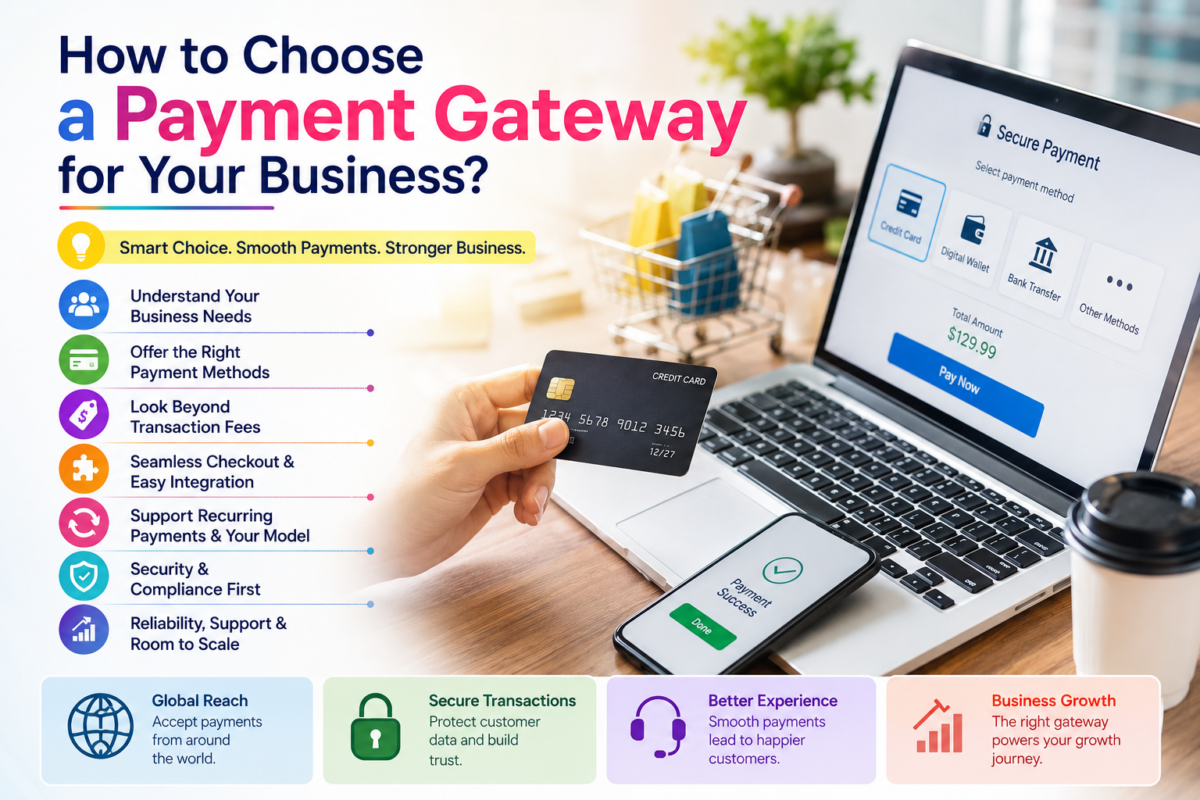
Choosing a payment gateway is not simply a matter of finding the lowest transaction fee. A gateway becomes part of the infrastructure through which customers pay, transactions are authorized, refunds are handled, payment data is protected, and transaction information reaches your business systems.
A gateway that works well for a small domestic ecommerce store may be a poor fit for a SaaS company with recurring billing, a marketplace with multiple sellers, or a business expanding into several countries. The right approach is to evaluate the gateway against how your business actually accepts and manages payments.
Start With How Your Business Takes Payments
Before comparing providers, define what your payment operation needs to accomplish.
Consider a hypothetical online retailer processing around $100,000 in monthly sales. Most of its customers are domestic, but 15% are international. The business sells individual products rather than subscriptions and needs card payments and digital wallets.
Its requirements will be very different from a SaaS company charging customers $49 every month, or a marketplace that needs to process payments involving multiple sellers. The first step is therefore to understand your own payment environment:
- Where are your customers located?
- What payment methods do they commonly use?
- What currencies do you need to accept?
- What is your average transaction value and monthly volume?
- Do you need one-time payments, recurring payments, or both?
- What website, ecommerce platform, or application will connect to the gateway?
Once these questions are clear, gateway comparisons become much more meaningful.
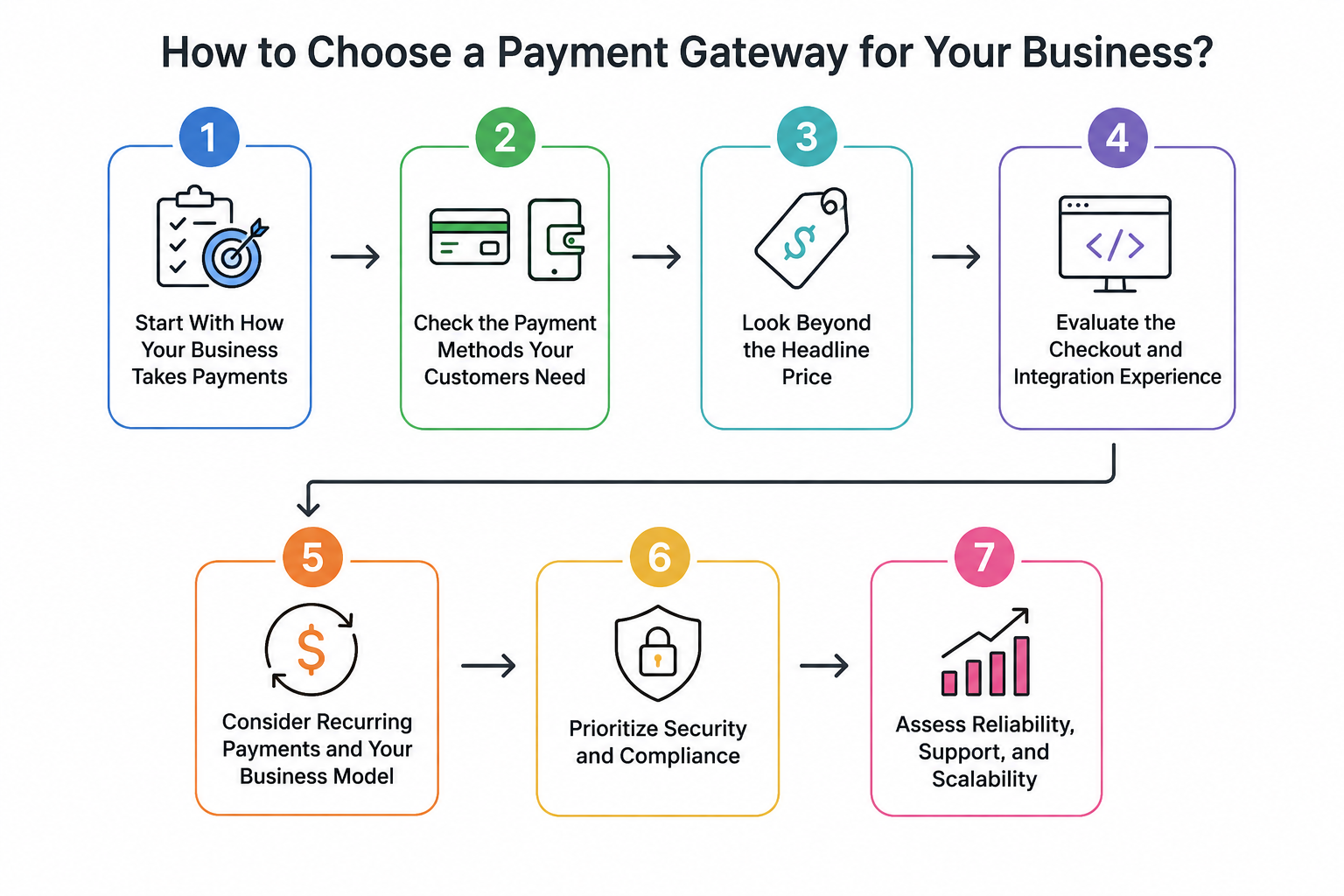
1. Check the Payment Methods Your Customers Actually Need
A gateway may support cards, wallets, bank-based payments, or other payment methods, but the important question is not how many methods it supports.
The question is: Does it support the methods your customers are likely to use?
For example, an online retailer selling primarily to U.S. customers may place greater importance on major card networks and digital wallets. A business selling across several countries may need local payment methods that are widely used in individual markets.
Supporting a payment method also does not necessarily mean that it is available in every country, currency, or transaction scenario. Confirm the exact combination that applies to your business.
For a business expanding internationally, geographic coverage deserves separate attention. A gateway may support a particular country but have different capabilities for local currencies, settlement, or acquiring there. These distinctions can affect the practical usefulness of the gateway.
2. Look Beyond the Headline Price
Pricing is important, but comparing gateways solely by their advertised transaction rate can produce the wrong conclusion.
A payment setup may involve percentage-based transaction fees, fixed transaction fees, refund-related charges, chargeback fees, currency-conversion costs, monthly charges, minimums, or fees for optional services. The exact structure varies by provider and contract.
Suppose Gateway A charges 2.5% plus $0.30 per transaction, while Gateway B has a different pricing structure. For a $1,000 transaction, the first model would produce:
$1,000 × 2.5% + $0.30 = $25.30
That calculation alone does not tell you which gateway is cheaper for your business. If your customers frequently pay in foreign currencies, use particular payment methods, or generate refunds and disputes, other charges can materially change the total cost.
The better question is:
“What will this payment infrastructure cost across my actual transaction mix?”
Current gateway comparisons commonly recommend looking beyond the base transaction rate to factors such as chargebacks, currency conversion, monthly minimums and optional services.
3. Evaluate the Checkout and Integration Experience
A gateway does not exist separately from your website or application. Customers experience the payment flow through your checkout.
Different gateways can offer different implementation approaches, including hosted pages, embedded components and API-based integrations. The right option depends on how much control your business needs and how much development work it can support.
A small business with limited technical resources may prefer a hosted checkout that requires less custom development. A software company with a dedicated engineering team may require an API-based setup to create a more customized payment experience.
Neither approach is automatically better. The important question is whether the gateway’s integration model fits your technical environment.
4. Consider Recurring Payments and Your Business Model
Payment requirements change significantly depending on what you sell. An ecommerce store selling a $200 product once has different needs from a SaaS company charging $49 every month.
If your business uses subscriptions, determine whether the gateway supports the recurring-payment functionality you need. Consider how it handles recurring charges, stored payment credentials, failed recurring payments, cancellations, refunds and changes to subscription plans. A marketplace introduces another set of requirements. It may need capabilities related to multiple sellers, payment allocation, reporting or payouts.
This is why a gateway should be evaluated against your business model, not simply against a generic feature checklist.
5. Examine Security and Compliance Responsibilities
Payment security should be evaluated as part of the architecture, not treated as a checkbox.
Ask how the gateway handles sensitive payment information and what security features are available. Depending on the integration, this may involve hosted payment pages, tokenization, encryption, authentication mechanisms and tools that help reduce exposure to sensitive card data.
PCI DSS is also important. However, using a gateway does not mean that every merchant automatically has identical compliance responsibilities. Those responsibilities depend on the payment architecture and how payment data is handled.
The PCI Security Standards Council provides authoritative terminology and guidance for understanding payment-data security and PCI DSS requirements. For the underlying mechanisms, see payment gateway security and how online payments are protected.
6. Check Geographic and Currency Support
If you only operate in one market, geographic coverage may be relatively straightforward. For an international business, it becomes much more important.
Check:
- Countries where you can accept payments
- Supported transaction currencies
- Settlement currencies
- Availability of local payment methods
- Cross-border payment capabilities
- Currency-conversion costs
- Whether local acquiring is available where relevant
Do not assume that “supports international payments” means the same thing as “provides everything needed to operate efficiently in every country.”
For example, a retailer selling in the United States, Germany and Singapore may need to examine each market separately rather than simply checking whether the gateway advertises global coverage.
7. Evaluate Reporting, Refunds, and Day-to-Day Operations
Payment infrastructure is not finished when a transaction succeeds.
Your finance and operations teams may need to identify individual transactions, issue refunds, reconcile payments, investigate failures and understand settlement activity.
A gateway should therefore be evaluated for the information it provides after the customer has paid. Look at transaction reporting, refund functionality, settlement information, reconciliation capabilities, dispute visibility and access to transaction records.
Imagine processing 5,000 transactions per month and discovering that your finance team has to manually match payment records against orders. A gateway that initially appeared inexpensive could create significant operational work.
8. Think About Reliability and Future Growth
A gateway should work not only for today’s transaction volume but also for the business you expect to become.
Ask what happens if your transaction volume doubles. Can the same integration support the additional volume? Can you add payment methods or enter new markets without rebuilding the entire payment flow?
Reliability also matters. Review the provider’s documented service commitments, incident history where available, monitoring capabilities and communication process for outages.
Scalability does not necessarily mean choosing the largest or most feature-heavy provider. It means choosing infrastructure that can support your foreseeable requirements without creating unnecessary complexity.
A Simple Way to Compare Payment Gateways
After identifying your requirements, create a comparison based on the factors that actually matter to your business.
For example, a SaaS company might assign greater importance to recurring payments, API capabilities and subscription management, while an international retailer might prioritize payment methods, currency support and cross-border capabilities.
A useful evaluation can include:
- Payment methods and geographic coverage
- Total cost for your actual transaction mix
- Integration and technical requirements
- Security and compliance considerations
- Recurring or specialized payment requirements
- Reporting, refunds and reconciliation
- Reliability and scalability
- Support and documentation
The goal is not to find the gateway with the longest feature list. It is to identify the one whose capabilities align with your payment requirements.
The Best Payment Gateway Is the Best Fit, Not the Most Popular
There is no universally best payment gateway for every business.
A gateway should be judged in the context of what you sell, where your customers are located, how they prefer to pay, how your technology is built, how much you process, and what your payment operation may look like in the future.
For one business, a simple hosted checkout may be the most practical choice. For another, a highly customizable API integration may justify the additional development effort.
The most reliable selection process is therefore to define your requirements first, compare the total operational and financial impact second, and evaluate providers against those requirements rather than starting with brand names. Once the shortlist is established, the next step is understanding how to integrate a payment gateway into a website or application, because the quality of the implementation can be just as important as the gateway selected.

Categories
- ACH Payments (10)
- adult payment processing (11)
- AI (9)
- Altcoins (10)
- Banking (10)
- Bitcoin (133)
- Bitcoin ETF (11)
- Bitcoin Price (30)
- Blockchain (50)
- Brokering World Hunger Away (16)
- Business (17)
- card payment processing (10)
- CBD (11)
- CBDC (11)
- Chargeback (8)
- coaching business (11)
- COVID-19 (3)
- Crypto ATMs (1)
- Crypto Banking (17)
- Crypto Bill (1)
- Crypto business owner platform (31)
- Crypto Investment (3)
- Crypto Markets (5)
- Crypto Payment (35)
- Crypto Payment Processor (4)
- Crypto Prices (1)
- Crypto Trading (92)
- Cryptocurrency (402)
- Cryptocurrency Exchange (108)
- Data Visualization (2)
- dating platforms (11)
- debt collection payment processing (10)
- Decentralized Finance (7)
- DeFi Payment (9)
- DEX (3)
- Digital Currency (23)
- dropshipping payment processing (12)
- Ethereum (2)
- FAQ (7)
- file sharing payment processing (11)
- Finance (25)
- Financial Equality (4)
- Financial Freedom (8)
- Forex (35)
- hemp (1)
- ICO (2)
- Investment (11)
- IPTV (11)
- Merchant Account (10)
- Mining (3)
- News (66)
- NFTs (2)
- online gambling (11)
- P2P (1)
- Paybito (147)
- PayBitoPro (693)
- PayBitoPro Coin Listing (6)
- PayBitoPro Exchange (2)
- Payment Gateway (48)
- peptide (10)
- Post COVID Digital Transformation (1)
- Press Release (130)
- Privacy & Security (3)
- Real Estate (1)
- Stablecoin (5)
- Technology (15)
- Travel (11)
- Uncategorized (10)
- US Presidential Election (2)
- Utility Coin (1)
- Web3 business (4)
- Web3 Wallets (2)
- White Label Crypto Exchange (8)
Recent Posts
- Payment Gateway vs. Payment Orchestration: What’s the Difference?
- What Is Smart Payment Routing? Strategies to Optimize Payment Performance
- How to Improve Payment Approval Rates for High-Risk Businesses?
- Why Are Online Payments Failing? Common Causes and How to Fix Them
- How to Use Multiple Payment Processors to Reduce Business Disruptions?