Payment Gateway API Explained: How Businesses Connect Payment Systems to Software?
- August 17, 2026
- Soham Guchait
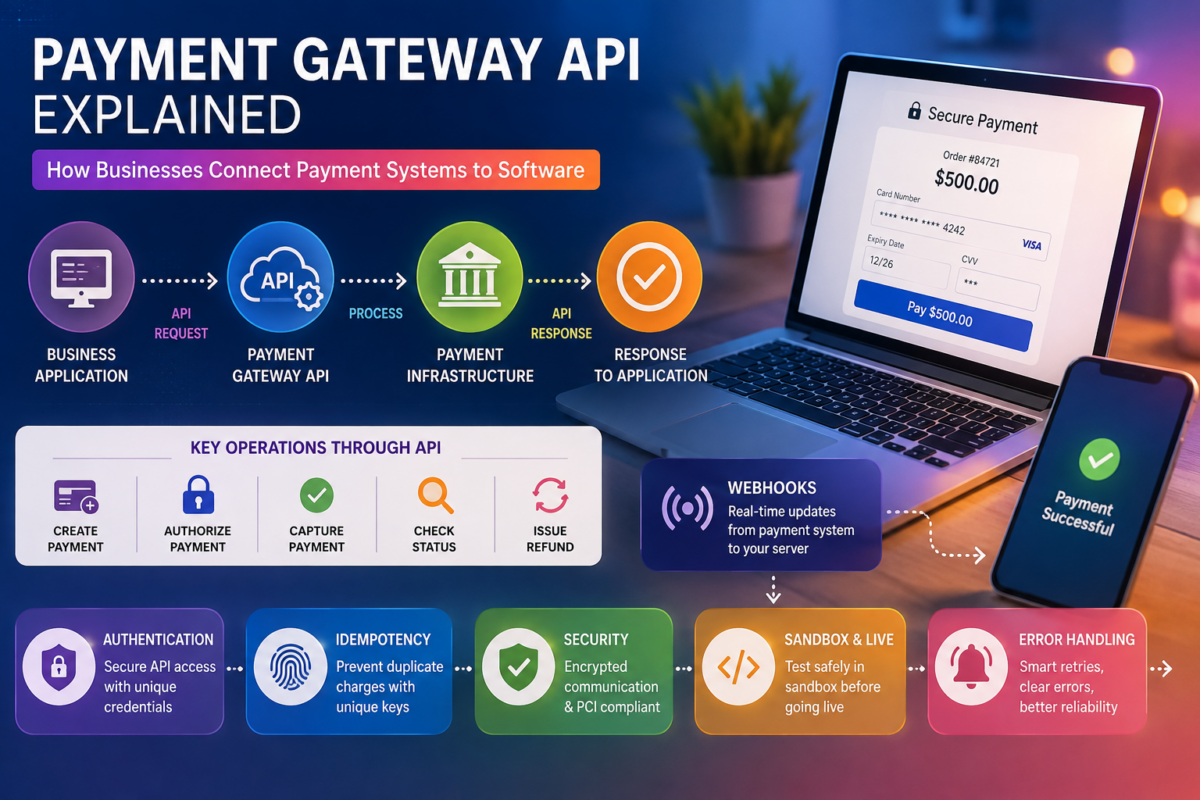
When a customer clicks “Pay” on a website, the merchant’s software has to communicate with payment infrastructure in a structured and secure way. A payment gateway API provides that connection.
An API allows a website or application to send payment requests to a gateway, receive responses, initiate actions such as refunds, and receive updates about transactions. Understanding this layer is useful for business owners as well as developers because it explains how payment functionality becomes part of an application.
What Is a Payment Gateway API?
A payment gateway API is a set of software interfaces that allows an application to communicate with a payment gateway programmatically.
Instead of a developer manually transferring information between systems, the application sends a structured request to an API endpoint. The gateway processes that request and returns a structured response. The basic relationship looks like this:
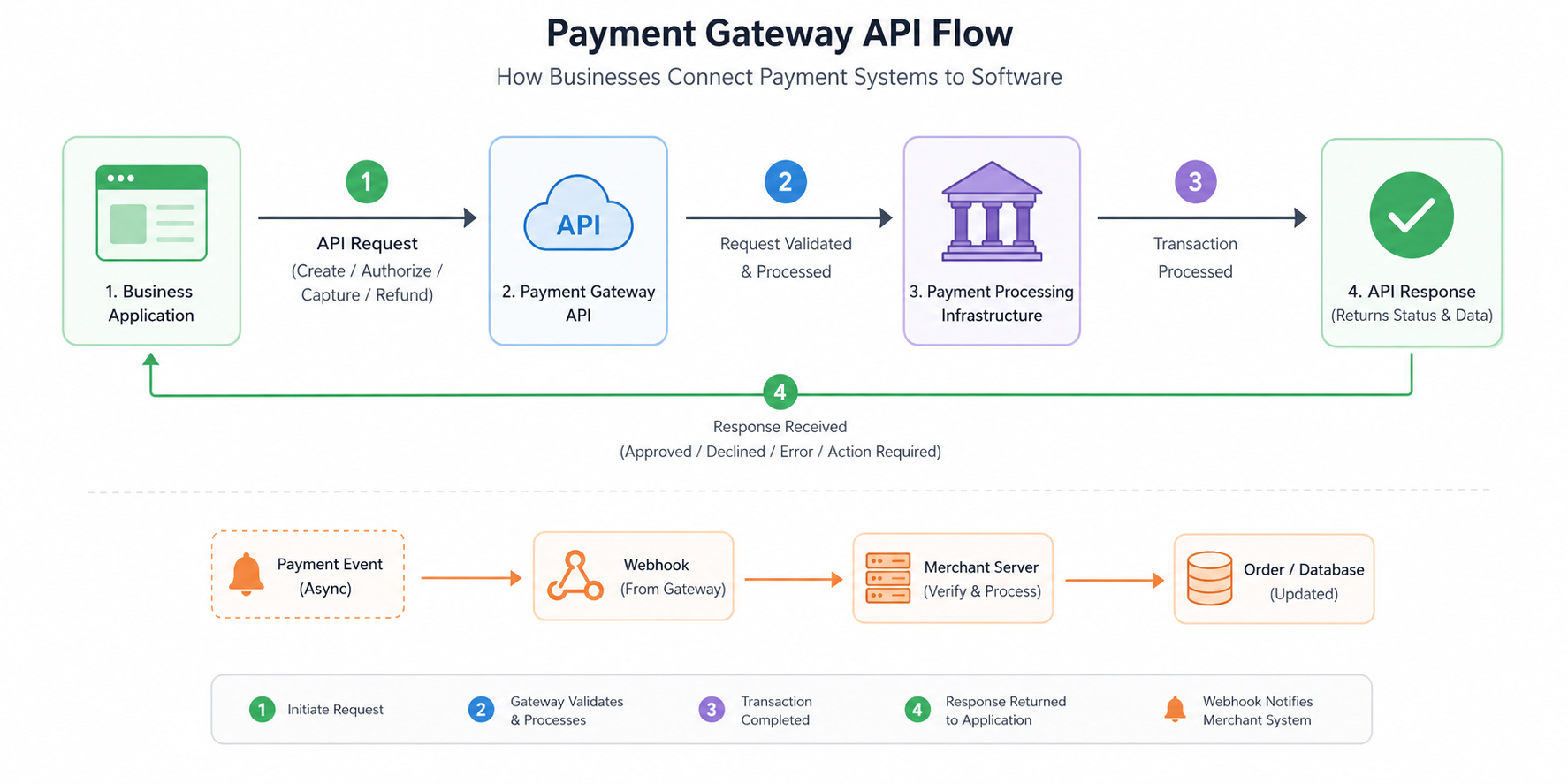
Business Application → API Request → Payment Gateway → API Response → Business Application
For example, imagine a SaaS company charging a customer $49 for a subscription. When the customer completes checkout, the company’s application can send a payment request containing information such as the amount, currency, order reference, and payment details or a secure payment token. The gateway processes the request and returns information about what happened.
The exact API structure differs between providers, but payment APIs commonly support operations such as creating payments, authorizing transactions, capturing funds, checking payment status, and issuing refunds.
The important distinction is that the API is the communication layer. It allows the merchant’s software to interact with the gateway rather than requiring the application to understand every underlying payment-system connection. The different payment gateway types determine how this payment interaction is presented and handled.
How Does a Payment Gateway API Work?
A useful way to understand a payment API is to think of it as a controlled conversation between two software systems.
The merchant’s application makes a request. The gateway receives and validates it, performs the requested operation, and returns a response. For example, an online retailer selling a $500 laptop might send a request representing:
Amount: $500
Currency: USD
Order: #84721
The gateway then returns information about the transaction, such as whether the request was accepted, declined, requires additional action, or encountered an error. This communication normally takes place over secure web protocols, with the gateway exposing specific endpoints for different operations.
API Endpoints, Requests, and Responses
An endpoint is a defined location through which an application accesses a particular API operation. A payment API could have different endpoints or operations for creating a payment, capturing an authorized payment, checking a transaction, or issuing a refund. The request contains the information required for the operation. The response provides the result.
A response might include a transaction identifier, payment status, error information, or instructions for the next stage of the payment flow. This structured approach allows the merchant’s software to make decisions automatically.
For example:
Payment approved → Mark order as paid
Payment declined → Keep order unpaid and show an appropriate message
Additional action required → Ask the customer to complete the required step
The application should not assume that every payment produces an immediate final result. Some payment methods and transaction flows can involve additional stages.
Authentication: How Does the API Know Who Is Making the Request?
Payment APIs need to authenticate applications before allowing them to perform financial operations. Providers use different authentication mechanisms, but businesses commonly receive API credentials that identify their account or application.
These credentials should be treated as sensitive information. Secret credentials should not be exposed in public repositories or unnecessarily placed in browser-side code.
Authentication answers an important question:
“Is this application authorized to communicate with the payment API?”
That is different from customer authentication. A merchant’s application being authorized to use an API does not mean that a particular customer has been authenticated for a transaction.
Payment Creation, Authorization, and Capture
Payment APIs often represent payments as a series of states or operations rather than one single action. Depending on the payment method and gateway, a merchant may create a payment, authorize it, capture it, cancel it, or refund it.
Consider a furniture retailer selling a $1,000 table. The business may first authorize the payment and capture it later when the product is ready to ship.
The API makes these operations programmable.
However, authorization and capture do not work identically for every payment method. Businesses should follow the transaction lifecycle supported by their specific gateway rather than assuming every payment follows exactly the same sequence. This is also why a payment API should not be confused with the complete payment process. The API provides the software interface; the transaction itself still moves through the underlying payment infrastructure.
What Are Webhooks?
One of the most important concepts surrounding payment APIs is the webhook.
An API request is initiated by the merchant’s application. A webhook works in the opposite direction: The payment system sends an event to the merchant’s server when something happens.
Imagine a customer submits a payment and then closes the browser immediately. The merchant’s server may still need to know whether the transaction was ultimately successful.
A webhook can notify the application when the payment status changes.
The merchant’s system can then verify the event, identify the related transaction, and update its internal records. This is particularly important because the customer’s browser is not a reliable communication channel for every payment event. A customer can lose connectivity, close the page, refresh the browser, or simply leave checkout.
Webhook processing should therefore be designed to handle duplicate events and verify that incoming notifications are legitimate before changing an order’s status.
Idempotency: Preventing Duplicate Operations
Payment APIs also need to deal with network failures and repeated requests. Suppose an application sends a request to charge $500. The gateway processes it, but the network connection fails before the merchant receives the response.
The application cannot immediately tell whether the payment succeeded. If it simply submits a completely new payment request, it could potentially create a duplicate charge.
Idempotency helps solve this problem.
An application can attach a unique idempotency key to an operation. If the application needs to retry because the response was lost, it can reuse the same key. The payment system can then recognize that the retry refers to the same operation rather than treating it as an unrelated request.
This makes idempotency especially important for payment operations where repeating an action can have financial consequences.
How Do Refunds Work Through an API?
A payment API is not limited to accepting payments.
Depending on the gateway, an application may also be able to initiate refunds, cancel transactions, capture authorized payments, or retrieve transaction information. For example, suppose a customer purchases a $200 product and later returns it. The merchant’s order-management system could initiate a refund through the payment API. The API request would identify the relevant transaction and specify the refund amount. The application can then record the refund against the customer’s order.
This creates a direct connection between payment infrastructure and the merchant’s internal systems.
What Happens When an API Request Fails?
API errors can occur for many reasons. A request might contain invalid information, authentication could fail, the transaction might be in an invalid state, or a temporary network problem could prevent communication.
Not every error should be handled in the same way. A temporary timeout might justify a carefully controlled retry. An invalid amount or malformed request needs to be corrected instead. This distinction is important because blindly retrying every failed payment operation can create unnecessary or potentially duplicate transactions.
A well-designed integration interprets the gateway’s response and follows the documented rules for retrying, correcting, or escalating the problem.
Sandbox and Production Environments
Payment APIs commonly provide a sandbox or test environment where developers can build and test integrations without processing ordinary live transactions. Developers can use test credentials and simulated payment scenarios to verify how the application handles successful payments, declines, errors, refunds, and other events.
Production is different. It uses live credentials and processes real transactions. Moving to production also means dealing with the actual payment gateway cost. which can vary depending on the provider, payment methods, transaction volume, and pricing structure.
Before switching to production, businesses should verify credentials, API endpoints, webhook destinations, payment-status handling, error handling, and order updates. A payment integration should not be considered complete simply because one test payment succeeded.
Security and Payment APIs
Security needs to be considered throughout the API architecture.
API credentials must be protected, communication should use secure connections, webhook events should be validated, and applications should avoid unnecessarily handling sensitive payment information.
PCI DSS provides requirements for protecting payment account data, although the exact responsibilities of a merchant depend on its systems and payment architecture.
The Payment Gateway API as a Communication Layer
A payment gateway API makes payment infrastructure programmable. The overall concept can be represented as:
Application
↓
Authenticated API Request
↓
Payment Gateway
↓
Payment Processing Infrastructure
↓
API Response
And separately:
Payment Event → Webhook → Merchant Server → Order/Database
The API request allows the application to initiate or retrieve an operation. The response tells the application what happened or what should happen next. Webhooks allow the payment system to communicate later events.
Understanding these three pieces – Requests, Responses, and Events – provides the foundation for understanding most payment API integrations.
A payment gateway API is therefore more than a technical connection for accepting cards. It is the software interface that allows a business’s applications to interact with payment infrastructure, manage transaction operations, and keep payment activity connected to its own systems.
Once that API layer is understood, the next important question is how to build the surrounding system so that failed payments, retries, webhooks, refunds, and order updates are handled reliably.

Categories
- ACH Payments (10)
- adult payment processing (11)
- AI (9)
- Altcoins (10)
- Banking (10)
- Bitcoin (133)
- Bitcoin ETF (11)
- Bitcoin Price (30)
- Blockchain (50)
- Brokering World Hunger Away (16)
- Business (17)
- card payment processing (10)
- CBD (11)
- CBDC (11)
- Chargeback (8)
- coaching business (11)
- COVID-19 (3)
- Crypto ATMs (1)
- Crypto Banking (17)
- Crypto Bill (1)
- Crypto business owner platform (31)
- Crypto Investment (3)
- Crypto Markets (5)
- Crypto Payment (35)
- Crypto Payment Processor (4)
- Crypto Prices (1)
- Crypto Trading (92)
- Cryptocurrency (402)
- Cryptocurrency Exchange (108)
- Data Visualization (2)
- dating platforms (11)
- debt collection payment processing (10)
- Decentralized Finance (7)
- DeFi Payment (9)
- DEX (3)
- Digital Currency (23)
- dropshipping payment processing (12)
- Ethereum (2)
- FAQ (7)
- file sharing payment processing (11)
- Finance (25)
- Financial Equality (4)
- Financial Freedom (8)
- Forex (35)
- hemp (1)
- ICO (2)
- Investment (11)
- IPTV (11)
- Merchant Account (10)
- Mining (3)
- News (66)
- NFTs (2)
- online gambling (11)
- P2P (1)
- Paybito (147)
- PayBitoPro (693)
- PayBitoPro Coin Listing (6)
- PayBitoPro Exchange (2)
- Payment Gateway (48)
- peptide (10)
- Post COVID Digital Transformation (1)
- Press Release (130)
- Privacy & Security (3)
- Real Estate (1)
- Stablecoin (5)
- Technology (15)
- Travel (11)
- Uncategorized (10)
- US Presidential Election (2)
- Utility Coin (1)
- Web3 business (4)
- Web3 Wallets (2)
- White Label Crypto Exchange (8)
Recent Posts
- Payment Gateway vs. Payment Orchestration: What’s the Difference?
- What Is Smart Payment Routing? Strategies to Optimize Payment Performance
- How to Improve Payment Approval Rates for High-Risk Businesses?
- Why Are Online Payments Failing? Common Causes and How to Fix Them
- How to Use Multiple Payment Processors to Reduce Business Disruptions?