Payment Gateway Security: How Online Payments Are Protected From Fraud and Data Theft?
- August 17, 2026
- Soham Guchait
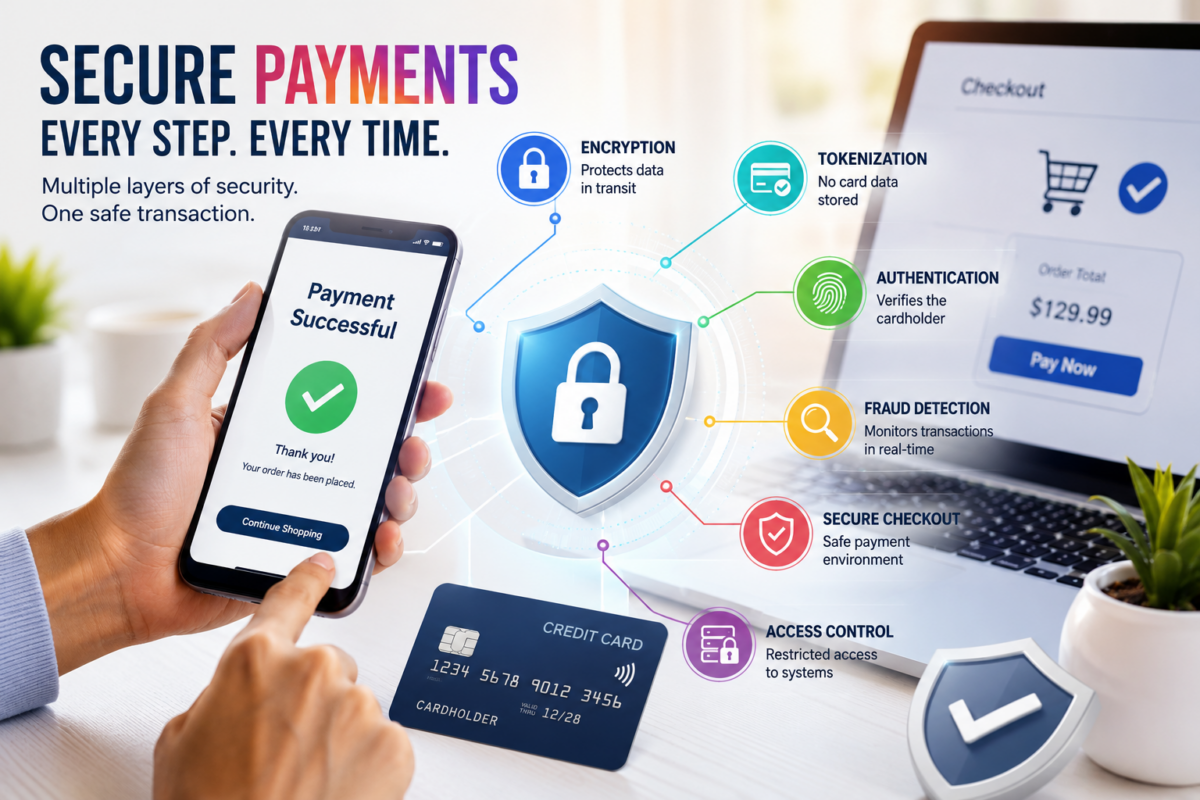
A customer can enter card details, complete a purchase, and receive confirmation within seconds. Behind that simple experience, however, payment information passes through systems that must protect it from interception, misuse, unauthorized access, and fraud.
Payment gateway security is not one technology. It is a combination of secure communication, data protection, authentication, fraud controls, access restrictions, and operational safeguards. Each layer addresses a different risk. Understanding these mechanisms helps businesses make better decisions about checkout design, payment integrations, data handling, and security responsibilities.
How Payment Gateway Security Works?
A simplified online payment flow looks like this:
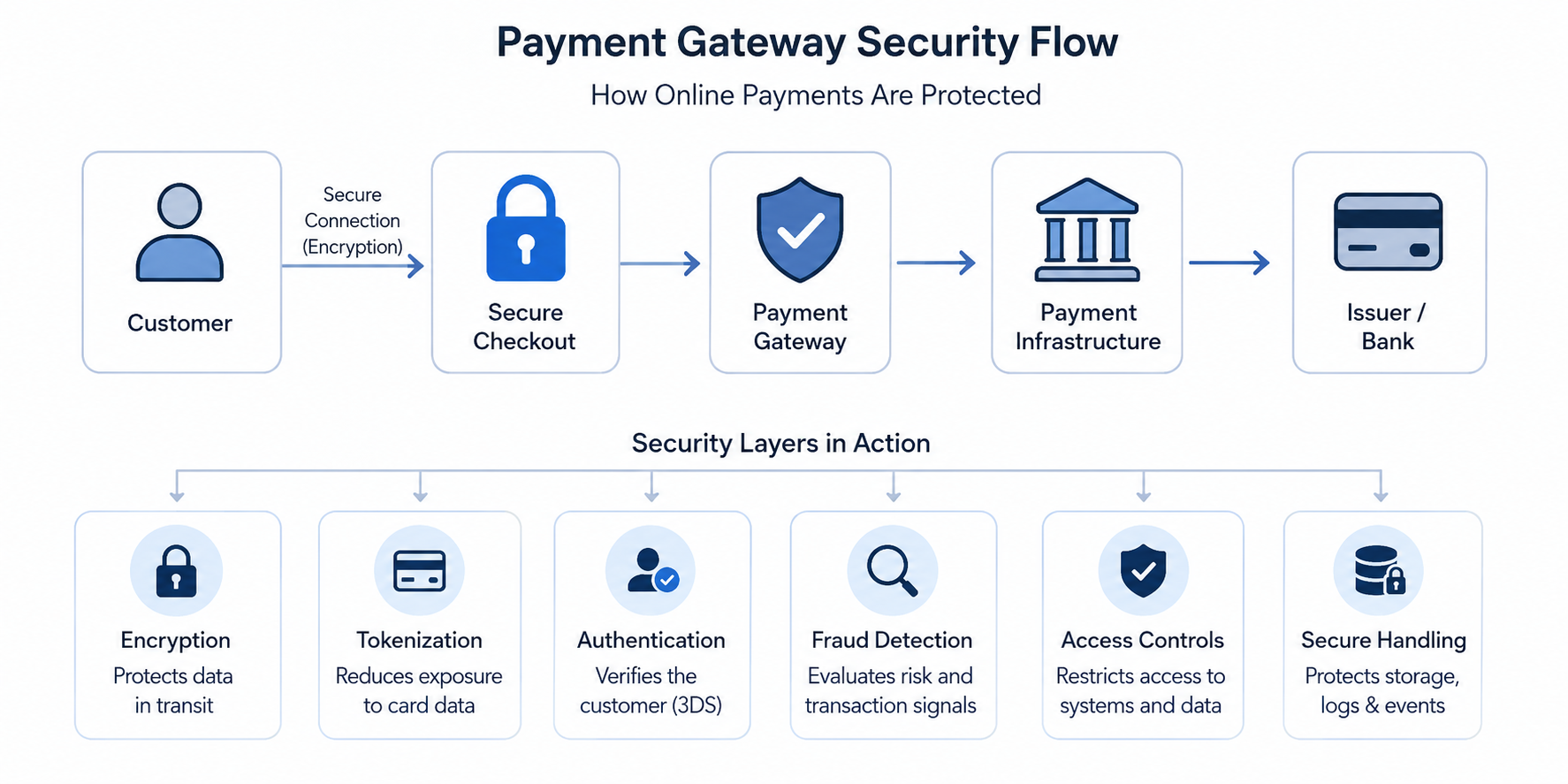
Customer → Secure Checkout → Payment Gateway → Payment Infrastructure → Issuer
Security controls can operate at several points. Secure connections protect information while it travels. Tokenization can reduce how much sensitive card data a merchant handles. Authentication helps establish that a transaction is legitimate. Fraud controls look for suspicious patterns.
These controls solve different problems. Encryption protects data in transit; authentication helps verify a customer or transaction; fraud detection evaluates risk; and tokenization can reduce exposure to original payment credentials. The controls are often used together, with each addressing a different part of the payment security process rather than serving as a replacement for the others.
Encryption: Protecting Data in Transit
Encryption converts information into a form that unauthorized parties cannot readily understand without the appropriate keys. During an online payment, secure connections help protect information as it moves between the customer’s device, merchant systems, and payment infrastructure.
Encryption does not make every part of a payment environment secure by itself. It protects transmission, but businesses must also consider how payment information is collected, processed, stored, accessed, and deleted.
For example, an ecommerce store can use secure connections while still creating unnecessary risk if sensitive payment data is stored carelessly in its own database.
Tokenization: Reducing Exposure to Card Data
Tokenization replaces sensitive payment information with a different value, commonly called a token, that can be used for supported payment operations without exposing the original card number to every system.
Imagine a subscription business storing a customer’s payment method for future billing. Instead of keeping the original card number in its own database, the business may use a payment token supplied by its payment infrastructure.
This can reduce the amount of sensitive payment data held by the merchant. The PCI Security Standards Council has published guidance on tokenization and its relationship to protecting payment account data.
Tokenization is therefore best understood as part of a broader payment-data architecture, not as a complete security solution by itself.
PCI DSS and Security Responsibilities
PCI DSS is an industry security standard containing technical and operational requirements designed to protect payment account data.
A common misconception is that using a payment gateway automatically removes every security responsibility from a merchant. Responsibilities depend on how the payment environment is designed.
A business using a hosted payment page may have a different security scope from one that directly handles payment data. But both still need to protect their websites, accounts, integrations, administrative access, and systems that can affect payment security. PCI DSS should therefore be considered part of a wider security program rather than a single checkbox.
Authentication: Verifying the Customer
Authentication adds another layer by helping determine whether the person making an online payment is the legitimate cardholder.
One important technology is EMV 3-D Secure (3DS). It enables merchants and issuers to exchange transaction, payment-method, and device information to help authenticate consumers and assess transactions. Lower-risk transactions can sometimes proceed with little visible friction, while higher-risk transactions may require an additional challenge.
For example, a familiar customer purchasing a low-value item may experience a seamless flow, while an unusual high-value transaction may trigger additional verification.
EMVCo describes 3DS as a technology designed to help prevent card-not-present fraud while balancing security with the customer experience.
Fraud Detection: Looking Beyond Card Details
A payment can be fraudulent even when the card information is valid. Fraud systems can evaluate transaction signals such as amount, transaction patterns, device information, location, and other risk indicators. Different participants in the payment ecosystem may apply different controls.
Consider an account that normally makes $50 purchases but suddenly attempts several large transactions within minutes. That pattern may warrant additional scrutiny.
A risk system might allow the payment, request additional authentication, or decline it. The exact process varies. The objective is not to reject every unusual transaction, because excessive controls can also block legitimate customers.
Hosted Checkout and Secure Payment Collection
The way payment information is collected affects the merchant’s security architecture.
With a hosted checkout page, sensitive payment information can be entered into an environment operated by the payment provider rather than directly into the merchant’s application.
Other implementations may use hosted fields or embedded payment components that keep sensitive fields separated from ordinary application logic.
For example, a SaaS company may want a branded checkout without having its own backend receive raw card numbers. A suitable payment component can reduce the amount of sensitive information handled directly by the merchant.
The exact security and compliance implications depend on the implementation, so businesses should evaluate the actual data flow rather than assume that one checkout model removes every obligation.
API and Integration Security
Payment gateway APIs create another security boundary between business software and payment infrastructure.
API credentials should be treated as sensitive secrets and should not be unnecessarily exposed in client-side code or public repositories. Applications should also protect administrative access, use secure connections, validate incoming data, and handle payment events carefully.
For example, if a merchant’s server receives a notification saying that a $500 order has been paid, the application should verify that event using the provider’s documented security mechanism before releasing the order.
This technical layer is closely connected to how a payment gateway API works, but API security is only one part of the overall payment-security architecture.
How the Security Layers Work Together?
Imagine an online store processing a $1,500 camera purchase.
The secure connection protects information while it travels. The checkout architecture limits how much sensitive data reaches the merchant’s systems. Tokenization can reduce the need to retain original payment credentials. Fraud controls evaluate transaction risk, while authentication can add verification when necessary. Access controls protect the systems that manage the payment environment.
Each mechanism addresses a different threat.
This layered approach matters because no single control can prevent every type of payment attack. Security comes from combining protections across the transaction flow.
What Businesses Still Need to Protect?
A merchant should look beyond the gateway itself and examine every system that can influence payment activity. Important areas include:
- Website and application security
- API credentials and administrative accounts
- Payment-related databases and logs
- Webhook handling and third-party integrations
- Employee access, software updates, monitoring, and incident response
The exact responsibilities depend on the merchant’s architecture. Businesses should know what payment data they receive, where it travels, what they store, and which systems can change a transaction’s status.
A Practical Example
Consider a SaaS company charging customers $49 each month.
The customer enters payment information through a secure checkout component. The payment data travels through protected connections and is handled by the payment infrastructure. The merchant receives a payment result without unnecessarily storing the customer’s raw card details.
A token may represent the payment method for supported future transactions. Fraud controls assess the payment, while authentication may be introduced when required. Later, a server-side payment event confirms the recurring transaction, and the merchant verifies it before updating the subscription.
No individual step provides complete protection. The security comes from the combination of controlled data handling, secure communication, authentication, fraud detection, access controls, and reliable integration.
Payment Security Is a Shared Responsibility
A payment gateway can provide important security capabilities, but a business remains responsible for the systems it controls.
The payment infrastructure may provide tools such as tokenization, authentication, fraud controls, and secure APIs. The merchant remains responsible for its website, application, credentials, employee access, integrations, and operational practices.
This distinction matters because security failures can occur outside the gateway. An exposed API credential, compromised administrator account, vulnerable application, or poorly handled payment event can create risk even when the payment infrastructure itself is operating normally.
Conclusion
Online payment security works through layers rather than one protective mechanism.
Encryption helps protect information in transit. Tokenization can reduce exposure to sensitive card data. PCI DSS provides a framework for protecting payment account data. Authentication helps verify customers, while fraud controls evaluate transaction risk. Secure checkout and API design can further limit exposure.
The most useful question for a business is not simply, “Is this payment gateway secure?”
It is:
How does payment data move through our system, which controls protect each stage, and which responsibilities remain with us?
Answering those questions provides a much clearer understanding of how secure online payments actually work and where a business’s own security decisions matter most.
Categories
- ACH Payments (10)
- adult payment processing (11)
- AI (9)
- Altcoins (10)
- Banking (10)
- Bitcoin (133)
- Bitcoin ETF (11)
- Bitcoin Price (30)
- Blockchain (50)
- Brokering World Hunger Away (16)
- Business (17)
- card payment processing (10)
- CBD (11)
- CBDC (11)
- Chargeback (8)
- coaching business (11)
- COVID-19 (3)
- Crypto ATMs (1)
- Crypto Banking (17)
- Crypto Bill (1)
- Crypto business owner platform (31)
- Crypto Investment (3)
- Crypto Markets (5)
- Crypto Payment (35)
- Crypto Payment Processor (4)
- Crypto Prices (1)
- Crypto Trading (92)
- Cryptocurrency (402)
- Cryptocurrency Exchange (108)
- Data Visualization (2)
- dating platforms (11)
- debt collection payment processing (10)
- Decentralized Finance (7)
- DeFi Payment (9)
- DEX (3)
- Digital Currency (23)
- dropshipping payment processing (12)
- Ethereum (2)
- FAQ (7)
- file sharing payment processing (11)
- Finance (25)
- Financial Equality (4)
- Financial Freedom (8)
- Forex (35)
- hemp (1)
- ICO (2)
- Investment (11)
- IPTV (11)
- Merchant Account (10)
- Mining (3)
- News (66)
- NFTs (2)
- online gambling (11)
- P2P (1)
- Paybito (147)
- PayBitoPro (693)
- PayBitoPro Coin Listing (6)
- PayBitoPro Exchange (2)
- Payment Gateway (48)
- peptide (10)
- Post COVID Digital Transformation (1)
- Press Release (130)
- Privacy & Security (3)
- Real Estate (1)
- Stablecoin (5)
- Technology (15)
- Travel (11)
- Uncategorized (10)
- US Presidential Election (2)
- Utility Coin (1)
- Web3 business (4)
- Web3 Wallets (2)
- White Label Crypto Exchange (8)
Recent Posts
- Payment Gateway vs. Payment Orchestration: What’s the Difference?
- What Is Smart Payment Routing? Strategies to Optimize Payment Performance
- How to Improve Payment Approval Rates for High-Risk Businesses?
- Why Are Online Payments Failing? Common Causes and How to Fix Them
- How to Use Multiple Payment Processors to Reduce Business Disruptions?