How to Improve Payment Approval Rates for High-Risk Businesses?
- October 9, 2026
- Soham Guchait
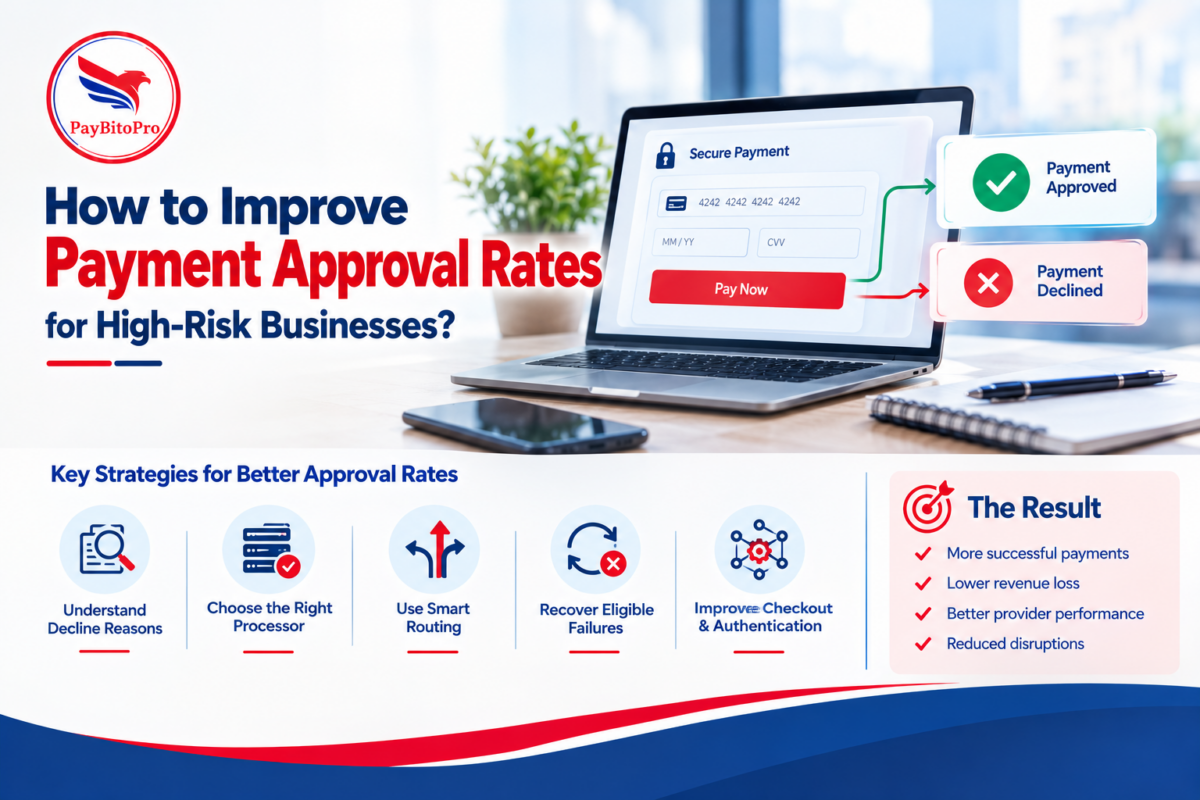
A customer enters their card details, clicks the payment button, and gets a decline. The customer may have enough funds, the card may be valid, and the purchase may be completely legitimate. Yet the transaction still fails.
For high-risk businesses, this problem can be especially frustrating. Payment providers and acquiring banks may apply stricter risk controls, and approval performance can vary depending on the customer’s location, payment method, issuing bank, and processor.
Improving payment approval rates is not simply about sending more transactions through the system. It means understanding why legitimate payments fail, choosing suitable processing routes, and reducing avoidable friction without weakening fraud controls.
What Is a Payment Approval Rate?
A payment approval rate measures the proportion of submitted payment transactions that are approved. The exact calculation can vary by provider and reporting system, so merchants should understand which transactions are included in their figures.
A low approval rate does not automatically mean the processor is performing badly. Some declines may result from insufficient funds, suspected fraud, expired cards, or issuer decisions that the merchant cannot directly control.
The real opportunity lies in identifying avoidable failures. A technical outage, an unsuitable processor, or an incorrect routing rule may prevent a legitimate payment from reaching an appropriate processing connection. This is why approval-rate improvement should form part of a broader payment processing optimization strategy for high-risk merchants.
1. Understand Why Payments Are Being Declined
Before changing processors or retrying transactions, examine the reasons behind failed payments.
Start by separating failures into meaningful categories, such as issuer declines, technical errors, authentication problems, suspected fraud, and processor restrictions. Review the available response codes and compare failure patterns across markets, payment methods, and transaction types.
For example, a sudden increase in technical errors may indicate a processor or integration problem. A higher decline rate for one region could point to provider compatibility issues, local payment preferences, or differences in issuer behavior. Understanding why online payments fail and how to fix them gives merchants a more useful starting point than treating every decline as the same problem.
2. Choose the Right Payment Processor
Not every processor is suitable for every business. High-risk merchants may face industry-specific underwriting requirements, restrictions on certain products, or limited support for particular countries and payment methods.
A processor that performs well for one merchant may deliver different results for another because their transaction profiles, customer locations, and risk characteristics differ.
Evaluate providers based on compatibility, reliability, supported payment methods, reporting quality, and approval performance across your actual customer base. Processing fees matter too, but the cheapest provider is not necessarily the most effective option if legitimate transactions regularly fail. Merchants using multiple providers can also compare performance across connections instead of relying on a single processing relationship.
3. Use Payment Routing to Send Transactions More Effectively
Payment routing determines which processor or acquiring connection receives a transaction. Instead of sending every payment through the same provider, merchants can apply rules based on factors such as currency, geography, payment method, provider availability, or historical performance.
For instance, if one processor supports a particular market more effectively, a routing rule may direct suitable transactions there. Another provider can handle transactions better suited to its capabilities.
Effective routing depends on reliable data and carefully designed rules. Simply switching between processors without understanding their strengths will not necessarily improve approvals. For a deeper look at how these decisions work, payment routing for high-risk businesses explains how merchants can structure processing paths around their payment requirements.
4. Recover Eligible Failed Transactions With Payment Cascading
Some transactions fail because of temporary technical problems rather than a definitive rejection from the issuing bank. In those cases, a controlled retry through another suitable processor may recover a payment that would otherwise be lost.
This is where payment cascading can help. When a transaction fails, the system evaluates the failure reason and, if the transaction is eligible, attempts another processing route under predefined rules.
However, not every decline should trigger another attempt. Hard declines, suspected fraud, and other issuer decisions may require a different response. Merchants should also check the status of timed-out transactions before retrying to avoid duplicate charges. The practical value of payment cascading for recovering failed transactions comes from applying the right recovery action to the right failure.
5. Improve Checkout and Authentication
Payment processing does not begin and end with the processor. Customers can abandon or fail checkout because of confusing instructions, slow pages, poorly handled authentication, or unclear error messages.
Authentication also deserves attention. Additional verification may be necessary for certain transactions, but a poorly implemented challenge can interrupt legitimate purchases. Test the complete flow and ensure that customers can recover from interruptions without unnecessarily restarting checkout.
6. Coordinate Payment Providers More Effectively
Managing several processors separately can make it difficult to compare results, maintain integrations, and respond to disruptions. A payment orchestration platform can bring multiple provider connections, routing rules, and reporting functions into a more centralized setup.
Depending on the platform, merchants may be able to monitor performance across providers and adjust routing without maintaining every connection independently.
That coordination can support a more consistent approval strategy, particularly for businesses operating across multiple markets. Still, orchestration does not guarantee better approvals. Its value depends on the quality of the connected providers, the rules being used, and the accuracy of the underlying data.
Businesses evaluating this approach can explore how payment orchestration coordinates payment services.
Practical Steps to Improve Approval Rates
Merchants do not need to overhaul their entire payment setup at once. Start with a focused review and improve the areas causing the most avoidable failures.
- Analyze decline patterns: Compare response codes, regions, payment methods, and processor performance to identify recurring problems.
- Test routing and recovery rules: Measure whether changes improve approvals without increasing costs, duplicate charges, or fraud exposure.
- Monitor results consistently: Track approval rates alongside processing costs, chargebacks, technical failures, and customer complaints.
These checks help distinguish meaningful improvements from changes that simply shift transactions between providers.
How to Measure Improvement
Approval rates should be reviewed over time and segmented by processor, market, payment method, and transaction type where possible. A single overall figure may hide important differences.
Also consider the cost of achieving an approval. A routing change might increase approvals but introduce higher processing fees or additional risk. Similarly, aggressive retries may generate more attempts without recovering many legitimate transactions.
The aim is to improve the number of legitimate payments that succeed while maintaining acceptable fraud, compliance, and operating costs.
Final Thoughts
Improving payment approval rates for high-risk businesses requires more than finding a processor that promises better performance. Merchants need to understand decline reasons, choose compatible providers, configure sensible routing rules, and recover failed transactions only when another attempt is appropriate.
Better checkout experiences and centralized payment monitoring can support that work, but the results should always be measured against both revenue and risk.
The goal is not to approve every transaction. It is to stop losing legitimate payments for reasons the business can prevent or fix.

Categories
- ACH Payments (10)
- adult payment processing (11)
- AI (9)
- Altcoins (10)
- Banking (10)
- Bitcoin (133)
- Bitcoin ETF (11)
- Bitcoin Price (30)
- Blockchain (50)
- Brokering World Hunger Away (16)
- Business (17)
- card payment processing (10)
- CBD (11)
- CBDC (11)
- Chargeback (8)
- coaching business (11)
- COVID-19 (3)
- Crypto ATMs (1)
- Crypto Banking (17)
- Crypto Bill (1)
- Crypto business owner platform (31)
- Crypto Investment (3)
- Crypto Markets (5)
- Crypto Payment (35)
- Crypto Payment Processor (4)
- Crypto Prices (1)
- Crypto Trading (92)
- Cryptocurrency (402)
- Cryptocurrency Exchange (108)
- Data Visualization (2)
- dating platforms (11)
- debt collection payment processing (10)
- Decentralized Finance (7)
- DeFi Payment (9)
- DEX (3)
- Digital Currency (23)
- dropshipping payment processing (12)
- Ethereum (2)
- FAQ (7)
- file sharing payment processing (11)
- Finance (25)
- Financial Equality (4)
- Financial Freedom (8)
- Forex (35)
- hemp (1)
- ICO (2)
- Investment (11)
- IPTV (11)
- Merchant Account (10)
- Mining (3)
- News (66)
- NFTs (2)
- online gambling (11)
- P2P (1)
- Paybito (147)
- PayBitoPro (693)
- PayBitoPro Coin Listing (6)
- PayBitoPro Exchange (2)
- Payment Gateway (48)
- peptide (10)
- Post COVID Digital Transformation (1)
- Press Release (130)
- Privacy & Security (3)
- Real Estate (1)
- Stablecoin (5)
- Technology (15)
- Travel (11)
- Uncategorized (10)
- US Presidential Election (2)
- Utility Coin (1)
- Web3 business (4)
- Web3 Wallets (2)
- White Label Crypto Exchange (8)
Recent Posts
- Payment Gateway vs. Payment Orchestration: What’s the Difference?
- What Is Smart Payment Routing? Strategies to Optimize Payment Performance
- How to Improve Payment Approval Rates for High-Risk Businesses?
- Why Are Online Payments Failing? Common Causes and How to Fix Them
- How to Use Multiple Payment Processors to Reduce Business Disruptions?