ACH Payment Processing Fees: How Much Do ACH Payments Cost?
- August 19, 2026
- Soham Guchait
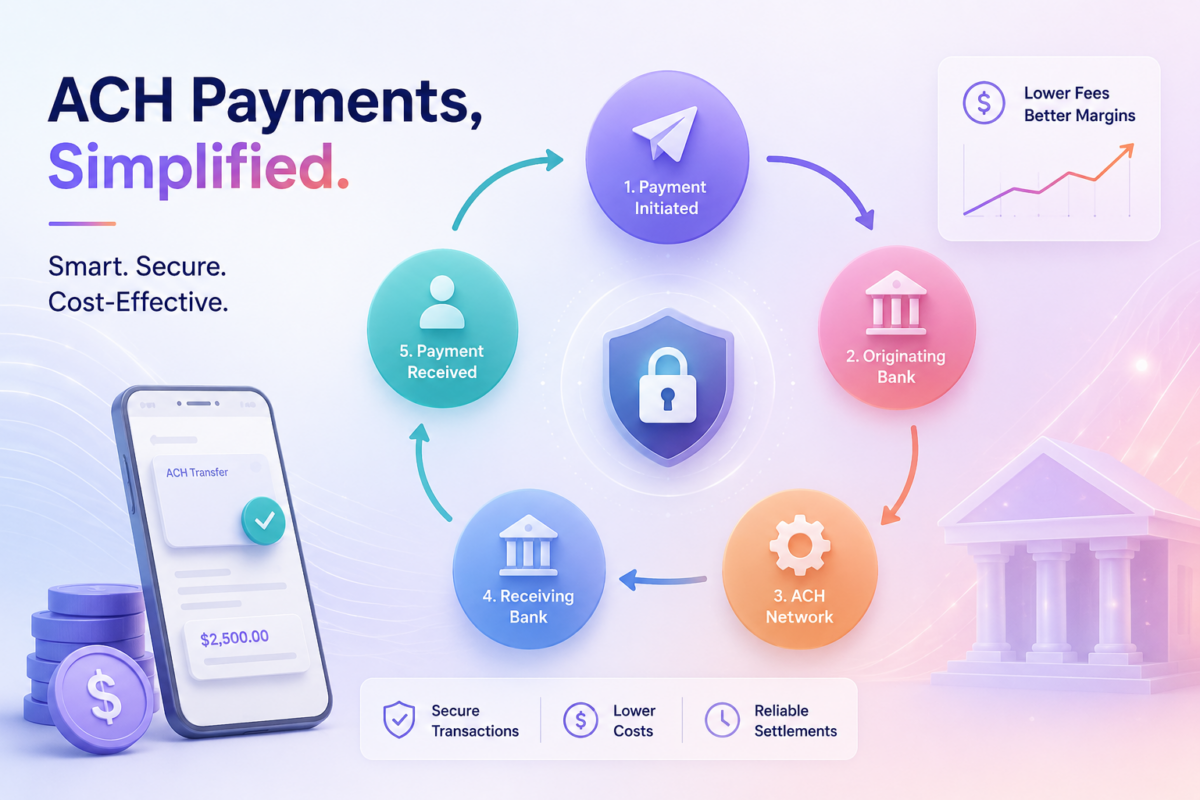
The cost of accepting payments can have a noticeable impact on a business’s margins, particularly when payment volume grows. For businesses considering bank-account payments, one of the most common questions is: How much do ACH payments cost?
There is no single ACH fee that applies to every business. Pricing depends on the payment provider, transaction volume, business model, pricing structure, and the services included in the arrangement.
ACH pricing can involve a simple per-transaction charge, but businesses may also encounter monthly fees, return fees, account-verification charges, or other costs. Understanding the full pricing structure is therefore more useful than comparing one advertised transaction fee.
How Much Do ACH Payments Cost?
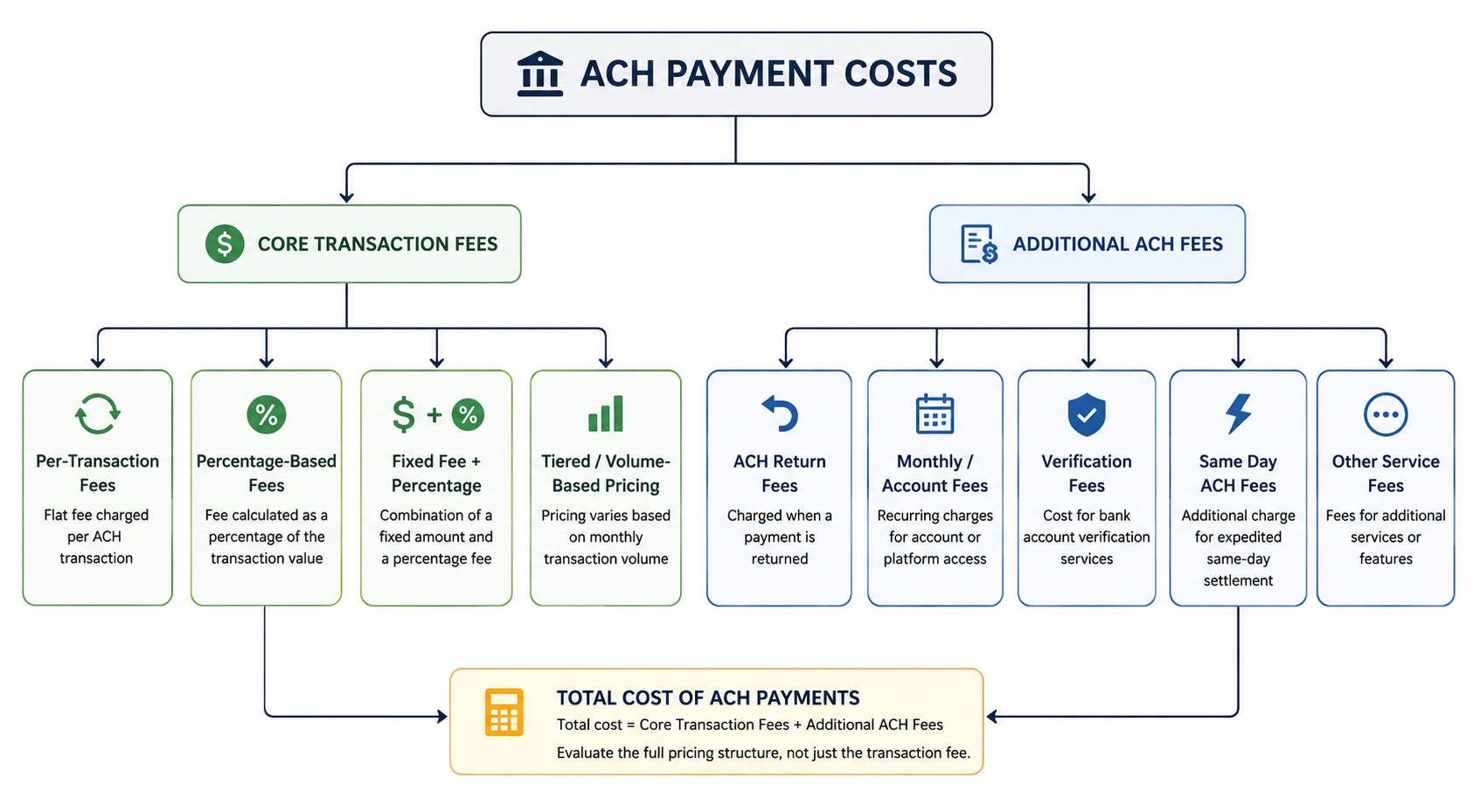
ACH payment costs vary by provider and business arrangement. A business may be charged a flat fee per ACH transaction, a percentage-based fee, a combination of both, or additional fees for specific services. Common ACH-related costs can include:
- Per-transaction processing fees
- Monthly or account fees
- ACH return fees
- Failed-payment or retry-related charges
- Bank-account verification fees
- Same Day ACH charges
- Other service or platform fees
Some businesses may encounter only one or two of these charges, while others may have a more complex pricing structure.
The important question is not simply “What is the ACH transaction fee?” but rather:
What will the total cost of processing ACH payments be for my particular business?
What Is an ACH Processing Fee?
An ACH processing fee is a charge associated with processing an ACH transaction. Depending on the pricing model, the fee may be charged to the business each time it sends or receives an ACH payment.
For example, a provider might charge a hypothetical flat fee for each successful ACH transaction. Another arrangement might use a percentage of the transaction value, while another could combine a percentage with a fixed amount. Because pricing structures differ, businesses should compare the actual fee model rather than assuming all ACH providers charge in the same way.
Common ACH Pricing Models
1. Flat Per-Transaction Pricing
Under a flat-fee model, the business pays a fixed amount for each ACH transaction.
For example, if a hypothetical provider charges $0.50 per ACH transaction, processing 1,000 transactions would result in:
1,000 × $0.50 = $500
This is a hypothetical example, not a statement of universal ACH pricing. Flat pricing can be relatively easy to forecast because the cost is not directly tied to the transaction amount.
2. Percentage-Based Pricing
Some pricing structures calculate the processing charge as a percentage of the transaction value.
For example, under a hypothetical 0.5% fee, a $1,000 transaction would generate a $5 processing charge. However, percentage-based pricing can produce very different costs as transaction values increase. Businesses processing large-value payments should therefore pay close attention to how the percentage is calculated.
3. Fixed Fee Plus Percentage
A pricing structure can combine a fixed amount with a percentage. For example, a hypothetical fee of $0.30 + 0.5% on a $1,000 transaction would be:
- Fixed portion: $0.30
- Percentage portion: $5.00
- Total: $5.30
Again, this is purely a mathematical example. Actual provider pricing varies.
4. Tiered or Volume-Based Pricing
Some businesses may receive pricing based on transaction volume or their broader commercial arrangement.
A business processing a few hundred ACH transactions per month may have different pricing from one processing hundreds of thousands. When comparing quotes, businesses should determine whether the quoted rate applies to their expected volume and whether pricing changes at different transaction levels.
What Other ACH Fees Should Businesses Watch For?
The transaction fee is only one part of the total cost.
ACH Return Fees
An ACH payment can be returned because of insufficient funds, incorrect account information, a closed account, authorization issues, or other reasons.
Some providers may charge a separate fee when a transaction is returned. This matters because businesses with a high return rate can end up paying substantially more than the basic transaction rate suggests. For a better understanding of why transactions are returned, ACH return codes can provide useful context.
Monthly or Account Fees
Some arrangements may include recurring account, platform, or service charges. A business processing a small number of transactions should pay particular attention to fixed monthly costs because they can represent a larger cost per transaction at lower volumes.
Verification Costs
Businesses may use bank-account verification services to confirm account information or ownership before initiating payments. Depending on the setup, verification can involve an additional charge.
Verification may be particularly relevant for businesses accepting large payments or establishing recurring ACH relationships.
Same Day ACH Costs
Same Day ACH can provide faster processing and settlement for eligible transactions, but businesses should check whether their pricing arrangement applies a separate charge for the service.
Faster processing can be valuable in some situations, but it should be evaluated against the actual business requirement rather than treated as necessary for every payment.
Does ACH Cost Less Than Credit Cards?
ACH can be less expensive than card payments for certain businesses, but it is not accurate to say that ACH is always cheaper. Businesses may also compare ACH with other bank-based payment methods, such as wire transfer, when evaluating payment costs. The actual comparison depends on:
- Transaction size
- Transaction volume
- Provider pricing
- Percentage-based versus flat fees
- Monthly charges
- Return rates
- Card processing costs
- Other applicable services
Consider two hypothetical transactions:
Business A collects $25 subscription payments.
Business B collects $5,000 B2B invoices.
A percentage-based payment fee can behave very differently for these two businesses. A flat ACH fee may also have different economic implications depending on transaction size. That is why businesses should compare their effective payment cost, not simply the headline rate.
How to Calculate Your Effective ACH Cost?
A useful way to evaluate ACH pricing is to calculate the total payment-related cost over a specific period. A simplified formula is:
Effective ACH cost = Total ACH-related fees ÷ Total ACH transaction volume
Suppose a hypothetical business processes $500,000 in ACH payments during one month and pays $1,500 in total ACH-related fees. Its effective processing cost would be:
$1,500 ÷ $500,000 = 0.3%
This calculation can be more informative than looking at an individual transaction fee because it accounts for the business’s overall payment activity. For a meaningful comparison, include applicable transaction fees, monthly charges, return fees, and other recurring or usage-based costs.
How Transaction Size Changes the Economics?
The same pricing model can have very different implications depending on payment size. Imagine two businesses under a hypothetical flat $1 ACH transaction fee.
- Business A processes $20 payments.
- Business B processes $2,000 payments.
Both pay $1, but that represents:
- 5% of the $20 payment
- 0.05% of the $2,000 payment
This does not mean the second business will necessarily have a lower total processing cost under every pricing arrangement. It simply demonstrates why transaction size matters when evaluating payment fees.
Businesses should examine their own average transaction value and payment distribution rather than relying on a generic estimate.
What Makes ACH More Expensive Than Expected?
A business may underestimate ACH costs by focusing only on the advertised transaction fee. Several factors can increase the actual cost:
- High payment-return rates
- Low transaction volume combined with monthly fees
- Additional verification services
- Fraud prevention and risk-management measures
- Faster-processing requirements
- Multiple payment-related services
- Manual handling of failed payments
- Reconciliation and administrative work
The last point is easy to overlook. A payment method has an operational cost as well as a direct processing cost. If finance staff spend significant time identifying returned transactions, contacting customers, correcting account information, and reconciling payments, those activities also consume business resources.
How Can Businesses Keep ACH Costs Under Control?
Businesses cannot eliminate every ACH-related expense, but they can improve the economics of their payment process. Useful practices include:
- Compare total pricing rather than the headline transaction fee.
- Review return rates regularly.
- Keep customer account information accurate.
- Use account verification where it makes financial sense.
- Automate reconciliation when transaction volume justifies it.
- Understand any monthly minimums or fixed charges.
- Compare pricing against the business’s average transaction value.
- Review whether faster ACH processing is actually necessary.
Reducing avoidable payment returns can be particularly useful because a returned transaction can create both a direct fee and additional administrative work.
ACH Costs and Payment Timing
Cost is not the only factor businesses should consider.
A business may prefer a payment method because of its processing speed, recurring-payment capabilities, customer familiarity, or operational requirements.
ACH timing can vary depending on submission schedules, processing windows, banking days, transaction type, and Same Day ACH eligibility. This matters when comparing payment methods because a slightly lower processing cost may not compensate for a timing requirement that the payment method cannot satisfy.
Frequently Asked Questions
How much does an ACH transaction cost?
There is no universal ACH transaction fee. Pricing can vary based on the provider, transaction volume, pricing model, business type, and additional services.
Are ACH fees usually a flat fee or percentage?
Either is possible. Some pricing models use a flat per-transaction fee, while others use a percentage or combine a fixed fee with a percentage.
Are ACH payments cheaper than credit cards?
They can be for certain businesses, particularly depending on transaction size and pricing arrangements. However, businesses should compare their actual total costs rather than assuming ACH is always cheaper.
Do ACH payments have hidden fees?
Businesses may encounter costs beyond the basic transaction charge, such as return fees, monthly fees, verification charges, or other service costs. These should be reviewed before selecting a payment arrangement.
Do businesses pay for ACH returns?
Some payment arrangements charge a fee for returned ACH transactions. The applicable amount and structure depend on the provider and agreement.
How can a business calculate its ACH processing cost?
Add the applicable ACH-related fees for a specific period and divide that amount by the total ACH payment volume processed during the same period. This gives an effective processing-cost percentage.
Conclusion
The cost of ACH payments depends less on a single advertised fee and more on the complete pricing structure behind the payment arrangement.
Transaction charges, monthly fees, returns, verification, faster-processing options, and administrative work can all contribute to the total cost. A business processing small recurring payments may have very different economics from one collecting large B2B invoices.
The most reliable approach is to model ACH costs using your actual transaction volume, average payment size, expected return rate, and required services. That provides a much clearer picture of what accepting ACH will cost than comparing headline rates alone.

Categories
- ACH Payments (10)
- adult payment processing (11)
- AI (9)
- Altcoins (10)
- Banking (10)
- Bitcoin (133)
- Bitcoin ETF (11)
- Bitcoin Price (30)
- Blockchain (50)
- Brokering World Hunger Away (16)
- Business (17)
- card payment processing (10)
- CBD (11)
- CBDC (11)
- Chargeback (8)
- coaching business (11)
- COVID-19 (3)
- Crypto ATMs (1)
- Crypto Banking (17)
- Crypto Bill (1)
- Crypto business owner platform (31)
- Crypto Investment (3)
- Crypto Markets (5)
- Crypto Payment (35)
- Crypto Payment Processor (4)
- Crypto Prices (1)
- Crypto Trading (92)
- Cryptocurrency (402)
- Cryptocurrency Exchange (108)
- Data Visualization (2)
- dating platforms (11)
- debt collection payment processing (10)
- Decentralized Finance (7)
- DeFi Payment (9)
- DEX (3)
- Digital Currency (23)
- dropshipping payment processing (12)
- Ethereum (2)
- FAQ (7)
- file sharing payment processing (11)
- Finance (25)
- Financial Equality (4)
- Financial Freedom (8)
- Forex (35)
- hemp (1)
- ICO (2)
- Investment (11)
- IPTV (11)
- Merchant Account (10)
- Mining (3)
- News (66)
- NFTs (2)
- online gambling (11)
- P2P (1)
- Paybito (147)
- PayBitoPro (693)
- PayBitoPro Coin Listing (6)
- PayBitoPro Exchange (2)
- Payment Gateway (48)
- peptide (10)
- Post COVID Digital Transformation (1)
- Press Release (130)
- Privacy & Security (3)
- Real Estate (1)
- Stablecoin (5)
- Technology (15)
- Travel (11)
- Uncategorized (10)
- US Presidential Election (2)
- Utility Coin (1)
- Web3 business (4)
- Web3 Wallets (2)
- White Label Crypto Exchange (8)
Recent Posts
- Payment Gateway vs. Payment Orchestration: What’s the Difference?
- What Is Smart Payment Routing? Strategies to Optimize Payment Performance
- How to Improve Payment Approval Rates for High-Risk Businesses?
- Why Are Online Payments Failing? Common Causes and How to Fix Them
- How to Use Multiple Payment Processors to Reduce Business Disruptions?