ACH Return Codes: Reasons & What They Mean
- August 19, 2026
- Soham Guchait
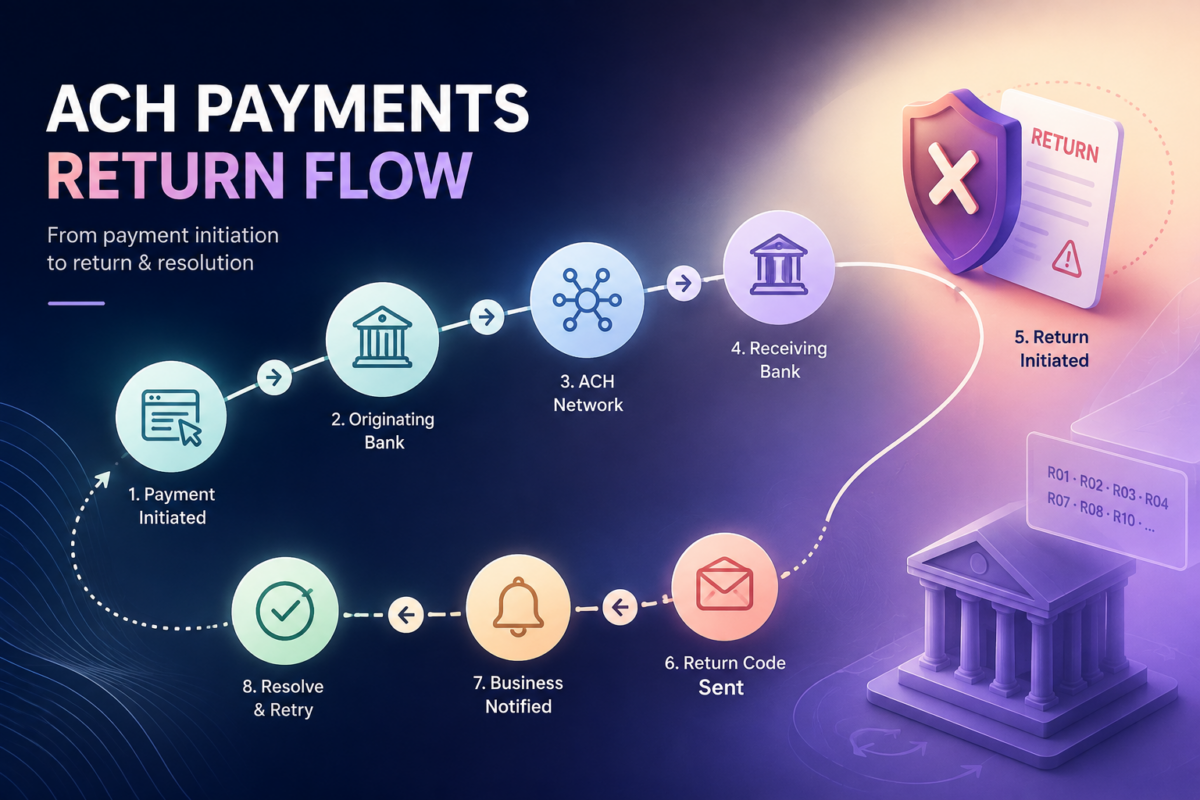
An ACH payment can be submitted correctly and still fail to reach its intended destination. When that happens, the transaction may be returned through the ACH network, and the return code provides information about why it could not be completed.
For businesses that accept recurring payments, customer invoices, or other bank-account payments, understanding ACH return codes is important. A returned payment can affect cash flow, customer accounts, collections, reconciliation, and future payment attempts. The good news is that an ACH return is not simply a generic “payment failed” message. The return code identifies the reason for the failure and helps determine what the business should do next.
What Is an ACH Return?
An ACH return occurs when a previously submitted ACH transaction cannot be completed and is sent back through the ACH network with a standardized reason code. The receiving financial institution, known as the RDFI, generally initiates the return when it cannot process the transaction as instructed. Common causes include:
- Insufficient funds
- Invalid or incorrect account information
- Closed bank account
- Unauthorized transaction
- Account restrictions
- Stop-payment instructions
- Other conditions defined under ACH rules
The specific reason matters because different ACH returns require different responses.
For example, a payment returned because an account has insufficient funds presents a different situation from one returned because the account number is invalid.
What Are ACH Return Codes?
ACH return codes are standardized codes used to identify why an ACH transaction was returned.
The codes begin with the letter R, followed by a number. Each code corresponds to a particular return reason. For businesses, the code is more useful than simply knowing that a transaction failed. It helps determine whether the business should correct account information, contact the customer, review authorization, or take another action.
Here are some of the most commonly encountered ACH return codes.
Common ACH Return Codes Explained
R01 — Insufficient Funds
R01 means the available balance in the customer’s account was insufficient to cover the transaction.
This is one of the most familiar ACH return reasons.
For example, imagine a customer has authorized a $250 monthly subscription payment, but only $100 is available when the debit is processed. The transaction may be returned with R01.
The business may need to contact the customer or follow its established process for handling the unpaid amount. An insufficient-funds return does not necessarily mean the customer’s account information was wrong. The account can be valid while simply lacking enough available funds at the time of processing.
R02 — Account Closed
R02 indicates that the account identified in the ACH transaction has been closed.
For example, a customer may have changed banks but forgotten to update their payment information for a recurring subscription. Repeated attempts against a closed account are unlikely to solve the problem. The business generally needs updated account information from the customer.
R03 — No Account / Unable to Locate Account
R03 indicates that the receiving institution cannot locate the account identified in the transaction.
This can happen because the account information supplied to the business was incorrect or no longer corresponds to an active account. A business receiving R03 should investigate the account information rather than treating it the same way as an insufficient-funds return.
R04 — Invalid Account Number
R04 indicates that the account number structure is invalid or does not meet the receiving institution’s requirements.
This can result from incorrect information being entered or transmitted. For businesses accepting ACH payments, accurate collection and validation of bank-account information can help reduce these types of failures.
R07 — Authorization Revoked by Customer
R07 indicates that the customer has revoked authorization for the ACH debit.
This is particularly relevant to businesses collecting recurring payments.
Suppose a customer previously authorized a monthly membership debit but later revokes that authorization. A subsequent transaction may be returned with R07. The business should not simply assume that another attempt will resolve the issue. The authorization status needs to be addressed.
R08 — Payment Stopped
R08 indicates that payment was stopped.
This can occur when a customer has instructed their financial institution to stop payment on the transaction. The business may need to contact the customer to understand the situation and determine how the outstanding payment should be handled.
R10 — Customer Advises Unauthorized, Improper, Ineligible, or Part of an Incomplete Transaction
R10 is associated with a customer-advised unauthorized or otherwise improper transaction in applicable consumer debit situations.
This type of return deserves particular attention because it can indicate a problem with authorization or the customer’s understanding of the transaction. Businesses should investigate the underlying payment authorization and their records rather than simply attempting the transaction again.
Why Do ACH Payments Get Returned?
While individual return codes provide specific explanations, the underlying causes generally fall into a few broad categories.
1. Insufficient Funds
The account exists and may be valid, but there is not enough available money to complete the payment.
2. Incorrect Account Information
A routing number or account number may have been entered incorrectly or may no longer correspond to the intended account.
3. Closed or Unavailable Accounts
Customers and businesses change bank accounts. If old account details remain in a payment system, transactions may be returned.
4. Authorization Problems
An ACH debit may be returned when the customer disputes its authorization or revokes permission for the payment.
5. Payment Restrictions
A financial institution may return a transaction because of a stop-payment instruction or another restriction applicable to the account.
Understanding the specific return reason is therefore more useful than treating every failed ACH transaction as the same problem.
What Should a Business Do When an ACH Payment Is Returned?
The correct response depends on the return code.
- Identify the return code.
- Determine why the transaction was returned.
- Check the customer’s account and payment history.
- Review authorization records when relevant.
- Contact the customer when updated information or clarification is required.
- Correct the underlying issue before initiating another transaction.
- Reconcile the returned transaction in the accounting system.
The most important step is not necessarily contacting the customer immediately. First, understand why the payment failed.
For example, contacting a customer to provide new bank details makes sense when the account is closed. It would not address the underlying issue in the same way if the customer had explicitly revoked authorization.
Can a Business Retry a Returned ACH Payment?
Sometimes, businesses should not assume that every returned ACH transaction can simply be resubmitted whenever they choose. The appropriate handling can depend on the return reason, transaction type, applicable ACH rules, and authorization circumstances.
For example:
- An insufficient-funds return may call for a different response from an unauthorized-debit return.
- A closed account generally requires updated account information.
- An authorization-related return may require resolving the authorization issue before another debit is attempted.
Businesses should therefore build return handling around the reason code instead of creating a single automatic “retry everything” process.
How ACH Returns Affect Businesses?
Returned payments create more than a payment failure. They can affect:
Cash Flow
An expected payment may not arrive as anticipated, which can create short-term cash-flow issues.
Customer Accounts
A returned subscription payment may leave an account showing an unpaid balance.
Reconciliation
Finance teams need to reverse or adjust the original payment entry and correctly record the returned transaction.
Collections
Businesses may need to contact customers, request updated information, or use another payment method to collect an outstanding balance.
Operational Workload
At higher transaction volumes, even a relatively small number of returns can create substantial administrative work.
For this reason, ACH return management should be considered part of payment operations rather than an occasional accounting problem.
Example: A Recurring ACH Payment Return
Consider a hypothetical streaming service that collects $40 per month from a customer’s bank account.
The customer’s first several payments succeed. Later, the customer closes that bank account and opens another one but does not update the payment information.
The next $40 ACH debit is returned with an account-related return code. The business now needs to:
- Identify the return reason
- Prevent the failed account from being treated as successfully paid
- Notify the customer if appropriate
- Obtain updated payment information
- Update the customer’s billing record
- Reconcile the returned transaction
Simply retrying the same bank-account information would not solve the underlying problem.
How Can Businesses Reduce ACH Returns?
Not every return can be prevented, but businesses can reduce avoidable failures through better payment operations.
Useful practices include:
- Verify bank-account information during enrollment where appropriate.
- Keep customer payment records up to date.
- Make authorization terms clear.
- Monitor recurring payments for unusual patterns.
- Reconcile transactions regularly.
- Track return codes instead of treating all failures identically.
- Establish different workflows for different return reasons.
- Provide customers with an easy way to update payment information.
Businesses should also monitor return patterns over time. A sudden increase in a particular return code may point to a problem with data collection, account verification, billing practices, or another part of the payment workflow.
ACH Returns vs. ACH Payment Failures
The terms “failed” and “returned” are sometimes used interchangeably, but they can describe different points in the payment process.
A transaction might encounter a problem before it is successfully processed, while an ACH return generally refers to a transaction being returned through the ACH system after submission.
This distinction matters for businesses because the appropriate operational response depends on where the problem occurred and what information is available. A return code gives the business a standardized explanation that can help guide the next action.
Frequently Asked Questions
What is the most common ACH return code?
R01, which indicates insufficient funds, is one of the commonly encountered ACH return reasons. However, return frequency varies by business, transaction type, customer base, and payment process.
What does R01 mean in ACH?
R01 means Insufficient Funds. The receiving account did not have sufficient available funds to cover the ACH transaction.
What does R02 mean in ACH?
R02 means Account Closed. The account identified in the transaction has been closed.
What does R03 mean in ACH?
R03 means No Account / Unable to Locate Account. The receiving financial institution cannot locate the account identified in the transaction.
Can an ACH return be prevented?
Some returns can be reduced through accurate account information, appropriate verification, clear authorization, and effective payment monitoring. However, businesses cannot prevent every possible return.
Should businesses automatically retry ACH returns?
No blanket retry strategy should be applied to every return. The appropriate response depends on the specific return code, transaction circumstances, authorization, and applicable ACH rules.
Conclusion
ACH return codes turn a generic payment failure into a specific operational signal. Instead of simply telling a business that an ACH transaction did not complete, the code helps identify what went wrong and what may need attention.
For businesses, the most useful approach is to connect each return reason with an appropriate response. Insufficient funds, closed accounts, incorrect account information, stopped payments, and authorization issues should not all be handled the same way.
A reliable ACH operation therefore requires more than accepting payments. It also requires monitoring returns, maintaining accurate customer information, preserving authorization records, reconciling transactions, and responding appropriately when payments do not go through.

Categories
- ACH Payments (10)
- adult payment processing (11)
- AI (9)
- Altcoins (10)
- Banking (10)
- Bitcoin (133)
- Bitcoin ETF (11)
- Bitcoin Price (30)
- Blockchain (50)
- Brokering World Hunger Away (16)
- Business (17)
- card payment processing (10)
- CBD (11)
- CBDC (11)
- Chargeback (8)
- coaching business (11)
- COVID-19 (3)
- Crypto ATMs (1)
- Crypto Banking (17)
- Crypto Bill (1)
- Crypto business owner platform (31)
- Crypto Investment (3)
- Crypto Markets (5)
- Crypto Payment (35)
- Crypto Payment Processor (4)
- Crypto Prices (1)
- Crypto Trading (92)
- Cryptocurrency (402)
- Cryptocurrency Exchange (108)
- Data Visualization (2)
- dating platforms (11)
- debt collection payment processing (10)
- Decentralized Finance (7)
- DeFi Payment (9)
- DEX (3)
- Digital Currency (23)
- dropshipping payment processing (12)
- Ethereum (2)
- FAQ (7)
- file sharing payment processing (11)
- Finance (25)
- Financial Equality (4)
- Financial Freedom (8)
- Forex (35)
- hemp (1)
- ICO (2)
- Investment (11)
- IPTV (11)
- Merchant Account (10)
- Mining (3)
- News (66)
- NFTs (2)
- online gambling (11)
- P2P (1)
- Paybito (147)
- PayBitoPro (693)
- PayBitoPro Coin Listing (6)
- PayBitoPro Exchange (2)
- Payment Gateway (48)
- peptide (10)
- Post COVID Digital Transformation (1)
- Press Release (130)
- Privacy & Security (3)
- Real Estate (1)
- Stablecoin (5)
- Technology (15)
- Travel (11)
- Uncategorized (10)
- US Presidential Election (2)
- Utility Coin (1)
- Web3 business (4)
- Web3 Wallets (2)
- White Label Crypto Exchange (8)
Recent Posts
- Payment Gateway vs. Payment Orchestration: What’s the Difference?
- What Is Smart Payment Routing? Strategies to Optimize Payment Performance
- How to Improve Payment Approval Rates for High-Risk Businesses?
- Why Are Online Payments Failing? Common Causes and How to Fix Them
- How to Use Multiple Payment Processors to Reduce Business Disruptions?