Coaching Business Payment Models: How Coaches Structure Payments for Programs, Memberships, and Services?
- August 6, 2026
- Soham Guchait
The way a coaching business charges clients has a direct impact on revenue stability, customer experience, and long-term growth.
A coach selling individual sessions has very different payment requirements compared to a company offering monthly coaching memberships, group programs, or executive coaching packages. As the coaching industry moves from simple one-time consultations toward structured programs and subscription-based communities, businesses need to carefully consider how they collect revenue.
Coaching business payment models define how customers pay for services, whether through upfront packages, installment plans, recurring subscriptions, memberships, or customized agreements. Choosing the right model allows coaching businesses to make services more accessible for clients while creating predictable revenue streams.
Why Payment Models Matter for Coaching Businesses?
Many coaches focus on creating valuable programs but spend less time thinking about how those programs should be priced and paid for.
However, the payment structure affects several important areas of the business:
- How easily customers can commit to a program?
- How predictable is the monthly revenue?
- How do businesses manage cash flow?
- How clients perceive the value of services?
For example, an executive coach offering a six-month leadership transformation program may find that requiring a full upfront payment limits potential customers. Offering a structured payment plan may make the program more accessible while still maintaining predictable revenue.
On the other hand, a fitness coach offering daily accountability and ongoing support may benefit more from a monthly membership model because the service continues beyond a fixed program period.
The right payment model depends on the type of coaching service, target audience, pricing level, and customer relationship.
Common Payment Models Used by Coaching Businesses
Different coaching businesses use different approaches depending on how their services are delivered.
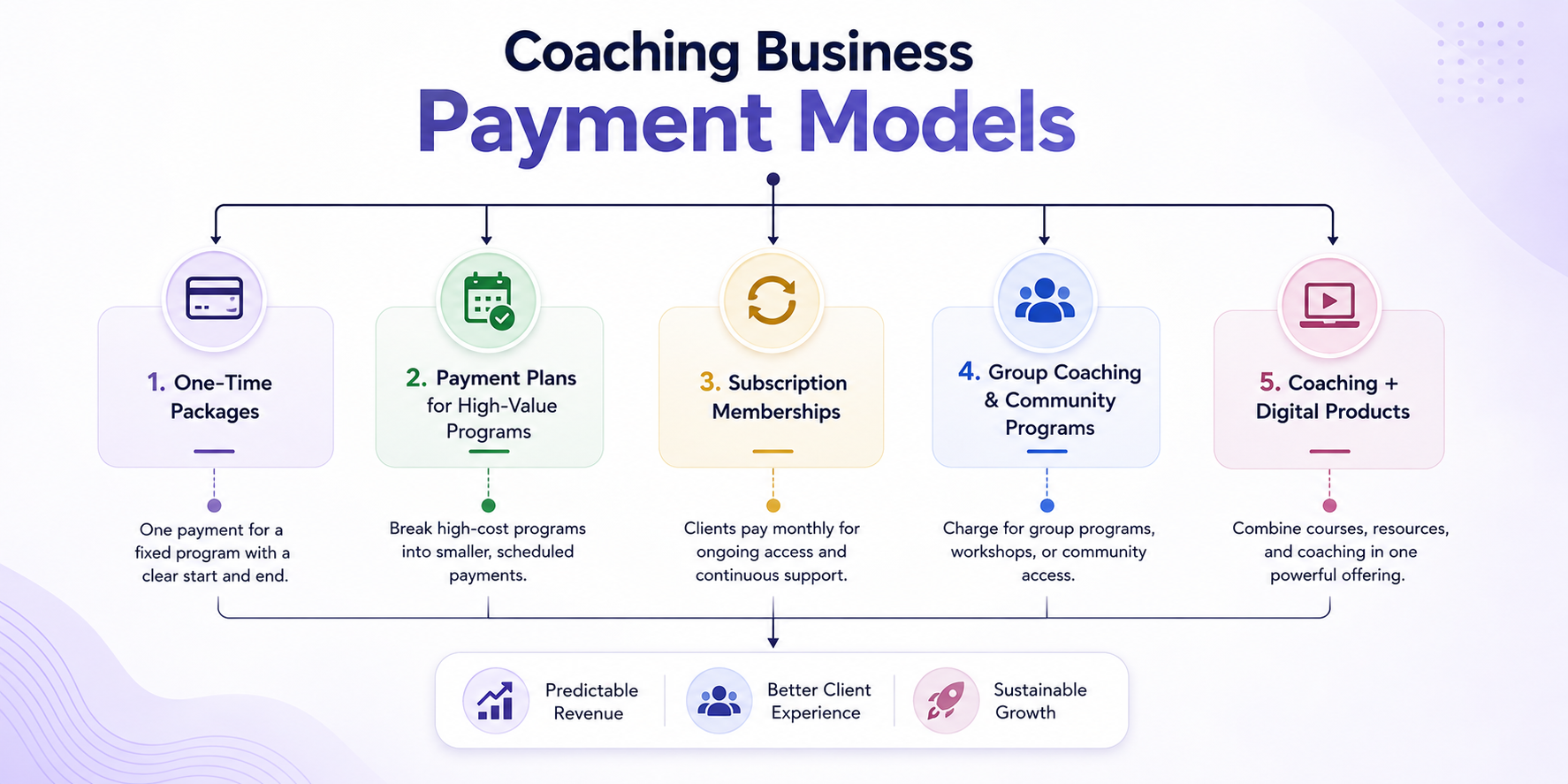
One-Time Coaching Packages
One-time payments are commonly used for fixed-duration coaching programs.
Examples include:
- Six-week career coaching programs
- Twelve-week fitness transformations
- Executive leadership packages
- Business strategy consultations
In this model, the client pays once for a clearly defined service.
For example, a business coach may offer a 90-day growth program that includes weekly sessions, business reviews, and personalized recommendations. The customer pays a fixed amount before the program begins.
This model works well when:
- The service has a clear beginning and end
- The outcome is easy to define
- Clients prefer completing a specific program
However, revenue depends on continuously acquiring new customers because payments are not automatically repeated.
Payment Plans for High-Value Coaching Programs
Many coaching businesses use payment plans when their programs involve higher costs. Instead of asking clients to pay a large amount upfront, businesses divide the total price into smaller scheduled payments.
For example:
A career coach sells a four-month career transition program for $2,000. Instead of collecting the full amount immediately, the business allows the client to pay $500 each month.
Payment plans can improve accessibility because clients may be more comfortable committing to smaller payments. However, businesses need proper systems to manage scheduled payments and ensure future installments are collected successfully. A missed installment can interrupt cash flow and create additional administrative work if payments are tracked manually.
Subscription-Based Coaching Models
Subscription models have become increasingly popular because they create recurring revenue. Instead of selling a single program, businesses provide ongoing access through monthly payments.
Examples include:
- Personal development memberships
- Wellness coaching communities
- Business accountability groups
- Continuous mentorship programs
For example, a wellness coach may create a monthly membership where clients receive weekly coaching calls, personalized guidance, and access to a private community.
The advantage of subscriptions is that they create more predictable revenue compared to constantly selling individual programs. However, subscription businesses must manage recurring billing carefully. Failed renewals, expired payment details, and customer cancellations can affect revenue stability. Businesses planning subscription models should understand how recurring payments work and how successful renewals are maintained.
Group Coaching and Community-Based Payment Models
Group coaching allows businesses to serve multiple clients through a shared program.
This model is common among:
- Business coaches
- Fitness coaches
- Career development coaches
- Online education companies
Instead of charging one customer for individual attention, businesses create structured group experiences.
For example, a marketing coach may run a three-month group program where fifty entrepreneurs receive weekly workshops, community discussions, and coaching sessions. The payment model may include:
- A single upfront program fee
- Monthly payments during the program
- Membership access after completion
This approach allows coaches to increase revenue without increasing individual session hours.
Combining Coaching With Digital Products
Many coaching businesses now combine coaching services with digital products.
Examples include:
- Online courses with coaching calls
- Training libraries with monthly support
- Digital resources with community access
This creates hybrid payment models.
For example, a leadership coach may sell an online management course and include monthly group coaching sessions as part of a premium membership. The payment structure needs to reflect both parts of the offering: the digital product and the ongoing coaching relationship.
Choosing the Right Payment Model for a Coaching Business
There is no single payment model that works for every coaching company.
A new life coach may begin with one-time packages because the business is still building its client base. An established executive coaching company may prefer payment plans because its programs have higher price points. A coaching community may choose subscriptions because its value comes from continuous access.
When selecting a payment model, businesses should consider:
- Service duration
- Customer expectations
- Pricing level
- Revenue goals
- Operational capacity
The payment model should support both the client experience and the business’s ability to deliver consistent value.
How Payment Infrastructure Supports Different Coaching Models?
As coaching businesses grow, the payment model often becomes connected with broader payment operations.
A business offering subscriptions needs reliable recurring billing. A company selling premium programs may require structured payment collection and transaction management. A coaching marketplace connecting multiple coaches with customers may need more advanced payment capabilities.
Understanding payment infrastructure helps businesses create systems that support their chosen revenue model instead of creating unnecessary manual work.
Businesses planning their payment operations should also understand the broader role of payment processing for coaching businesses and how different payment systems support growth.
Final Thoughts
Coaching business payment models are not just about deciding when customers pay. They influence how programs are sold, how revenue is collected, and how businesses scale.
Whether a coach uses one-time packages, payment plans, subscriptions, or community memberships, the payment structure should match the service being delivered and the expectations of the customer.
As coaching businesses evolve, choosing the right payment model becomes an important part of building predictable revenue and creating a smoother client experience.

Categories
- ACH Payments (10)
- adult payment processing (11)
- AI (9)
- Altcoins (10)
- Banking (10)
- Bitcoin (133)
- Bitcoin ETF (11)
- Bitcoin Price (30)
- Blockchain (50)
- Brokering World Hunger Away (16)
- Business (17)
- card payment processing (10)
- CBD (11)
- CBDC (11)
- Chargeback (8)
- coaching business (11)
- COVID-19 (3)
- Crypto ATMs (1)
- Crypto Banking (17)
- Crypto Bill (1)
- Crypto business owner platform (31)
- Crypto Investment (3)
- Crypto Markets (5)
- Crypto Payment (35)
- Crypto Payment Processor (4)
- Crypto Prices (1)
- Crypto Trading (92)
- Cryptocurrency (402)
- Cryptocurrency Exchange (108)
- Data Visualization (2)
- dating platforms (11)
- debt collection payment processing (10)
- Decentralized Finance (7)
- DeFi Payment (9)
- DEX (3)
- Digital Currency (23)
- dropshipping payment processing (12)
- Ethereum (2)
- FAQ (7)
- file sharing payment processing (11)
- Finance (25)
- Financial Equality (4)
- Financial Freedom (8)
- Forex (35)
- hemp (1)
- ICO (2)
- Investment (11)
- IPTV (11)
- Merchant Account (10)
- Mining (3)
- News (66)
- NFTs (2)
- online gambling (11)
- P2P (1)
- Paybito (147)
- PayBitoPro (693)
- PayBitoPro Coin Listing (6)
- PayBitoPro Exchange (2)
- Payment Gateway (48)
- peptide (10)
- Post COVID Digital Transformation (1)
- Press Release (130)
- Privacy & Security (3)
- Real Estate (1)
- Stablecoin (5)
- Technology (15)
- Travel (11)
- Uncategorized (10)
- US Presidential Election (2)
- Utility Coin (1)
- Web3 business (4)
- Web3 Wallets (2)
- White Label Crypto Exchange (8)
Recent Posts
- Payment Gateway vs. Payment Orchestration: What’s the Difference?
- What Is Smart Payment Routing? Strategies to Optimize Payment Performance
- How to Improve Payment Approval Rates for High-Risk Businesses?
- Why Are Online Payments Failing? Common Causes and How to Fix Them
- How to Use Multiple Payment Processors to Reduce Business Disruptions?