Fraud Prevention for Coaching Businesses: How to Protect Online Payments and Client Transactions?
- August 6, 2026
- Soham Guchait

As coaching businesses expand online, they become more accessible to legitimate clients – and unfortunately, to fraudsters as well. Whether a business offers one-on-one coaching, group programs, memberships, or digital coaching products, every online payment carries a certain level of risk.
Many coaching business owners assume fraud is only a concern for large eCommerce companies. In reality, online coaching businesses can also become targets for stolen payment cards, fake customer accounts, account takeovers, and refund abuse.
Fraud not only results in financial losses but can also damage customer trust, increase operational costs, and disrupt day-to-day business operations. Understanding how fraud occurs and implementing preventive measures helps coaching businesses create safer payment experiences while supporting sustainable growth.
Why Are Online Coaching Businesses Vulnerable to Payment Fraud?
Unlike physical businesses, coaching services are usually purchased and delivered online. Clients often complete payments without meeting the coach in person, making identity verification more difficult.
The growing popularity of virtual coaching has also increased the number of high-value digital transactions. Executive coaching programs, business mentorships, and wellness memberships frequently involve payments ranging from hundreds to several thousand dollars, making them attractive targets for fraudulent activity.
Consider a business coach offering a six-month coaching program for $4,000. A fraudster uses stolen card information to purchase the program. The payment appears successful initially, but days later the legitimate cardholder disputes the transaction, leaving the coaching business with financial losses and administrative work.
Situations like this highlight why fraud prevention should be part of every coaching business’s payment strategy.
Common Types of Fraud Affecting Coaching Businesses
Fraud can occur in different forms depending on how coaching services are sold.
Stolen Card Transactions
One of the most common payment risks involves stolen credit or debit card information. Fraudsters use compromised card details to purchase coaching programs before the cardholder notices unauthorized activity.
For example, a leadership coaching company receives payment for a premium package from a first-time client. A week later, the payment is reversed because the actual card owner reports unauthorized use.
Although the business may have already started delivering services, recovering those losses can be difficult.
Fake Client Accounts
Some individuals create fake customer accounts using false identities to gain access to coaching resources or promotional offers. This may involve:
- Temporary email addresses
- False personal information
- Disposable phone numbers
- Automated account creation
While not every fake account results in payment fraud, these accounts can create unnecessary operational costs and increase security risks.
Account Takeovers
Businesses offering membership portals or coaching communities may face account takeover attempts. In these situations, attackers gain unauthorized access to legitimate customer accounts through stolen passwords or compromised login credentials.
For example, a wellness coaching platform with hundreds of active members may discover that several customer accounts have been accessed from unfamiliar locations.
Once inside an account, attackers may change payment information, access premium content, or misuse customer data. Protecting customer accounts is therefore an important part of payment security.
How Fraud Differs From Chargebacks?
Fraud and chargebacks are often discussed together, but they are not the same. Fraud involves unauthorized or deceptive activity intended to obtain services or payments illegally. Chargebacks, on the other hand, often occur after a legitimate customer disputes a completed transaction with their card issuer.
For example:
A stolen credit card used to purchase coaching services is a fraud case. A customer who attended coaching sessions but later disputes the payment because they were dissatisfied is generally a chargeback issue. Understanding this difference helps businesses develop appropriate prevention strategies for each situation.
Practical Ways to Reduce Fraud Risk
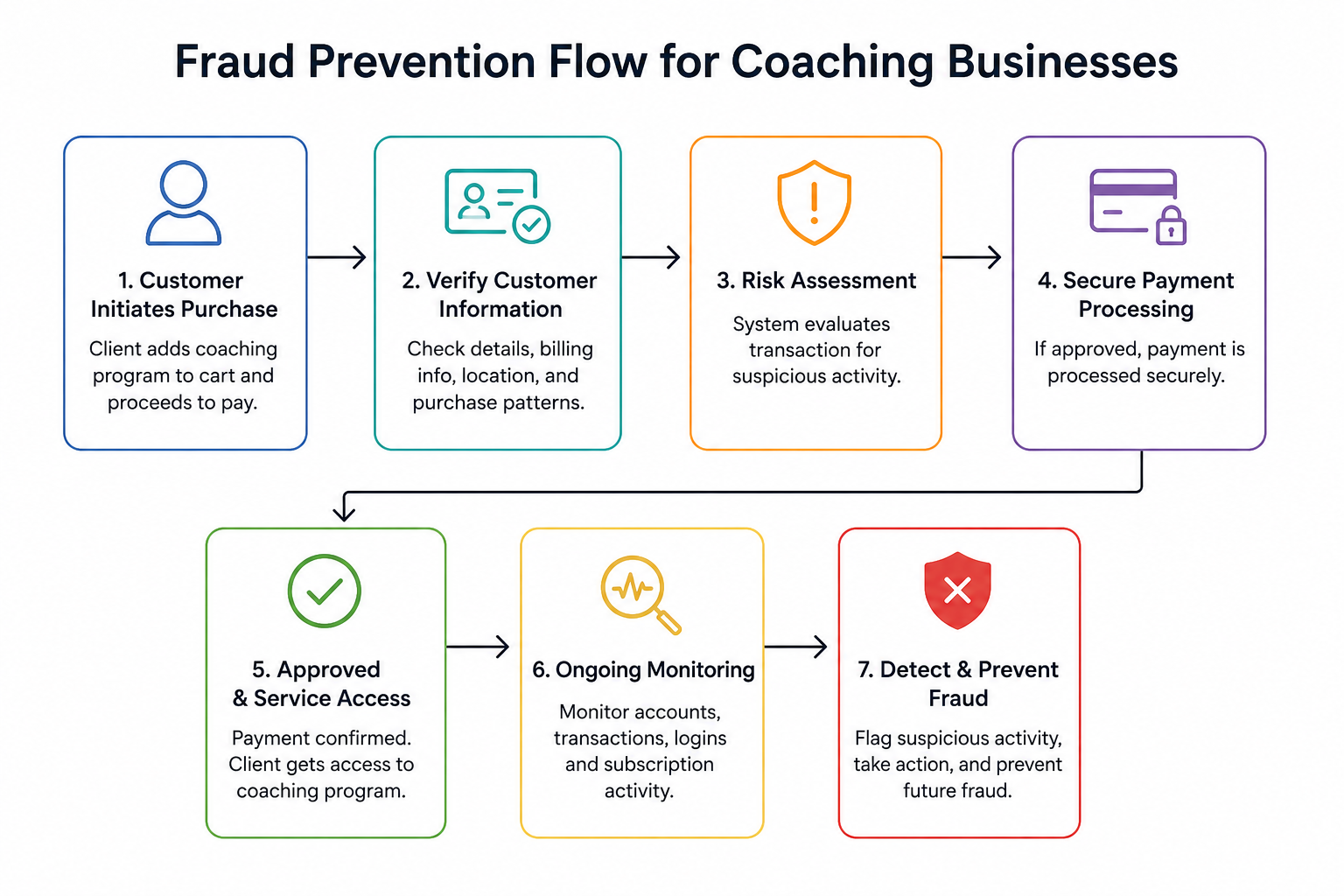
Fraud prevention is most effective when businesses combine technology with good operational practices. Several measures can significantly reduce payment risks.
Verify Customer Information
Businesses should review customer information when unusual transactions occur.
For example, warning signs may include:
- Very high-value purchases from first-time clients
- Multiple payment attempts within a short period
- Mismatched billing information
- Purchases from unfamiliar regions
- Several accounts created from the same device
Reviewing unusual activity before delivering services can prevent avoidable losses. For businesses processing higher-value coaching transactions, maintaining accurate customer and transaction records through a reliable merchant account for coaching businesses can also support better payment monitoring and risk management.
Secure Customer Accounts
Membership-based coaching businesses should encourage strong account security.
Useful practices include:
- Strong password requirements
- Multi-factor authentication where available
- Login notifications
- Monitoring unusual account activity
For example, if a customer’s account suddenly logs in from another country immediately after a password change, the business should investigate before allowing further account activity.
Monitor Transaction Patterns
Fraud rarely appears completely random. Businesses should regularly review transaction activity to identify unusual behavior.
Examples include:
- Repeated payment failures from the same customer
- Multiple purchases using different cards
- Unexpected spikes in expensive program purchases
- Numerous refund requests from new accounts
Recognizing patterns early allows businesses to respond before losses increase.
Building Trust Without Creating Friction
Fraud prevention should never make legitimate customers feel that purchasing coaching services is difficult. The goal is to identify suspicious activity without creating unnecessary obstacles during checkout.
For example, a business coach selling leadership programs may request additional verification only for unusually large international purchases rather than applying extra steps to every client.
Balancing security with customer convenience helps businesses maintain positive user experiences while reducing fraud risks.
Fraud Prevention for Membership and Subscription Coaching
Subscription-based coaching businesses face additional challenges because payments continue over time. A fraudster who successfully creates an account may continue accessing premium content until suspicious activity is detected.
Businesses offering memberships should regularly monitor:
- Account activity
- Subscription changes
- Payment updates
- Login locations
- Billing history
Monitoring recurring accounts helps identify suspicious behavior before it becomes a larger problem.
Subscription businesses should also understand how recurring payment management and payment failures influence long-term revenue protection.
How Payment Infrastructure Supports Fraud Prevention?
As coaching businesses grow, fraud prevention becomes part of broader payment operations. Reliable payment infrastructure helps businesses monitor transactions, identify unusual activity, and maintain secure payment environments.
Businesses expanding internationally or managing higher transaction volumes should regularly review their payment processes to ensure they support both customer convenience and transaction security. Payment security should not be viewed as a one-time setup but as an ongoing operational process that evolves alongside the business.
Final Thoughts
Fraud prevention for coaching businesses is about protecting both revenue and client trust.
As more coaching services move online, businesses must understand how fraudulent transactions occur, recognize warning signs, and establish practical safeguards without creating unnecessary barriers for legitimate customers.
By combining customer verification, secure account management, transaction monitoring, and clear operational processes, coaching businesses can reduce payment risks while delivering a safer and more reliable experience for every client. Businesses that treat fraud prevention as an ongoing part of payment management are better prepared to support long-term growth in an increasingly digital coaching industry.

Categories
- ACH Payments (10)
- adult payment processing (11)
- AI (9)
- Altcoins (10)
- Banking (10)
- Bitcoin (133)
- Bitcoin ETF (11)
- Bitcoin Price (30)
- Blockchain (50)
- Brokering World Hunger Away (16)
- Business (17)
- card payment processing (10)
- CBD (11)
- CBDC (11)
- Chargeback (8)
- coaching business (11)
- COVID-19 (3)
- Crypto ATMs (1)
- Crypto Banking (17)
- Crypto Bill (1)
- Crypto business owner platform (31)
- Crypto Investment (3)
- Crypto Markets (5)
- Crypto Payment (35)
- Crypto Payment Processor (4)
- Crypto Prices (1)
- Crypto Trading (92)
- Cryptocurrency (402)
- Cryptocurrency Exchange (108)
- Data Visualization (2)
- dating platforms (11)
- debt collection payment processing (10)
- Decentralized Finance (7)
- DeFi Payment (9)
- DEX (3)
- Digital Currency (23)
- dropshipping payment processing (12)
- Ethereum (2)
- FAQ (7)
- file sharing payment processing (11)
- Finance (25)
- Financial Equality (4)
- Financial Freedom (8)
- Forex (35)
- hemp (1)
- ICO (2)
- Investment (11)
- IPTV (11)
- Merchant Account (10)
- Mining (3)
- News (66)
- NFTs (2)
- online gambling (11)
- P2P (1)
- Paybito (147)
- PayBitoPro (693)
- PayBitoPro Coin Listing (6)
- PayBitoPro Exchange (2)
- Payment Gateway (48)
- peptide (10)
- Post COVID Digital Transformation (1)
- Press Release (130)
- Privacy & Security (3)
- Real Estate (1)
- Stablecoin (5)
- Technology (15)
- Travel (11)
- Uncategorized (10)
- US Presidential Election (2)
- Utility Coin (1)
- Web3 business (4)
- Web3 Wallets (2)
- White Label Crypto Exchange (8)
Recent Posts
- Payment Gateway vs. Payment Orchestration: What’s the Difference?
- What Is Smart Payment Routing? Strategies to Optimize Payment Performance
- How to Improve Payment Approval Rates for High-Risk Businesses?
- Why Are Online Payments Failing? Common Causes and How to Fix Them
- How to Use Multiple Payment Processors to Reduce Business Disruptions?