Chargeback Prevention for Coaching Businesses: How to Reduce Payment Disputes and Protect Revenue?
- August 6, 2026
- Soham Guchait
For coaching businesses, a successful payment does not always mean the transaction is complete. Weeks or even months after a client purchases a coaching program, the payment may be reversed through a chargeback.
Unlike a standard refund request, a chargeback involves the customer’s card issuer reviewing the transaction after the customer disputes it. If the dispute is resolved in the customer’s favor, the business loses the revenue and may also incur additional processing fees.
Chargebacks can affect coaching businesses of every size, from independent life coaches to large coaching platforms. Since coaching services are delivered digitally and often rely on conversations, mentorship, and long-term relationships rather than physical products, proving that a service was delivered can be more challenging. Understanding why chargebacks happen and how to prevent them helps coaching businesses protect revenue while maintaining a better client experience.
What Is a Chargeback?
A chargeback occurs when a customer asks their card issuer to reverse a completed payment instead of requesting a refund directly from the business.
Chargebacks were originally introduced to protect consumers from unauthorized transactions and fraud. However, they are also used when customers believe they did not receive the service they expected or when they do not recognize a charge on their statement.
For example, a client purchases a twelve-week executive coaching program. After attending several sessions, they dispute the transaction with their card issuer, claiming they never received the promised service. Even if the coach delivered every scheduled session, the business must provide evidence that the service was completed. This is one reason digital service businesses need strong documentation and clear payment processes.
Why Coaching Businesses Experience Chargebacks?
Most coaching chargebacks are not caused by stolen cards. They usually result from misunderstandings, unclear expectations, or communication problems. Several situations commonly lead to disputes.
Unclear Service Expectations
Many coaching programs are outcome – driven rather than product-driven.
A business coach may promise strategic guidance, while a fitness coach provides accountability and personalized support. The final results depend on both the coach and the client’s participation. If customers expect guaranteed outcomes rather than professional guidance, disappointment may lead to payment disputes.
For example, a career coach may help improve interview skills and resumes, but cannot guarantee that every client will immediately receive a job offer. Clearly explaining what clients are purchasing helps reduce unrealistic expectations.
Subscription Misunderstandings
Membership-based coaching businesses frequently experience disputes when customers forget recurring payments. A client may join a monthly coaching community, stop participating after several months, and later dispute a renewal because they forgot the subscription remained active.
These disputes are often connected to the way coaching services are structured and billed. Whether a business uses one-time coaching packages, installment plans, memberships, or subscription-based programs, clearly explaining the payment model before purchase helps customers understand their financial commitment and reduces future disputes. Businesses can learn more about different payment models for coaching businesses and how they impact customer billing experiences.
These situations often occur because billing terms were not communicated clearly during signup. Businesses should ensure clients understand:
- Billing frequency
- Renewal dates
- Cancellation procedures
- Membership benefits
- Refund policies
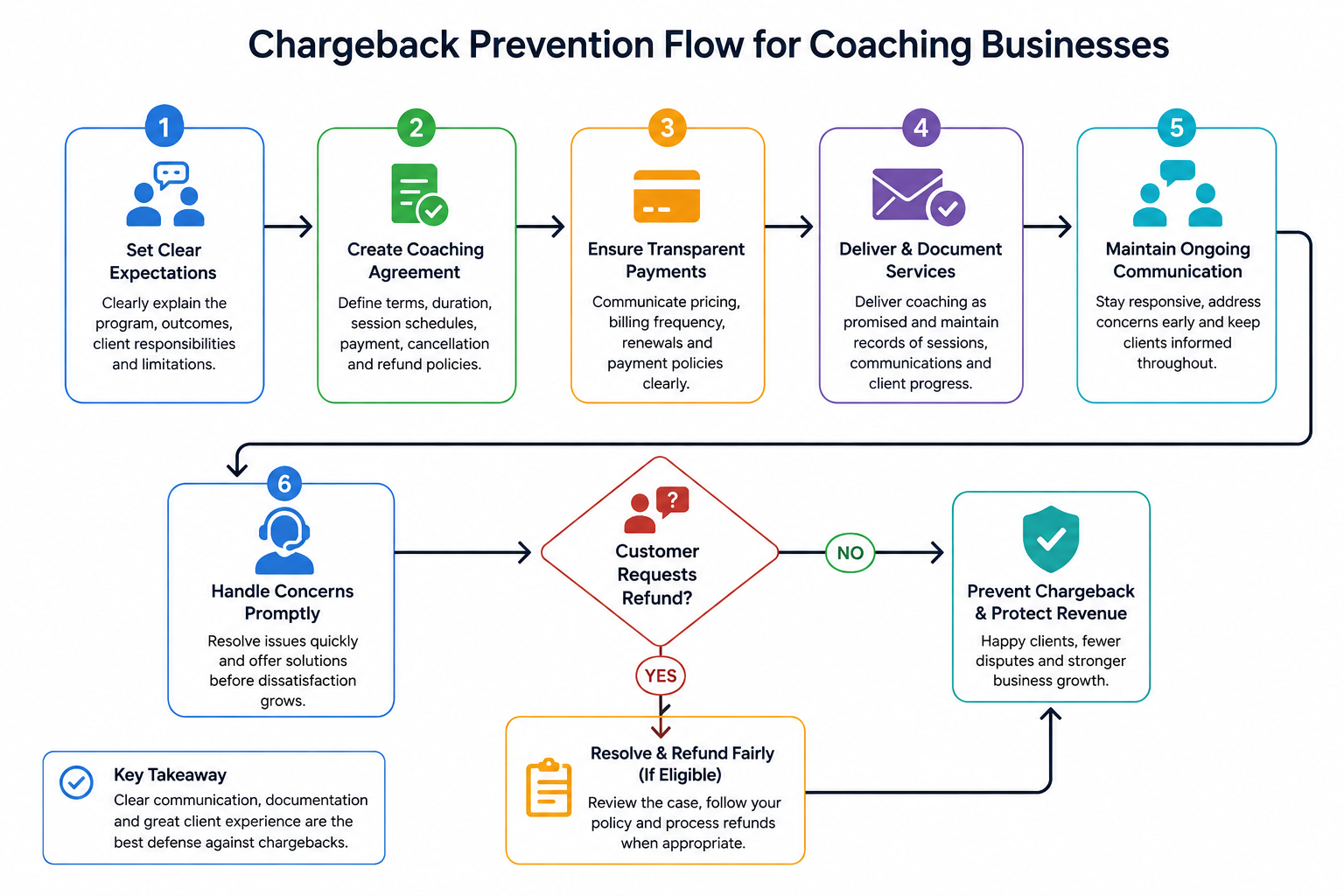
Clear communication before payment is one of the simplest ways to reduce future disputes.
Communication Breakdowns
Clients are more likely to initiate chargebacks when they cannot easily resolve issues with the business.
For example, a relationship coaching platform delays responding to customer support requests after several coaching sessions are canceled due to scheduling conflicts. Unable to resolve the issue directly, the customer contacts their bank instead. Many chargebacks can be prevented simply by maintaining responsive customer communication throughout the coaching relationship.
Creating Clear Coaching Agreements
A coaching agreement establishes shared expectations before services begin. Instead of focusing only on pricing, businesses should explain how the coaching relationship works.
Important topics include:
- Program duration
- Session schedules
- Client responsibilities
- Payment terms
- Cancellation policies
- Refund conditions
For example, a leadership coach selling a six-month mentoring program should explain whether missed sessions can be rescheduled, how installment payments work, and what happens if a client leaves the program early.
Well-defined agreements reduce confusion because clients understand exactly what they are purchasing.
Documenting Service Delivery
One challenge unique to coaching businesses is proving that services were delivered. Unlike physical products, coaching sessions leave little visible evidence unless businesses maintain proper records.
Useful documentation may include:
- Coaching session schedules
- Attendance records
- Meeting confirmations
- Email communications
- Signed coaching agreements
- Client onboarding records
- Progress reports
- Coaching resource delivery
Imagine a business coach conducting weekly virtual sessions for three months. If a dispute occurs, records showing scheduled meetings, attendance, shared materials, and follow-up communications help demonstrate that the coaching program was delivered as agreed.
Good documentation supports both operational management and dispute resolution.
Setting Accurate Customer Expectations
Many payment disputes begin long before the payment itself. Marketing messages, sales conversations, and onboarding all influence what clients expect.
For example, advertising a wellness coaching program as a guaranteed weight-loss solution creates unrealistic expectations because individual results depend on many factors outside the coach’s control. Instead, businesses should accurately describe:
- What does the coaching include?
- Expected level of support
- Program timelines
- Client responsibilities
- Available resources
When expectations match actual delivery, disputes become less likely.
Building a Better Payment Experience
The payment process itself also influences chargeback rates. The payment method a coaching business offers can also influence the customer experience. Different clients may prefer different ways to complete transactions, and limited payment options can create confusion or failed purchases. Understanding suitable payment methods for coaching businesses helps companies create smoother checkout experiences while maintaining transparency. Clients should always understand:
- What are they purchasing?
- The total payment amount
- Whether payments are recurring?
- When will future charges occur?
- How receipts and confirmations will be provided?
For example, after purchasing a monthly business coaching membership, a customer should immediately receive confirmation explaining billing frequency, membership benefits, and account access.
A transparent payment experience builds trust and reduces confusion later. Businesses that rely on subscriptions should also understand how recurring payments are managed because many disputes originate from misunderstood automatic renewals.
Handling Refund Requests Before They Become Chargebacks
A refund request should not automatically be viewed as a loss. Often, it is an opportunity to resolve a concern before the customer contacts their card issuer. When clients experience problems, businesses should respond promptly, review the situation fairly, and communicate possible solutions.
For example, a client who misses several coaching sessions because of unexpected travel may appreciate rescheduling options instead of immediately requesting a refund. Providing reasonable support can preserve both customer relationships and revenue.
Chargeback Prevention as Coaching Businesses Scale
As coaching businesses grow, preventing disputes becomes part of daily operations rather than an occasional task. Businesses managing memberships, premium coaching packages, or international clients should regularly review:
- Customer communication processes
- Coaching agreements
- Payment confirmations
- Documentation practices
- Subscription management
- Dispute trends
These operational improvements not only reduce chargebacks but also improve the overall client experience.
Final Thoughts
Chargeback prevention for coaching businesses begins long before a payment dispute is filed. Clear communication, transparent billing, realistic expectations, detailed documentation, and responsive customer support all work together to reduce misunderstandings that often lead to disputes.
As coaching platforms expand their operations, managing payments across multiple programs, coaches, memberships, and customer transactions requires more structured payment infrastructure. Businesses scaling these models may explore solutions such as a white label payment platform for coaching businesses to create more centralized control over payment workflows, reporting, and customer transactions.

Categories
- ACH Payments (10)
- adult payment processing (11)
- AI (9)
- Altcoins (10)
- Banking (10)
- Bitcoin (133)
- Bitcoin ETF (11)
- Bitcoin Price (30)
- Blockchain (50)
- Brokering World Hunger Away (16)
- Business (17)
- card payment processing (10)
- CBD (11)
- CBDC (11)
- Chargeback (8)
- coaching business (11)
- COVID-19 (3)
- Crypto ATMs (1)
- Crypto Banking (17)
- Crypto Bill (1)
- Crypto business owner platform (31)
- Crypto Investment (3)
- Crypto Markets (5)
- Crypto Payment (35)
- Crypto Payment Processor (4)
- Crypto Prices (1)
- Crypto Trading (92)
- Cryptocurrency (402)
- Cryptocurrency Exchange (108)
- Data Visualization (2)
- dating platforms (11)
- debt collection payment processing (10)
- Decentralized Finance (7)
- DeFi Payment (9)
- DEX (3)
- Digital Currency (23)
- dropshipping payment processing (12)
- Ethereum (2)
- FAQ (7)
- file sharing payment processing (11)
- Finance (25)
- Financial Equality (4)
- Financial Freedom (8)
- Forex (35)
- hemp (1)
- ICO (2)
- Investment (11)
- IPTV (11)
- Merchant Account (10)
- Mining (3)
- News (66)
- NFTs (2)
- online gambling (11)
- P2P (1)
- Paybito (147)
- PayBitoPro (693)
- PayBitoPro Coin Listing (6)
- PayBitoPro Exchange (2)
- Payment Gateway (48)
- peptide (10)
- Post COVID Digital Transformation (1)
- Press Release (130)
- Privacy & Security (3)
- Real Estate (1)
- Stablecoin (5)
- Technology (15)
- Travel (11)
- Uncategorized (10)
- US Presidential Election (2)
- Utility Coin (1)
- Web3 business (4)
- Web3 Wallets (2)
- White Label Crypto Exchange (8)
Recent Posts
- Payment Gateway vs. Payment Orchestration: What’s the Difference?
- What Is Smart Payment Routing? Strategies to Optimize Payment Performance
- How to Improve Payment Approval Rates for High-Risk Businesses?
- Why Are Online Payments Failing? Common Causes and How to Fix Them
- How to Use Multiple Payment Processors to Reduce Business Disruptions?