How Do ACH Payments Work? The Complete ACH Transaction Process Explained
- August 19, 2026
- Soham Guchait
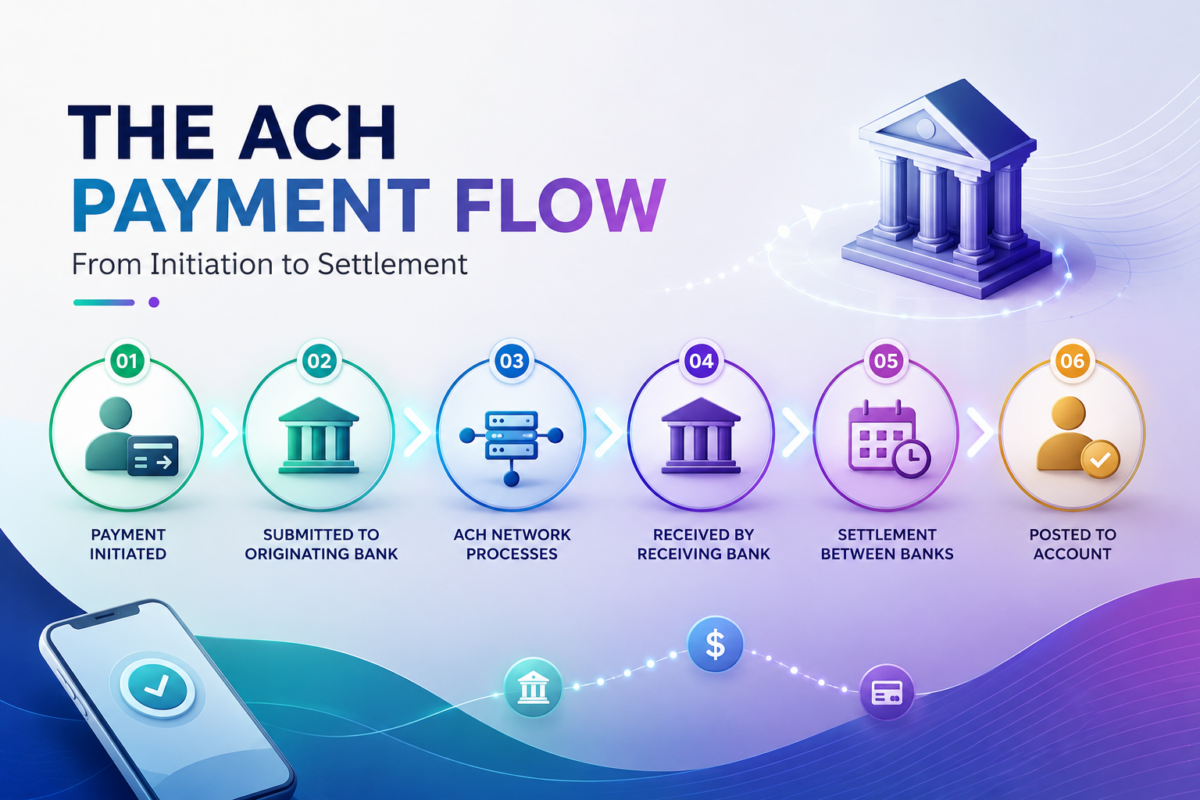
When a customer pays a bill directly from a bank account, an employer deposits wages, or a business pays a supplier electronically, the transaction may be processed through the Automated Clearing House (ACH) network.
But how do ACH payments work once the payment is initiated?
An ACH payment does not simply move directly from one bank account to another. The transaction passes through several stages involving the business or individual initiating the payment, financial institutions, and ACH processing infrastructure. The timing and exact steps can vary depending on the type of transaction and how it is initiated. Understanding this process matters because it explains why ACH payments have processing windows, authorization requirements, settlement stages, and return procedures.
How Do ACH Payments Work?
ACH payments work by electronically transmitting payment instructions between financial institutions through the ACH network. The originating party initiates the transaction, its financial institution submits the payment information, an ACH operator processes and routes it, and the receiving financial institution posts the transaction to the recipient’s account.
At a simplified level, the process looks like this:
Payment initiated → Originating bank processes instruction → ACH network routes transaction → Receiving bank receives it → Recipient’s account is credited or debited
The actual process contains several more steps, particularly when authorization, account verification, settlement, and transaction returns are involved.
Step 1: The ACH Payment Is Initiated
Every ACH transaction starts with an originating party. That could be:
- A company paying an employee
- A customer paying a business
- A business paying a supplier
- A utility company collecting a bill
- A borrower making a scheduled payment
The direction of the transaction depends on whether it is an ACH credit or ACH debit.
With an ACH credit, the originator instructs money to be sent to another account.
With an ACH debit, the originator initiates a request to collect money from another account after obtaining the required authorization.
Example: A Monthly Subscription
Imagine a customer has authorized a software company to collect a hypothetical $100 monthly subscription payment from their checking account.
The customer has provided the necessary bank-account information and authorization. When the monthly payment is due, the software company initiates an ACH debit for the authorized amount. The customer doesn’t manually send the $100 each month. Instead, the business initiates the collection through its ACH payment process.
Step 2: Payment Information Is Submitted
The payment instruction needs to reach the ACH network through an originating financial institution. This institution is known as the Originating Depository Financial Institution (ODFI).
The ODFI submits ACH entries on behalf of its customer, known as the originator. At this point, the transaction contains information needed to identify the relevant accounts and process the payment according to the applicable ACH rules.
For businesses, this is one reason accurate payment information matters. Incorrect account details can prevent a transaction from reaching the intended account or can contribute to a returned payment.
Step 3: The ACH Operator Processes the Transaction
The ACH network uses ACH operators to process and route transactions between participating financial institutions.
In the United States, the ACH system operates through established network infrastructure rather than functioning like a real-time, one-to-one messaging system between two consumer bank accounts. The ACH operator receives transaction files from originating institutions, processes them, and makes the appropriate transactions available to receiving institutions.
This processing structure is a major reason ACH transactions have defined processing windows rather than behaving exactly like instant payment methods.
Step 4: The Transaction Reaches the Receiving Bank
The receiving financial institution is known as the Receiving Depository Financial Institution (RDFI). The RDFI receives the ACH transaction and identifies the account associated with the payment instruction.
If the transaction is an ACH credit, the recipient’s account is credited according to the applicable processing and settlement schedule. And, if it is an ACH debit, the receiving institution processes the debit against the customer’s account, subject to the transaction and account conditions. The person or business whose account is affected is referred to as the receiver in ACH terminology.
Step 5: Settlement Takes Place
Processing and settlement are related, but they are not exactly the same thing.
Settlement is the point at which the financial obligations created by the ACH transactions are settled between participating institutions. This distinction helps explain why seeing a payment initiated does not necessarily mean the recipient has immediate access to final funds.
ACH timing can depend on:
- When the transaction is submitted?
- Applicable processing windows
- Banking days and holidays
- Transaction type
- Receiving institution procedures
- Whether Same Day ACH applies?
Eligible transactions can use Same Day ACH, but that does not mean every ACH payment is automatically instantaneous. For businesses that depend on predictable cash flow, understanding these timing differences is particularly important.
Step 6: The Transaction Is Posted to the Account
Once the receiving institution processes the transaction, the appropriate account is credited or debited. For example, consider a hypothetical payroll payment:
- An employer prepares payroll.
- The employer’s financial institution receives the payment instructions.
- The ACH transaction is submitted for processing.
- The transaction is routed to the employee’s financial institution.
- The employee’s account is credited according to the applicable processing and settlement schedule.
From the employee’s perspective, the result is simply a deposit appearing in the account. The underlying process involves multiple participants and processing stages.
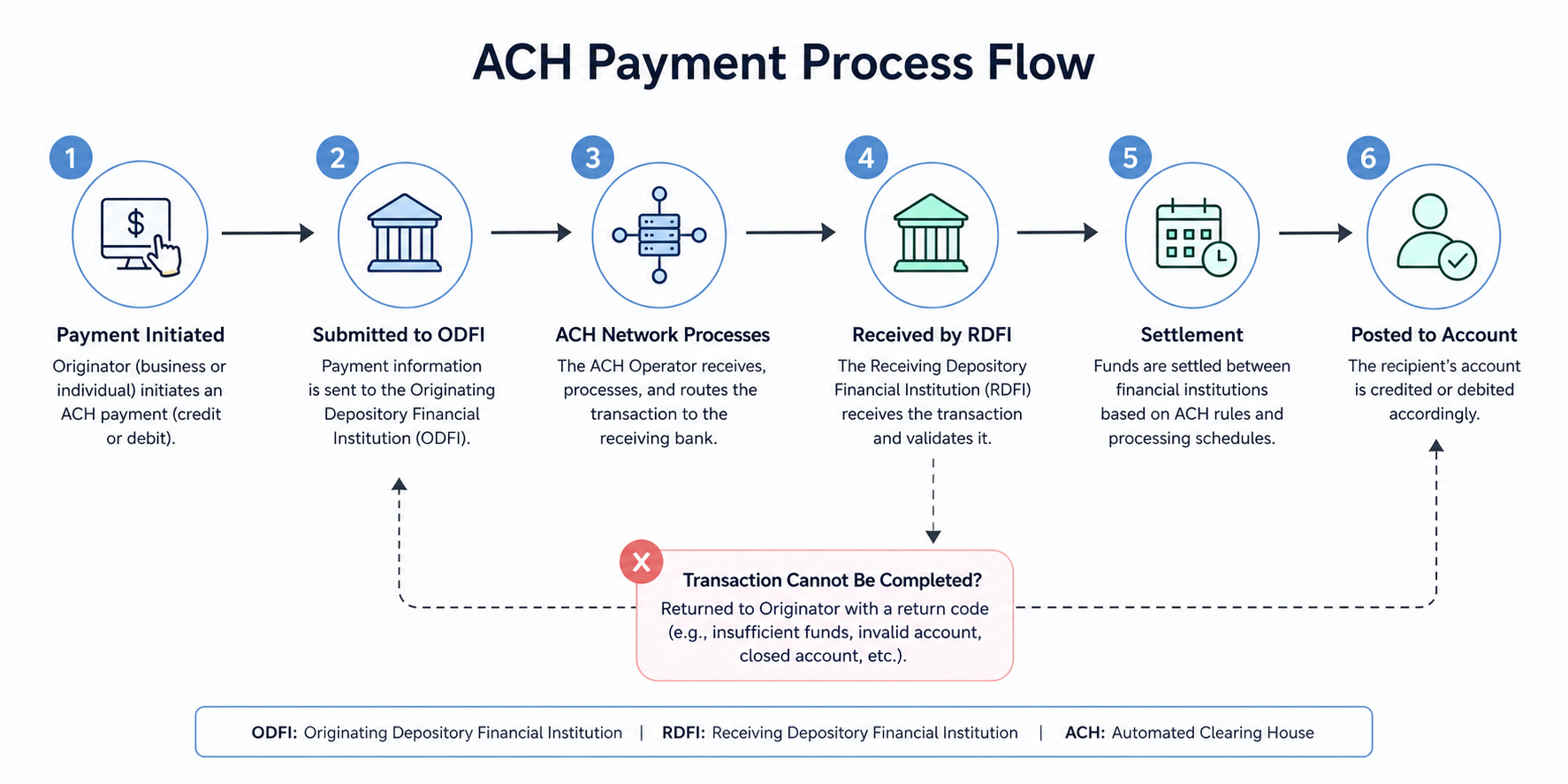
What Happens If an ACH Payment Cannot Be Completed?
An ACH transaction does not always reach successful completion. A payment may be returned for reasons such as:
- Insufficient funds
- Incorrect or invalid account information
- Closed account
- Account restrictions
- Other conditions recognized under ACH rules
When a transaction is returned, the receiving institution communicates the applicable return information through the ACH system. The specific return code matters because it identifies why the transaction could not be completed and can influence what the originating business should do next.
For example, a business dealing with an insufficient-funds return may need to determine whether and when another collection attempt is appropriate. A transaction involving incorrect account information may require the customer to provide updated banking details. This is why ACH processing doesn’t necessarily end when a payment is submitted. Businesses also need procedures for monitoring returns and reconciling them with their accounting records.
Understanding why ACH transactions are returned and what individual return codes mean becomes particularly important for businesses collecting payments from customers.
What Does the Customer Actually See?
The ACH process is mostly invisible to the customer.
A customer might see:
ACH DEBIT — $100.00
on a bank statement after a recurring payment.
The statement doesn’t necessarily show every processing stage that occurred behind the scenes. The transaction may have involved the business, its financial institution, an ACH operator, and the customer’s financial institution before the debit appeared on the account.
This is also why the date a business submits a transaction and the date a customer sees it posted can sometimes differ.
How Businesses Manage ACH Payments After Processing?
For a business, successful ACH processing involves more than submitting transactions. Finance and operations teams may need to:
- Match payments against invoices or customer accounts
- Monitor successful and returned transactions
- Reconcile bank activity with accounting records
- Track recurring payment schedules
- Maintain authorization records
- Investigate unexpected payment activity
- Update incorrect account information
For example, a subscription business collecting hundreds of recurring payments cannot simply assume every scheduled debit succeeded. Its payment and accounting processes need to distinguish successful transactions from returns and other exceptions.
This operational layer becomes increasingly important as ACH payment volume grows.
A Simple ACH Transaction Example
Consider a hypothetical online business collecting a $300 invoice from a customer through ACH debit. The process can be summarized as:
- The customer authorizes payment and provides the required bank-account information.
- Business initiates the ACH debit for $300.
- Originating financial institutions receive instruction from the business.
- ACH transaction enters the network for processing and routing.
- The receiving financial institution receives the transaction.
- Customer’s account is debited according to the applicable schedule.
- Business receives the corresponding payment information and reconciles the transaction.
- If the transaction cannot be completed, a return is generated with information about the reason.
This illustrates why ACH is better understood as a processing system rather than an instant transfer between two consumer banking apps.
Frequently Asked Questions
How long does an ACH payment take to process?
It depends on factors such as submission timing, processing windows, banking days, transaction type, and whether Same Day ACH applies. ACH should not automatically be assumed to be instant.
Does an ACH payment go directly from one bank to another?
The funds ultimately move between bank accounts, but the transaction is processed through the ACH network and participating financial institutions rather than simply traveling directly between the two banks.
What is an ODFI in ACH processing?
An ODFI, or Originating Depository Financial Institution, is the financial institution that submits ACH transactions into the network on behalf of the originating party.
What is an RDFI?
An RDFI, or Receiving Depository Financial Institution, is the financial institution that receives an ACH transaction for the account holder.
Can an ACH transaction fail after being submitted?
Yes. An ACH transaction can be returned for reasons such as insufficient funds, invalid account information, or other conditions recognized by the ACH rules.
Conclusion
The answer to how ACH payments work becomes much clearer when the transaction is viewed as a sequence rather than a single transfer.
A payment begins with an originator, moves through the originating financial institution and ACH processing infrastructure, reaches the receiving financial institution, and is ultimately posted to the appropriate account. Settlement, processing windows, authorization, and return procedures all play a role along the way.
For businesses, understanding this process is useful for setting realistic payment expectations, managing cash flow, handling returned transactions, and building reliable reconciliation procedures. ACH may appear simple on a bank statement, but several coordinated steps make that final account entry possible.

Categories
- ACH Payments (10)
- adult payment processing (11)
- AI (9)
- Altcoins (10)
- Banking (10)
- Bitcoin (133)
- Bitcoin ETF (11)
- Bitcoin Price (30)
- Blockchain (50)
- Brokering World Hunger Away (16)
- Business (17)
- card payment processing (10)
- CBD (11)
- CBDC (11)
- Chargeback (8)
- coaching business (11)
- COVID-19 (3)
- Crypto ATMs (1)
- Crypto Banking (17)
- Crypto Bill (1)
- Crypto business owner platform (31)
- Crypto Investment (3)
- Crypto Markets (5)
- Crypto Payment (35)
- Crypto Payment Processor (4)
- Crypto Prices (1)
- Crypto Trading (92)
- Cryptocurrency (402)
- Cryptocurrency Exchange (108)
- Data Visualization (2)
- dating platforms (11)
- debt collection payment processing (10)
- Decentralized Finance (7)
- DeFi Payment (9)
- DEX (3)
- Digital Currency (23)
- dropshipping payment processing (12)
- Ethereum (2)
- FAQ (7)
- file sharing payment processing (11)
- Finance (25)
- Financial Equality (4)
- Financial Freedom (8)
- Forex (35)
- hemp (1)
- ICO (2)
- Investment (11)
- IPTV (11)
- Merchant Account (10)
- Mining (3)
- News (66)
- NFTs (2)
- online gambling (11)
- P2P (1)
- Paybito (147)
- PayBitoPro (693)
- PayBitoPro Coin Listing (6)
- PayBitoPro Exchange (2)
- Payment Gateway (48)
- peptide (10)
- Post COVID Digital Transformation (1)
- Press Release (130)
- Privacy & Security (3)
- Real Estate (1)
- Stablecoin (5)
- Technology (15)
- Travel (11)
- Uncategorized (10)
- US Presidential Election (2)
- Utility Coin (1)
- Web3 business (4)
- Web3 Wallets (2)
- White Label Crypto Exchange (8)
Recent Posts
- Payment Gateway vs. Payment Orchestration: What’s the Difference?
- What Is Smart Payment Routing? Strategies to Optimize Payment Performance
- How to Improve Payment Approval Rates for High-Risk Businesses?
- Why Are Online Payments Failing? Common Causes and How to Fix Them
- How to Use Multiple Payment Processors to Reduce Business Disruptions?