White Label Payment Platform for Dropshipping Businesses: How Ecommerce Companies Build Custom Payment Solutions?
- August 7, 2026
- Soham Guchait
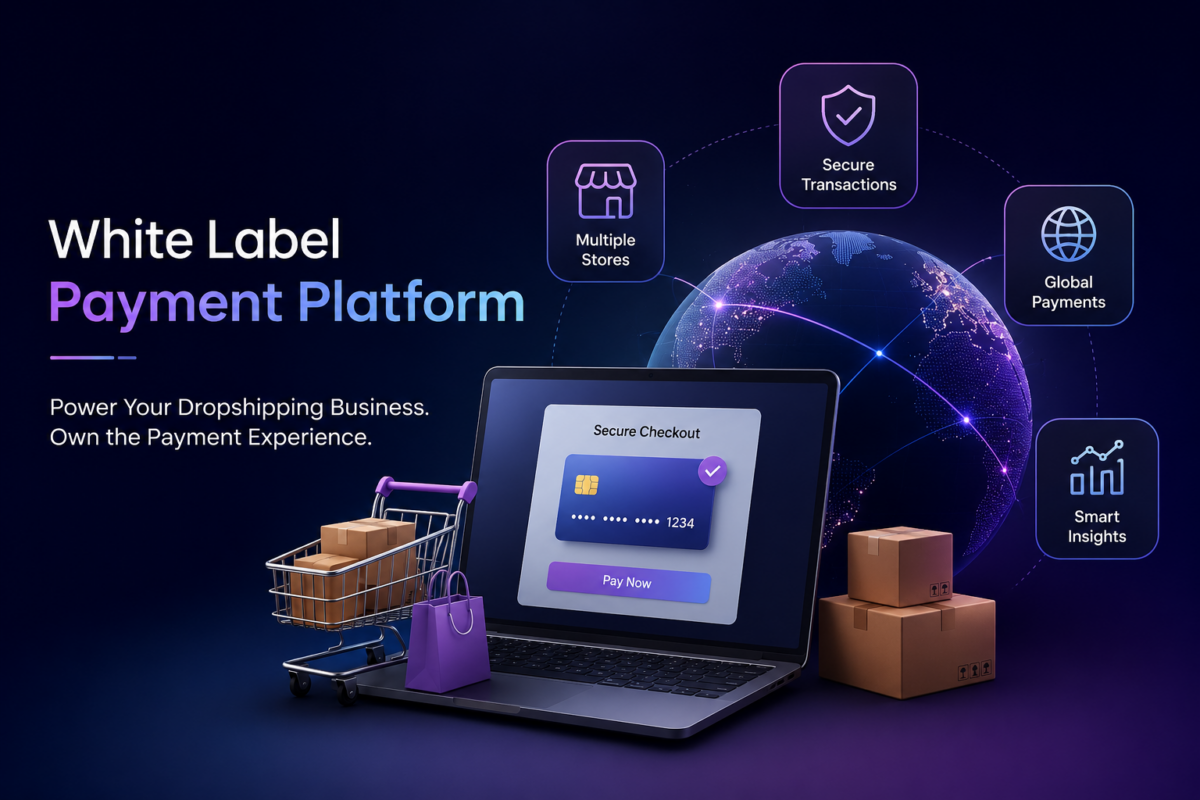
As dropshipping businesses grow, managing payments becomes increasingly complex. A store that starts by processing a few customer orders each day may eventually operate multiple storefronts, serve customers across different countries, manage multiple sellers, or build an entire ecommerce ecosystem. At that stage, relying only on basic payment tools may not provide enough flexibility, control, or scalability.
This is where a white label payment platform for dropshipping businesses becomes relevant. Instead of building payment infrastructure from the ground up, businesses can use customizable payment technology that allows them to offer payment capabilities under their own brand while managing different aspects of the payment experience.
Understanding how white label payment platforms work helps ecommerce entrepreneurs, marketplace operators, and dropshipping businesses evaluate whether this approach fits their growth strategy.
What Is a White Label Payment Platform?
A white label payment platform is a ready-made payment infrastructure that businesses can customize and operate under their own brand.
Unlike traditional payment solutions where merchants simply use an external checkout experience, a white label platform allows businesses to create a more branded payment environment while using established payment technology behind the scenes. The concept is similar to how many ecommerce companies use third-party infrastructure while maintaining their own customer-facing brand identity.
For example, a dropshipping agency managing multiple online stores may want to provide sellers with a unified payment experience. Instead of creating payment systems separately for every store, a white label platform can provide the underlying payment infrastructure while allowing the agency to manage payment operations through its own platform.
Why Dropshipping Businesses May Need Advanced Payment Infrastructure?
A new dropshipping store usually has simple payment requirements. Customers visit the website, select products, complete checkout, and the merchant receives funds after processing. However, as the business model expands, payment requirements often become more complicated.
A growing ecommerce operation may need to manage:
- Multiple online stores with different product categories.
- International customers and multiple currencies.
- Higher transaction volumes.
- Different seller accounts.
- Advanced reporting and payment management.
For example, an entrepreneur who starts with one Shopify store selling fitness products may later launch separate stores for electronics, lifestyle products, and home accessories. Managing payments across several businesses using disconnected systems can create operational challenges.
A scalable payment platform provides a more organized approach as the business grows.
How White Label Payment Platforms Work for Ecommerce Businesses?
A white label payment platform combines multiple payment functions into a customizable system. The platform typically connects different parts of the payment process, allowing businesses to manage customer payments, transaction monitoring, reporting, and payment operations through a centralized environment. At the foundation of this infrastructure is the payment gateway, which acts as the connection between the ecommerce store, customer payment methods, and the broader payment processing system.
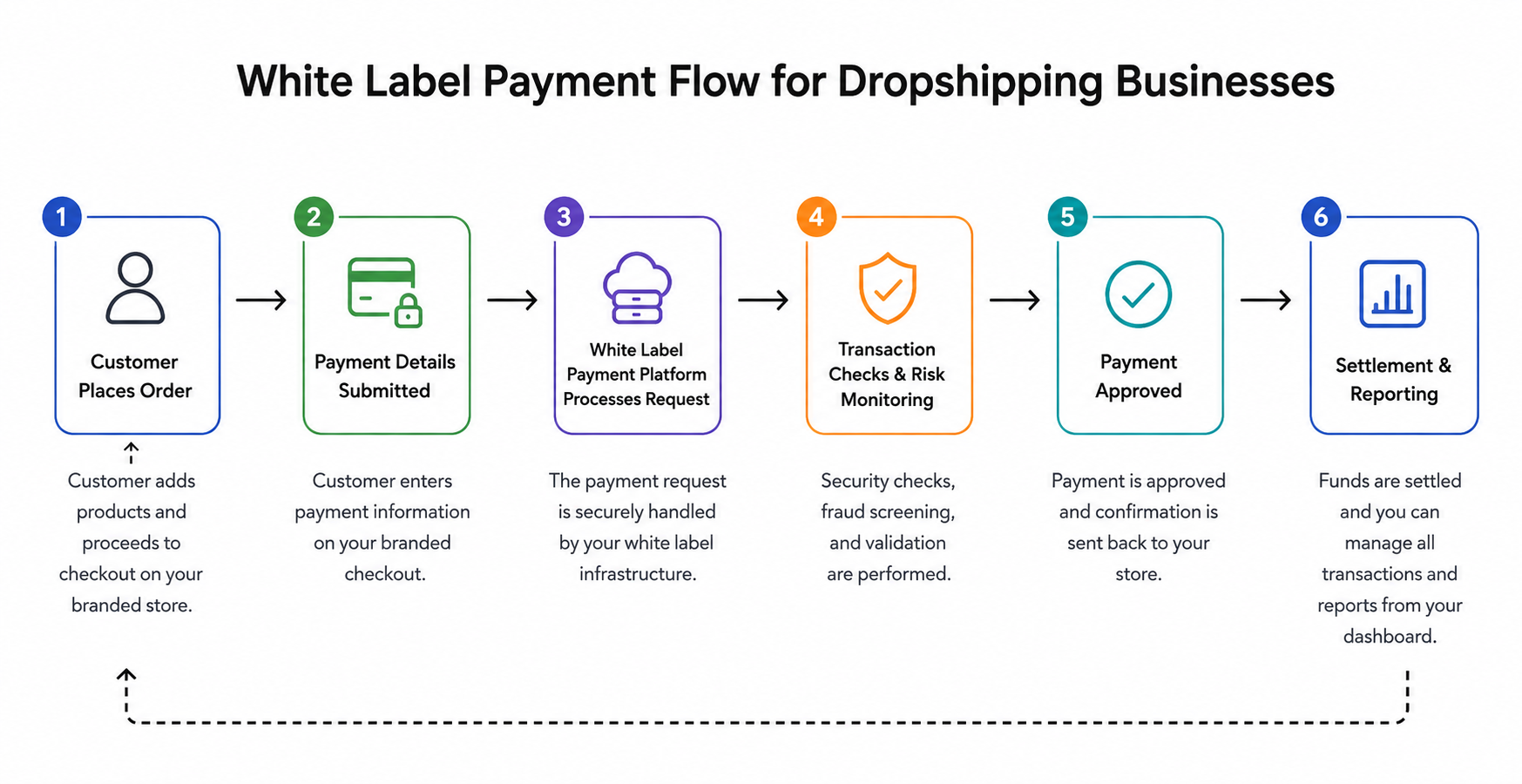
A simplified payment flow may look like this:
A customer purchases a product from a branded ecommerce store. The payment request is processed through the white label infrastructure, transaction checks are performed, and the payment status is returned to the store. The business can then manage transaction information through its own branded interface. The customer experience remains connected to the business rather than appearing as a separate third-party payment process.
Benefits of White Label Payment Platforms for Dropshipping Businesses
The main advantage of a white label payment platform is flexibility. Businesses gain more control over how payments are managed without needing to develop every component internally.
Several benefits make this model attractive for growing ecommerce companies.
Managing Multiple Ecommerce Stores
Many entrepreneurs operate multiple dropshipping stores targeting different niches.
A business owner may manage one store selling outdoor products, another selling beauty products, and another selling technology accessories. Handling payments separately for each store can become difficult. A centralized payment platform allows businesses to organize payment operations across multiple storefronts while maintaining visibility into transaction activity.
Creating a Branded Payment Experience
Customer trust is extremely important during checkout. When customers move through a payment experience that feels disconnected from the store they are shopping from, they may hesitate before completing the purchase. A white label payment platform allows businesses to maintain a consistent brand experience throughout the customer journey.
For example, an ecommerce marketplace connecting multiple independent sellers can provide buyers with a unified checkout experience instead of sending them through different payment processes.
Supporting Ecommerce Ecosystems
Some businesses go beyond selling their own products. They create platforms where multiple sellers, suppliers, or merchants participate.
A dropshipping marketplace, for example, may allow different suppliers to list products while customers complete purchases through one platform. In this situation, payment management becomes more complex because the business may need to handle different sellers, transaction records, and payment flows.
White label payment infrastructure can support these types of ecommerce ecosystems by providing more structured payment management.
White Label Payment Platforms and International Ecommerce
Dropshipping naturally supports global selling, but international growth creates additional payment challenges. Businesses selling across borders must consider different currencies, customer preferences, payment methods, and transaction requirements. A business operating multiple international stores may need to manage payments from customers in different regions while maintaining consistent reporting and operational control.
For example, an ecommerce company selling products in North America, Europe, and Asia may need to understand transaction activity across multiple currencies while providing customers with convenient payment experiences.
A flexible payment platform helps businesses manage these complexities as they expand into new markets.
Security and Risk Management Considerations
Payment infrastructure must prioritize security because ecommerce transactions involve sensitive financial information. A white label payment platform should support important payment security functions, including transaction monitoring, fraud prevention, and customer verification processes.
For dropshipping businesses, this becomes especially important because many operate internationally and process payments from customers they may never interact with directly.
For example, a store experiencing rapid growth may suddenly receive a large number of high-value orders. Without proper monitoring systems, fraudulent transactions can create significant financial losses.
Effective payment infrastructure helps businesses identify unusual activity while maintaining a smooth customer experience.
Who Can Benefit From a White Label Payment Platform?
White label payment platforms are not only designed for large ecommerce companies. They can also be useful for businesses planning to create scalable payment operations.
Potential users include:
- Dropshipping agencies managing multiple stores.
- Ecommerce platforms supporting multiple sellers.
- Marketplace businesses.
- Entrepreneurs building niche shopping ecosystems.
- Companies creating branded payment experiences.
The right solution depends on the business model, transaction volume, operational requirements, and future growth plans.
White Label Payment Platforms vs Traditional Payment Solutions
Traditional payment solutions are often suitable for businesses that only need basic payment acceptance. A single online store selling products directly to customers may not require advanced payment infrastructure.
However, businesses managing multiple stores, sellers, or markets often need greater control.
The difference is mainly flexibility.
Traditional payment processing focuses on accepting transactions, while white label payment platforms focus on creating a broader payment ecosystem that businesses can customize and scale.
Building Scalable Payment Operations for the Future
Dropshipping businesses often evolve quickly. A small online store can become a global ecommerce operation within a short period if products, marketing, and customer demand align.
Payment infrastructure should be prepared for that growth. As businesses expand, they need systems that support higher transaction volumes, international customers, multiple storefronts, and more complex payment operations. A white label payment platform provides one approach for businesses looking to move beyond basic payment acceptance and create a more controlled payment environment.
Final Thoughts
A white label payment platform for dropshipping businesses provides a way for ecommerce companies to build more flexible and scalable payment operations without developing payment infrastructure from scratch.
For businesses managing multiple stores, seller networks, or international customers, having greater control over payments can improve operational efficiency and create a more consistent customer experience.
As the dropshipping industry becomes increasingly competitive, payment infrastructure is becoming more than just a checkout tool. It is becoming an important part of how ecommerce businesses scale, manage risk, and build long-term digital operations.

Categories
- ACH Payments (10)
- adult payment processing (11)
- AI (9)
- Altcoins (10)
- Banking (10)
- Bitcoin (133)
- Bitcoin ETF (11)
- Bitcoin Price (30)
- Blockchain (50)
- Brokering World Hunger Away (16)
- Business (17)
- card payment processing (10)
- CBD (11)
- CBDC (11)
- Chargeback (8)
- coaching business (11)
- COVID-19 (3)
- Crypto ATMs (1)
- Crypto Banking (17)
- Crypto Bill (1)
- Crypto business owner platform (31)
- Crypto Investment (3)
- Crypto Markets (5)
- Crypto Payment (35)
- Crypto Payment Processor (4)
- Crypto Prices (1)
- Crypto Trading (92)
- Cryptocurrency (402)
- Cryptocurrency Exchange (108)
- Data Visualization (2)
- dating platforms (11)
- debt collection payment processing (10)
- Decentralized Finance (7)
- DeFi Payment (9)
- DEX (3)
- Digital Currency (23)
- dropshipping payment processing (12)
- Ethereum (2)
- FAQ (7)
- file sharing payment processing (11)
- Finance (25)
- Financial Equality (4)
- Financial Freedom (8)
- Forex (35)
- hemp (1)
- ICO (2)
- Investment (11)
- IPTV (11)
- Merchant Account (10)
- Mining (3)
- News (66)
- NFTs (2)
- online gambling (11)
- P2P (1)
- Paybito (147)
- PayBitoPro (693)
- PayBitoPro Coin Listing (6)
- PayBitoPro Exchange (2)
- Payment Gateway (48)
- peptide (10)
- Post COVID Digital Transformation (1)
- Press Release (130)
- Privacy & Security (3)
- Real Estate (1)
- Stablecoin (5)
- Technology (15)
- Travel (11)
- Uncategorized (10)
- US Presidential Election (2)
- Utility Coin (1)
- Web3 business (4)
- Web3 Wallets (2)
- White Label Crypto Exchange (8)
Recent Posts
- Payment Gateway vs. Payment Orchestration: What’s the Difference?
- What Is Smart Payment Routing? Strategies to Optimize Payment Performance
- How to Improve Payment Approval Rates for High-Risk Businesses?
- Why Are Online Payments Failing? Common Causes and How to Fix Them
- How to Use Multiple Payment Processors to Reduce Business Disruptions?