International Payment Processing for Dropshipping Businesses: How Online Stores Accept Global Payments?
- August 7, 2026
- Soham Guchait
One of the biggest advantages of the dropshipping business model is the ability to sell products to customers anywhere in the world without maintaining physical stores or warehouses in every market. A business owner can operate a store from one country while selling products to customers across multiple continents.
However, accepting payments from international customers introduces challenges that domestic ecommerce businesses rarely face. Different currencies, payment preferences, banking systems, fraud risks, and settlement requirements can affect how smoothly transactions are processed.
For businesses expanding beyond their local market, understanding international payment processing for dropshipping businesses is essential. A reliable global payment system helps merchants accept payments from customers worldwide while reducing payment failures, improving checkout experiences, and supporting long-term growth.
What Is International Payment Processing?
International payment processing refers to the systems and processes that allow businesses to accept payments from customers located in different countries.
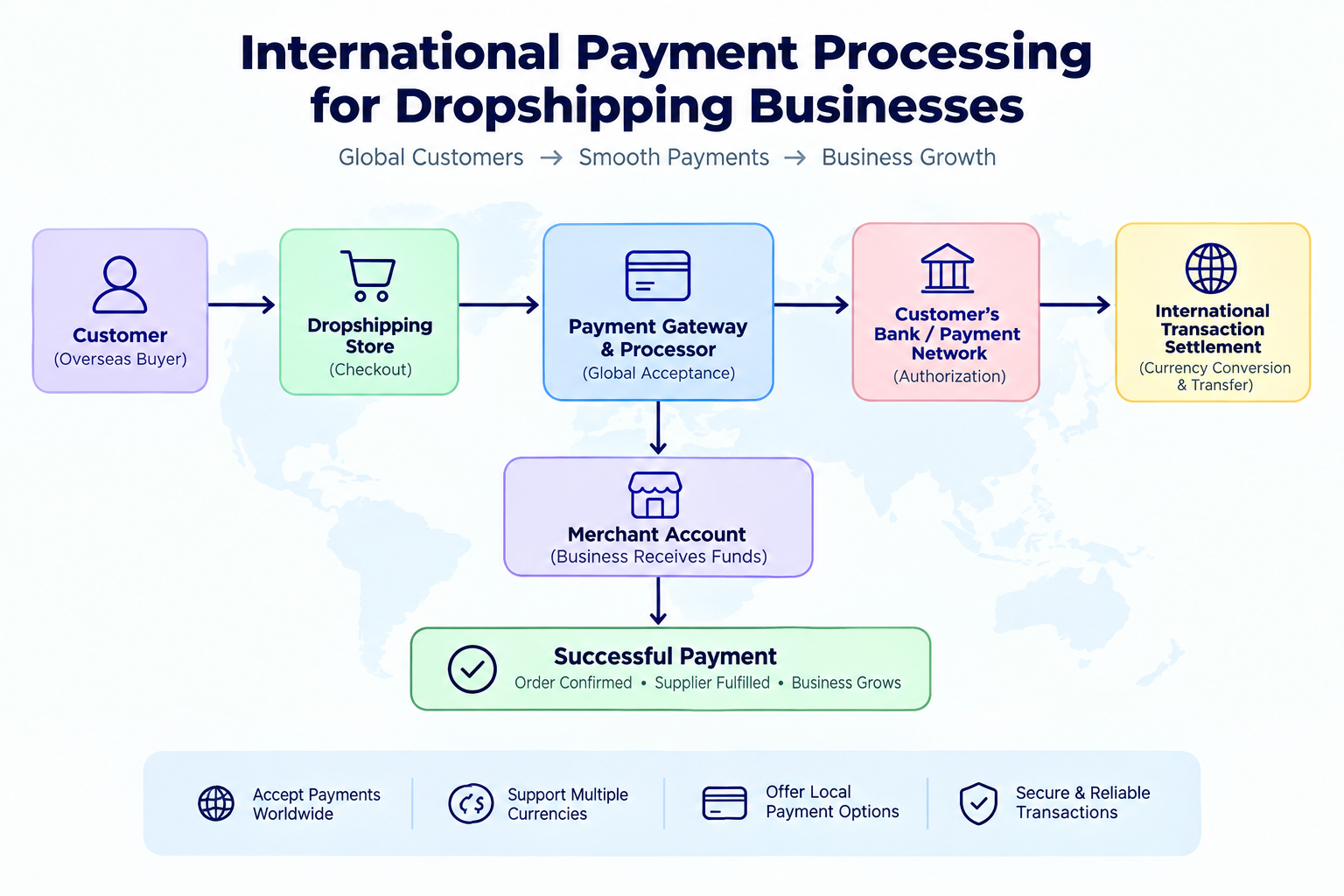
When a customer purchases a product from a dropshipping store operating in another country, multiple parties may be involved in completing the transaction. The payment gateway, payment processor, customer’s bank, card network, and merchant account all work together to authorize and settle the payment.
For example, consider a dropshipping business based in the United States selling skincare products to customers in France. The customer may pay in euros using a locally issued card. The transaction then needs to be authorized internationally, converted into the merchant’s preferred settlement currency, and transferred to the business account. Although this process happens within seconds, multiple financial systems must coordinate to complete the payment successfully.
Why Are International Payments Important for Dropshipping Businesses?
Traditional retailers often expand into new countries by opening local stores, warehouses, or offices. Dropshipping businesses can reach global customers much faster because fulfillment is handled through suppliers. This global opportunity also means merchants must be prepared to support customers with different payment behaviors. A customer in one market may prefer credit cards, while another may rely heavily on digital wallets, bank transfers, or local payment methods.
For example, a dropshipping store selling electronics accessories may receive strong demand from customers in North America, Europe, and Asia. If the checkout experience only supports one currency and limited payment options, potential customers may hesitate or abandon their purchase. International payment processing helps remove these barriers by allowing businesses to serve customers in different regions more effectively.
The Challenges of International Payment Processing
Accepting payments globally creates additional complexity compared with domestic transactions. Dropshipping businesses commonly face challenges related to:
- Currency conversion and exchange rates.
- International transaction approvals.
- Different customer payment preferences.
- Cross-border fraud risks.
- Settlement timelines.
- Regional compliance requirements.
Each market has unique payment expectations. A checkout process that works well for customers in one country may not perform equally well in another. Understanding these differences helps businesses create a payment experience that feels familiar and trustworthy to international shoppers.
Managing Multiple Currencies
Currency management is one of the most important considerations for global dropshipping businesses. Customers generally prefer seeing prices in their local currency because it makes the purchase decision easier and creates greater confidence during checkout.
Imagine a customer in Canada visiting a dropshipping store that displays all prices only in US dollars. The customer may need to calculate the final cost themselves while also considering possible foreign transaction fees charged by their bank. This additional uncertainty can create hesitation at the exact moment they are ready to purchase.
Supporting multiple currencies helps customers understand pricing more clearly and creates a more localized shopping experience. However, merchants also need to consider how currency conversion affects revenue, settlement amounts, and financial reporting.
Supporting Local Payment Preferences
Customers around the world do not all pay the same way. While card payments remain popular globally, many markets have developed strong preferences for alternative payment methods. A customer may abandon a purchase if their preferred payment option is unavailable, even if they are interested in the product. For example, a dropshipping business targeting customers in multiple regions may discover that:
- Some customers prefer digital wallets for faster mobile checkout.
- Some markets rely more heavily on bank-based payment methods.
- Some buyers prefer local payment options they already trust.
Offering relevant payment choices improves convenience and can increase successful transactions from international customers. The goal is not to provide every possible payment method but to understand where customers are located and which options best match their purchasing behavior.
Cross-Border Payment Security and Fraud Risks
International transactions require careful fraud management because cross-border purchases often involve additional risk factors. A customer purchasing from another country may trigger security checks because the transaction appears different from their normal spending behavior.
For example, a customer located in Australia purchasing from a dropshipping store based in the United Kingdom may use a payment card issued in another country while shipping the product to a new address. These factors may appear unusual to automated fraud systems. At the same time, international ecommerce attracts fraudulent activity such as stolen card usage and unauthorized purchases.
Effective payment systems balance security with customer convenience by identifying suspicious transactions without blocking legitimate buyers unnecessarily.
Settlement and Cash Flow Considerations
International payment processing also affects how quickly merchants receive their funds.
Different payment methods and regions may have different settlement timelines. Currency conversion, banking processes, and transaction reviews can influence when funds become available. For dropshipping businesses, cash flow management is particularly important because merchants often pay suppliers before receiving customer revenue.
Consider a store that receives hundreds of international orders during a successful marketing campaign. If payment settlements are delayed while supplier payments are immediately required, the business may experience operational pressure. Understanding settlement processes allows merchants to plan inventory payments, advertising budgets, and business expenses more effectively.
Compliance Considerations for Global Selling
Selling internationally means operating across different financial environments. Payment providers evaluate businesses based on factors such as transaction patterns, customer locations, products sold, and business practices.
Merchants should maintain transparent operations by providing accurate business information, clear customer policies, and proper documentation.
International payment compliance is not only about meeting financial requirements. It also helps build trust with customers and payment partners. Businesses that maintain organized records and follow responsible payment practices are better positioned for sustainable global growth.
How Dropshipping Businesses Can Improve International Payment Success?
Successful international payment processing requires continuous improvement rather than a one-time setup.
Businesses can strengthen their payment operations by:
- Offering payment methods suitable for target markets.
- Displaying prices clearly in relevant currencies.
- Providing transparent shipping and refund information.
- Monitoring declined transactions by region.
- Reviewing customer checkout behavior.
For example, if a business notices high cart abandonment from customers in a specific country, analyzing payment preferences and checkout issues may reveal opportunities for improvement. Small adjustments to the payment experience can significantly impact international conversion rates.
Building a Payment System for Global Growth
International expansion is one of the biggest opportunities available to dropshipping businesses, but payment infrastructure must grow alongside customer demand.
As dropshipping businesses expand into multiple markets, managing payments across different storefronts, currencies, and customer segments can become more complex. Businesses operating multiple online stores or ecommerce platforms may explore solutions such as a white label payment platform for dropshipping businesses to create a more customized and scalable payment infrastructure.
A store processing payments from a single country has very different requirements compared with a business serving customers across multiple continents.
As businesses expand, they must consider payment acceptance, fraud prevention, chargeback management, merchant account stability, and compliance together. A strong international payment strategy creates a smoother experience for customers while helping merchants operate more efficiently.
Final Thoughts
International payment processing for dropshipping businesses is a critical part of building a successful global ecommerce operation. Selling products worldwide requires more than simply accepting payments – it requires understanding currencies, customer preferences, security risks, settlement processes, and regional payment expectations.
Businesses that invest in reliable international payment systems can reduce checkout friction, improve customer confidence, and create better opportunities for global growth.
As dropshipping continues becoming more competitive, the ability to accept payments smoothly across borders is no longer just an advantage. It is a foundation for building a scalable ecommerce business.
Categories
- ACH Payments (10)
- adult payment processing (11)
- AI (9)
- Altcoins (10)
- Banking (10)
- Bitcoin (133)
- Bitcoin ETF (11)
- Bitcoin Price (30)
- Blockchain (50)
- Brokering World Hunger Away (16)
- Business (17)
- card payment processing (10)
- CBD (11)
- CBDC (11)
- Chargeback (8)
- coaching business (11)
- COVID-19 (3)
- Crypto ATMs (1)
- Crypto Banking (17)
- Crypto Bill (1)
- Crypto business owner platform (31)
- Crypto Investment (3)
- Crypto Markets (5)
- Crypto Payment (35)
- Crypto Payment Processor (4)
- Crypto Prices (1)
- Crypto Trading (92)
- Cryptocurrency (402)
- Cryptocurrency Exchange (108)
- Data Visualization (2)
- dating platforms (11)
- debt collection payment processing (10)
- Decentralized Finance (7)
- DeFi Payment (9)
- DEX (3)
- Digital Currency (23)
- dropshipping payment processing (12)
- Ethereum (2)
- FAQ (7)
- file sharing payment processing (11)
- Finance (25)
- Financial Equality (4)
- Financial Freedom (8)
- Forex (35)
- hemp (1)
- ICO (2)
- Investment (11)
- IPTV (11)
- Merchant Account (10)
- Mining (3)
- News (66)
- NFTs (2)
- online gambling (11)
- P2P (1)
- Paybito (147)
- PayBitoPro (693)
- PayBitoPro Coin Listing (6)
- PayBitoPro Exchange (2)
- Payment Gateway (48)
- peptide (10)
- Post COVID Digital Transformation (1)
- Press Release (130)
- Privacy & Security (3)
- Real Estate (1)
- Stablecoin (5)
- Technology (15)
- Travel (11)
- Uncategorized (10)
- US Presidential Election (2)
- Utility Coin (1)
- Web3 business (4)
- Web3 Wallets (2)
- White Label Crypto Exchange (8)
Recent Posts
- Payment Gateway vs. Payment Orchestration: What’s the Difference?
- What Is Smart Payment Routing? Strategies to Optimize Payment Performance
- How to Improve Payment Approval Rates for High-Risk Businesses?
- Why Are Online Payments Failing? Common Causes and How to Fix Them
- How to Use Multiple Payment Processors to Reduce Business Disruptions?