White Label Payment Platforms for CBD, Hemp, and Cannabis Businesses: What They Are and Who Needs One?
- August 3, 2026
- Soham Guchait
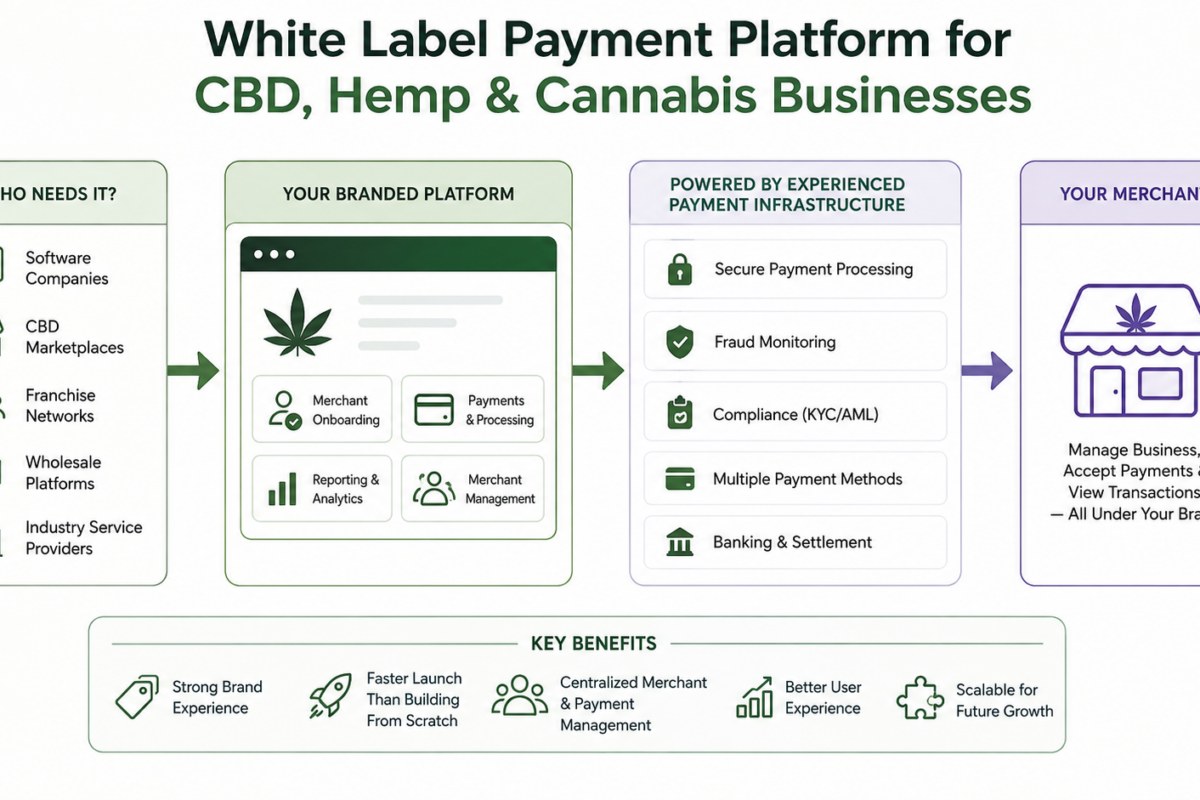
As a CBD, hemp, or cannabis business grows, accepting payments is no longer the only challenge. Some companies eventually reach a stage where they want to offer payment services under their own brand, create a unified payment experience for merchants, or build a payment solution for partners without developing the entire infrastructure from scratch.
This is where a white label payment platform comes into the picture.
While many CBD businesses only need a merchant account and payment gateway, larger businesses, marketplaces, software providers, franchisors, and industry-focused platforms may benefit from offering branded payment solutions of their own. Understanding how white label payment platforms work can help business owners decide whether this approach aligns with their long-term goals.
What Is a White Label Payment Platform?
A white label payment platform is a payment solution developed by one company but rebranded and offered under another company’s name.
Instead of building payment technology from the ground up, businesses use an existing platform and customize it with their own branding, user interface, and customer experience.
For example, imagine a software company that provides inventory management and point-of-sale solutions exclusively for CBD retailers. Rather than asking customers to integrate a separate payment provider, the company could offer a branded payment platform directly within its software.
From the customer’s perspective, everything appears to come from a single provider, even though the payment infrastructure operates behind the scenes. This approach allows businesses to expand their services without creating complex payment technology themselves.
Which CBD Businesses Can Benefit?
Not every CBD or hemp business needs a white label payment platform. For a small online store selling CBD oils or hemp skincare products, a standard merchant account and payment gateway are usually sufficient. However, businesses serving other businesses may find additional value in a branded payment solution.
Examples include:
- Software companies serving CBD merchants
- Franchise networks
- CBD marketplace operators
- Wholesale platforms
- Industry-specific business service providers
- Large retail groups managing multiple brands
Consider a company that develops eCommerce software specifically for CBD brands. Instead of directing customers to third-party payment providers, it could integrate a white label payment platform into its existing software, allowing merchants to manage products, orders, and payments from one place.
Why Businesses Choose White Label Payment Platforms?
For many companies, the biggest advantage is creating a consistent customer experience. Instead of sending users to multiple third-party services, businesses can provide a single branded environment where merchants manage payments alongside their other business operations.
Other potential advantages include:
- Consistent branding across the platform
- Faster launch compared to building payment infrastructure
- Centralized merchant management
- Better user experience
- Opportunities to expand business services
For example, a CBD wholesale marketplace could allow vendors to manage inventory, receive payments, and track transactions within one dashboard instead of using several unrelated systems. This creates a smoother experience for both the platform operator and its merchants.
Features to Look For
Choosing a white label payment platform involves more than evaluating branding options. Businesses should also consider whether the platform supports the operational needs of their merchants.
Important capabilities may include:
- Merchant onboarding tools
- Secure payment processing
- Reporting and transaction history
- Customer management
- Payment analytics
- Fraud monitoring
- User access controls
- API and software integrations
Imagine a CBD-focused business platform supporting hundreds of independent retailers. Administrators may need reporting tools to monitor payment activity, while each merchant requires access only to their own transactions. A scalable platform should support both types of users without creating unnecessary complexity.
Security and Compliance Still Matter
Using a white label platform does not eliminate the need for responsible payment management. Businesses offering branded payment services should still understand how compliance, fraud prevention, and merchant verification affect payment operations.
For example, if a software company begins onboarding CBD merchants onto its branded payment platform, it must ensure those merchants complete appropriate verification procedures and provide accurate business information. Understanding KYC and AML for CBD payment processing becomes especially important because these processes help verify merchants and maintain a secure payment environment.
Likewise, businesses should understand how fraud monitoring and transaction security continue to play an important role, even when payment technology is provided by another company.
Planning for Future Growth
One reason businesses adopt white label payment platforms is scalability. A growing CBD marketplace may initially support a handful of merchants but later expand to hundreds or even thousands. Choosing technology that can accommodate future growth reduces the need for major system changes later.
Businesses should consider questions such as:
- Will the platform support additional merchants?
- Can new payment methods be added over time?
- Does it integrate with existing software?
- Can reporting scale with business growth?
- Will it support future expansion into new markets where permitted?
Planning ahead helps businesses avoid replacing systems as operational requirements become more complex.
Common Misconceptions
Many business owners assume a white label payment platform is simply another payment gateway. In reality, the two serve different purposes. A payment gateway allows a business to accept customer payments. A white label payment platform enables a business to offer a branded payment experience, often serving multiple merchants or business users.
For example, a CBD retailer selling products directly to consumers generally needs a payment gateway.
A technology company building software for hundreds of CBD retailers may instead consider a white label payment platform because it supports a broader business model. Understanding this distinction helps businesses choose the solution that matches their objectives instead of investing in technology they do not actually need.
Final Thoughts
White label payment platforms are not designed for every CBD, hemp, or cannabis business. For many merchants, a reliable merchant account and payment gateway provide everything needed to accept payments successfully.
However, businesses that serve other merchants, operate marketplaces, or develop industry-specific software may benefit from offering branded payment services through a white label platform.
The right solution depends on your business model, long-term growth plans, and the value you want to provide to your customers. By understanding how white label payment platforms work and where they fit within the payment ecosystem, businesses can make more informed technology decisions as they continue to expand.

Categories
- ACH Payments (10)
- adult payment processing (11)
- AI (9)
- Altcoins (10)
- Banking (10)
- Bitcoin (133)
- Bitcoin ETF (11)
- Bitcoin Price (30)
- Blockchain (50)
- Brokering World Hunger Away (16)
- Business (17)
- card payment processing (10)
- CBD (11)
- CBDC (11)
- Chargeback (8)
- coaching business (11)
- COVID-19 (3)
- Crypto ATMs (1)
- Crypto Banking (17)
- Crypto Bill (1)
- Crypto business owner platform (31)
- Crypto Investment (3)
- Crypto Markets (5)
- Crypto Payment (35)
- Crypto Payment Processor (4)
- Crypto Prices (1)
- Crypto Trading (92)
- Cryptocurrency (402)
- Cryptocurrency Exchange (108)
- Data Visualization (2)
- dating platforms (11)
- debt collection payment processing (10)
- Decentralized Finance (7)
- DeFi Payment (9)
- DEX (3)
- Digital Currency (23)
- dropshipping payment processing (12)
- Ethereum (2)
- FAQ (7)
- file sharing payment processing (11)
- Finance (25)
- Financial Equality (4)
- Financial Freedom (8)
- Forex (35)
- hemp (1)
- ICO (2)
- Investment (11)
- IPTV (11)
- Merchant Account (10)
- Mining (3)
- News (66)
- NFTs (2)
- online gambling (11)
- P2P (1)
- Paybito (147)
- PayBitoPro (693)
- PayBitoPro Coin Listing (6)
- PayBitoPro Exchange (2)
- Payment Gateway (48)
- peptide (10)
- Post COVID Digital Transformation (1)
- Press Release (130)
- Privacy & Security (3)
- Real Estate (1)
- Stablecoin (5)
- Technology (15)
- Travel (11)
- Uncategorized (10)
- US Presidential Election (2)
- Utility Coin (1)
- Web3 business (4)
- Web3 Wallets (2)
- White Label Crypto Exchange (8)
Recent Posts
- Payment Gateway vs. Payment Orchestration: What’s the Difference?
- What Is Smart Payment Routing? Strategies to Optimize Payment Performance
- How to Improve Payment Approval Rates for High-Risk Businesses?
- Why Are Online Payments Failing? Common Causes and How to Fix Them
- How to Use Multiple Payment Processors to Reduce Business Disruptions?