White-Label Payment Platforms for Travel Businesses: What They Are and When to Consider One
- July 30, 2026
- Soham Guchait

As travel businesses grow, their payment requirements often become more complex. A small travel agency may only need a simple checkout page to accept bookings, but a larger booking platform or travel marketplace may require greater control over the payment experience, customer journey, and operational workflows.
This is where a white-label payment platform can become valuable. Instead of building an entire payment infrastructure from scratch, businesses can use a white-label solution that provides payment functionality under their own brand.
While not every travel business requires a white-label platform, understanding how these solutions work can help companies plan for future growth and make informed payment decisions.
What Is a White-Label Payment Platform?
A white-label payment platform is a payment solution that allows businesses to offer payment services using their own branding while the underlying payment technology is provided by another company.
From the customer’s perspective, the payment experience appears to be part of the business’s website or application rather than a third-party service.
For example, imagine an online travel marketplace where customers book hotels, tours, airport transfers, and travel experiences through a single website. Throughout the booking process, customers remain within the company’s branded environment while payments are processed securely in the background.
The business benefits from a consistent customer experience without developing an entire payment infrastructure on its own.
How Is It Different from a Payment Gateway?
A payment gateway and a white-label payment platform are often confused, but they serve different purposes.
Payment gateway focuses primarily on securely transmitting payment information and authorizing transactions.
While, a white-label payment platform may include a payment gateway, but it also provides additional capabilities such as branded payment experiences, merchant management, reporting, and operational tools.
Businesses that are still learning about online payments should first understand how a travel payment gateway works before evaluating more advanced payment infrastructure.
Which Travel Businesses Can Benefit?
Not every travel company needs a white-label payment platform.
For many small travel agencies and independent tour operators, a traditional payment gateway and merchant account provide everything needed to accept customer payments. However, white-label platforms become more relevant as businesses grow or begin managing payments on behalf of multiple merchants or partners.
Examples include:
- Online travel marketplaces
- Booking software providers
- Franchise travel networks
- Large travel management companies
- Travel technology platforms
These businesses often require greater flexibility than a standard payment gateway can provide.
Why Businesses Choose White-Label Payment Platforms?
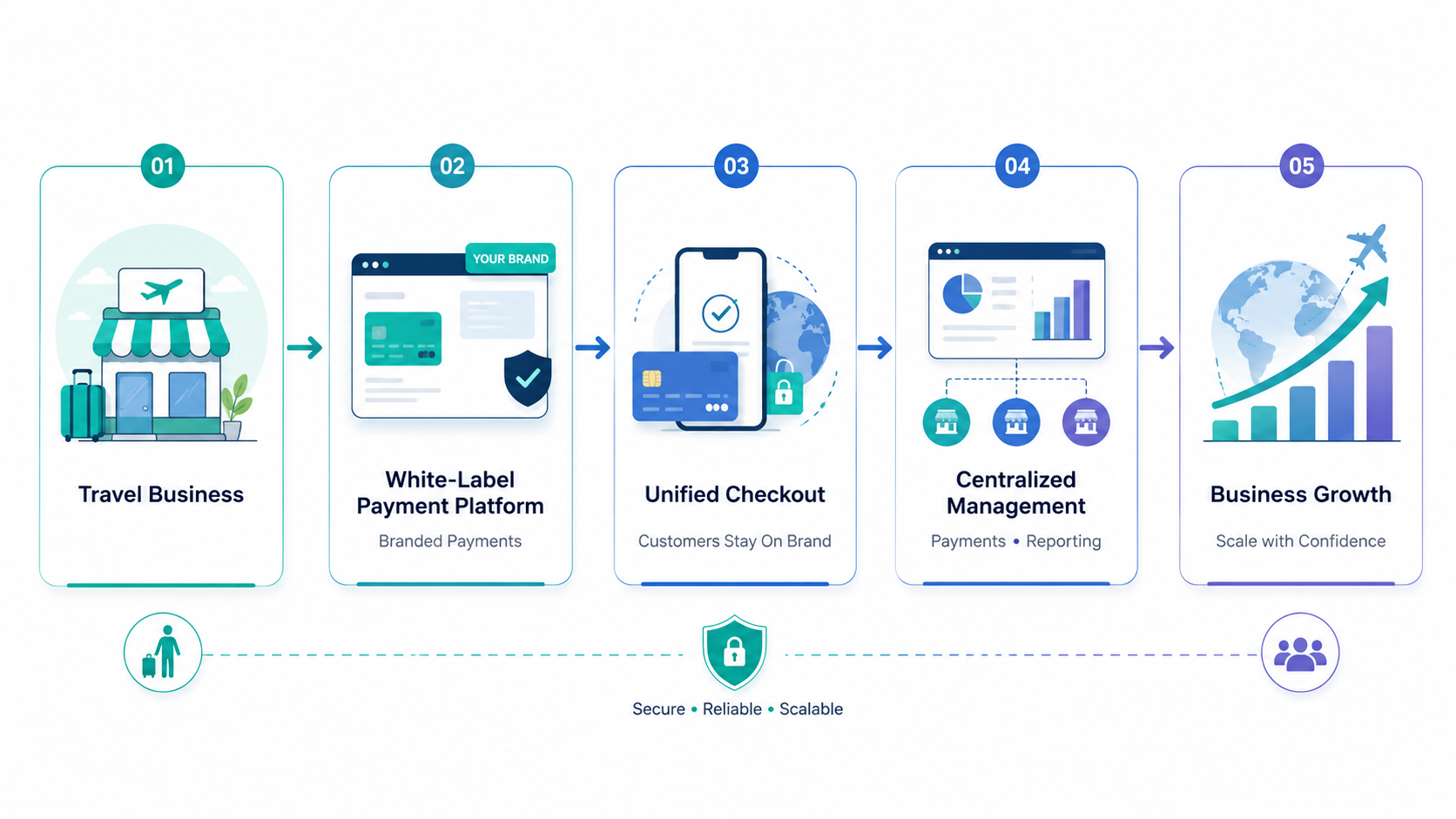
One of the biggest advantages of a white-label platform is the ability to deliver a consistent brand experience. Customers remain within the same booking environment from the moment they search for travel services until the payment is completed. This consistency can strengthen customer confidence and create a smoother checkout experience.
White-label platforms may also help businesses:
- Maintain consistent branding throughout the payment journey.
- Manage payments across multiple business units or merchants.
- Access centralized reporting and transaction management.
- Scale payment operations as the business expands.
- Introduce new payment features without rebuilding the entire system.
Rather than managing several disconnected payment tools, businesses can operate through a more unified payment environment.
Supporting Business Growth
As travel businesses expand, payment operations often become more demanding.
A company that begins as a local travel agency may eventually launch a booking platform serving hundreds of travel providers across multiple countries. Managing these payment relationships manually becomes increasingly difficult as transaction volumes grow.
A white-label payment platform for travel businesses can help support this expansion by providing a centralized system for managing payments, reporting, and merchant activity while maintaining a consistent customer experience.
Businesses planning international growth should also understand international payment processing for travel businesses and multi-currency payment processing, as these capabilities are often important when serving customers across different regions.
Things to Consider Before Choosing a White-Label Platform
A white-label solution is a significant investment, so businesses should carefully evaluate whether it matches their operational needs.
Some important considerations include:
- Business size and future growth plans.
- Number of merchants or partners being managed.
- Integration with existing booking systems.
- International payment capabilities.
- Reporting and operational requirements.
- Customer experience goals.
For many businesses, implementing a white-label platform only becomes practical after reaching a certain level of scale.
Example: From Travel Agency to Booking Platform
Imagine a regional travel agency that initially sells holiday packages through its own website.
As the business grows, it begins partnering with local tour operators, hotels, and activity providers, allowing customers to book multiple services from a single platform.
Instead of directing customers to different payment pages for each provider, the company adopts a white-label payment platform that creates one consistent, branded payment experience across the entire booking process.
Customers enjoy a smoother checkout journey, while the business gains better visibility into transactions and payment operations as the platform continues to expand.
Is a White-Label Platform Right for Every Travel Business?
The answer is usually no.
Small and newly established travel businesses generally do not need the advanced capabilities offered by a white-label platform. A secure payment gateway, merchant account, and reliable travel payment processing system are often sufficient for day-to-day operations.
However, businesses with ambitious growth plans or those developing travel marketplaces, booking platforms, or software solutions may eventually benefit from the additional flexibility and branding opportunities that white-label payment platforms provide.
Understanding the available options early allows businesses to choose payment solutions that align with both their current requirements and future objectives.
Conclusion
A white-label payment platform allows travel businesses to deliver a branded payment experience while using established payment technology behind the scenes. Although these platforms are not necessary for every company, they can provide significant advantages for larger travel businesses, booking platforms, and travel technology providers that require greater control over their payment operations.
By understanding how white-label platforms differ from traditional payment gateways and merchant accounts, travel businesses can make informed decisions as they expand, improve the customer experience, and build a payment infrastructure that supports long-term growth.

Categories
- ACH Payments (10)
- adult payment processing (11)
- AI (9)
- Altcoins (10)
- Banking (10)
- Bitcoin (133)
- Bitcoin ETF (11)
- Bitcoin Price (30)
- Blockchain (50)
- Brokering World Hunger Away (16)
- Business (17)
- card payment processing (10)
- CBD (11)
- CBDC (11)
- Chargeback (8)
- coaching business (11)
- COVID-19 (3)
- Crypto ATMs (1)
- Crypto Banking (17)
- Crypto Bill (1)
- Crypto business owner platform (31)
- Crypto Investment (3)
- Crypto Markets (5)
- Crypto Payment (35)
- Crypto Payment Processor (4)
- Crypto Prices (1)
- Crypto Trading (92)
- Cryptocurrency (402)
- Cryptocurrency Exchange (108)
- Data Visualization (2)
- dating platforms (11)
- debt collection payment processing (10)
- Decentralized Finance (7)
- DeFi Payment (9)
- DEX (3)
- Digital Currency (23)
- dropshipping payment processing (12)
- Ethereum (2)
- FAQ (7)
- file sharing payment processing (11)
- Finance (25)
- Financial Equality (4)
- Financial Freedom (8)
- Forex (35)
- hemp (1)
- ICO (2)
- Investment (11)
- IPTV (11)
- Merchant Account (10)
- Mining (3)
- News (66)
- NFTs (2)
- online gambling (11)
- P2P (1)
- Paybito (147)
- PayBitoPro (693)
- PayBitoPro Coin Listing (6)
- PayBitoPro Exchange (2)
- Payment Gateway (48)
- peptide (10)
- Post COVID Digital Transformation (1)
- Press Release (130)
- Privacy & Security (3)
- Real Estate (1)
- Stablecoin (5)
- Technology (15)
- Travel (11)
- Uncategorized (10)
- US Presidential Election (2)
- Utility Coin (1)
- Web3 business (4)
- Web3 Wallets (2)
- White Label Crypto Exchange (8)
Recent Posts
- Payment Gateway vs. Payment Orchestration: What’s the Difference?
- What Is Smart Payment Routing? Strategies to Optimize Payment Performance
- How to Improve Payment Approval Rates for High-Risk Businesses?
- Why Are Online Payments Failing? Common Causes and How to Fix Them
- How to Use Multiple Payment Processors to Reduce Business Disruptions?