Why CBD Payments Get Declined (And How to Fix Them)?
- August 3, 2026
- Soham Guchait
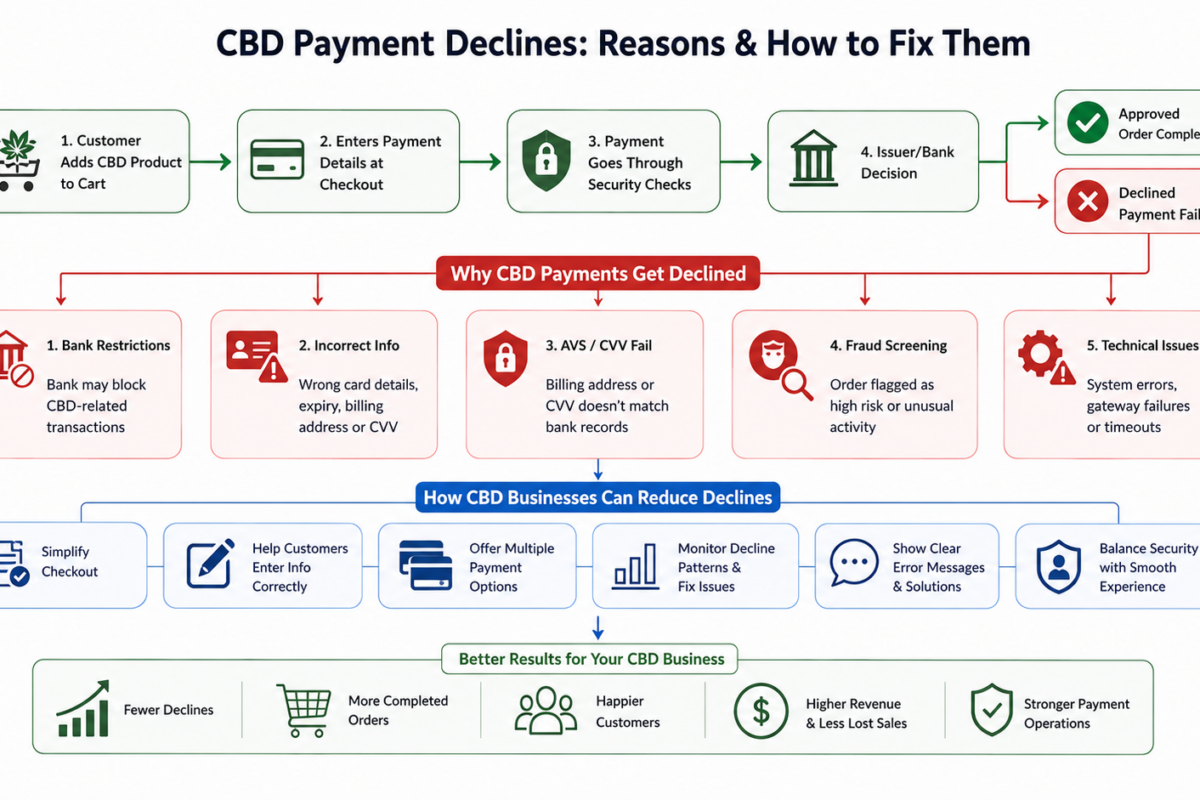
A customer finds a CBD product they want to purchase, enters their payment details, and expects the order to go through. Instead, they receive a message saying their payment has been declined.
For the customer, it may feel like a simple inconvenience. For the business owner, repeated payment declines can mean lost revenue, abandoned carts, and frustrated customers who may not return.
Payment declines are a common challenge for CBD, hemp, and cannabis-related businesses. However, a declined transaction does not always mean there is a problem with the customer’s card or account. Payments can fail for many reasons, including bank restrictions, fraud prevention systems, incorrect information, or technical issues.
Understanding why CBD payments get declined can help businesses identify problems, improve checkout experiences, and reduce unnecessary lost sales.
Why Do CBD Payments Get Declined?
Every payment goes through multiple checks before it is approved. Banks, payment providers, and security systems evaluate transactions to determine whether they appear legitimate.
For businesses in industries considered higher risk, including CBD and hemp, these checks may involve additional scrutiny because of regulatory requirements, fraud concerns, and transaction risk. A payment decline can happen even when a customer has enough funds available.
For example, a customer may regularly purchase CBD skincare products from an online store. One day, their payment is declined even though their card works elsewhere. The reason may not be the customer’s account – it could be a security rule, issuer restriction, or payment verification issue.
Common Reasons CBD Payments Are Declined
Bank and Card Issuer Restrictions
One of the most common reasons for declined CBD payments is that the customer’s bank or card issuer does not support certain types of transactions. Banks make their own decisions about which transactions they approve based on their internal risk policies.
For example, a customer may attempt to buy a hemp-derived CBD supplement using a debit card. The payment fails because their issuing bank automatically blocks transactions associated with certain merchant categories. In this situation, the customer may have sufficient funds, but the transaction is still rejected because of the bank’s policies.
Incorrect Card Information
Simple input errors are another frequent cause of payment failures.
A customer may accidentally enter:
- An incorrect card number
- An outdated expiration date
- The wrong billing address
- An incorrect security code
For example, a customer ordering CBD gummies may enter their old billing address after moving recently. The payment system detects that the information does not match bank records and declines the transaction.
These issues can often be solved by improving checkout instructions and allowing customers to verify their information before submitting payment.
AVS and CVV Verification Failures
Payment systems use security checks such as Address Verification Service (AVS) and Card Verification Value (CVV) checks to reduce fraud. AVS compares the billing address entered during checkout with the address registered with the card issuer. CVV verification confirms that the customer has access to the security code on the physical card.
While these tools help prevent fraud, they can sometimes block legitimate customers.
For example, a customer may place an order while traveling and enter a shipping address different from their billing address. The transaction may be flagged because the information does not match expected patterns.
Fraud Prevention Systems
Fraud protection tools are designed to identify suspicious transactions, but sometimes they may also block genuine purchases. CBD businesses can experience this when transactions appear unusual compared to normal customer behavior.
Examples include:
- A first-time customer placing a high-value order
- Multiple purchases from the same device
- Orders from unfamiliar locations
- Unusual purchasing patterns
For instance, a customer purchasing several CBD wellness bundles as gifts may trigger automated security checks because the order differs from typical buying behavior. The goal is finding the right balance between preventing fraud and allowing legitimate customers to complete purchases.
Technical Issues Can Also Cause Failed Payments
Not every payment decline is related to risk or compliance. Technical problems can also interrupt transactions. Common examples include:
- Website checkout errors
- Payment gateway communication failures
- Expired payment sessions
- Temporary system outages
Imagine a customer completing a checkout for a CBD subscription order. They click the payment button, but the connection between the website and payment system fails before authorization is completed.
From the customer’s perspective, the payment simply appears unsuccessful. Without proper monitoring, businesses may not realize how many sales are being lost due to technical problems.
How CBD Businesses Can Reduce Payment Declines?
Reducing payment failures requires looking at the entire customer payment journey.
Businesses should focus on making payments easier while maintaining appropriate security controls.
Some effective practices include:
- Keeping checkout forms simple and clear
- Allowing customers to correct payment information easily
- Providing multiple payment options
- Monitoring transaction decline patterns
- Communicating clearly when payments fail
For example, if a business notices that many customers from a specific region experience failed payments, it can investigate whether the issue is related to payment restrictions, customer information, or technical limitations.
Offering Alternative Payment Options
Relying on a single payment method can increase the impact of payment declines.
If a customer’s card payment fails, having another available option may allow the transaction to continue. For instance, a customer purchasing CBD supplements may experience a card decline but successfully complete the order using another supported payment method. Understanding the best payment methods for CBD businesses can help companies create a more flexible checkout experience.
Payment Declines and Customer Trust
A declined payment is not just a technical issue – it can affect how customers view a business.
A shopper who experiences repeated payment failures may assume the website is unreliable or avoid returning in the future. Clear communication can make a major difference. Instead of showing a generic error message, businesses should guide customers toward possible solutions, such as checking payment details, trying another payment method, or contacting support. Good payment experiences help build trust, especially in industries where customers may already have questions about product quality and reliability.
Final Thoughts
CBD payment declines happen for many reasons, from bank restrictions and security checks to simple customer errors and technical problems.
The key is understanding that a declined payment does not always indicate a failed business operation. By monitoring transaction issues, improving checkout processes, offering suitable payment options, and maintaining strong customer communication, businesses can reduce unnecessary payment failures.
For CBD, hemp, and cannabis businesses, reliable payment processing is an ongoing process. Identifying why transactions fail is the first step toward creating a smoother experience for customers and building stronger payment operations.

Categories
- ACH Payments (10)
- adult payment processing (11)
- AI (9)
- Altcoins (10)
- Banking (10)
- Bitcoin (133)
- Bitcoin ETF (11)
- Bitcoin Price (30)
- Blockchain (50)
- Brokering World Hunger Away (16)
- Business (17)
- card payment processing (10)
- CBD (11)
- CBDC (11)
- Chargeback (8)
- coaching business (11)
- COVID-19 (3)
- Crypto ATMs (1)
- Crypto Banking (17)
- Crypto Bill (1)
- Crypto business owner platform (31)
- Crypto Investment (3)
- Crypto Markets (5)
- Crypto Payment (35)
- Crypto Payment Processor (4)
- Crypto Prices (1)
- Crypto Trading (92)
- Cryptocurrency (402)
- Cryptocurrency Exchange (108)
- Data Visualization (2)
- dating platforms (11)
- debt collection payment processing (10)
- Decentralized Finance (7)
- DeFi Payment (9)
- DEX (3)
- Digital Currency (23)
- dropshipping payment processing (12)
- Ethereum (2)
- FAQ (7)
- file sharing payment processing (11)
- Finance (25)
- Financial Equality (4)
- Financial Freedom (8)
- Forex (35)
- hemp (1)
- ICO (2)
- Investment (11)
- IPTV (11)
- Merchant Account (10)
- Mining (3)
- News (66)
- NFTs (2)
- online gambling (11)
- P2P (1)
- Paybito (147)
- PayBitoPro (693)
- PayBitoPro Coin Listing (6)
- PayBitoPro Exchange (2)
- Payment Gateway (48)
- peptide (10)
- Post COVID Digital Transformation (1)
- Press Release (130)
- Privacy & Security (3)
- Real Estate (1)
- Stablecoin (5)
- Technology (15)
- Travel (11)
- Uncategorized (10)
- US Presidential Election (2)
- Utility Coin (1)
- Web3 business (4)
- Web3 Wallets (2)
- White Label Crypto Exchange (8)
Recent Posts
- Payment Gateway vs. Payment Orchestration: What’s the Difference?
- What Is Smart Payment Routing? Strategies to Optimize Payment Performance
- How to Improve Payment Approval Rates for High-Risk Businesses?
- Why Are Online Payments Failing? Common Causes and How to Fix Them
- How to Use Multiple Payment Processors to Reduce Business Disruptions?