Why Peptide Payments Get Declined and How Businesses Can Fix It?
- July 28, 2026
- Soham Guchait
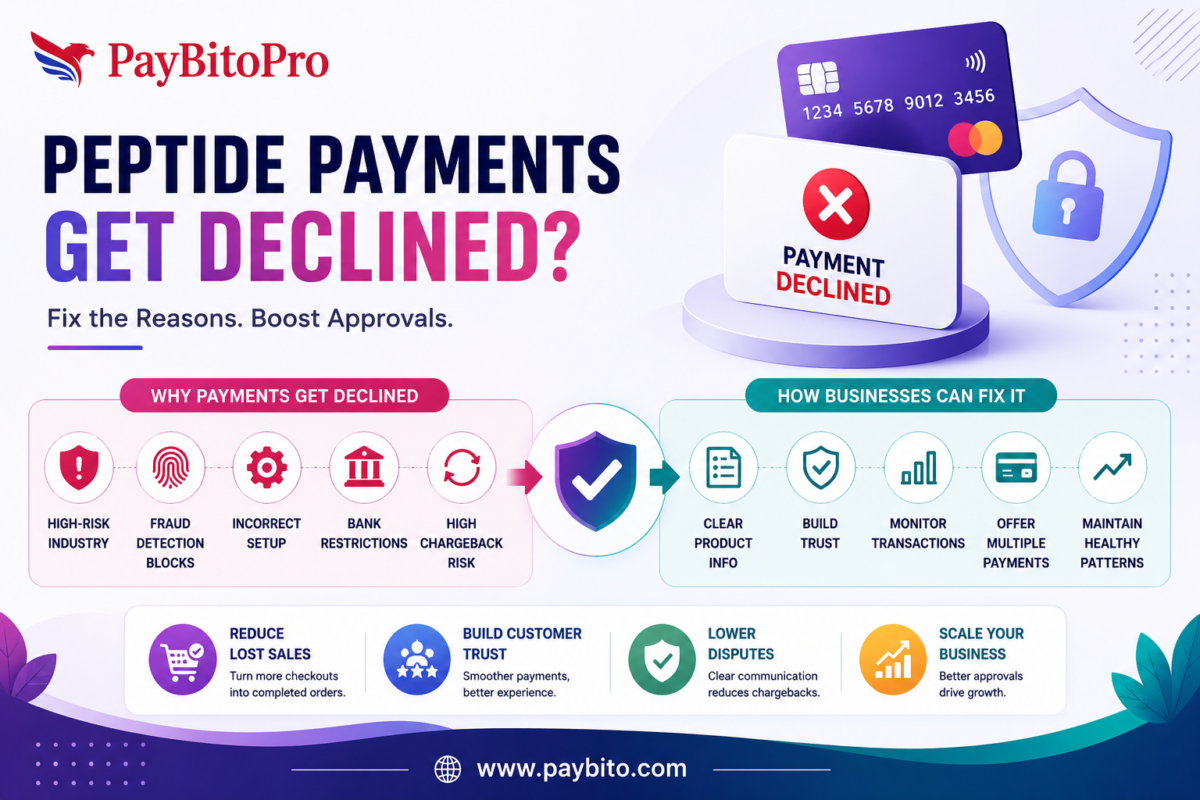
Payment declines are one of the biggest challenges faced by online businesses. For peptide companies, the problem can be even more common because the industry may be classified as high-risk by some payment providers.
A declined payment does not always mean there is something wrong with the customer’s card or account. Payment failures can happen because of risk checks, incorrect payment settings, fraud detection systems, merchant account restrictions, or transaction patterns.
Understanding why peptide payments get declined can help businesses improve payment approval rates, reduce lost sales, and create a smoother checkout experience for customers.
What Does a Payment Decline Mean?
A payment decline occurs when a transaction is rejected before the payment is completed.
During a typical online transaction, multiple systems review the payment request:
- Customer enters payment information
- Payment gateway sends transaction details
- Payment processor evaluates the transaction
- Bank or card network approves or rejects payment
- Settlement begins after approval
If any stage identifies a potential issue, the transaction may be declined.
For example:
A customer places a $200 order from a peptide website. The card has sufficient funds, but the transaction is declined because the payment system detects unusual activity or the merchant account settings require additional verification.
Why Do Peptide Payments Get Declined?
Several factors can cause payment failures for peptide businesses.
1. High-Risk Industry Classification
One of the most common reasons peptide transactions face challenges is industry classification.
Payment processors evaluate businesses based on historical risk data. Some industries experience higher levels of:
- Customer disputes
- Fraud attempts
- Refund requests
- Regulatory review
Because peptide businesses may fall into a higher-risk category, transactions may go through additional monitoring.
Example:
A new peptide company receives a large number of transactions shortly after launching. Automated risk systems may flag this activity because it does not match an established processing history.
2. Fraud Prevention Systems Blocking Legitimate Customers
Payment providers use fraud detection tools to protect businesses and customers. However, sometimes legitimate transactions can be declined.
Common triggers include:
- Customer location mismatch
- Unusual purchase amounts
- Multiple payment attempts
- New customer accounts
- Suspicious transaction patterns
Example:
A returning customer normally purchases small orders but suddenly places a much larger order. The transaction may be declined because the system identifies it as unusual behavior.
3. Incorrect Merchant Account Setup
A properly configured merchant account is essential for successful payment processing.
Problems may occur when:
- Business information is inaccurate
- Product categories are incorrectly represented
- Transaction limits are not configured properly
- Payment settings do not match business needs
Accurate information during merchant account setup helps payment systems better understand the business.
4. Customer Bank Restrictions
Not every declined payment is caused by the merchant or payment processor.
Customer banks may decline transactions because of:
- Insufficient funds
- Card restrictions
- International transaction blocks
- Bank fraud prevention rules
- Expired card details
For example:
A customer from another country attempts to purchase a peptide product, but their bank automatically blocks international online transactions.
5. Increased Chargeback Risk
Payment providers monitor chargeback rates closely.
A high number of disputes can affect future transaction approvals.
Common causes of chargebacks include:
- Customers not recognizing transactions
- Poor communication
- Confusing product information
- Delayed responses
Businesses that manage customer expectations effectively usually experience fewer payment disputes.
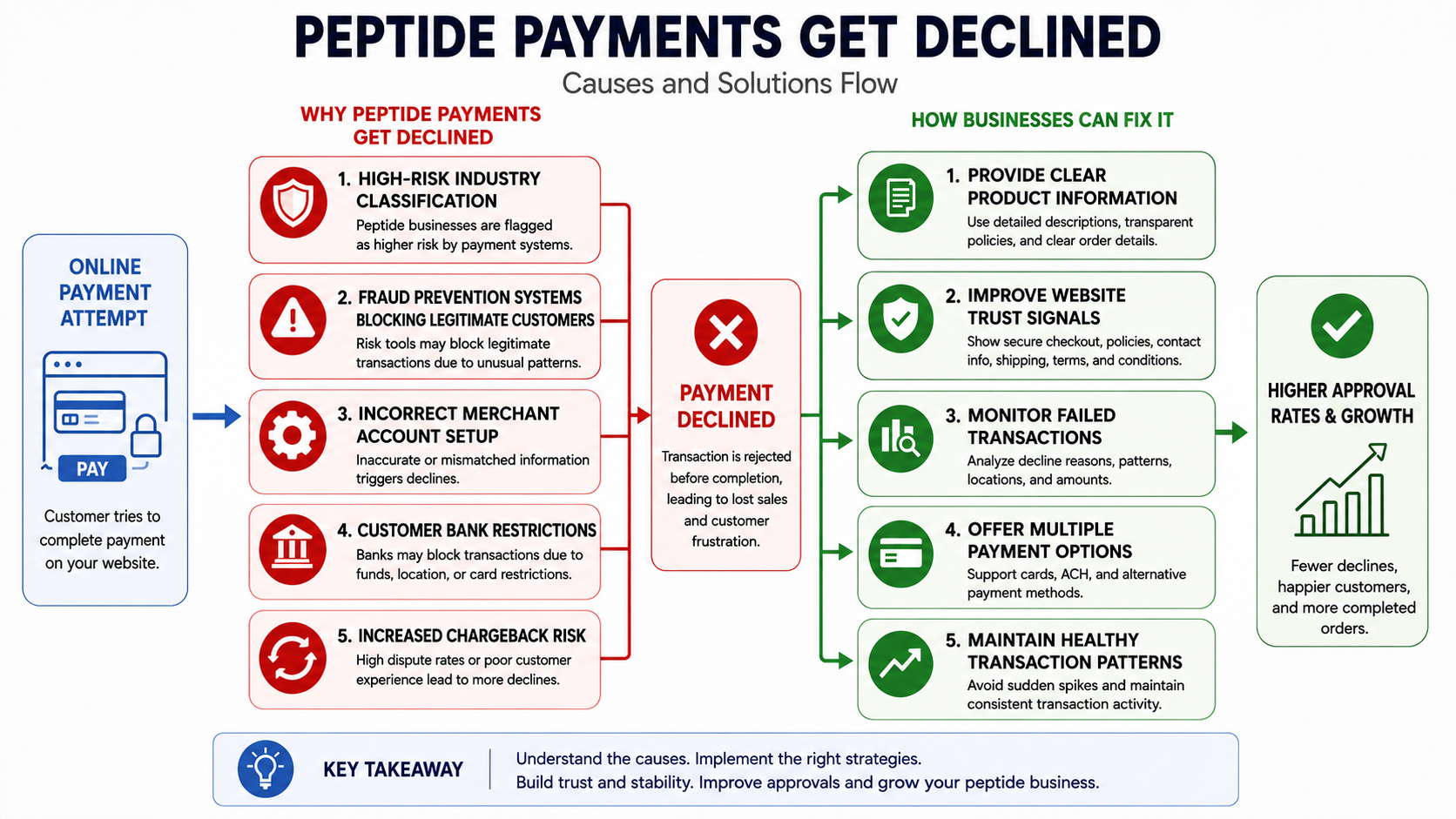
How Can Peptide Businesses Reduce Payment Declines?
Reducing declined transactions requires improving both payment operations and customer experience.
1. Provide Clear Product Information
Customers should clearly understand what they are purchasing.
Businesses should maintain:
- Detailed product descriptions
- Transparent policies
- Clear order information
- Accessible customer support
Clear communication reduces confusion and prevents unnecessary disputes.
2. Improve Website Trust Signals
Payment systems and customers both benefit from a professional website.
Important trust elements include:
- Secure checkout experience
- Business contact information
- Refund policy
- Shipping information
- Terms and conditions
Example:
A customer is more likely to complete payment on a website that clearly explains the business, policies, and purchasing process.
3. Monitor Failed Transactions
Businesses should analyze declined payments instead of treating them as random failures.
Important metrics include:
- Decline reasons
- Failed payment patterns
- Customer locations
- Transaction amounts
Understanding why payments fail helps businesses make targeted improvements.
4. Offer Multiple Payment Options
Different customers prefer different payment methods.
Supporting multiple options can improve payment success rates.
Examples include:
- Credit cards
- Debit cards
- ACH payments
- Alternative payment methods
A customer whose card payment fails may still be able to complete the transaction through another available method.
5. Maintain Healthy Transaction Patterns
Sudden changes in payment activity can trigger risk systems.
Businesses should monitor:
- Sudden volume increases
- Large order changes
- Unusual customer activity
For example:
A peptide company that normally processes $20,000 monthly suddenly processes $200,000 may receive additional reviews from payment providers.
Example: Why Two Similar Peptide Businesses Experience Different Approval Rates
Consider two peptide companies.
Company A:
- Professional website
- Clear product information
- Low dispute rate
- Consistent transaction history
- Multiple payment options
Company B:
- Limited website information
- Frequent disputes
- Sudden transaction spikes
- Poor customer communication
Even though both sell similar products, Company A may experience fewer payment declines because its payment environment appears more stable.
When Should a Peptide Business Review Its Payment Setup?
Businesses should evaluate their payment processing when they experience:
- Frequent declined transactions
- Increasing customer complaints
- Payment provider restrictions
- Slow settlements
- Difficulty accepting international payments
A reliable payment setup should support business growth without creating unnecessary checkout barriers.
Conclusion
Payment declines can significantly impact peptide businesses by reducing completed orders and affecting customer trust. Because peptide companies may operate in a high-risk payment category, understanding the causes behind declined transactions is essential.
By improving website transparency, maintaining accurate business information, monitoring transaction patterns, and choosing appropriate payment solutions, businesses can improve payment approval rates and create a more reliable checkout experience.
A strong payment processor helps peptide companies reduce lost revenue and build smoother customer transactions.

Categories
- ACH Payments (10)
- adult payment processing (11)
- AI (9)
- Altcoins (10)
- Banking (10)
- Bitcoin (133)
- Bitcoin ETF (11)
- Bitcoin Price (30)
- Blockchain (50)
- Brokering World Hunger Away (16)
- Business (17)
- card payment processing (10)
- CBD (11)
- CBDC (11)
- coaching business (11)
- COVID-19 (3)
- Crypto ATMs (1)
- Crypto Banking (17)
- Crypto Bill (1)
- Crypto business owner platform (31)
- Crypto Investment (3)
- Crypto Markets (5)
- Crypto Payment (35)
- Crypto Payment Processor (4)
- Crypto Prices (1)
- Crypto Trading (92)
- Cryptocurrency (402)
- Cryptocurrency Exchange (108)
- Data Visualization (2)
- dating platforms (11)
- debt collection payment processing (10)
- Decentralized Finance (7)
- DeFi Payment (9)
- DEX (3)
- Digital Currency (23)
- dropshipping payment processing (12)
- Ethereum (2)
- FAQ (7)
- file sharing payment processing (11)
- Finance (25)
- Financial Equality (4)
- Financial Freedom (8)
- Forex (35)
- hemp (1)
- ICO (2)
- Investment (11)
- IPTV (11)
- Merchant Account (10)
- Mining (3)
- News (66)
- NFTs (2)
- online gambling (11)
- P2P (1)
- Paybito (139)
- PayBitoPro (693)
- PayBitoPro Coin Listing (6)
- PayBitoPro Exchange (2)
- Payment Gateway (40)
- peptide (10)
- Post COVID Digital Transformation (1)
- Press Release (130)
- Privacy & Security (3)
- Real Estate (1)
- Stablecoin (5)
- Technology (15)
- Travel (11)
- Uncategorized (9)
- US Presidential Election (2)
- Utility Coin (1)
- Web3 business (4)
- Web3 Wallets (2)
- White Label Crypto Exchange (8)
Recent Posts
- ACH vs Wire Transfer: Which Payment Method Is Better for Businesses?
- ACH Fraud Prevention: How Businesses Can Secure Bank Account Payments?
- ACH Credit vs ACH Debit: What’s the Difference? With Real Examples
- ACH vs Credit Card: Which Payment Method Is Better for Businesses?
- How Long Do ACH Payments Take? Processing Times, Settlement, and Same Day ACH