Why Are Online Gambling Businesses Considered High Risk?
- July 30, 2026
- Soham Guchait
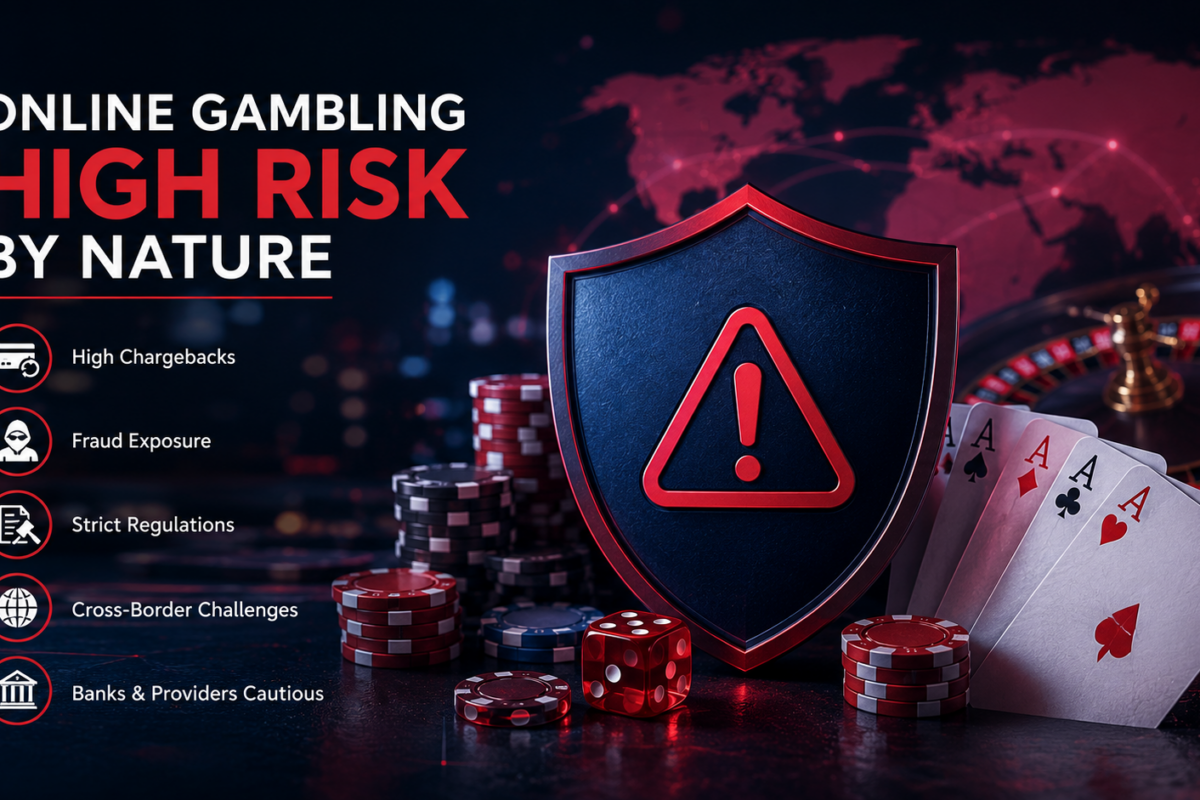
Starting an online casino or sportsbook can be challenging for many reasons, but one of the biggest obstacles new operators face is payment processing. Many gambling businesses discover that banks, payment processors, and financial institutions classify them as “high risk” during the onboarding process.
This classification does not necessarily mean the business is unreliable or unsafe. Instead, it means financial institutions consider gambling transactions more complex because of factors such as fraud exposure, regulatory requirements, chargeback risks, and industry-specific compliance obligations.
Understanding why online gambling businesses are considered high risk helps operators prepare better, improve their approval chances, and build a more reliable payment infrastructure.
What Does “High Risk” Mean in Payment Processing?
A high-risk business is a company that payment providers consider more challenging to support because transactions may carry higher financial or regulatory risks.
In traditional eCommerce, a customer buys a product, receives it, and the transaction is usually completed. Gambling businesses work differently. A player may deposit funds, participate in games, withdraw winnings, and dispute transactions later. This creates additional challenges for payment providers that must manage fraud risks, regulatory obligations, and potential financial losses.
For example, an online sportsbook may process thousands of deposits during a major sporting event. If fraudulent transactions increase during that period, the payment provider may face significant chargeback costs and compliance concerns.
This is why gambling businesses often require specialized payment solutions designed for higher-risk industries.
Why Are Online Gambling Businesses Classified as High Risk?
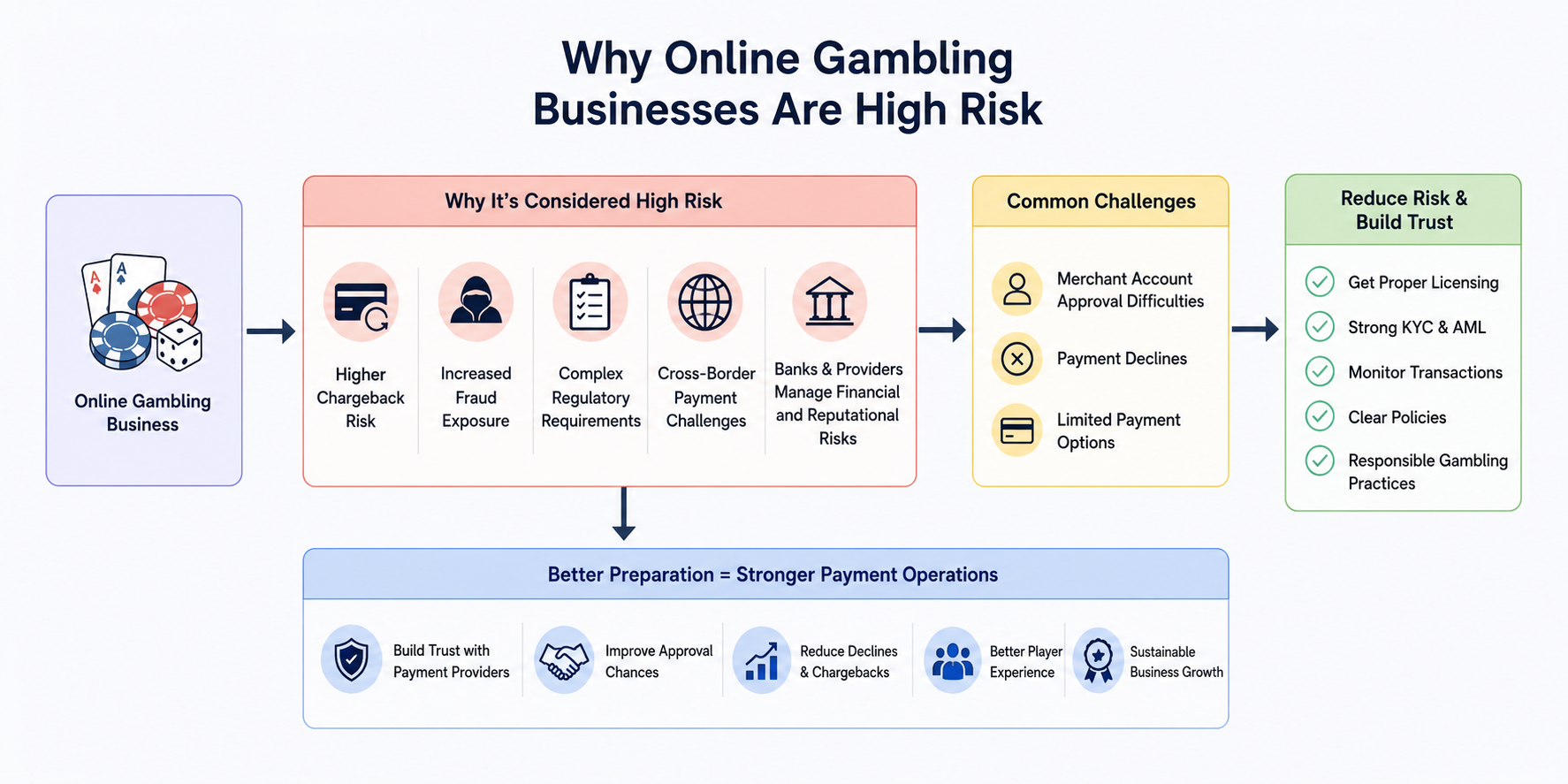
Several factors contribute to the high-risk classification of online casinos and sportsbooks.
Higher Chargeback Risk
Chargebacks are one of the biggest concerns for payment providers working with gambling businesses. A chargeback occurs when a player disputes a transaction with their bank or card issuer and requests a reversal of the payment.
Gambling-related disputes can happen for different reasons:
- A player does not recognize a transaction
- A customer claims unauthorized account activity
- A player disputes losses from gambling activity
- Fraudulent users use stolen payment information
A high number of chargebacks can create financial losses for payment providers and increase monitoring requirements for operators. Because of this, operators need to understand effective chargeback prevention for online casinos and sports betting sites before scaling their payment operations.
Increased Fraud Exposure
Online gambling platforms handle valuable transactions, making them attractive targets for fraudsters. Criminals may attempt to exploit gaming platforms through stolen cards, fake identities, or compromised accounts.
Common fraud risks include:
- Payment card fraud
- Account takeover attacks
- Identity theft
- Bonus abuse
- Multiple account creation
For example, a fraudster may create several accounts using stolen identities, deposit funds with stolen cards, claim promotional bonuses, and withdraw money before detection.
To reduce these risks, operators often implement advanced monitoring systems and follow strong fraud prevention in online gambling payments practices.
Complex Regulatory Requirements
Online gambling is regulated differently depending on the country or region where an operator provides services. Unlike many online businesses, gambling companies must often meet strict requirements related to:
- Licensing
- Player protection
- Responsible gambling
- Transaction monitoring
- Customer verification
Payment providers must ensure that the businesses they support follow applicable regulations. If an operator cannot demonstrate proper compliance, payment providers may reject the application or limit available services. This is why understanding how KYC and AML work in online gambling payment processing is essential for any new operator entering the market.
Cross-Border Payment Challenges
Many gambling businesses serve players from multiple countries. This creates additional payment complexity.
Different regions may have:
- Different preferred payment methods
- Different financial regulations
- Different restrictions on gambling transactions
- Different currency requirements
For example, a sportsbook accepting players from Europe, Asia, and North America may need to support different payment preferences while ensuring compliance in each market. Managing international payments requires careful planning, especially for operators expanding beyond their initial target region.
Why Banks and Payment Providers Are Careful With Gambling Businesses?
Banks and payment processors evaluate gambling businesses more carefully because they need to manage financial and reputational risks.
During onboarding, they may review:
- Business model
- Gambling license
- Website functionality
- Customer verification process
- Responsible gambling policies
- Expected transaction volume
A new operator with incomplete documentation may face delays or rejection because providers cannot accurately evaluate the business risk. Preparing proper documentation and understanding their merchant account requirements can improve the chances of successful approval.
Common Challenges Faced by High-Risk Gambling Businesses
Being classified as high risk can create several operational challenges.
Merchant Account Approval Difficulties
Many new operators struggle to find payment providers willing to support their business model.
Common reasons for rejection include:
- Missing licenses
- Weak compliance procedures
- Incomplete business information
- Lack of operational history
Understanding the approval process and learning how to get a merchant account for an online gambling business can help operators avoid common mistakes.
Payment Declines
Even after approval, operators may experience failed transactions.
Payments can be declined because of:
- Bank restrictions
- Fraud detection rules
- Incorrect transaction information
- Regional limitations
- Customer verification issues
A high decline rate directly affects player experience and revenue. Learning why online gambling payments get declined helps operators identify and solve common problems.
Limited Payment Options
Some payment providers may restrict available payment methods for gambling businesses due to risk concerns. However, offering multiple trusted payment options can improve player convenience and reduce abandoned deposits.
Operators should carefully evaluate how to choose the right payment gateway for an online casino or sportsbook based on reliability, security, payment coverage, and scalability.
How Gambling Businesses Can Reduce Their Risk Profile?
Although gambling businesses are considered high risk, operators can take steps to build trust with payment providers.
Important practices include:
- Obtaining proper licensing before accepting players
- Maintaining clear terms and conditions
- Implementing strong customer verification
- Monitoring suspicious transactions
- Creating transparent refund policies
- Using responsible gambling practices
A well-prepared operator demonstrates that it understands compliance requirements and takes payment security seriously.
Final Thoughts
Online gambling businesses are considered high risk because they involve complex transactions, increased fraud exposure, strict regulations, and higher chargeback possibilities.
However, being classified as high risk does not prevent a business from building successful payment operations. Operators who understand these challenges early can prepare better documentation, choose appropriate payment solutions, and create safer experiences for players.
The key is recognizing that payment processing for gambling is not only about accepting deposits. It requires a combination of compliance, security, risk management, and reliable transaction infrastructure.

Categories
- ACH Payments (10)
- adult payment processing (11)
- AI (9)
- Altcoins (10)
- Banking (10)
- Bitcoin (133)
- Bitcoin ETF (11)
- Bitcoin Price (30)
- Blockchain (50)
- Brokering World Hunger Away (16)
- Business (17)
- card payment processing (10)
- CBD (11)
- CBDC (11)
- coaching business (11)
- COVID-19 (3)
- Crypto ATMs (1)
- Crypto Banking (17)
- Crypto Bill (1)
- Crypto business owner platform (31)
- Crypto Investment (3)
- Crypto Markets (5)
- Crypto Payment (35)
- Crypto Payment Processor (4)
- Crypto Prices (1)
- Crypto Trading (92)
- Cryptocurrency (402)
- Cryptocurrency Exchange (108)
- Data Visualization (2)
- dating platforms (11)
- debt collection payment processing (10)
- Decentralized Finance (7)
- DeFi Payment (9)
- DEX (3)
- Digital Currency (23)
- dropshipping payment processing (12)
- Ethereum (2)
- FAQ (7)
- file sharing payment processing (11)
- Finance (25)
- Financial Equality (4)
- Financial Freedom (8)
- Forex (35)
- hemp (1)
- ICO (2)
- Investment (11)
- IPTV (11)
- Merchant Account (10)
- Mining (3)
- News (66)
- NFTs (2)
- online gambling (11)
- P2P (1)
- Paybito (139)
- PayBitoPro (693)
- PayBitoPro Coin Listing (6)
- PayBitoPro Exchange (2)
- Payment Gateway (40)
- peptide (10)
- Post COVID Digital Transformation (1)
- Press Release (130)
- Privacy & Security (3)
- Real Estate (1)
- Stablecoin (5)
- Technology (15)
- Travel (11)
- Uncategorized (9)
- US Presidential Election (2)
- Utility Coin (1)
- Web3 business (4)
- Web3 Wallets (2)
- White Label Crypto Exchange (8)
Recent Posts
- ACH vs Wire Transfer: Which Payment Method Is Better for Businesses?
- ACH Fraud Prevention: How Businesses Can Secure Bank Account Payments?
- ACH Credit vs ACH Debit: What’s the Difference? With Real Examples
- ACH vs Credit Card: Which Payment Method Is Better for Businesses?
- How Long Do ACH Payments Take? Processing Times, Settlement, and Same Day ACH