How to Get a Merchant Account for an Online Gambling Business?
- July 30, 2026
- Soham Guchait
For any online casino, sportsbook, or gaming platform, accepting player payments is one of the most important parts of running the business. However, many new operators discover that getting approved for payment processing is more difficult than expected.
Unlike traditional online businesses, gambling companies are often classified as high risk because of regulatory requirements, fraud exposure, and chargeback concerns. As a result, many standard banks and payment providers may not support gambling transactions.
A merchant account allows an online gambling business to accept card payments and receive settlements from approved transactions. Understanding the approval process, requirements, and common challenges can help operators prepare before applying.
What Is a Merchant Account for an Online Gambling Business?
A merchant account is a specialized business account that allows companies to accept electronic payments from customers.
When a player deposits money into an online casino account, the transaction passes through multiple stages involving payment gateways, acquiring banks, card networks, and financial institutions before funds are settled. For gambling businesses, the process involves additional risk checks because operators handle:
- Player deposits
- Withdrawals
- High transaction volumes
- Cross-border payments
- Regulated gaming activity
A standard business merchant account is often not suitable for gambling operators because the industry requires additional risk assessment and compliance review. This is why online gambling businesses typically need a specialized high-risk merchant account designed to handle their specific operational requirements.
Why Is It Difficult to Get a Merchant Account for Online Gambling?
The biggest challenge is that payment providers evaluate gambling businesses differently from regular online businesses. Payment providers consider online gambling businesses as high risk business due to factors such as frequent chargebacks, fraud attempts, regulatory obligations, and transaction disputes, as explained in our article on the topic.
For example, an online sportsbook may experience a sudden increase in transactions during a major sporting event. If fraud rates or payment disputes increase during that period, the payment provider must manage additional financial exposure.
Because of these risks, providers usually conduct more detailed reviews before approving gambling merchants.
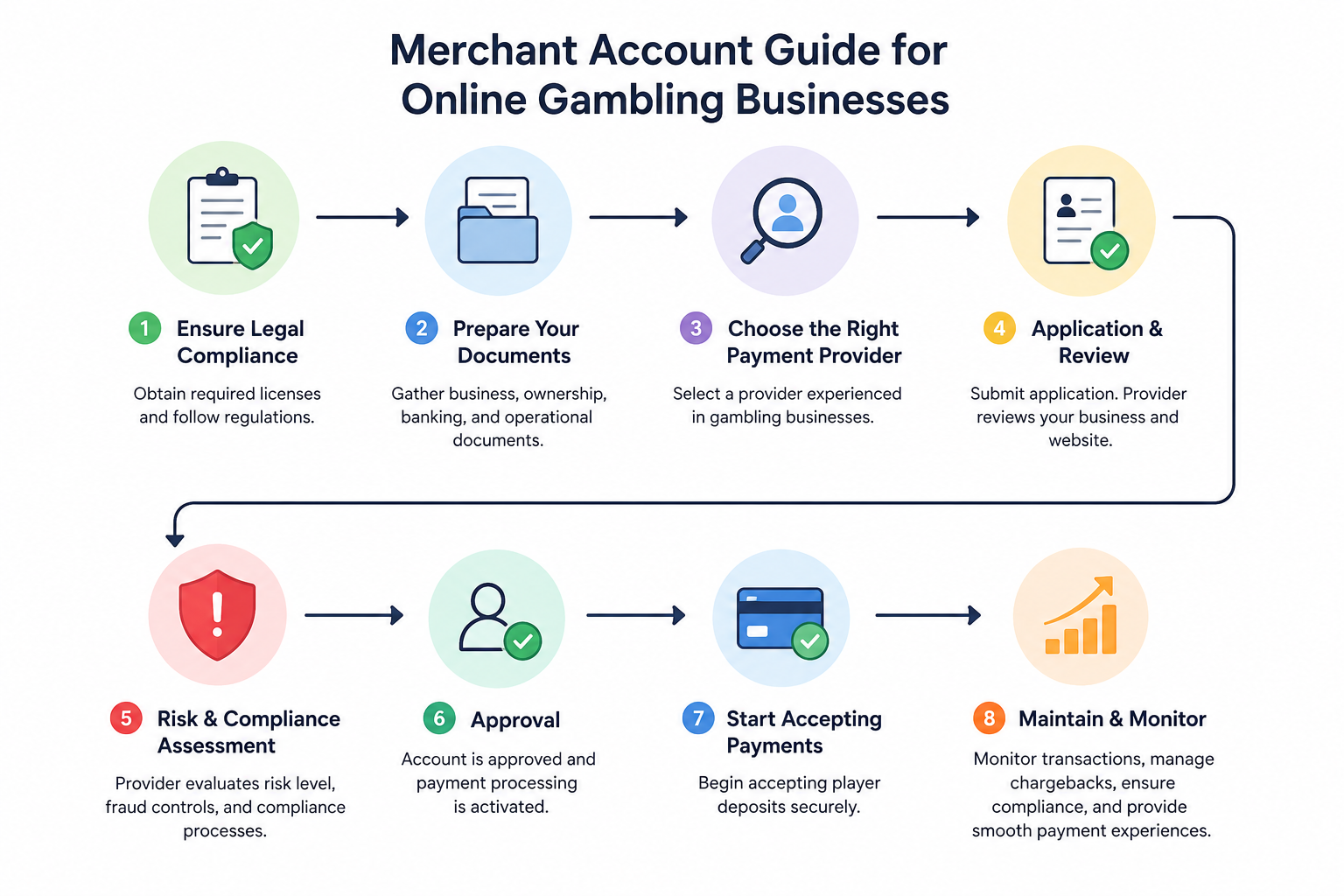
Steps to Get a Merchant Account for an Online Gambling Business
1. Ensure Your Business Is Legally Compliant
Before applying, operators should have their business structure and regulatory requirements properly organized. Payment providers typically evaluate whether the gambling operation is legitimate and follows applicable laws.
Important areas include:
- Gambling licenses where required
- Business registration details
- Responsible gambling policies
- Terms and conditions
- Privacy policies
- Customer protection measures
A business without proper licensing or compliance documentation will often struggle during the approval process.
2. Prepare Your Business Documentation
Payment providers need enough information to understand the business model, expected transaction activity, and risk level.
Common documents may include:
- Company registration documents
- Ownership information
- Identification documents
- Banking information
- Business plan
- Expected processing volume
- Website details
Having complete documentation improves transparency and reduces unnecessary delays. Understanding the merchant account requirements for gambling companies before applying helps operators avoid missing important information during onboarding.
3. Choose a Payment Provider Experienced With Gambling Businesses
Not every payment provider supports online gambling transactions. Operators should evaluate providers based on their experience with regulated gaming businesses, supported regions, payment methods, and compliance capabilities.
Important factors to consider include:
- Supported payment methods
- Geographic coverage
- Security features
- Transaction monitoring
- Settlement options
- Integration capabilities
Selecting the right infrastructure early is important because changing payment providers after launch can create disruption for players. Learning how to choose the right payment gateway for an online casino or sportsbook can help operators compare available options more effectively.
What Payment Providers Look For During Approval?
When reviewing an online gambling merchant application, providers usually assess several areas.
Business Legitimacy
Providers want to confirm that the operator is a genuine business with transparent ownership and clear operations.
They may review:
- Company information
- Licensing status
- Website content
- Business model
Risk Management Processes
As gambling transactions involve higher fraud risks, providers want to see that operators have systems in place to monitor suspicious activity.
This may include:
- Transaction monitoring
- Customer verification procedures
- Fraud detection controls
Strong security practices are especially important because online gambling platforms are frequent targets for fraud attempts. Operators should understand fraud prevention in online gambling payments to build stronger protection systems.
Customer Verification Procedures
Payment providers often require operators to follow identity verification and anti-money laundering procedures. These processes help confirm player identities and reduce illegal financial activity. Having proper KYC and AML processes in online gambling payment processing is an important part of gaining payment provider confidence.
Common Reasons Gambling Merchant Account Applications Get Rejected
Many applications fail because operators underestimate the level of preparation required.
Common rejection reasons include:
Incomplete Documentation
Missing business information, unclear ownership details, or incomplete compliance documents can delay approval.
Weak Website Compliance
Payment providers often review the operator’s website before approval.
Problems may include:
- Missing terms and conditions
- No responsible gambling information
- Unclear payment policies
- Lack of licensing details
Poor Risk Management Planning
Operators without clear fraud prevention and dispute management procedures may appear too risky. This is especially important because excessive disputes can lead to financial losses and account restrictions.
Understanding chargeback prevention for online casinos and sports betting sites helps businesses prepare strategies before processing begins.
After Getting Approved: Maintaining Your Merchant Account
Approval is only the beginning. Gambling operators must continue maintaining healthy payment operations.
Important practices include:
- Monitoring transaction activity
- Keeping chargebacks under control
- Maintaining compliance documentation
- Reviewing suspicious activity
- Providing smooth payment experiences
Payment issues after launch can affect revenue and player satisfaction. Problems such as failed deposits, payment restrictions, or transaction blocks should be addressed quickly. Understanding why online gambling payments get declined can help operators identify common issues and improve payment performance.
Final Thoughts
Getting a merchant account for an online gambling business requires more preparation than applying for a traditional business payment account.
Operators need to demonstrate regulatory compliance, strong security practices, transparent operations, and effective risk management. The approval process becomes much easier when businesses understand what payment providers evaluate and prepare the necessary documentation before applying. A reliable merchant account is not just a payment tool. It is a foundation that allows online casinos and sportsbooks to accept player payments securely while building long-term operational stability.

Categories
- ACH Payments (10)
- adult payment processing (11)
- AI (9)
- Altcoins (10)
- Banking (10)
- Bitcoin (133)
- Bitcoin ETF (11)
- Bitcoin Price (30)
- Blockchain (50)
- Brokering World Hunger Away (16)
- Business (17)
- card payment processing (10)
- CBD (11)
- CBDC (11)
- Chargeback (8)
- coaching business (11)
- COVID-19 (3)
- Crypto ATMs (1)
- Crypto Banking (17)
- Crypto Bill (1)
- Crypto business owner platform (31)
- Crypto Investment (3)
- Crypto Markets (5)
- Crypto Payment (35)
- Crypto Payment Processor (4)
- Crypto Prices (1)
- Crypto Trading (92)
- Cryptocurrency (402)
- Cryptocurrency Exchange (108)
- Data Visualization (2)
- dating platforms (11)
- debt collection payment processing (10)
- Decentralized Finance (7)
- DeFi Payment (9)
- DEX (3)
- Digital Currency (23)
- dropshipping payment processing (12)
- Ethereum (2)
- FAQ (7)
- file sharing payment processing (11)
- Finance (25)
- Financial Equality (4)
- Financial Freedom (8)
- Forex (35)
- hemp (1)
- ICO (2)
- Investment (11)
- IPTV (11)
- Merchant Account (10)
- Mining (3)
- News (66)
- NFTs (2)
- online gambling (11)
- P2P (1)
- Paybito (147)
- PayBitoPro (693)
- PayBitoPro Coin Listing (6)
- PayBitoPro Exchange (2)
- Payment Gateway (48)
- peptide (10)
- Post COVID Digital Transformation (1)
- Press Release (130)
- Privacy & Security (3)
- Real Estate (1)
- Stablecoin (5)
- Technology (15)
- Travel (11)
- Uncategorized (10)
- US Presidential Election (2)
- Utility Coin (1)
- Web3 business (4)
- Web3 Wallets (2)
- White Label Crypto Exchange (8)
Recent Posts
- Payment Gateway vs. Payment Orchestration: What’s the Difference?
- What Is Smart Payment Routing? Strategies to Optimize Payment Performance
- How to Improve Payment Approval Rates for High-Risk Businesses?
- Why Are Online Payments Failing? Common Causes and How to Fix Them
- How to Use Multiple Payment Processors to Reduce Business Disruptions?