KYC and AML in Online Gambling Payment Processing: Why They Matter for Every Operator
- July 31, 2026
- Soham Guchait
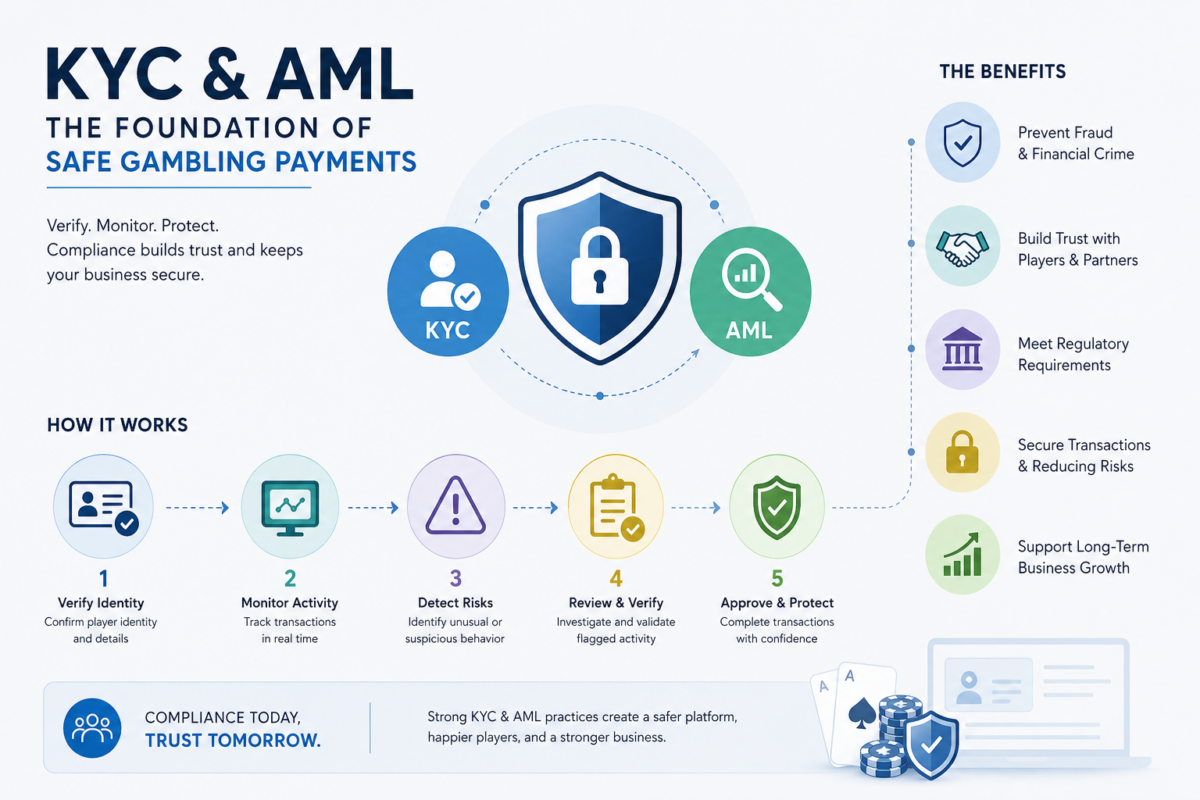
Launching an online casino or sportsbook involves more than creating games and accepting deposits. Before a player can access certain features or withdraw winnings, operators are often required to verify identities, monitor transactions, and comply with financial regulations.
These responsibilities are commonly known as Know Your Customer (KYC) and Anti-Money Laundering (AML) compliance.
For many new operators, KYC and AML appear to be administrative tasks that slow down onboarding. In reality, they are essential parts of online gambling payment processing that help prevent fraud, reduce financial crime, and build trust with payment providers. Understanding how these processes work can help operators create a safer payment environment while meeting regulatory expectations.
Why KYC and AML Are Essential in Online Gambling?
Unlike many online businesses, gambling platforms process continuous financial transactions involving deposits, withdrawals, bonuses, and player balances. This makes them attractive targets for identity fraud, money laundering, and other financial crimes.
KYC and AML procedures help operators answer important questions before processing payments:
- Is the player who they claim to be?
- Is the payment coming from a legitimate source?
- Does the transaction follow regulatory requirements?
- Is there any suspicious financial activity?
For example, imagine a newly registered customer attempts to deposit a large amount of money immediately after creating an account and then requests a withdrawal without participating in any games. This unusual activity may require additional verification before the transaction proceeds.
Rather than creating unnecessary obstacles, these checks help protect both legitimate players and the operator.
Understanding KYC in the Payment Journey
Know Your Customer (KYC) refers to the process of verifying a player’s identity before allowing certain financial activities. The exact requirements depend on the jurisdiction and licensing authority, but the objective remains the same: Confirm that the customer is genuine.
Identity verification often includes information such as:
- Government-issued identification
- Proof of address
- Date of birth
- Contact information
For example, if a player creates multiple accounts using different names but the same supporting documents or device, verification procedures can help identify inconsistencies before payments are processed. KYC also supports responsible gambling initiatives by helping operators ensure that players meet age requirements and comply with local regulations.
How AML Supports Secure Payment Processing?
While KYC focuses on verifying customers, AML procedures focus on monitoring financial activity. The objective is to identify transactions that may indicate illegal or suspicious behavior.
Examples of activities that may require further review include:
- Multiple high-value deposits within a short period
- Unusual withdrawal patterns
- Transactions that differ significantly from normal customer behavior
- Attempts to move funds through several accounts
For example, if a player consistently deposits modest amounts but suddenly begins making unusually large transactions from different payment sources, automated monitoring systems may flag the activity for further review. These reviews help operators investigate unusual behavior before financial risks increase.
Why Payment Providers Care About Compliance?
Payment providers share responsibility for maintaining secure financial systems. Before approving a gambling business, they often evaluate whether the operator has practical procedures for customer verification and transaction monitoring.
A business with clear compliance processes demonstrates that it understands industry responsibilities and is better prepared to manage payment risks.
This is one reason operators seeking a merchant account for an online gambling business are often asked detailed questions about their KYC and AML procedures during the approval process.
Balancing Compliance and Player Experience
One challenge for gambling operators is maintaining strong compliance without creating unnecessary friction for legitimate customers. Long verification delays can frustrate players, while weak verification procedures increase fraud exposure. Successful operators typically focus on making compliance as efficient as possible by:
- Explaining why verification is required.
- Requesting documents only when appropriate.
- Keeping players informed during the review process.
- Using secure digital verification methods.
For example, notifying a player that identity verification is required before their first withdrawal helps set expectations early and reduces confusion later. A transparent process improves trust while supporting regulatory compliance.
KYC and AML Are Not One-Time Tasks
Some new operators assume compliance ends after verifying a customer’s identity. In practice, KYC and AML continue throughout the customer relationship. Operators regularly review transaction activity, update customer information when necessary, and investigate unusual behavior as it occurs. This ongoing approach helps businesses respond to changing risk levels rather than relying only on initial verification.
It also supports stronger chargeback prevention for online casinos and sports betting sites, since well-documented customer records and verified identities can help resolve payment disputes more effectively.
Technology’s Role in Compliance
Modern gambling platforms increasingly rely on technology to support compliance efforts. Automated systems can assist with:
- Identity verification
- Document validation
- Transaction monitoring
- Risk scoring
- Suspicious activity alerts
Technology does not replace human oversight, but it helps operators process information more efficiently while identifying patterns that may otherwise be overlooked. Combining automation with well-defined internal procedures creates a more effective compliance program.
Building Long-Term Trust
Strong KYC and AML practices benefit more than regulatory compliance. They help operators:
- Protect legitimate players.
- Reduce financial crime.
- Improve payment security.
- Build credibility with financial institutions.
- Support sustainable business growth.
They also complement broader fraud prevention in online gambling payments, creating multiple layers of protection that reduce financial and operational risks.
Final Thoughts
KYC and AML are fundamental parts of online gambling payment processing rather than administrative requirements added after launch. By verifying customer identities, monitoring transactions, and responding to unusual financial activity, operators create a safer environment for players while strengthening their relationships with payment providers.
Businesses that integrate compliance into their everyday operations are generally better positioned to reduce risk, maintain regulatory standards, and support long-term growth in an increasingly regulated industry.

Categories
- ACH Payments (10)
- adult payment processing (11)
- AI (9)
- Altcoins (10)
- Banking (10)
- Bitcoin (133)
- Bitcoin ETF (11)
- Bitcoin Price (30)
- Blockchain (50)
- Brokering World Hunger Away (16)
- Business (17)
- card payment processing (10)
- CBD (11)
- CBDC (11)
- coaching business (11)
- COVID-19 (3)
- Crypto ATMs (1)
- Crypto Banking (17)
- Crypto Bill (1)
- Crypto business owner platform (31)
- Crypto Investment (3)
- Crypto Markets (5)
- Crypto Payment (35)
- Crypto Payment Processor (4)
- Crypto Prices (1)
- Crypto Trading (92)
- Cryptocurrency (402)
- Cryptocurrency Exchange (108)
- Data Visualization (2)
- dating platforms (11)
- debt collection payment processing (10)
- Decentralized Finance (7)
- DeFi Payment (9)
- DEX (3)
- Digital Currency (23)
- dropshipping payment processing (12)
- Ethereum (2)
- FAQ (7)
- file sharing payment processing (11)
- Finance (25)
- Financial Equality (4)
- Financial Freedom (8)
- Forex (35)
- hemp (1)
- ICO (2)
- Investment (11)
- IPTV (11)
- Merchant Account (10)
- Mining (3)
- News (66)
- NFTs (2)
- online gambling (11)
- P2P (1)
- Paybito (139)
- PayBitoPro (693)
- PayBitoPro Coin Listing (6)
- PayBitoPro Exchange (2)
- Payment Gateway (40)
- peptide (10)
- Post COVID Digital Transformation (1)
- Press Release (130)
- Privacy & Security (3)
- Real Estate (1)
- Stablecoin (5)
- Technology (15)
- Travel (11)
- Uncategorized (9)
- US Presidential Election (2)
- Utility Coin (1)
- Web3 business (4)
- Web3 Wallets (2)
- White Label Crypto Exchange (8)
Recent Posts
- ACH vs Wire Transfer: Which Payment Method Is Better for Businesses?
- ACH Fraud Prevention: How Businesses Can Secure Bank Account Payments?
- ACH Credit vs ACH Debit: What’s the Difference? With Real Examples
- ACH vs Credit Card: Which Payment Method Is Better for Businesses?
- How Long Do ACH Payments Take? Processing Times, Settlement, and Same Day ACH