Why Are Adult Businesses Considered High Risk?
- August 4, 2026
- Soham Guchait
A business can be successful, profitable, and completely legitimate while still being classified as “high risk” by banks and payment providers. This classification is often misunderstood because many business owners assume high risk means something is wrong with the company. In payment processing, however, high risk usually refers to the level of financial exposure a business creates for payment providers, acquiring banks, and card networks.
Adult businesses are commonly placed in this category because they combine several factors that increase payment-related risks, including recurring transactions, customer disputes, fraud exposure, regulatory requirements, and industry-specific restrictions.
Understanding why adult businesses are considered high risk helps business owners prepare for payment challenges, choose suitable payment solutions, and build stronger operational processes.
What Does “High Risk” Mean for an Adult Business?
When a bank or payment provider evaluates a business, it does not only consider whether the company is legal. It also analyzes the possibility of future losses caused by chargebacks, fraud, regulatory issues, or sudden changes in transaction activity.
A high-risk classification means the payment provider believes the business requires additional monitoring and risk management compared to traditional industries.
For example, a local clothing store usually has straightforward transactions: a customer purchases a product, receives the item, and the transaction is completed. An adult subscription platform may operate differently. A customer might sign up for a monthly membership, forget about the renewal, fail to recognize the billing description on their statement, and later dispute the payment.
From the payment provider’s perspective, that creates a higher possibility of disputes and financial losses. This classification affects many areas of payment operations, including account approval processes, transaction monitoring, settlement arrangements, and risk controls. Businesses that want to understand the wider payment environment should first explore adult entertainment payment processing and how the industry’s payment systems operate.
Why Adult Businesses Face Higher Payment Risks?
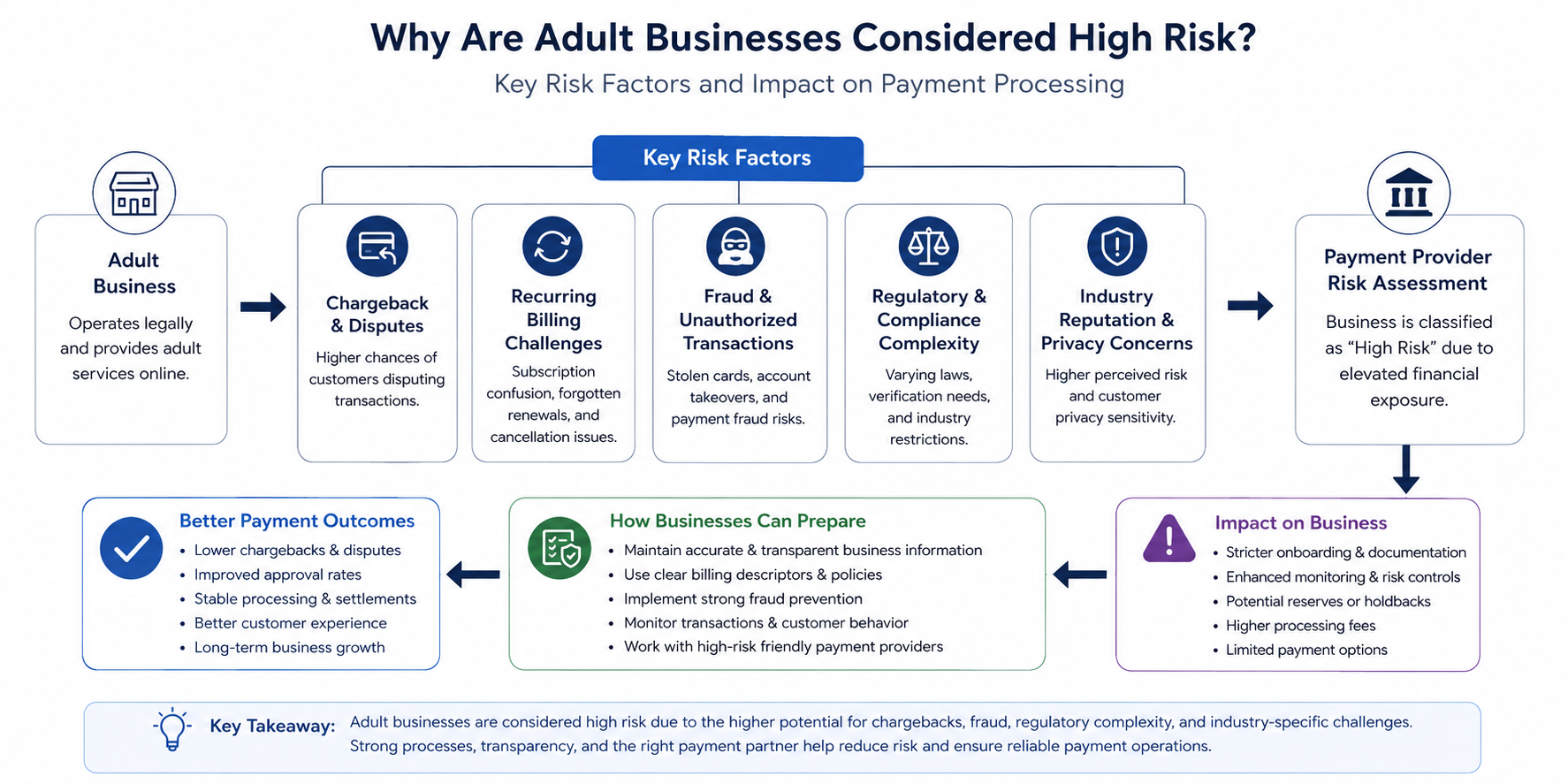
Adult businesses are not considered high risk because of one single factor. Instead, the classification usually comes from a combination of challenges that can affect payment reliability.
Chargeback and Dispute Exposure
Chargebacks are one of the biggest reasons adult businesses receive additional scrutiny.
A chargeback occurs when a customer asks their bank to reverse a payment instead of resolving the issue directly with the business. While disputes happen in many industries, adult businesses may experience higher dispute rates because of customer privacy concerns, subscription misunderstandings, and billing confusion.
For example, a customer may subscribe to a premium membership on an adult content platform. Several months later, they notice a recurring charge on their bank statement and do not recognize the billing descriptor. Instead of contacting the platform, they report the transaction as unauthorized.
Even if the payment was legitimate, the business must spend time responding to the dispute and providing evidence that the transaction was valid. This is why many adult businesses focus heavily on clear subscription terms, customer communication, and dispute prevention strategies. Businesses dealing with recurring customer disputes should also understand how to prevent chargebacks for adult entertainment businesses.
Recurring Billing Challenges
Many adult-industry companies rely on recurring revenue models, including creator memberships, subscription websites, and premium access platforms. Recurring billing creates predictable revenue, but it also introduces unique payment challenges.
Customers may:
- Forget they signed up for automatic renewals.
- Lose access to the card used for payment.
- Cancel through one channel but continue receiving renewal attempts.
- Dispute charges they no longer remember authorizing.
For example, a customer joins a creator membership during a promotional period. After the trial ends, the subscription automatically renews. If the renewal terms were unclear or the customer does not recognize the charge, the business may receive a dispute.
Payment providers consider these scenarios when evaluating risk because recurring billing creates ongoing opportunities for disputes.
Fraud and Unauthorized Transactions
Adult businesses can also attract higher levels of fraudulent activity because digital products and online access are difficult to reverse once delivered. Fraudsters may use stolen payment information to purchase premium memberships, access digital content, or buy account credits. Businesses may only discover the problem after the legitimate cardholder reports the transaction.
Common risks include:
- Stolen card usage.
- Account takeover attempts.
- Multiple accounts created for abuse.
- Automated payment testing using compromised cards.
For this reason, payment providers often review fraud prevention processes when assessing adult businesses. Understanding fraud prevention for adult entertainment payment processing is an important part of maintaining reliable payment operations.
Additional Factors That Influence Risk Classification
Beyond payment behavior, several operational factors can affect how financial institutions evaluate adult businesses.
Some common considerations include:
- Regulatory differences: Laws and payment expectations vary across countries and regions.
- Business transparency: Payment providers need accurate information about what services a company provides.
- Customer privacy concerns: Customers may be more sensitive about transactions appearing on financial statements.
- Industry reputation risk: Banks and payment companies consider the broader risks associated with certain industries.
- Transaction patterns: Sudden increases in volume or unusual activity may trigger additional reviews.
For example, an adult marketplace that suddenly grows from hundreds of transactions per month to thousands may receive additional monitoring because the change could indicate either successful growth or potential fraud activity.
How Adult Businesses Can Prepare for Payment Challenges?
Being classified as high risk does not prevent an adult business from accepting payments. It simply means the business must approach payment operations with greater preparation and awareness.
Strong business practices usually include maintaining accurate company information, creating clear customer policies, monitoring transaction activity, and understanding payment requirements before applying for processing services. Businesses preparing for payment acceptance should also understand how to get approved for an adult merchant account, as proper preparation can reduce delays and improve the chances of successful onboarding.
Conclusion
Adult businesses are considered high risk because payment providers evaluate the potential financial and operational risks associated with the industry. Factors such as chargebacks, recurring billing disputes, fraud attempts, regulatory considerations, and customer privacy concerns all contribute to this classification.
The key takeaway is that high-risk status is not simply about the type of business being operated. It is about understanding the challenges that come with processing payments in an industry where transaction disputes and fraud risks require additional attention.
By understanding these risks and building strong payment practices, adult businesses can create more reliable payment operations and provide a better experience for their customers.

Categories
- ACH Payments (10)
- adult payment processing (11)
- AI (9)
- Altcoins (10)
- Banking (10)
- Bitcoin (133)
- Bitcoin ETF (11)
- Bitcoin Price (30)
- Blockchain (50)
- Brokering World Hunger Away (16)
- Business (17)
- card payment processing (10)
- CBD (11)
- CBDC (11)
- coaching business (11)
- COVID-19 (3)
- Crypto ATMs (1)
- Crypto Banking (17)
- Crypto Bill (1)
- Crypto business owner platform (31)
- Crypto Investment (3)
- Crypto Markets (5)
- Crypto Payment (35)
- Crypto Payment Processor (4)
- Crypto Prices (1)
- Crypto Trading (92)
- Cryptocurrency (402)
- Cryptocurrency Exchange (108)
- Data Visualization (2)
- dating platforms (11)
- debt collection payment processing (10)
- Decentralized Finance (7)
- DeFi Payment (9)
- DEX (3)
- Digital Currency (23)
- dropshipping payment processing (12)
- Ethereum (2)
- FAQ (7)
- file sharing payment processing (11)
- Finance (25)
- Financial Equality (4)
- Financial Freedom (8)
- Forex (35)
- hemp (1)
- ICO (2)
- Investment (11)
- IPTV (11)
- Merchant Account (10)
- Mining (3)
- News (66)
- NFTs (2)
- online gambling (11)
- P2P (1)
- Paybito (139)
- PayBitoPro (693)
- PayBitoPro Coin Listing (6)
- PayBitoPro Exchange (2)
- Payment Gateway (40)
- peptide (10)
- Post COVID Digital Transformation (1)
- Press Release (130)
- Privacy & Security (3)
- Real Estate (1)
- Stablecoin (5)
- Technology (15)
- Travel (11)
- Uncategorized (9)
- US Presidential Election (2)
- Utility Coin (1)
- Web3 business (4)
- Web3 Wallets (2)
- White Label Crypto Exchange (8)
Recent Posts
- ACH vs Wire Transfer: Which Payment Method Is Better for Businesses?
- ACH Fraud Prevention: How Businesses Can Secure Bank Account Payments?
- ACH Credit vs ACH Debit: What’s the Difference? With Real Examples
- ACH vs Credit Card: Which Payment Method Is Better for Businesses?
- How Long Do ACH Payments Take? Processing Times, Settlement, and Same Day ACH