Payment Processing for Dropshipping Businesses: Complete Guide to Accepting Online Payments
- August 6, 2026
- Soham Guchait
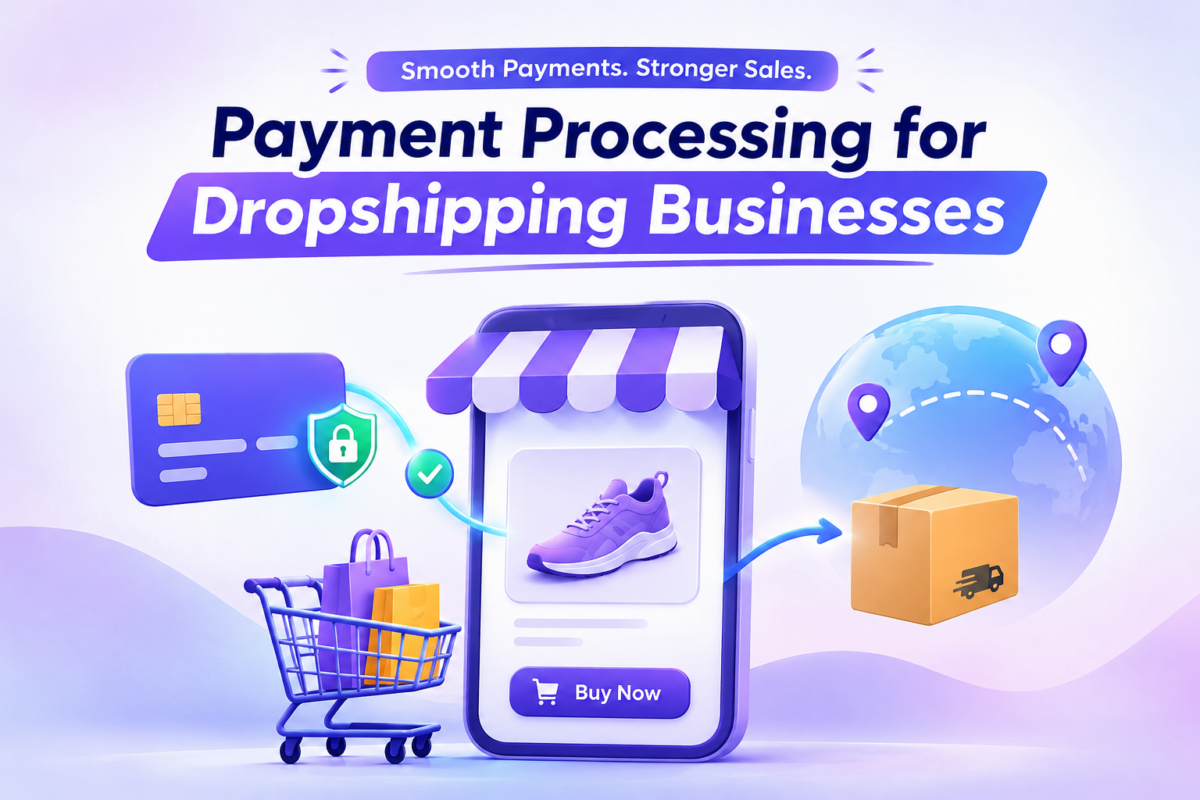
A dropshipping store can be launched within days, but building a reliable payment system is one of the most important steps before accepting customer orders. While many entrepreneurs focus on finding suppliers, creating product pages, and running advertisements, payment processing determines whether customers can successfully complete purchases and whether the business can operate smoothly as sales increase.
For dropshipping businesses, payments involve more than simply accepting a customer’s card at checkout. Behind every successful transaction are multiple systems working together, including payment gateways, merchant accounts, fraud detection tools, transaction verification processes, and settlement systems.
Understanding how payment processing for dropshipping businesses works helps store owners avoid common problems such as declined transactions, delayed settlements, chargebacks, and account approval challenges.
What Is Payment Processing for Dropshipping Businesses?
Payment processing is the system that allows a dropshipping store to accept, verify, and receive payments from customers.
When a customer purchases a product from a dropshipping store, the payment does not move directly from the customer’s bank account to the merchant. Instead, several parties are involved in approving and completing the transaction.
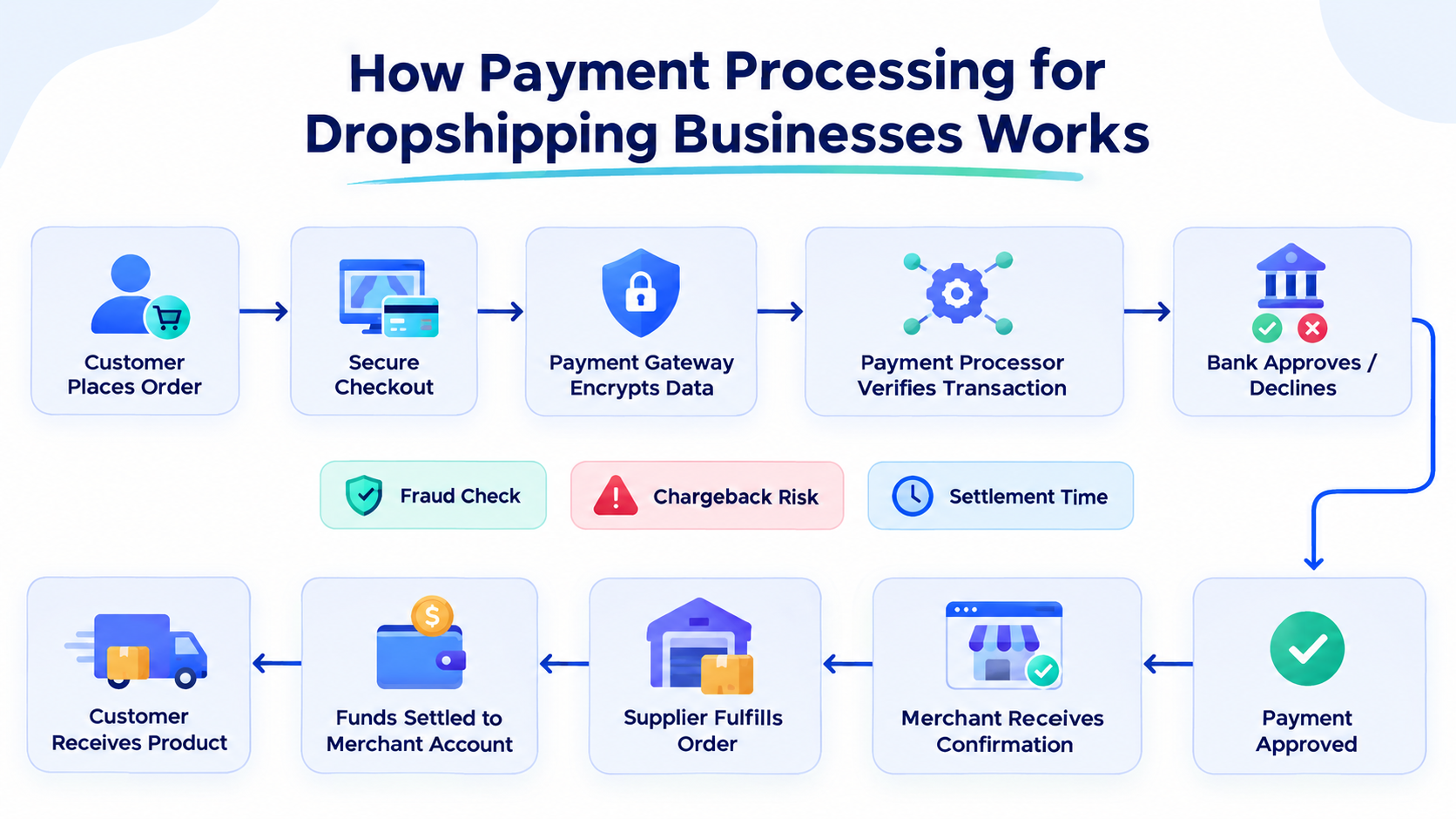
The process usually includes:
- The customer enters payment details during checkout.
- The payment gateway securely transfers transaction information for verification.
- The payment processor communicates with financial institutions to approve or decline the transaction.
- Funds are settled into the merchant’s account after successful authorization.
For example, imagine a customer in Canada purchases a fitness accessory from a dropshipping store based in the United States. The customer enters their card information, the transaction is reviewed for validity, and once approved, the store receives confirmation to process the order with its supplier. Although the customer experiences a simple checkout process, several payment systems work together in the background to complete the purchase.
How Do Dropshipping Businesses Accept Customer Payments?
Most high risk businesses like in dropshipping use a combination of ecommerce platforms, payment gateways, and merchant accounts to accept payments.
A typical payment journey looks like this:
Customer Checkout
The process begins when a customer selects a product and enters payment information at checkout. The payment page collects necessary details while protecting sensitive information through security measures.
Payment Authorization
The payment gateway sends transaction information for verification. The customer’s bank checks factors such as available funds, card validity, and transaction risk before approving or declining the payment.
Transaction Settlement
After approval, the payment moves through the processing network before reaching the merchant according to the settlement schedule.
A common misconception among new dropshipping entrepreneurs is that receiving a successful payment means the money is immediately available. In reality, settlement timing depends on several factors, including transaction volume, business history, risk evaluation, and payment processing arrangements.
The Role of Payment Gateways in Dropshipping Payments
A payment gateway acts as the connection between the customer’s checkout experience and the payment processing network. For dropshipping stores, a reliable payment gateway affects both customer experience and business operations. A poorly functioning checkout system can result in:
- Failed transactions
- Customers abandoning purchases
- Lower conversion rates
- Increased support requests
For example, a customer may be ready to purchase a trending product after seeing an advertisement on social media. If the payment page fails during checkout or does not support the customer’s preferred payment method, the merchant may lose the sale immediately.
When evaluating payment gateways, dropshipping businesses usually need to consider factors such as transaction reliability, ecommerce compatibility, security features, international payment support, and reporting capabilities. Businesses selling globally may also need payment systems that support multiple currencies and payment preferences across different regions.
Why Dropshipping Businesses Face Unique Payment Challenges?
Although dropshipping allows entrepreneurs to start online stores without managing physical inventory, the business model creates certain payment-related challenges. The payment industry evaluates businesses based on factors such as customer experience, fulfillment reliability, refund patterns, and dispute exposure.
Dropshipping can sometimes receive additional attention because:
- Products may be shipped from third-party suppliers.
- Delivery times can vary depending on supplier location.
- Customers may dispute transactions if orders arrive late.
- Product expectations may not always match the delivered item.
For example, a customer orders a gadget from a dropshipping store expecting delivery within a week. However, the supplier experiences delays, and the product arrives after three weeks. Even if the order eventually arrives, the customer may contact their bank and request a payment dispute because they believe the purchase experience was unacceptable.
Understanding these risks helps merchants build stronger payment processes and customer experiences. Businesses facing approval challenges should also understand how merchant accounts for dropshipping businesses work and why payment providers review certain industries differently.
Payment Processing Challenges Dropshipping Businesses Should Prepare For
As a dropshipping store grows, payment challenges often become more complex.
Payment Declines
A payment decline does not always mean there is something wrong with the customer’s card. Transactions can fail because of fraud detection systems, incorrect payment information, international restrictions, or authentication issues.
Reducing unnecessary declines requires monitoring transaction patterns and ensuring the checkout process works correctly.
Chargebacks and Customer Disputes
Chargebacks occur when customers challenge transactions through their banks. For dropshipping businesses, common reasons include:
- Orders arriving later than expected
- Customers not recognizing transactions
- Product quality disputes
- Refund disagreements
Clear product descriptions, accurate delivery expectations, order tracking, and responsive customer support can reduce dispute rates.
Fraudulent Transactions
Online stores can become targets for fraudulent orders involving stolen payment information or suspicious purchasing behavior. Dropshipping businesses should monitor unusual patterns such as:
- Multiple high-value orders from the same customer
- Unusual shipping locations
- Repeated failed payment attempts
Fraud prevention strategies help merchants identify risky transactions before fulfilling orders.
International Payment Processing for Dropshipping Businesses
Many dropshipping stores sell products globally, which creates additional payment considerations. A customer purchasing from another country may use different currencies, payment methods, and banking systems.
For example, a European customer purchasing from a US-based dropshipping store may expect local payment options and pricing in their preferred currency. If the checkout experience creates uncertainty about currency conversion or payment security, the customer may abandon the purchase.
International dropshipping businesses should consider:
- Currency conversion
- Local payment preferences
- Cross-border transaction handling
- Settlement processes
- Customer trust during checkout
Understanding international payment processing becomes increasingly important as stores expand beyond domestic customers.
Scaling Payment Operations as a Dropshipping Business Grows
A payment setup that works for the first few sales may not always support a growing business. As transaction volume increases, merchants need to pay closer attention to:
- Payment reliability
- Fraud monitoring
- Customer disputes
- Compliance requirements
- Reporting and transaction visibility
A store generating hundreds of orders each month has different payment needs compared with a new store testing its first products.
Growing businesses may also explore advanced payment solutions, including systems designed for managing multiple sellers, ecommerce platforms, or larger payment operations.
Final Thoughts
Payment processing for dropshipping businesses is not only about accepting customer payments. It is about creating a reliable system that supports customer trust, reduces transaction problems, and allows the business to grow.
Successful dropshipping stores understand how payment gateways work, how merchant approval processes operate, why payment risks exist, and how to prevent issues such as fraud and chargebacks.
By building a strong payment foundation from the beginning, entrepreneurs can create smoother checkout experiences, improve customer confidence, and prepare their businesses for long-term growth.
Categories
- ACH Payments (10)
- adult payment processing (11)
- AI (9)
- Altcoins (10)
- Banking (10)
- Bitcoin (133)
- Bitcoin ETF (11)
- Bitcoin Price (30)
- Blockchain (50)
- Brokering World Hunger Away (16)
- Business (17)
- card payment processing (10)
- CBD (11)
- CBDC (11)
- coaching business (11)
- COVID-19 (3)
- Crypto ATMs (1)
- Crypto Banking (17)
- Crypto Bill (1)
- Crypto business owner platform (31)
- Crypto Investment (3)
- Crypto Markets (5)
- Crypto Payment (35)
- Crypto Payment Processor (4)
- Crypto Prices (1)
- Crypto Trading (92)
- Cryptocurrency (402)
- Cryptocurrency Exchange (108)
- Data Visualization (2)
- dating platforms (11)
- debt collection payment processing (10)
- Decentralized Finance (7)
- DeFi Payment (9)
- DEX (3)
- Digital Currency (23)
- dropshipping payment processing (12)
- Ethereum (2)
- FAQ (7)
- file sharing payment processing (11)
- Finance (25)
- Financial Equality (4)
- Financial Freedom (8)
- Forex (35)
- hemp (1)
- ICO (2)
- Investment (11)
- IPTV (11)
- Merchant Account (10)
- Mining (3)
- News (66)
- NFTs (2)
- online gambling (11)
- P2P (1)
- Paybito (139)
- PayBitoPro (693)
- PayBitoPro Coin Listing (6)
- PayBitoPro Exchange (2)
- Payment Gateway (40)
- peptide (10)
- Post COVID Digital Transformation (1)
- Press Release (130)
- Privacy & Security (3)
- Real Estate (1)
- Stablecoin (5)
- Technology (15)
- Travel (11)
- Uncategorized (9)
- US Presidential Election (2)
- Utility Coin (1)
- Web3 business (4)
- Web3 Wallets (2)
- White Label Crypto Exchange (8)
Recent Posts
- ACH vs Wire Transfer: Which Payment Method Is Better for Businesses?
- ACH Fraud Prevention: How Businesses Can Secure Bank Account Payments?
- ACH Credit vs ACH Debit: What’s the Difference? With Real Examples
- ACH vs Credit Card: Which Payment Method Is Better for Businesses?
- How Long Do ACH Payments Take? Processing Times, Settlement, and Same Day ACH