Payment Gateway for Dropshipping Stores: How to Choose the Right Solution for Online Payments?
- August 6, 2026
- Soham Guchait
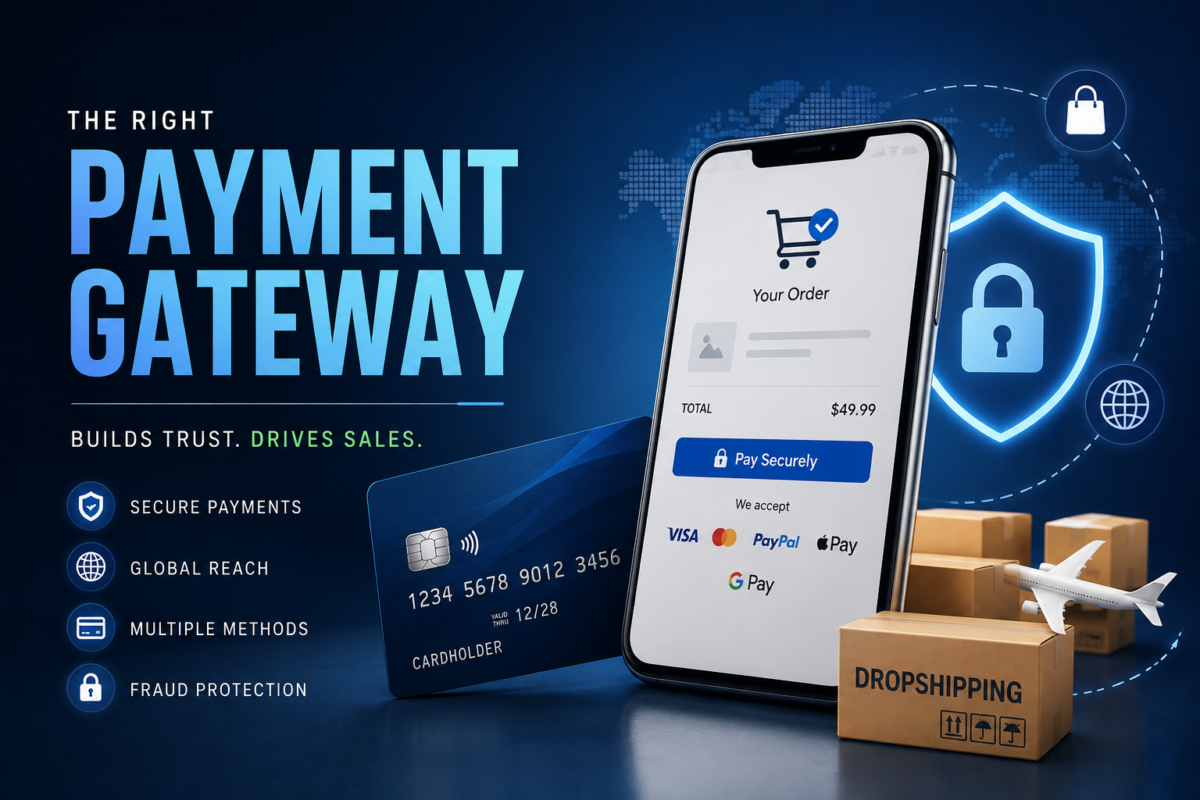
Launching a dropshipping store is easier than ever, but converting visitors into paying customers depends heavily on one critical component – The Payment Gateway. A well-designed storefront and effective marketing campaign can bring customers to checkout, but if the payment experience is slow, unreliable, or lacks trusted payment options, many shoppers will leave without completing their purchase.
For dropshipping businesses, choosing a payment gateway is more than a technical decision. It directly influences customer trust, payment success rates, international expansion, fraud protection, and overall business growth. Understanding how payment gateways work and what features matter can help merchants build a smoother buying experience while avoiding common payment challenges.
What Is a Payment Gateway?
A payment gateway is the technology that securely captures a customer’s payment information during checkout and transfers it for authorization. It acts as the communication bridge between the online store, the payment processor, the customer’s bank, and the merchant’s financial institution.
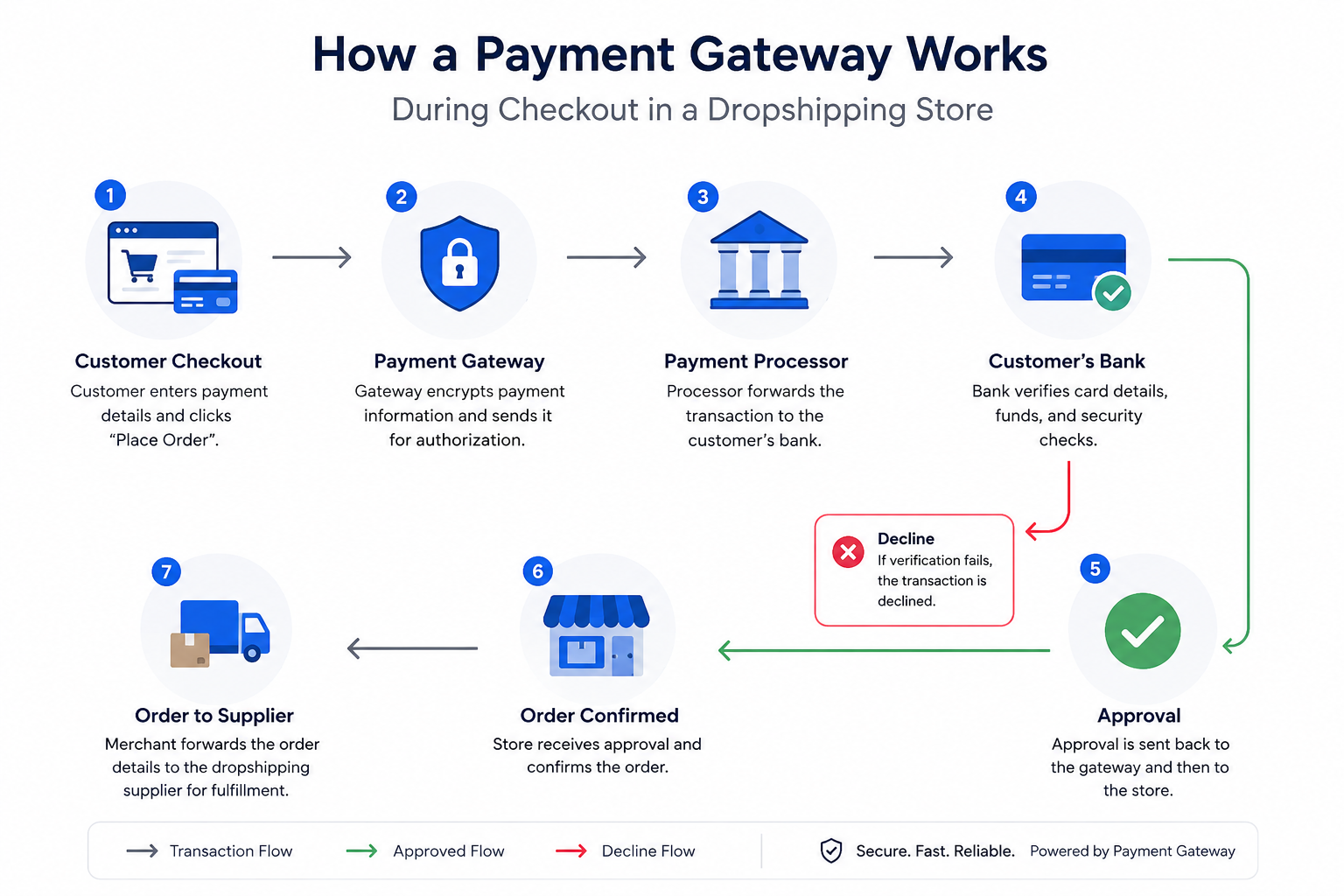
While customers simply enter their payment details and click “Place Order“, the payment gateway performs several actions within seconds:
- Encrypts sensitive payment information.
- Sends transaction details for authorization.
- Returns an approval or decline response.
- Confirms whether the order can proceed.
Unlike a merchant account, which temporarily holds transaction funds before settlement, the payment gateway is responsible for securely transmitting payment information throughout the authorization process. Understanding this distinction is important when setting up payment processing for a dropshipping business.
Why Payment Gateways Matter for Dropshipping Businesses?
Dropshipping businesses operate differently from traditional online retailers. Since products are fulfilled by third-party suppliers rather than stored by the merchant, customer expectations depend heavily on clear communication and a reliable checkout experience.
The payment gateway is often the customer’s first direct interaction with the business after deciding to make a purchase. A confusing or unreliable checkout experience can immediately reduce confidence.
Consider a customer shopping for home office accessories. They browse your website, compare products, and decide to purchase. At checkout, the payment page loads slowly, fails to recognize their preferred payment method, or returns an unexpected error. Instead of trying again, they leave the website and purchase from another store. Although the product and pricing were competitive, the sale was lost because of the payment experience rather than the product itself.
How a Payment Gateway Works During Checkout?
Understanding the payment journey helps merchants identify where problems may occur.
When a customer completes a purchase, several systems work together almost instantly. First, the customer enters payment details through the checkout page. The payment gateway encrypts this information to protect sensitive financial data before forwarding it for authorization. The customer’s bank then verifies details such as card validity, available funds, and security checks. If everything matches, the transaction is approved and confirmation is returned to the online store. The merchant can then begin processing the customer’s order with their supplier. If any verification step fails, the transaction is declined, and the customer is asked to use another payment method or correct the information provided.
Although this entire process usually takes only a few seconds, every stage contributes to the overall customer experience.
Features to Look for in a Payment Gateway for Dropshipping Stores
Not every payment gateway offers the same capabilities. Choosing the right solution involves understanding the needs of both your business and your customers.
Important features include:
- Strong security and encryption for customer payment information.
- Reliable transaction processing with minimal downtime.
- Support for multiple payment methods and currencies.
- Integration with popular ecommerce platforms.
- Fraud detection and transaction monitoring.
- Reporting tools for tracking sales and payment activity.
- Scalable infrastructure that supports business growth.
For example, a new Shopify dropshipping store may initially process only a handful of transactions each day. As advertising campaigns succeed and sales increase, the same payment gateway should be able to manage higher transaction volumes without affecting checkout performance.
Supporting International Customers
One of the biggest advantages of dropshipping is the ability to sell products across multiple countries without maintaining warehouses in each market. However, international selling introduces additional payment considerations.
Customers in different regions often have different payment preferences. While credit and debit cards remain popular in many countries, some customers prefer digital wallets, local bank transfers, or region-specific payment methods.
Imagine a customer in Germany purchasing a fitness accessory from a dropshipping store based in the United States. If prices are displayed only in US dollars and the checkout supports limited payment options, the customer may hesitate before completing the purchase.
A payment gateway that supports multiple currencies and accommodates international payment preferences can create a more familiar checkout experience, improving customer confidence and reducing cart abandonment. Businesses planning to expand globally should also understand how international payment processing affects settlement, currency conversion, and customer expectations.
Security and Fraud Prevention
Because dropshipping businesses operate entirely online, payment fraud remains a significant concern. Fraud can occur in several forms, including stolen payment cards, fake customer identities, account takeover attempts, and automated card-testing attacks.
Modern payment gateways often include tools designed to reduce these risks by monitoring transaction behavior and identifying suspicious activity before orders are processed.
For instance, if a customer places multiple expensive orders within minutes using different cards but requests delivery to the same address, the payment system may flag the activity for additional review before approval. Preventing fraudulent transactions not only protects revenue but also helps reduce future disputes and chargebacks.
Common Mistakes When Choosing a Payment Gateway
Many new dropshipping businesses focus primarily on transaction fees while overlooking factors that have a greater long-term impact on business operations.
Common mistakes include:
- Choosing a gateway that lacks international payment support.
- Ignoring integration compatibility with the ecommerce platform.
- Overlooking fraud prevention capabilities.
- Failing to review settlement schedules.
- Selecting a solution that cannot scale as order volume grows.
For example, a merchant experiencing rapid sales growth after a successful social media campaign may discover that their chosen payment solution struggles to handle increased transaction volumes efficiently. Planning for future growth helps avoid unnecessary operational disruptions.
Choosing a Payment Gateway That Supports Long-Term Growth
As a dropshipping business evolves, payment requirements become more complex. What works for a new store processing a few orders each week may no longer meet the needs of a business serving customers across multiple countries.
When evaluating payment gateways, merchants should consider both current needs and future expansion. A solution that supports secure transactions, multiple payment methods, fraud prevention, reporting, and international capabilities provides greater flexibility as the business grows.
It is equally important to understand that a payment gateway is only one part of the overall payment ecosystem. Merchant account approval, business verification, payment compliance, and transaction monitoring also influence how efficiently a business can accept payments and manage risk.
Final Thoughts
A payment gateway is far more than a checkout tool. It is a critical part of the payment experience that influences customer trust, transaction success, fraud prevention, and long-term business growth.
For dropshipping businesses, selecting the right payment gateway means balancing security, reliability, customer convenience, and scalability. Understanding how gateways interact with merchant accounts, payment processing systems, and international transactions helps merchants make informed decisions before accepting their first payment.
As your business grows, your payment infrastructure should grow with it. Learning how merchant accounts work, why some dropshipping businesses are considered higher risk, how to reduce payment declines, and how to support international customers will help build a stronger and more resilient payment operation.
Categories
- ACH Payments (10)
- adult payment processing (11)
- AI (9)
- Altcoins (10)
- Banking (10)
- Bitcoin (133)
- Bitcoin ETF (11)
- Bitcoin Price (30)
- Blockchain (50)
- Brokering World Hunger Away (16)
- Business (17)
- card payment processing (10)
- CBD (11)
- CBDC (11)
- coaching business (11)
- COVID-19 (3)
- Crypto ATMs (1)
- Crypto Banking (17)
- Crypto Bill (1)
- Crypto business owner platform (31)
- Crypto Investment (3)
- Crypto Markets (5)
- Crypto Payment (35)
- Crypto Payment Processor (4)
- Crypto Prices (1)
- Crypto Trading (92)
- Cryptocurrency (402)
- Cryptocurrency Exchange (108)
- Data Visualization (2)
- dating platforms (11)
- debt collection payment processing (10)
- Decentralized Finance (7)
- DeFi Payment (9)
- DEX (3)
- Digital Currency (23)
- dropshipping payment processing (12)
- Ethereum (2)
- FAQ (7)
- file sharing payment processing (11)
- Finance (25)
- Financial Equality (4)
- Financial Freedom (8)
- Forex (35)
- hemp (1)
- ICO (2)
- Investment (11)
- IPTV (11)
- Merchant Account (10)
- Mining (3)
- News (66)
- NFTs (2)
- online gambling (11)
- P2P (1)
- Paybito (139)
- PayBitoPro (693)
- PayBitoPro Coin Listing (6)
- PayBitoPro Exchange (2)
- Payment Gateway (40)
- peptide (10)
- Post COVID Digital Transformation (1)
- Press Release (130)
- Privacy & Security (3)
- Real Estate (1)
- Stablecoin (5)
- Technology (15)
- Travel (11)
- Uncategorized (9)
- US Presidential Election (2)
- Utility Coin (1)
- Web3 business (4)
- Web3 Wallets (2)
- White Label Crypto Exchange (8)
Recent Posts
- ACH vs Wire Transfer: Which Payment Method Is Better for Businesses?
- ACH Fraud Prevention: How Businesses Can Secure Bank Account Payments?
- ACH Credit vs ACH Debit: What’s the Difference? With Real Examples
- ACH vs Credit Card: Which Payment Method Is Better for Businesses?
- How Long Do ACH Payments Take? Processing Times, Settlement, and Same Day ACH