Fraud Prevention in Forex Payment Processing: Protecting Deposits and Trading Accounts
- August 13, 2026
- Soham Guchait
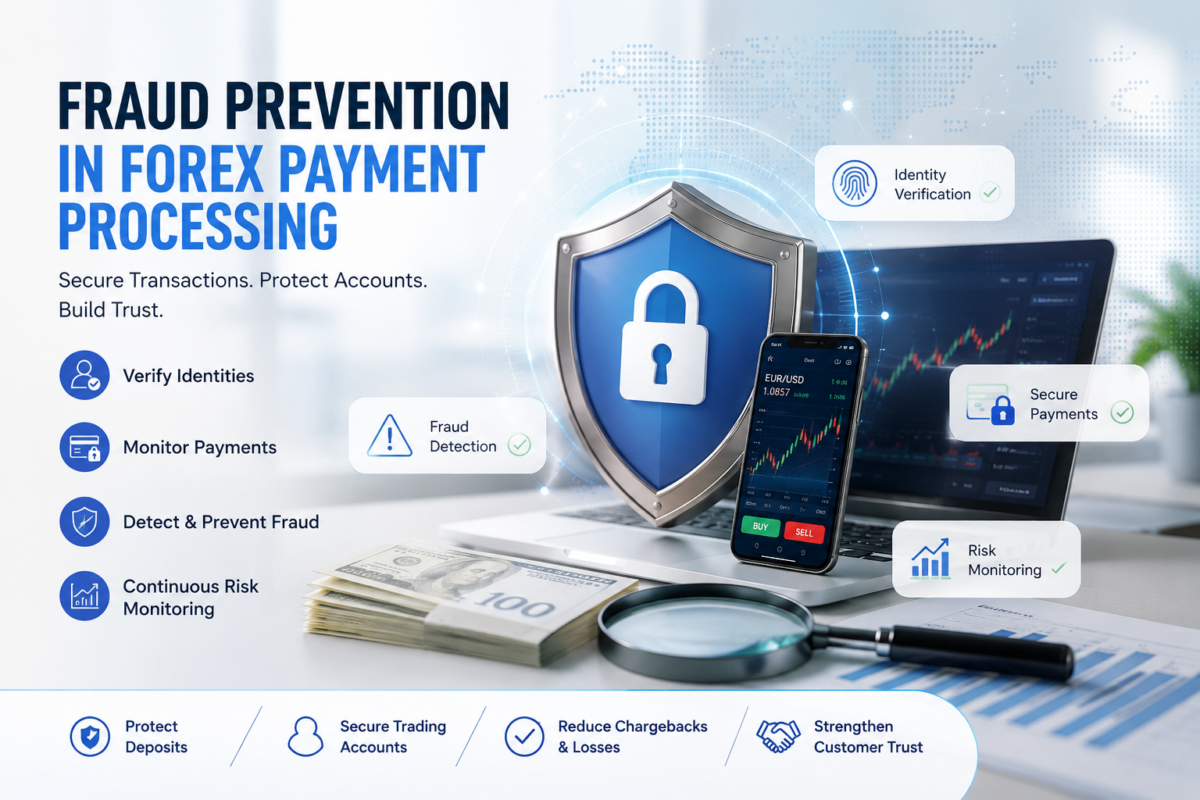
A Forex broker can lose money from payment fraud long before a customer places a trade. A stolen card may be used to fund a newly created trading account, a fraudster may take control of an existing account, or multiple accounts may be created to exploit weaknesses in the broker’s payment process.
This makes fraud prevention in Forex payment processing different from simply blocking suspicious card transactions. A broker needs to protect the entire payment lifecycle, from account creation and customer verification through deposits, trading activity, withdrawals, and account management.
The challenge is finding the right balance. Weak controls can expose the business to fraudulent transactions and disputes, while overly aggressive controls can reject legitimate customers and create unnecessary payment declines.
Why Forex Payment Fraud Requires a Broader Approach?
A conventional online purchase usually involves a customer paying for a product or service. A Forex account introduces a different environment because customers deposit money into an account that can subsequently be used for trading and withdrawals.
This creates several points where fraud can occur. A simplified payment lifecycle looks like:
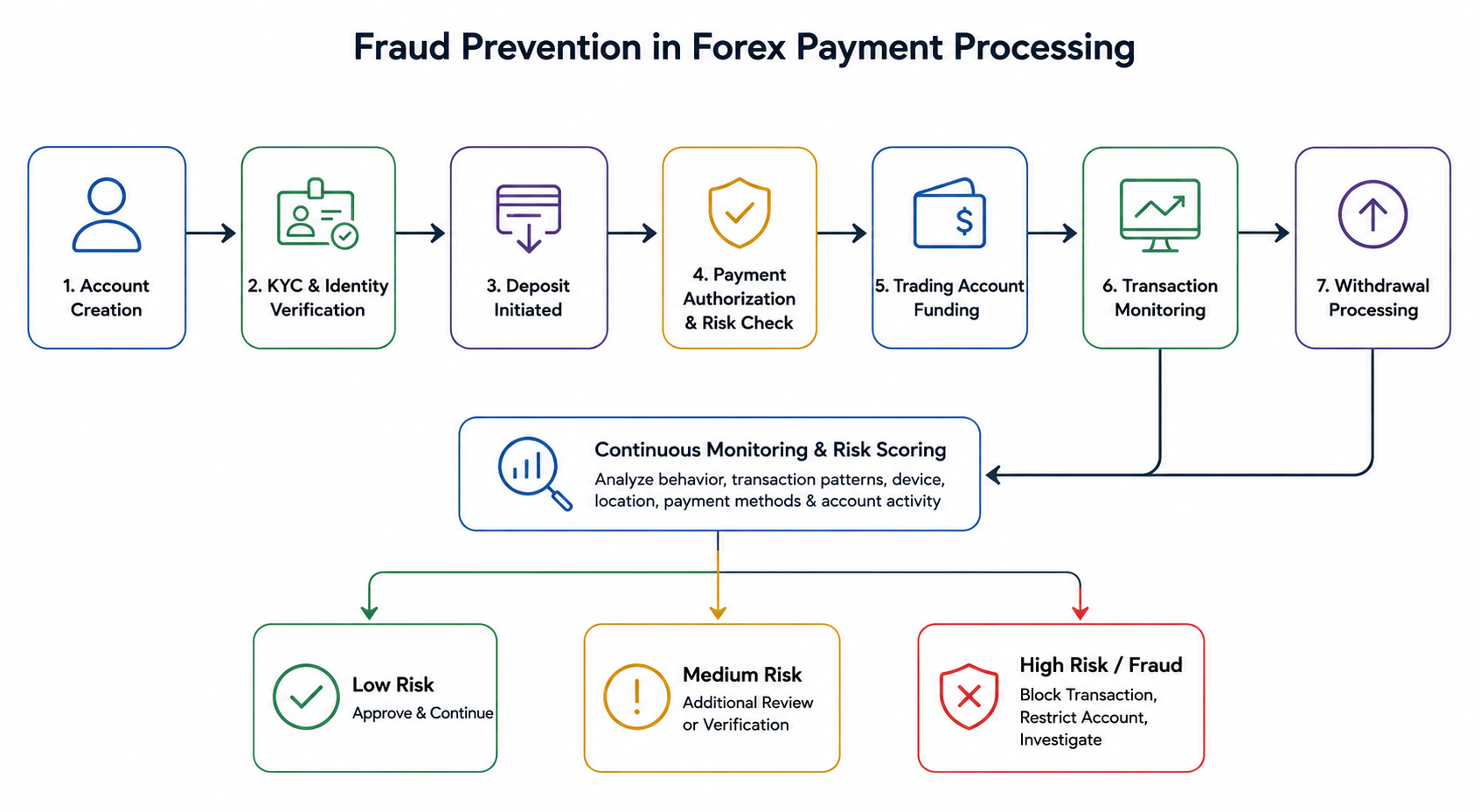
Account creation → KYC → Deposit → Payment authorization → Trading account funding → Transaction monitoring → Withdrawal
A weakness at any stage can affect the stages that follow.
For example, a fraudster could create an account using stolen personal information, fund it with compromised payment credentials, and then attempt to withdraw the money through another payment route. Detecting the problem only when the withdrawal occurs may be too late. Effective fraud prevention therefore begins before the first deposit.
Common Types of Fraud Affecting Forex Brokers
High risk businesses like Forex can encounter different forms of payment and account-related fraud.
Stolen payment credentials occur when someone uses compromised card or payment information to fund a trading account without authorization.
Account takeover occurs when a fraudster gains access to an existing customer’s account, potentially changing account information, initiating deposits, or attempting withdrawals.
Fake or synthetic identities involve accounts created using false, manipulated, or sometimes partially legitimate identity information.
Fraudulent deposits can involve payment activity intended to exploit weaknesses in authorization, refunds, withdrawals, or account-crediting processes.
These risks can overlap. A compromised identity may be used to create an account, a stolen card may fund it, and the account may later be used to move funds elsewhere.
How Fraud Can Enter the Forex Payment Lifecycle?
Consider a hypothetical CFD platform that receives a new customer registration. The customer passes the initial account-opening process and immediately makes several deposits using different cards. The transactions are approved, so the trading balance is credited. Later, the broker notices that the customer is attempting to withdraw funds through a different route.
No single event necessarily proves fraud. However, the combination of new-account activity, multiple payment instruments, unusual deposit behavior, and an unexpected withdrawal destination may justify additional review.
This illustrates an important principle: Fraud detection becomes stronger when individual payment events are analyzed in context.
Payment Fraud vs. Trading-Related Risk
Payment fraud should not be confused with ordinary trading losses or customer dissatisfaction. A trader losing money on a legitimate transaction does not automatically make the original deposit fraudulent. Similarly, a customer disputing a payment does not necessarily mean the transaction was unauthorized. Forex brokers need to distinguish between:
- Unauthorized or deceptive payment activity
- Legitimate transactions later disputed by customers
- Account-security incidents
- Compliance-related concerns
- Technical payment failures
This distinction matters because each situation may require a different response. For example, chargeback prevention for Forex brokers focuses heavily on reducing disputes and preparing appropriate transaction evidence, while fraud prevention focuses on identifying and stopping unauthorized or deceptive activity before or during the transaction.
Risk Scoring and Transaction Monitoring
Risk scoring can help brokers evaluate transactions using multiple signals instead of relying on one rule. A payment might receive additional scrutiny because of unusual transaction frequency, inconsistent customer information, geographic signals, device characteristics, payment-method changes, or other indicators defined by the broker’s risk framework.
Imagine a verified customer who normally deposits $1,000 once a month. Suddenly, the account attempts eight deposits using several different cards within ten minutes.
The pattern does not automatically prove fraud. However, it is materially different from the customer’s established behavior and could justify additional authentication or review. This type of monitoring is more useful than simply asking whether an individual card transaction was approved.
Device and Behavioral Intelligence
Fraudsters can change payment credentials quickly, but other signals may remain connected to their activity. Depending on the technology available, brokers may analyze device information, IP-related signals, session behavior, transaction velocity, account history, and other indicators.
For example, several newly created trading accounts may appear to belong to different customers but repeatedly originate from highly similar technical environments and demonstrate nearly identical payment behavior.
That pattern may warrant investigation.
These signals should not automatically be treated as proof of fraud. Shared networks, corporate environments, mobile carriers, and other legitimate circumstances can produce similar patterns. They are most useful as inputs into a broader risk assessment.
Protecting Against Account Takeover
Payment security does not stop at the checkout page. An attacker who gains access to an existing trading account may attempt to change personal information, add a new payment method, make deposits, or request a withdrawal. Account takeover can therefore turn an otherwise secure payment system into a payment risk.
Brokers should consider controls around login security, authentication, account-detail changes, password resets, new payment methods, and unusual withdrawal requests.
For example, if an account that has always withdrawn funds through one established method suddenly changes important account information and requests a large withdrawal, additional verification may be appropriate under the broker’s security procedures.
Authentication and Additional Verification
Additional authentication can help determine whether the person initiating a transaction is likely to be the legitimate account holder. Depending on the payment method, market, and available infrastructure, controls can include stronger customer authentication, one-time verification, transaction confirmation, or manual review. The objective should not be to add friction to every transaction.
Instead, a broker can use risk-based controls to introduce additional verification when the circumstances justify it. A routine deposit from an established customer may require a different process from a large transaction initiated immediately after significant account changes.
Preventing Fraudulent Deposits
Deposits need to be evaluated before funds are treated as available trading capital.
Suppose a fraudster uses stolen card information to make a $5,000 deposit. If the broker immediately credits the trading account and allows rapid movement of funds, the fraudster may exploit the payment lifecycle before the unauthorized transaction is identified.
A broker therefore needs clear rules governing when a deposit becomes available, how payment status is confirmed, and what happens when a transaction is reversed, disputed, or flagged. Payment authorization alone should not be confused with a guarantee that a transaction is risk-free. A reliable Forex payment gateway can help brokers manage payment authorization, transaction monitoring, and secure communication between customers, payment providers, and brokerage systems.
Connecting Fraud Controls With KYC and AML
Fraud prevention works alongside customer verification and financial-crime controls, but the three processes are not identical.
- KYC helps establish who the customer is.
- AML controls address risks associated with money laundering and related financial crime.
- Fraud controls focus on unauthorized or deceptive activity.
A suspicious transaction may involve one, two, or all three areas.
For example, a newly created account using questionable identity information and a stolen payment method could require both customer-verification review and fraud investigation. This is why KYC and AML requirements for Forex payment processing should be considered alongside payment-fraud controls rather than treated as unrelated functions.
Managing False Positives
A fraud system that blocks too many legitimate customers can damage payment performance.
Suppose a broker serves international traders. A legitimate customer may travel, use a different device, access the platform through a new network, or make a larger deposit than usual. If the system treats every unusual signal as fraud, genuine transactions may be rejected. This creates a direct connection between fraud prevention and why Forex payments get declined.
Effective fraud management therefore requires more than adding restrictive rules. Brokers need ways to distinguish genuine high-risk activity from legitimate changes in customer behavior. Manual review can be useful for transactions that require more context than an automated decision can provide.
What Happens When a Transaction Is Flagged?
A flagged transaction should lead to a defined workflow rather than an automatic assumption of fraud.
Depending on the broker’s procedures, the transaction might be approved, subjected to additional verification, held for review, or declined. The broker may examine customer information, payment history, transaction frequency, device signals, account changes, and other relevant evidence.
Clear workflows are especially important for larger brokers because thousands of transactions may need to be assessed without creating unnecessary delays for legitimate customers.
Building a Layered Fraud Prevention Strategy
No single fraud-control mechanism can identify every fraudulent transaction. A stronger approach uses multiple layers:
Customer verification → Payment screening → Risk scoring → Transaction monitoring → Authentication → Manual review → Post-transaction monitoring
Each layer addresses a different part of the risk.
For example, KYC can help identify inconsistencies during onboarding, payment controls can assess a deposit, transaction monitoring can identify unusual behavior, and account-security controls can protect the customer during later withdrawals.
The goal is not to guarantee that fraud will never occur. It is to make fraudulent activity harder to execute, easier to identify, and easier to investigate.
Protecting the Payment Lifecycle
For a Forex broker, fraud prevention should extend beyond the payment page.
The strongest payment-security strategy connects customer verification, deposits, transaction monitoring, account security, withdrawals, dispute management, and payment-provider controls. As the broker expands into new markets and processes more transactions, the payment infrastructure needs to maintain visibility over these activities without creating unnecessary friction for legitimate traders.
For brokers looking to improve payment operations without building a complete payment infrastructure from the ground up, a white label payment processing solution can provide customizable payment capabilities, allowing businesses to manage transactions, integrations, and payment workflows through a ready-made platform.
Understanding fraud prevention also helps explain why payment methods, KYC controls, processor capabilities, and chargeback management cannot be evaluated independently. They are connected parts of the same payment operation.
A Forex broker that builds these controls around the complete customer and payment lifecycle is better positioned to protect trading accounts, reduce avoidable payment losses, and maintain a payment experience that remains usable as transaction volume grows.

Categories
- ACH Payments (10)
- adult payment processing (11)
- AI (9)
- Altcoins (10)
- Banking (10)
- Bitcoin (133)
- Bitcoin ETF (11)
- Bitcoin Price (30)
- Blockchain (50)
- Brokering World Hunger Away (16)
- Business (17)
- card payment processing (10)
- CBD (11)
- CBDC (11)
- coaching business (11)
- COVID-19 (3)
- Crypto ATMs (1)
- Crypto Banking (17)
- Crypto Bill (1)
- Crypto business owner platform (31)
- Crypto Investment (3)
- Crypto Markets (5)
- Crypto Payment (35)
- Crypto Payment Processor (4)
- Crypto Prices (1)
- Crypto Trading (92)
- Cryptocurrency (402)
- Cryptocurrency Exchange (108)
- Data Visualization (2)
- dating platforms (11)
- debt collection payment processing (10)
- Decentralized Finance (7)
- DeFi Payment (9)
- DEX (3)
- Digital Currency (23)
- dropshipping payment processing (12)
- Ethereum (2)
- FAQ (7)
- file sharing payment processing (11)
- Finance (25)
- Financial Equality (4)
- Financial Freedom (8)
- Forex (35)
- hemp (1)
- ICO (2)
- Investment (11)
- IPTV (11)
- Merchant Account (10)
- Mining (3)
- News (66)
- NFTs (2)
- online gambling (11)
- P2P (1)
- Paybito (139)
- PayBitoPro (693)
- PayBitoPro Coin Listing (6)
- PayBitoPro Exchange (2)
- Payment Gateway (40)
- peptide (10)
- Post COVID Digital Transformation (1)
- Press Release (130)
- Privacy & Security (3)
- Real Estate (1)
- Stablecoin (5)
- Technology (15)
- Travel (11)
- Uncategorized (9)
- US Presidential Election (2)
- Utility Coin (1)
- Web3 business (4)
- Web3 Wallets (2)
- White Label Crypto Exchange (8)
Recent Posts
- ACH vs Wire Transfer: Which Payment Method Is Better for Businesses?
- ACH Fraud Prevention: How Businesses Can Secure Bank Account Payments?
- ACH Credit vs ACH Debit: What’s the Difference? With Real Examples
- ACH vs Credit Card: Which Payment Method Is Better for Businesses?
- How Long Do ACH Payments Take? Processing Times, Settlement, and Same Day ACH