Forex Payment Gateway: How to Accept Payments for Forex Brokers and Trading Platforms?
- August 13, 2026
- Soham Guchait
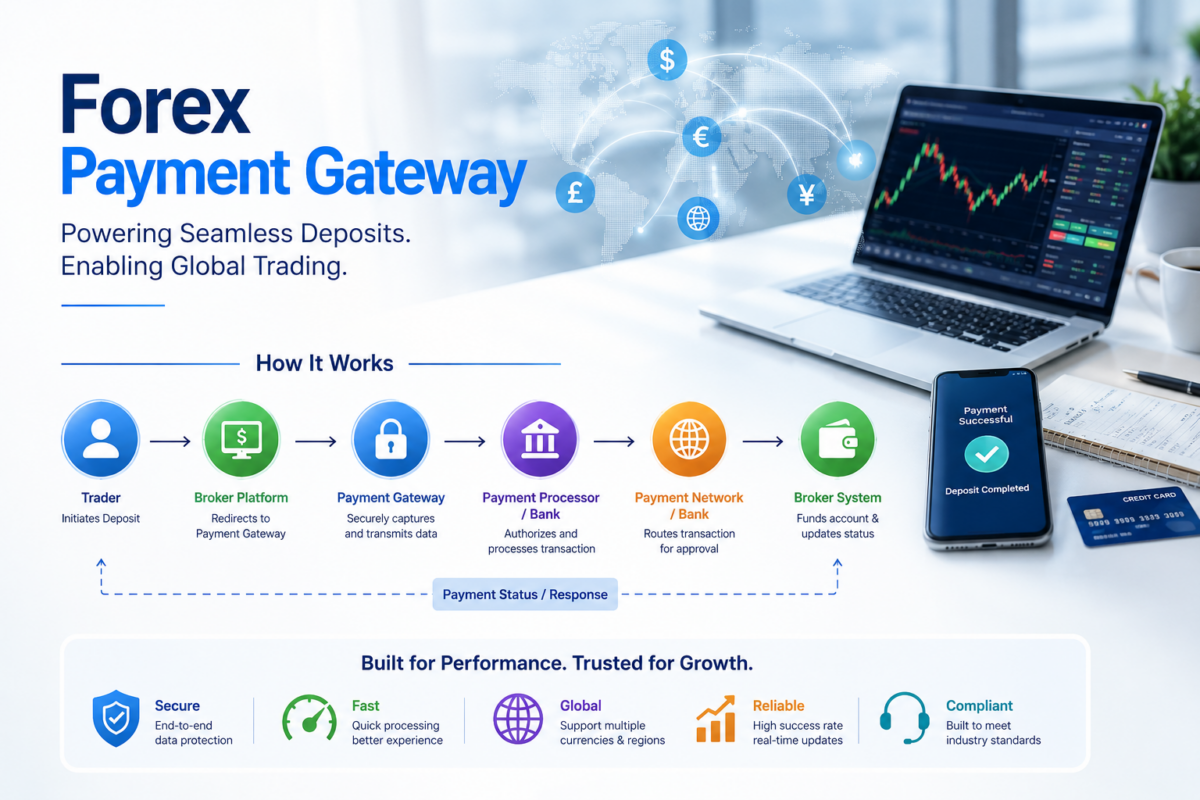
A trader clicking “Deposit” may see a simple payment form. Behind that screen, however, several systems may be working together to authenticate the customer, securely transmit payment information, request authorization, apply risk controls, return a transaction result, and communicate the outcome to the broker.
For a Forex broker, the payment gateway is therefore more than a checkout component. It is an important part of the infrastructure connecting the trader, payment method, payment-processing environment, and brokerage account.
A Forex payment gateway helps brokers accept online payments while integrating payment activity with the systems that manage customer accounts and trading operations. Understanding how this infrastructure works is important because payment reliability, security, reporting, and account funding all depend on how these components interact.
What Is a Forex Payment Gateway?
A Forex payment gateway is a technology layer that securely captures and transmits payment information between a trader and the relevant payment-processing infrastructure.
In a typical online card transaction, the gateway securely transmits payment data and receives the authorization result.
For a Forex broker, the gateway sits within a broader environment that can include the broker’s website or client portal, trading platform, customer relationship management system, merchant account, payment processor, acquiring institution, fraud controls, and internal accounting systems.
This distinction is important because a payment gateway is not the same thing as a merchant account or payment processor.
How Does a Forex Payment Gateway Work?
Consider a trader who has completed account verification and wants to deposit $1,000 into a trading account.
The payment journey may broadly look like this:
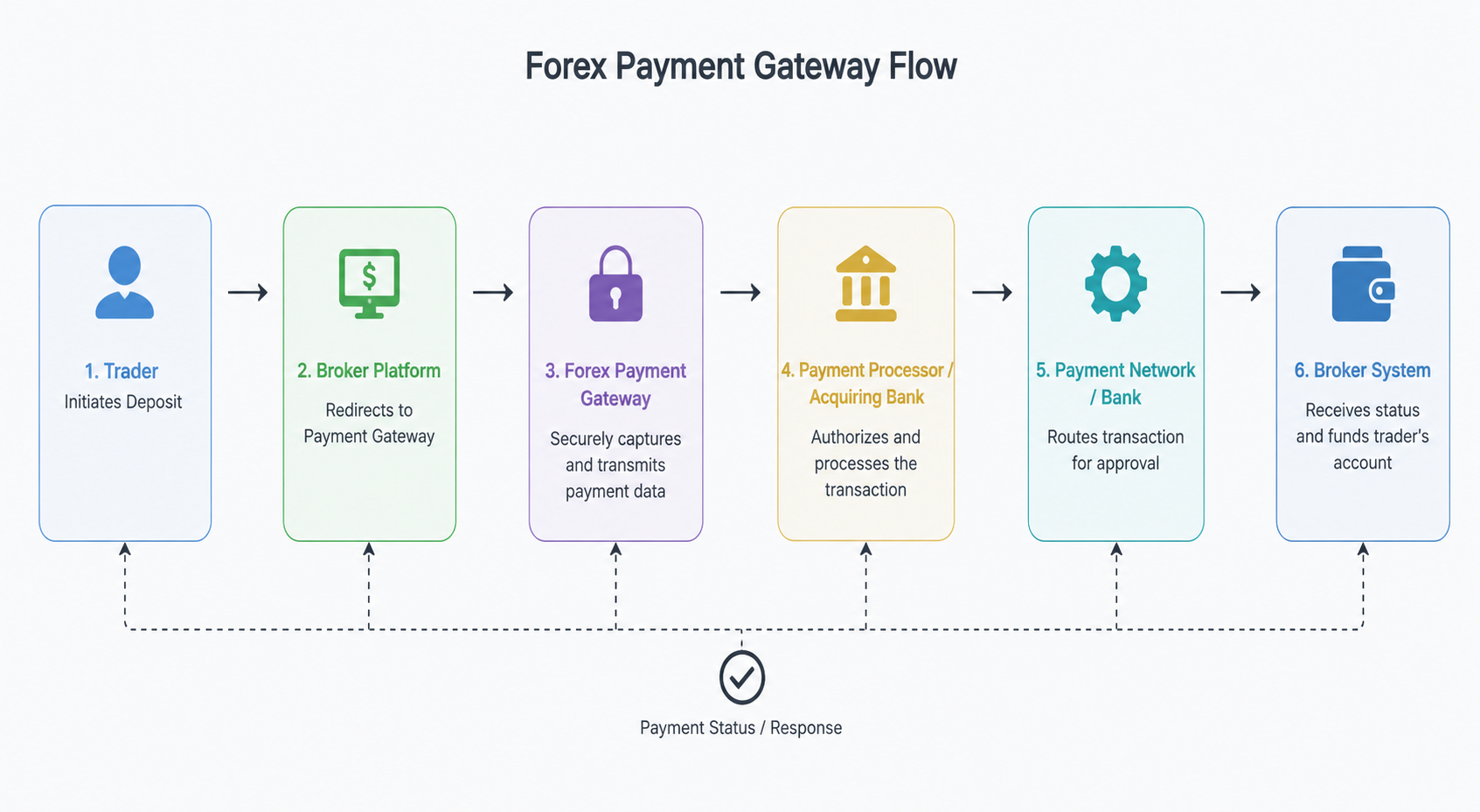
Trader → Broker’s payment interface → Payment gateway → Payment-processing/acquiring infrastructure → Card issuer or other payment method → Authorization response → Broker → Trading account
The gateway securely handles the transmission of payment information and communicates the transaction response back through the payment infrastructure.
If the transaction is approved, the broker’s systems then need to recognize the successful payment and process the deposit according to the broker’s internal controls.
The gateway itself does not mean that money is automatically available in a trader’s account at the instant an authorization response appears. The broker needs appropriate transaction-status handling, confirmation, reconciliation, and account-crediting procedures.
What Happens When a Trader Makes a Deposit?
The exact sequence depends on the payment method and technical architecture, but a Forex deposit typically involves several connected events.
Step 1: The trader selects a payment method
The customer enters the broker’s deposit area and selects an available method, such as a card, bank transfer, digital wallet, or another supported payment option.
The options presented may vary by country, currency, customer profile, and provider availability.
Step 2: Payment information is submitted securely
The gateway receives or transmits the information required to initiate the payment.
Security is critical at this stage because payment environments handle sensitive financial information. Payment-card environments are subject to security standards such as PCI DSS, which provides requirements and controls for protecting payment-account data.
Step 3: Authorization takes place
The transaction is sent through the relevant payment infrastructure for authorization. The result can be an approval, decline, or another status requiring additional handling. Authorization in card payments is the process that results in a merchant receiving an approval or decline response.
A successful authorization does not eliminate the need for the broker to track the transaction through its remaining lifecycle.
Step 4: The broker receives the transaction result
The gateway or associated payment system communicates the transaction status back to the broker. The broker’s client portal and back-office systems need to interpret that status correctly.
For example, if a trader receives a message saying that a $1,000 deposit was successful but the brokerage account remains unchanged, the problem may not be the card authorization itself. There could be a synchronization or reconciliation issue between the payment system and the brokerage platform.
Step 5: The deposit is reconciled
The transaction should ultimately be matched with the correct customer and recorded within the broker’s financial and operational systems.
This is particularly important for a high risk business like in Forex because payment activity can involve multiple currencies, payment methods, markets, and customer accounts.
Forex Payment Gateway vs. Merchant Account
These two terms are often confused.
A merchant account is part of the payment-processing arrangement that enables a business to accept eligible payment transactions and receive settlement.
A payment gateway is the technology that securely transmits payment information and transaction requests through the payment environment.
For example, a Forex broker might have an approved merchant account for card processing while using a separate gateway technology to connect its customer-facing deposit page to that processing infrastructure.
The two components perform different functions but generally need to work together. This is why obtaining a Forex merchant account and integrating a Forex payment gateway are related but separate parts of establishing payment infrastructure.
Forex Payment Gateway vs. Payment Processor
A payment processor handles payment transactions on behalf of a merchant within the processing ecosystem, while the gateway provides the technology for securely transmitting payment information and communicating transaction results.
The terminology can vary across the industry. The PCI Security Standards Council itself notes that “payment processor” is sometimes used alongside terms such as payment gateway or payment service provider, which makes it especially important to understand the actual function being offered rather than relying only on the product name.
For a broker evaluating providers, the practical questions are more useful than the labels:
- What handles the transaction?
- Where does authorization occur?
- Which entity provides the merchant relationship?
- How are payment methods connected?
- How are transaction statuses reported?
- How are settlements and disputes managed?
Why Is Payment Gateway Integration Important for Forex Brokers?
A Forex payment gateway should not operate as an isolated component. The broker may need it to communicate with:
- The customer portal or cashier.
- The brokerage CRM and back-office system.
- Trading-account management systems.
- Fraud and risk controls.
- Accounting and reconciliation systems.
Imagine a broker receiving 5,000 deposits each month. If payment confirmations have to be manually transferred into the brokerage system, the risk of delayed crediting, duplicate records, and reconciliation errors increases as volume grows.
Automated transaction-status communication can reduce this operational burden, provided the integration is designed to handle successful, failed, pending, reversed, and other relevant statuses correctly.
Supporting Multiple Payment Methods
A Forex payment gateway may need to support more than one payment method.
Cards can provide convenient retail deposits, while bank transfers may be more appropriate for larger transactions. Digital wallets and local payment methods can be useful in particular markets.
The challenge is that every additional payment method can introduce different authorization flows, transaction statuses, currencies, settlement processes, and technical requirements. Therefore, a broker should not choose a gateway simply because it supports the largest number of payment methods.
The better question is whether the gateway supports the methods that are actually relevant to the broker’s customers and target markets. This connects directly with the best payment methods for Forex brokers and trading platforms, because payment-method selection and gateway infrastructure should be considered together.
How Does a Forex Payment Gateway Handle International Payments?
International Forex brokers may receive payments from customers in multiple countries and currencies. This can create additional operational considerations around currency support, payment-method availability, transaction routing, settlement, and reconciliation.
For example, suppose a broker’s base accounting currency is USD while a customer wants to fund an account using a payment method denominated in EUR. The payment infrastructure needs to handle the transaction according to the applicable currency and settlement arrangement.
The broker should understand whether currency conversion occurs, where it occurs, what currency ultimately settles to the business, and how the resulting transaction is recorded internally. International coverage therefore involves much more than simply displaying a payment form to customers in another country.
Payment Authorization and Security
Security is fundamental because the payment gateway handles sensitive transaction information.
Authentication and authorization are different concepts. Authentication establishes identity, while payment authorization determines whether the transaction is approved or declined. A broker may also use additional fraud controls or authentication mechanisms depending on its payment environment.
For example, a transaction that appears unusual may require additional verification rather than being automatically approved. The objective is to balance payment security with a smooth experience for legitimate traders.
This is closely connected to fraud prevention in Forex payment processing, because overly weak controls can increase payment risk while overly aggressive controls can increase legitimate payment declines.
What About Withdrawals?
A complete Forex payment gateway strategy should consider withdrawals as well as deposits.
A trader may successfully fund an account but later request a withdrawal. The broker then needs to manage the withdrawal request, customer verification, applicable risk controls, payment-method requirements, transaction status, and settlement.
The withdrawal flow may differ from the original deposit flow depending on the payment method and applicable policies.
For example, a broker might receive a card deposit but use a different permitted payout route for a particular withdrawal scenario. The business needs to make these processes clear to customers and maintain accurate transaction records.
Reporting and Reconciliation
Payment reporting becomes increasingly important as a broker grows.
A useful payment environment should allow the business to understand transaction status, amounts, currencies, payment methods, and relevant references.
Suppose the broker’s payment dashboard shows 1,000 successful deposits while its internal accounting system records only 997. That three-transaction difference needs to be investigated. Without reliable reporting and reconciliation, payment problems can remain hidden until customers report missing funds.
This is also why brokers should evaluate how to choose a payment processor for a Forex broker based on reporting and operational visibility, not only transaction fees.
What Should a Forex Broker Look for in a Payment Gateway?
A gateway should be evaluated according to the broker’s actual payment environment. Important considerations include:
Integration: Can it connect reliably with the broker’s website, client portal, CRM, trading-account infrastructure, and back office?
Payment coverage: Does it support the payment methods, currencies, and geographic markets the broker needs?
Transaction visibility: Can the broker clearly identify successful, declined, pending, reversed, and failed transactions?
Security: Are appropriate controls in place for protecting payment information and supporting authentication?
Scalability: Can the system handle increasing transaction volume without introducing unnecessary manual processes?
Reconciliation: Can payment records be matched accurately with customer accounts and internal financial records?
The cheapest gateway is not necessarily the most suitable if it creates additional operational work or cannot support the broker’s target markets.
How Payment Gateways Affect Failed Forex Payments?
When deposits fail, the gateway can be one part of the investigation – but not necessarily the cause.
A transaction may be declined by the card issuer, blocked by fraud controls, affected by geographic restrictions, rejected because of incorrect information, or interrupted by a technical problem. The broker therefore needs detailed transaction statuses and error information to determine where the payment failed.
This is why Forex payment declines and failed transactions should be analyzed alongside gateway performance. A gateway that provides clear transaction information makes it easier to distinguish an issuer decline from an integration problem or risk-control decision.
Final Thoughts
A Forex payment gateway is a critical technology layer in the payment infrastructure of a brokerage. It connects the trader’s payment action with the systems responsible for authorization, transaction processing, payment status, and ultimately account funding.
However, a gateway should never be viewed in isolation. Merchant-account arrangements, payment processors, payment methods, fraud controls, customer verification, trading platforms, withdrawals, settlement, and reconciliation all influence the overall payment experience.
For a Forex broker, the goal is not simply to accept a payment. The infrastructure must reliably move transaction information through the correct systems, provide accurate status updates, protect sensitive payment data, and allow the business to reconcile financial activity.
Once the gateway layer is understood, the next challenge is protecting that payment flow from unauthorized activity – which makes fraud prevention in Forex payment processing the next important part of building a secure Forex payment operation.

Categories
- ACH Payments (10)
- adult payment processing (11)
- AI (9)
- Altcoins (10)
- Banking (10)
- Bitcoin (133)
- Bitcoin ETF (11)
- Bitcoin Price (30)
- Blockchain (50)
- Brokering World Hunger Away (16)
- Business (17)
- card payment processing (10)
- CBD (11)
- CBDC (11)
- coaching business (11)
- COVID-19 (3)
- Crypto ATMs (1)
- Crypto Banking (17)
- Crypto Bill (1)
- Crypto business owner platform (31)
- Crypto Investment (3)
- Crypto Markets (5)
- Crypto Payment (35)
- Crypto Payment Processor (4)
- Crypto Prices (1)
- Crypto Trading (92)
- Cryptocurrency (402)
- Cryptocurrency Exchange (108)
- Data Visualization (2)
- dating platforms (11)
- debt collection payment processing (10)
- Decentralized Finance (7)
- DeFi Payment (9)
- DEX (3)
- Digital Currency (23)
- dropshipping payment processing (12)
- Ethereum (2)
- FAQ (7)
- file sharing payment processing (11)
- Finance (25)
- Financial Equality (4)
- Financial Freedom (8)
- Forex (35)
- hemp (1)
- ICO (2)
- Investment (11)
- IPTV (11)
- Merchant Account (10)
- Mining (3)
- News (66)
- NFTs (2)
- online gambling (11)
- P2P (1)
- Paybito (139)
- PayBitoPro (693)
- PayBitoPro Coin Listing (6)
- PayBitoPro Exchange (2)
- Payment Gateway (40)
- peptide (10)
- Post COVID Digital Transformation (1)
- Press Release (130)
- Privacy & Security (3)
- Real Estate (1)
- Stablecoin (5)
- Technology (15)
- Travel (11)
- Uncategorized (9)
- US Presidential Election (2)
- Utility Coin (1)
- Web3 business (4)
- Web3 Wallets (2)
- White Label Crypto Exchange (8)
Recent Posts
- ACH vs Wire Transfer: Which Payment Method Is Better for Businesses?
- ACH Fraud Prevention: How Businesses Can Secure Bank Account Payments?
- ACH Credit vs ACH Debit: What’s the Difference? With Real Examples
- ACH vs Credit Card: Which Payment Method Is Better for Businesses?
- How Long Do ACH Payments Take? Processing Times, Settlement, and Same Day ACH