White Label Payment Platforms for Forex Brokers: Scaling Payment Operations
- August 13, 2026
- Soham Guchait

A Forex broker can manage payments reasonably well with a single gateway and a limited number of payment methods when transaction volumes are small. The situation changes when the business begins serving customers across multiple markets, supporting several currencies, adding new deposit methods, or operating more than one brokerage brand.
At that point, payment processing is no longer just a checkout function. The broker needs to coordinate deposits, withdrawals, transaction monitoring, reconciliation, reporting, fraud controls, and multiple payment providers without making the payment experience feel fragmented.
This is where a white label payment platform for Forex brokers can become useful. Instead of sending traders to unrelated payment interfaces or managing each payment connection separately, a white-label platform can provide a branded layer for managing payment operations while connecting the brokerage to the underlying payment infrastructure.
The important distinction is that white-label payment infrastructure is not automatically necessary for every Forex business. Its value depends on the broker’s size, geographic reach, number of brands, payment complexity, and operational requirements.
What Is a White Label Payment Platform for Forex Brokers?
A white-label payment platform is payment infrastructure that can be presented under a broker’s own brand while the underlying technology and payment connections are provided by another infrastructure provider.
For a Forex business, this may include a branded payment interface, payment-method integrations, transaction management, deposit and withdrawal workflows, reporting, APIs, and connections to multiple payment providers or acquiring partners.
The broker controls the customer-facing experience, while the underlying infrastructure handles much of the technical complexity.
This differs from simply adding a Forex payment gateway to a website. A gateway primarily facilitates the transmission and authorization of payment transactions. A broader white-label payment platform can sit above several payment connections and provide a centralized operational layer.
For example, a broker could offer cards, bank transfers, and selected local payment methods through one branded cashier. Behind that interface, different providers may handle different payment routes.
How White Label Payment Infrastructure Works?
The payment lifecycle for a Forex broker typically begins before the transaction itself.
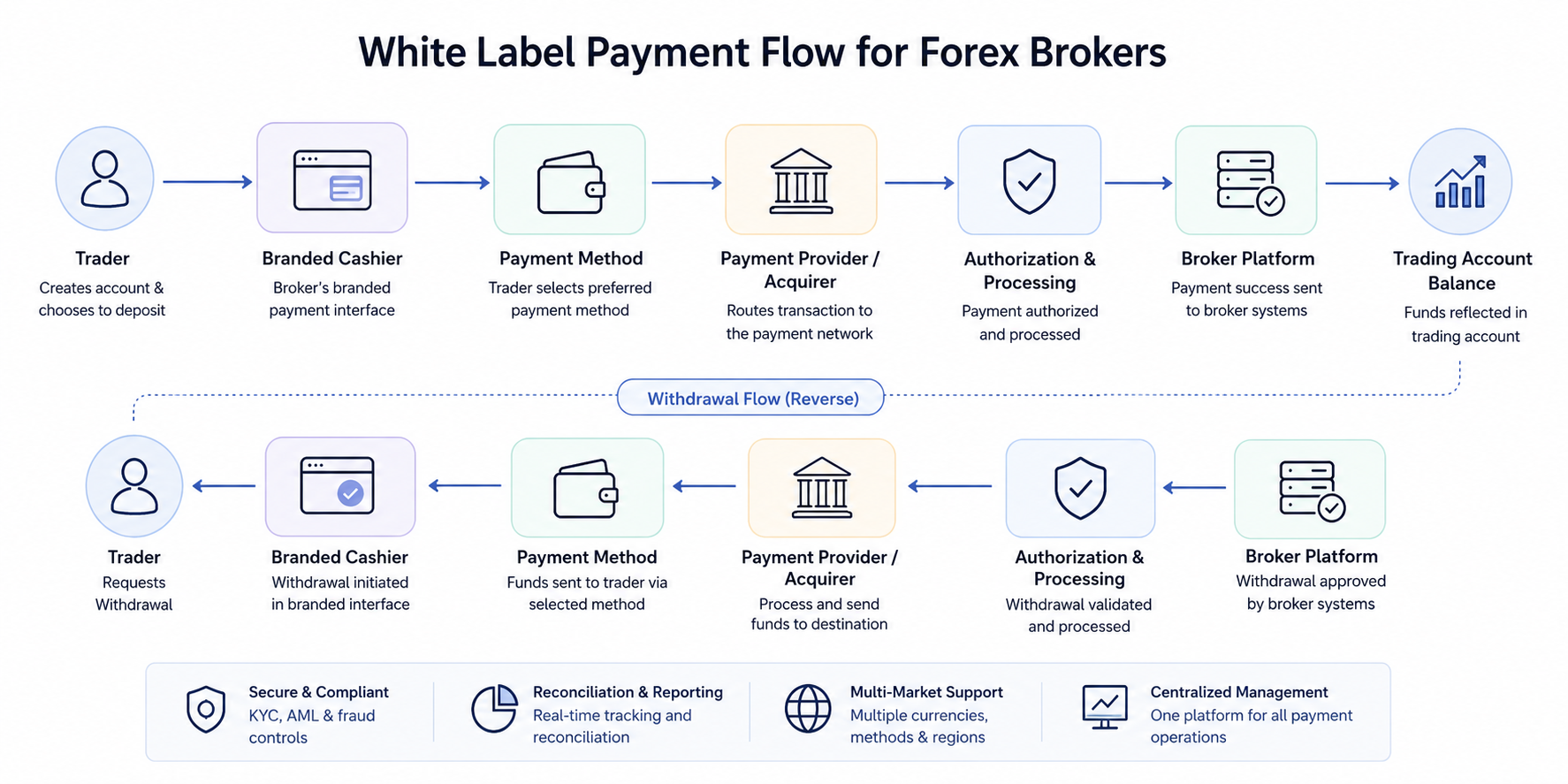
A trader creates an account, completes the applicable customer verification process, enters the trading environment, and chooses a funding method. The payment platform then needs to connect the deposit request with the appropriate payment route and communicate the result back to the broker’s systems. A simplified flow looks like this:
Trader → Branded Cashier → Payment Method → Payment Provider/Acquirer → Authorization → Broker Platform → Trading Account Balance
The same infrastructure may also support the reverse process for withdrawals.
This integration becomes particularly important when payment information must be synchronized with the broker’s CRM, client portal, compliance systems, and trading-account ledger. A successful payment should not simply appear as a successful transaction in a gateway dashboard; the broker’s internal systems also need to know what happened.
For example, imagine a trader deposits €2,000. The payment is authorized, but the broker’s CRM does not receive the confirmation correctly. The trader may see money deducted from the payment method while the trading balance remains unchanged. That creates a customer-service issue even though the underlying payment was successful. A well-integrated payment architecture reduces this type of operational gap.
Similar issues can also occur when transactions fail during authorization or processing. Understanding the common causes of failed Forex payments helps brokers identify whether problems are related to payment methods, customer verification, technical issues, or payment-provider limitations.
Why Forex Brokers Consider White Label Payment Platforms?
The main advantage is not branding alone. It is the ability to manage increasing payment complexity without rebuilding the payment layer every time the brokerage expands.
A growing Forex broker may eventually need to manage:
- Multiple payment methods and currencies
- Deposits and withdrawals through different providers
- Several geographic markets
- Transaction monitoring and fraud controls
- Reconciliation between payment and trading systems
- Centralized reporting
- Multiple brokerage brands or regional websites
Trying to manage each function independently can create disconnected systems and additional operational work. A white-label platform can provide a common management layer while allowing the underlying payment infrastructure to remain flexible.
This is particularly relevant to businesses that already understand the importance of choosing a payment processor for a Forex broker based on factors such as geographic coverage, reliability, risk controls, settlement arrangements, and integration capabilities.
Branded Payment Experiences Without Building Everything Internally
A white-label approach allows the payment experience to remain consistent with the brokerage’s brand.
The trader may remain within the broker’s website or client portal rather than being redirected to an unfamiliar third-party payment environment. The interface can potentially use the broker’s branding, terminology, and customer journey while the underlying payment technology remains external.
This matters because payment is part of the trading experience.
Consider a CFD broker operating in three regions. If each region uses a different payment page, different transaction statuses, and different customer workflows, traders may receive inconsistent experiences. A centralized white-label layer can help standardize the interface even when the payment methods underneath differ.
The branding itself, however, should not be confused with regulatory or payment-provider approval. A white-label arrangement does not automatically make a business eligible to process payments in a particular jurisdiction. The applicable licensing, compliance, underwriting, and contractual requirements still depend on the business model and jurisdictions involved.
Managing Multiple Payment Methods
International Forex businesses rarely have identical payment preferences across every market.
A broker may accept cards in one market, bank-based payments in another, and local payment methods elsewhere. Some customers may also require different currencies or settlement arrangements.
A white-label platform can provide a single payment-management layer while connecting different payment methods behind it.
For instance, a broker serving customers in Europe and Asia could present different funding options based on the customer’s location and applicable payment availability. The trader sees a relatively simple cashier, while the platform determines which payment route is available for that transaction.
This is where white-label infrastructure can complement a broader Forex payment processing strategy rather than replacing the underlying merchant accounts, processors, or acquiring relationships.
Deposits, Withdrawals, and Reconciliation
Deposits are only one part of Forex payment operations.
Withdrawals create another layer of complexity because the business must determine whether the withdrawal is permitted, verify the relevant account information and controls, and ensure that the payment reaches the intended recipient through an appropriate route.
A broker may also need to reconcile:
Payment transaction → Customer account → Trading balance → Settlement account
Suppose a broker records 4,000 customer deposits during a month. Payment providers may produce their own transaction reports, while the brokerage CRM and trading platform maintain separate records. If these systems are not reconciled properly, differences can appear between payment records, customer balances, and settled funds.
A centralized payment platform can make reporting and reconciliation more manageable by bringing transaction information into a common operational view.
Supporting Multiple Markets and Brands
White-label payment infrastructure becomes more valuable when a business operates across several markets or brands.
A brokerage group might operate separate websites for different regions while using common back-office systems. Each brand may require its own customer-facing payment experience, payment methods, currencies, or transaction rules.
Instead of building a completely separate payment stack for every brand, the group can potentially use shared infrastructure with controlled configurations for each operation. However, this should be designed carefully. Different jurisdictions may have different compliance expectations, available payment methods, customer requirements, and provider restrictions. Centralization should not mean applying identical rules everywhere.
Compliance and Security Still Matter
White-label technology does not remove the broker’s responsibility to operate within the applicable compliance framework.
Payment operations may intersect with KYC and AML requirements for Forex payment processing, particularly when customer identity, transaction activity, withdrawals, suspicious behavior, and source-of-funds considerations are relevant.
The payment platform should therefore fit into the broker’s broader compliance workflow rather than operate as an isolated system.
Security is equally important. Payment credentials, account information, authentication data, and transaction records need appropriate protection. Depending on the architecture and payment methods involved, responsibilities may be shared among the broker, payment platform, processor, acquirer, and other service providers.
Fraud controls should also remain connected to the payment lifecycle. A broker already dealing with fraudulent deposits or account takeover should not treat a white-label interface as a substitute for proper fraud prevention in Forex payment processing.
When Does a Forex Broker Actually Need White Label Payment Infrastructure?
Not every broker needs it. A small brokerage operating in one market with a limited number of payment methods may be better served by a straightforward gateway and merchant-account arrangement. Introducing additional infrastructure too early can increase integration and operational complexity without delivering meaningful benefits.
White-label infrastructure becomes more relevant when payment operations start becoming difficult to manage through separate tools.
Typical signals include:
- The broker operates across multiple markets, currencies, or brands.
- Several payment providers need to be managed through one operational workflow.
- The existing payment experience feels fragmented or inconsistent.
- Deposit and withdrawal reconciliation is becoming increasingly manual.
- The business needs centralized reporting and payment controls.
- The brokerage expects substantial transaction or geographic growth.
The decision should therefore be based on operational complexity rather than the assumption that white-label technology is inherently better.
Scaling Payment Operations Without Losing Control
White-label payment platforms are most useful when they solve a genuine infrastructure problem.
A Forex broker that expands from one market to several may gradually accumulate payment providers, currencies, customer workflows, reporting systems, and compliance requirements. Without a centralized architecture, that growth can make payments harder to operate even as the trading business becomes more successful.
The objective of white-label payment infrastructure is therefore not simply to put a broker’s logo on a payment page. It is to create a consistent operational layer between the trader, payment methods, processors, and the brokerage’s internal systems.
For businesses still evaluating the fundamentals, understanding Forex payment gateways, Forex merchant accounts, and payment methods for Forex brokers should come first. For businesses already managing significant payment complexity, white-label infrastructure can provide a more scalable way to organize those components.
The right approach depends on the brokerage’s markets, transaction volume, payment mix, compliance environment, and growth plans. When those factors are aligned, a white-label payment platform can turn payment processing from a collection of disconnected tools into a more centralized and manageable part of the brokerage operation.

Categories
- ACH Payments (10)
- adult payment processing (11)
- AI (9)
- Altcoins (10)
- Banking (10)
- Bitcoin (133)
- Bitcoin ETF (11)
- Bitcoin Price (30)
- Blockchain (50)
- Brokering World Hunger Away (16)
- Business (17)
- card payment processing (10)
- CBD (11)
- CBDC (11)
- coaching business (11)
- COVID-19 (3)
- Crypto ATMs (1)
- Crypto Banking (17)
- Crypto Bill (1)
- Crypto business owner platform (31)
- Crypto Investment (3)
- Crypto Markets (5)
- Crypto Payment (35)
- Crypto Payment Processor (4)
- Crypto Prices (1)
- Crypto Trading (92)
- Cryptocurrency (402)
- Cryptocurrency Exchange (108)
- Data Visualization (2)
- dating platforms (11)
- debt collection payment processing (10)
- Decentralized Finance (7)
- DeFi Payment (9)
- DEX (3)
- Digital Currency (23)
- dropshipping payment processing (12)
- Ethereum (2)
- FAQ (7)
- file sharing payment processing (11)
- Finance (25)
- Financial Equality (4)
- Financial Freedom (8)
- Forex (35)
- hemp (1)
- ICO (2)
- Investment (11)
- IPTV (11)
- Merchant Account (10)
- Mining (3)
- News (66)
- NFTs (2)
- online gambling (11)
- P2P (1)
- Paybito (139)
- PayBitoPro (693)
- PayBitoPro Coin Listing (6)
- PayBitoPro Exchange (2)
- Payment Gateway (40)
- peptide (10)
- Post COVID Digital Transformation (1)
- Press Release (130)
- Privacy & Security (3)
- Real Estate (1)
- Stablecoin (5)
- Technology (15)
- Travel (11)
- Uncategorized (9)
- US Presidential Election (2)
- Utility Coin (1)
- Web3 business (4)
- Web3 Wallets (2)
- White Label Crypto Exchange (8)
Recent Posts
- ACH vs Wire Transfer: Which Payment Method Is Better for Businesses?
- ACH Fraud Prevention: How Businesses Can Secure Bank Account Payments?
- ACH Credit vs ACH Debit: What’s the Difference? With Real Examples
- ACH vs Credit Card: Which Payment Method Is Better for Businesses?
- How Long Do ACH Payments Take? Processing Times, Settlement, and Same Day ACH