How to Choose a Payment Processor for a Forex Broker?
- August 13, 2026
- Soham Guchait
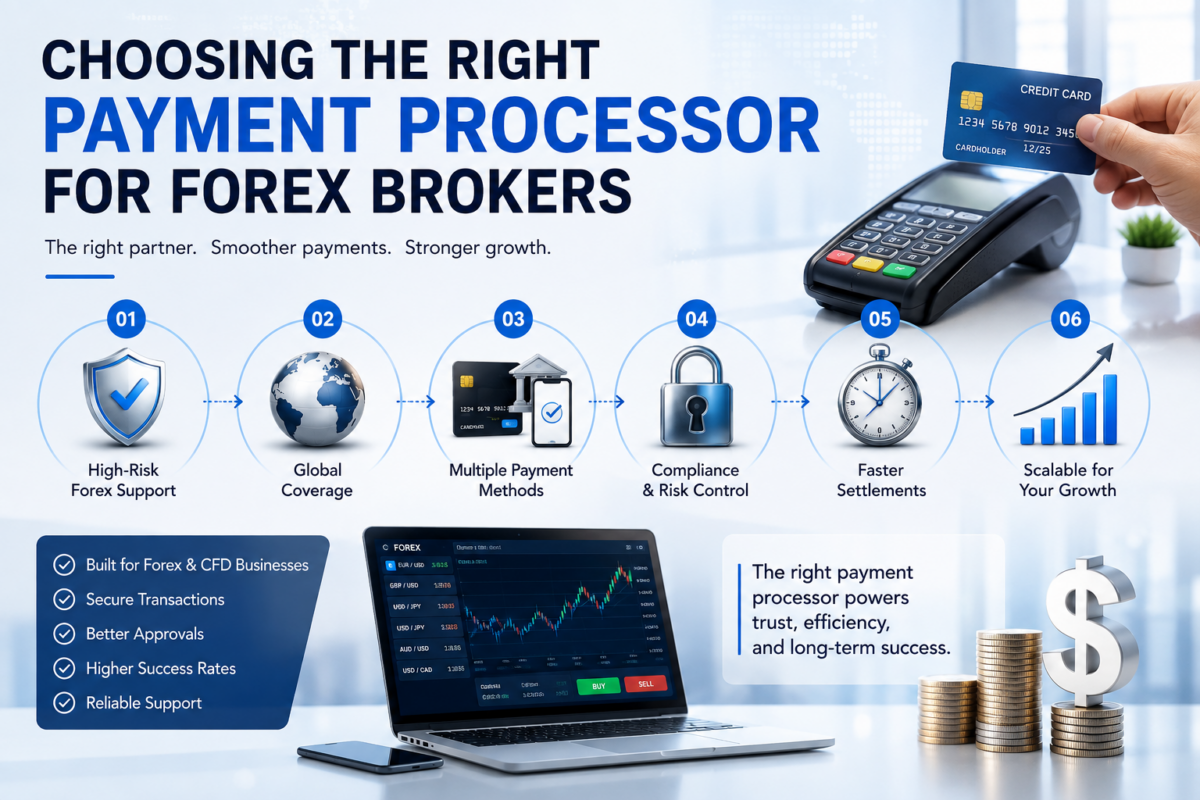
A Forex broker can have a strong trading platform, an established customer base, and a steady flow of deposits, yet still face payment problems if its processor is poorly matched to the business.
The issue is that choosing a payment processor for a Forex broker is not simply a matter of comparing transaction fees. The processor needs to fit the broker’s business model, customer markets, payment methods, compliance framework, settlement requirements, and risk profile.
A provider that works well for a conventional e-commerce merchant may not necessarily be suitable for a brokerage handling trading-account deposits, withdrawals, international customers, multiple currencies, disputes, and financial compliance requirements. The right evaluation therefore starts with the payment operation, not the advertised price.
What Does a Payment Processor Do for a Forex Broker?
A payment processor helps facilitate transactions between a broker, its customers, and the relevant payment infrastructure. Depending on the setup, the overall payment chain can involve the payment gateway, merchant account or acquiring relationship, card networks, banks, alternative payment providers, and settlement accounts.
For a Forex broker, this infrastructure needs to support more than a simple checkout. A typical deposit might follow this path:
Trader → Broker’s payment page → Payment gateway → Processor/acquirer → Payment network or bank → Authorization → Broker → Trading account
Once the payment is confirmed, the broker’s systems need to record the transaction and credit the appropriate trading account according to their internal controls.
Withdrawals introduce another workflow, while fraud screening, customer verification, transaction monitoring, reconciliation, and disputes add further operational requirements. This is why processor selection should be treated as part of the broker’s payment infrastructure rather than as a simple software purchase.
1. Start With Forex and High-Risk Acceptance
The first question should be whether the provider actually supports the broker’s business model.
Forex businesses can receive additional underwriting scrutiny because payment providers assess factors such as the nature of the service, customer geography, expected transaction activity, regulatory status, dispute exposure, and how funds move through the business. Requirements vary between providers and jurisdictions.
A broker should therefore establish whether the processor is prepared to underwrite Forex or CFD activity before investing significant time in integration. This connects directly with the question of why Forex brokers are considered high risk for payment processing. Understanding that risk profile helps a broker prepare for provider due diligence rather than treating an approval problem as an unexpected technical issue.
The processor may request information about the business, ownership, regulatory position, website, customer base, expected volumes, payment flows, and previous processing history. The exact requirements depend on the provider and applicable jurisdiction.
2. Check Geographic Coverage Before Comparing Prices
A processor can offer attractive pricing and still be unsuitable if it cannot effectively serve the broker’s target customers.
Consider a Forex broker expanding from one market into Europe, Asia, Latin America, or the Middle East. Customers in each region may have different payment preferences, currencies, banking infrastructure, and transaction restrictions. Geographic coverage should therefore be evaluated at two levels:
- Can the provider onboard the broker?
and
- Can the provider reliably process transactions from the customers the broker wants to serve?
The second question is often overlooked.
For example, a broker may technically have international card acceptance but discover that a significant portion of transactions from a particular market are declined because the payment route, issuer policies, fraud controls, or regional restrictions do not align with the customer base. A processor should be evaluated against the broker’s actual customer geography, not a generic claim of “global coverage.”
3. Evaluate Payment Methods Around the Customer Journey
Payment methods should be selected according to where the broker operates and how customers fund and withdraw from trading accounts.
Cards may be useful for certain customers, while bank-based payments or local payment methods may be more relevant in other markets. The important question is not which method is universally “best,” but which combination provides practical coverage for the broker’s target customers.
A broker should examine:
- Which deposit methods are supported?
- Which withdrawal methods are supported?
- Which currencies can be processed or settled?
- Are local payment methods available in important markets?
- Can new methods be added without rebuilding the payment architecture?
This is where understanding the best payment methods for Forex brokers and trading platforms becomes useful. Payment-method selection and processor selection should be considered together rather than as separate decisions.
4. Examine Transaction Reliability
A processor’s value is not measured only by whether transactions can technically be processed. Reliability matters throughout the payment lifecycle.
Suppose a broker receives 10,000 deposit attempts in a month. Even a relatively small failure rate can create a meaningful number of customers who cannot fund their accounts. When evaluating a processor, ask how it handles:
- Payment declines
- Technical failures
- Provider outages
- Authentication failures
- Duplicate transactions
- Failed callbacks or status notifications
- Transaction reconciliation
A decline does not always mean the customer’s card is invalid. Issuer decisions, fraud controls, incorrect payment information, geographic restrictions, payment-method limitations, and technical problems can all contribute to failed payments.
That is why brokers should also understand why Forex payments get declined and how failed transactions can be managed before judging a processor solely by its advertised approval performance. No provider can guarantee that every transaction will succeed.
5. Understand Settlement and Reserve Terms
A successful authorization does not necessarily mean the broker immediately has usable funds.
The processor and associated financial institutions may apply specific settlement schedules, reserves, funding conditions, or other commercial terms. These arrangements can vary according to risk assessment, transaction volume, geography, payment method, and processing history.
For a broker, settlement predictability matters because payment operations are connected to cash management and customer withdrawals.
Imagine a broker growing rapidly from $500,000 to $3 million in monthly deposits. If the settlement structure does not accommodate the new volume, the business could experience unexpected liquidity pressure even though customer transaction volume is increasing.
6. Look Beyond Basic Fraud Protection
Fraud prevention should be integrated into the payment lifecycle rather than added as an afterthought. Forex businesses can encounter stolen-card deposits, fraudulent account creation, account takeover, suspicious payment behavior, and transactions that do not match expected customer activity.
A processor may provide tools such as transaction monitoring, risk scoring, authentication, velocity controls, device information, or manual-review workflows. The exact capabilities vary. The broker should ask how these controls interact with its own fraud and compliance systems.
For example, a customer who suddenly attempts five deposits using different cards may require a different risk assessment from a verified customer making a normal recurring deposit. The payment infrastructure should provide enough information and control for the broker to investigate unusual behavior.
Fraud controls must also be balanced against legitimate customer access. Excessive blocking can create the same commercial problem as inadequate fraud protection if genuine deposits are repeatedly rejected.
7. Assess Chargeback and Dispute Management
Payment disputes can create both financial and operational costs for a brokerage.
A trader might dispute a transaction because they do not recognize the descriptor, claim that a payment was unauthorized, misunderstand the relationship between the deposit and the trading service, or raise a dispute after a trading loss.
The processor should therefore provide practical mechanisms for identifying, responding to, and monitoring disputes.
The broker should understand what transaction records are available, how dispute notifications are delivered, what evidence can be submitted, and whether reporting helps identify recurring dispute patterns.
This should be evaluated alongside a broader chargeback prevention strategy for Forex brokers, rather than treating chargebacks as something the processor alone is expected to solve. No processor can eliminate legitimate disputes or guarantee a particular chargeback rate.
8. Verify Compliance and Underwriting Support
Payment processing and compliance are closely connected for a Forex business. The broker may have its own customer-verification and transaction-monitoring obligations, while payment providers have their own onboarding, risk, and regulatory responsibilities. Requirements vary by jurisdiction and business model.
A processor should be able to explain what information it needs during onboarding and what ongoing monitoring or documentation may be required.
This is particularly important when the broker operates internationally. A payment method that is available in one jurisdiction may not be appropriate or permitted for another business model or customer base. The broker should also determine how payment transaction data can be accessed for internal compliance, reconciliation, and record-keeping purposes.
Understanding KYC and AML requirements for Forex payment processing is therefore essential when evaluating a processor, even though the processor does not replace the broker’s own compliance responsibilities.
9. Evaluate Integration and Reporting
10. Compare Total Cost, Not Just Transaction Fees
The lowest advertised processing fee does not necessarily produce the lowest overall payment cost.
A broker should examine the complete commercial structure, including processing fees, gateway costs, currency conversion charges, settlement costs, reserves, refunds, dispute-related fees, minimum commitments, and other applicable charges.
The processor with a slightly higher headline rate may ultimately be more economical if it provides better geographic coverage, more suitable payment methods, stronger reporting, and fewer operational problems. Pricing should therefore be compared against the payment experience the provider actually delivers.
11. Consider Scalability Before You Need It
A payment setup that works for a small broker may become restrictive as transaction volume grows.
The broker should ask whether the infrastructure can accommodate additional payment methods, markets, currencies, transaction volume, brands, and operational users without requiring a complete migration.
This is also where white-label payment platforms for Forex brokers may become relevant for businesses managing multiple brands, markets, or payment connections. White-label infrastructure is not necessary for every brokerage, but it can become useful when payment operations become sufficiently complex to require a centralized management layer.
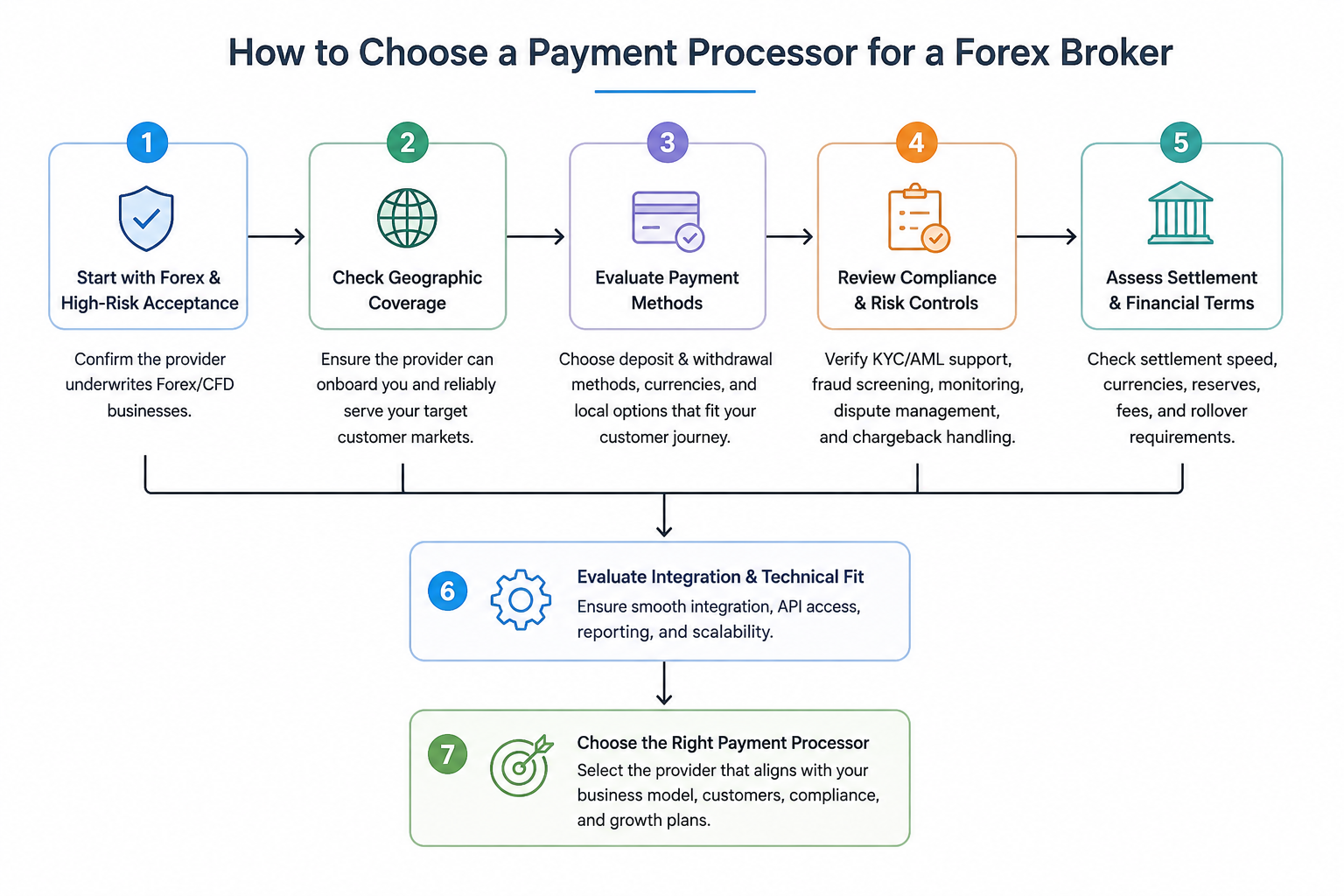
A Practical Framework for Choosing a Forex Payment Processor
Instead of selecting a provider based on one feature, score each candidate against the broker’s actual requirements.
A useful evaluation can be organized around five questions:
Can it support the business?
Forex acceptance, underwriting, regulatory context, customer geography, and expected volume.
Can customers pay successfully?
Payment methods, currencies, transaction reliability, authentication, and geographic coverage.
Can the broker operate efficiently?
Integration, reporting, reconciliation, settlements, dispute management, and support.
Can the business manage risk?
Fraud controls, transaction monitoring, security, compliance coordination, and chargeback processes.
Can the relationship scale?
Additional markets, payment methods, currencies, transaction volume, brands, and changing operational requirements.
This framework makes it easier to compare providers on business suitability rather than marketing claims.
Choosing for the Long-Term Payment Operation
Choosing a payment processor for a Forex broker is ultimately a decision about infrastructure, not just price.
The right processor needs to fit the broker’s customer markets, payment methods, transaction profile, compliance environment, settlement requirements, risk controls, and technology stack. A provider that performs well for one brokerage may not be the right choice for another because payment requirements differ significantly between business models and jurisdictions.
The evaluation should also continue after onboarding. Decline rates, dispute patterns, settlement performance, payment-method usage, and operational issues can reveal whether the original setup remains appropriate as the brokerage grows.
For a broker building its payment strategy, the next question is not simply which processor is cheapest. It is whether the entire payment system can reliably move money from customer deposit to trading balance, through monitoring and reconciliation, and back through withdrawals as the business expands.

Categories
- ACH Payments (10)
- adult payment processing (11)
- AI (9)
- Altcoins (10)
- Banking (10)
- Bitcoin (133)
- Bitcoin ETF (11)
- Bitcoin Price (30)
- Blockchain (50)
- Brokering World Hunger Away (16)
- Business (17)
- card payment processing (10)
- CBD (11)
- CBDC (11)
- coaching business (11)
- COVID-19 (3)
- Crypto ATMs (1)
- Crypto Banking (17)
- Crypto Bill (1)
- Crypto business owner platform (31)
- Crypto Investment (3)
- Crypto Markets (5)
- Crypto Payment (35)
- Crypto Payment Processor (4)
- Crypto Prices (1)
- Crypto Trading (92)
- Cryptocurrency (402)
- Cryptocurrency Exchange (108)
- Data Visualization (2)
- dating platforms (11)
- debt collection payment processing (10)
- Decentralized Finance (7)
- DeFi Payment (9)
- DEX (3)
- Digital Currency (23)
- dropshipping payment processing (12)
- Ethereum (2)
- FAQ (7)
- file sharing payment processing (11)
- Finance (25)
- Financial Equality (4)
- Financial Freedom (8)
- Forex (35)
- hemp (1)
- ICO (2)
- Investment (11)
- IPTV (11)
- Merchant Account (10)
- Mining (3)
- News (66)
- NFTs (2)
- online gambling (11)
- P2P (1)
- Paybito (139)
- PayBitoPro (693)
- PayBitoPro Coin Listing (6)
- PayBitoPro Exchange (2)
- Payment Gateway (40)
- peptide (10)
- Post COVID Digital Transformation (1)
- Press Release (130)
- Privacy & Security (3)
- Real Estate (1)
- Stablecoin (5)
- Technology (15)
- Travel (11)
- Uncategorized (9)
- US Presidential Election (2)
- Utility Coin (1)
- Web3 business (4)
- Web3 Wallets (2)
- White Label Crypto Exchange (8)
Recent Posts
- ACH vs Wire Transfer: Which Payment Method Is Better for Businesses?
- ACH Fraud Prevention: How Businesses Can Secure Bank Account Payments?
- ACH Credit vs ACH Debit: What’s the Difference? With Real Examples
- ACH vs Credit Card: Which Payment Method Is Better for Businesses?
- How Long Do ACH Payments Take? Processing Times, Settlement, and Same Day ACH