How to Accept ACH Payments: A Complete Guide for Businesses
- August 19, 2026
- Soham Guchait
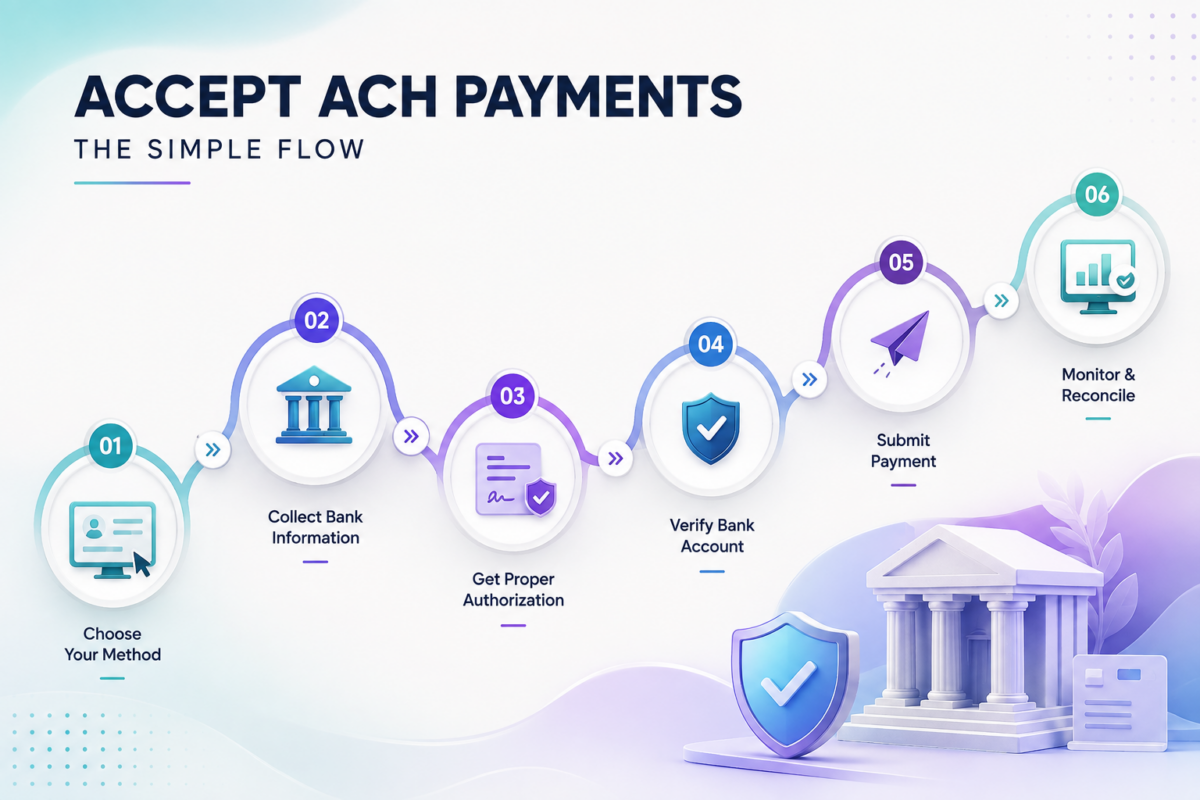
For businesses that collect recurring bills, invoices, subscriptions, or larger customer payments, accepting bank-account payments can be a useful alternative to relying only on cards or checks. That raises a practical question: How do you accept ACH payments from customers?
To accept ACH payments, a business generally needs a way to collect the customer’s bank-account information and required authorization, submit ACH payment instructions through an appropriate financial institution or payment provider, and manage the resulting transactions.
The process is straightforward in principle, but the details matter. Businesses need to think about authorization, account information, payment timing, returns, reconciliation, and fraud controls before making ACH part of their payment process.
How Do Businesses Accept ACH Payments?
Businesses typically accept ACH payments by setting up an ACH payment process that allows customers to authorize a bank-account payment. The basic workflow is:
Choose an ACH acceptance method → collect customer information and authorization → submit the payment → monitor processing → reconcile the result
The exact implementation depends on the business model. A SaaS company collecting recurring subscriptions may use a different workflow from a B2B company collecting one-time invoices.
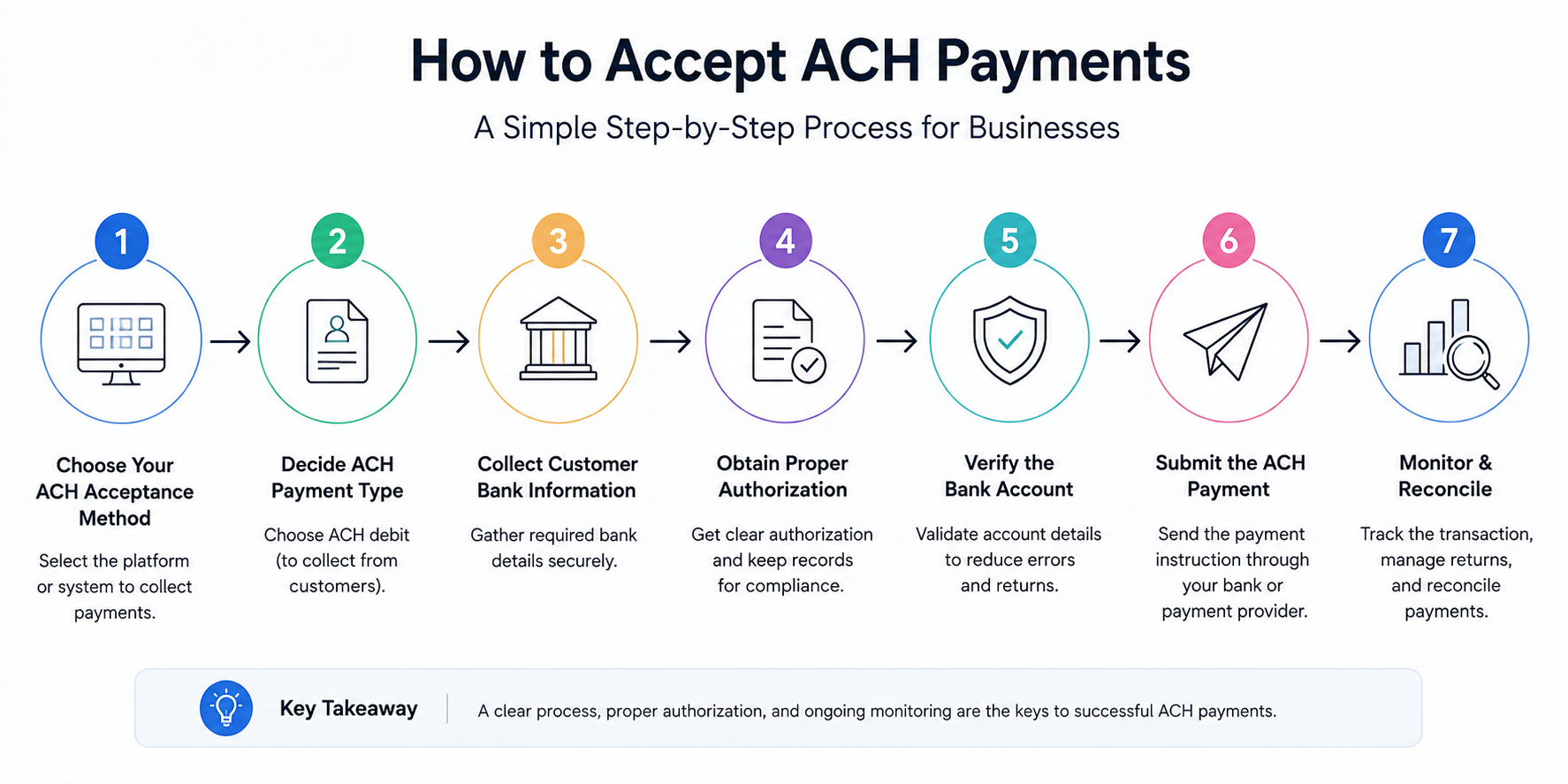
Step 1: Choose How You Will Accept ACH Payments
The first decision is how customers will provide their payment information and how your business will submit the resulting ACH transactions. Common approaches include:
- An online payment form
- A customer portal
- An invoicing system
- A recurring billing system
- An accounting or business-management platform
- A payment service that supports ACH
The right option depends on factors such as transaction volume, recurring-payment requirements, technical resources, and how customers currently pay.
For example, a small consulting firm that sends a few invoices each month may need a much simpler setup than a subscription business processing thousands of recurring payments. Businesses should also understand the underlying processing flow before choosing an acceptance method. Understanding how Ach payments work can help explain what happens after an ACH payment is initiated.
Step 2: Decide Which ACH Payment Type You Need
There are two primary ACH transaction types: ACH credit and ACH debit.
For businesses accepting payments from customers, ACH debit is particularly relevant because the business initiates the collection from the customer’s bank account after obtaining the appropriate authorization.
For example, suppose a customer owes a service business $750. With an authorized ACH debit:
- The customer provides the required payment information.
- The customer authorizes the business to collect the $750.
- The business submits the ACH payment instruction.
- The customer’s bank account is debited according to the applicable processing schedule.
- The business receives the corresponding transaction information and reconciles the payment.
An ACH credit works in the opposite direction: the party sending the money initiates the payment. Understanding this distinction is useful when designing the payment workflow.
Step 3: Collect the Customer’s Bank Information
A business needs the information required to identify the customer’s bank account and process the transaction. Depending on the acceptance method, this can include information such as:
- Customer or account-holder name
- Bank routing information
- Bank account number
- Account type
- Payment amount
- Payment frequency, when applicable
The exact information and verification process can vary by payment setup. This is also a point where businesses should think carefully about data handling. Bank-account information is sensitive financial information, so access should be restricted and appropriate security controls should be in place.
Step 4: Obtain Proper Payment Authorization
For ACH debits, authorization is a fundamental part of the process.
A customer must authorize the business to initiate the applicable debit under the relevant ACH requirements. The business should maintain appropriate records of that authorization and be able to demonstrate that the payment was properly authorized when necessary. The authorization process should make the important terms clear, including where appropriate:
- Who is receiving the authorization?
- The amount or method used to determine the amount
- Whether the payment is one-time or recurring?
- When will payments be initiated?
- How can the authorization be revoked?
The exact requirements can depend on the transaction type and applicable rules, so businesses should not treat an ACH authorization form as a generic checkbox.
Step 5: Verify the Bank Account
Bank-account verification can help reduce errors before a business submits an ACH transaction. This matters because incorrect account information can lead to failed or returned payments.
Businesses may use different verification approaches depending on their payment setup. For example, some processes may verify account ownership or require the customer to confirm information before the first payment.
Verification can be particularly valuable for businesses dealing with:
- High-value invoices
- Recurring payments
- New customers
- Vendor relationships
- Large transaction volumes
It should be viewed as part of payment operations rather than simply an optional technical feature.
Step 6: Submit the ACH Payment
Once the customer has provided the required information and authorization, the business can initiate the ACH transaction through its chosen payment infrastructure. The transaction is then submitted into the ACH system through the relevant financial institution and processing channels.
Businesses should pay attention to submission timing. ACH transactions operate according to processing windows and banking schedules, so the time a payment is initiated can affect when it is processed and settled. This is one reason businesses should avoid promising customers a universal “instant” ACH experience.
Step 7: Monitor Successful and Returned Payments
Accepting ACH payments doesn’t end when a transaction is submitted. Businesses should monitor whether transactions are successfully processed or returned. An ACH payment can be returned for reasons including:
- Insufficient funds
- Invalid account information
- Closed account
- Account restrictions
- Other applicable return conditions
A returned transaction needs to be handled differently from a successful payment. The appropriate response depends on the reason for the return.
For example, a subscription business may need to notify a customer after a payment is returned, while a B2B company may need to contact an accounts-payable team to correct banking information. Understanding the reason behind an ACH return is important because different return situations can require different operational responses.
Step 8: Reconcile ACH Payments With Your Records
Reconciliation is often overlooked when businesses first start accepting ACH. A payment appearing in a bank account does not automatically mean the business’s accounting records are correctly updated. Finance teams may need to match ACH transactions against:
- Customer invoices
- Subscription accounts
- Sales orders
- Vendor records
- Payroll records
- Accounting entries
For example, imagine an online business receives 200 ACH payments during a billing cycle. Its finance team needs to identify which payments correspond to which customers and invoices and determine whether any transactions were returned or require investigation.
A well-designed reconciliation process reduces the risk of incorrectly marking invoices as paid or overlooking failed transactions.
How Long Does It Take to Receive an ACH Payment?
ACH payment timing varies. Factors can include:
- Submission time
- Processing windows
- Banking days
- Holidays
- Transaction type
- Receiving financial institution
- Same Day ACH eligibility
Eligible transactions may be processed and settled through Same Day ACH, but businesses should not assume that every ACH payment is instantaneous.
If payment timing is important to your cash flow, build your internal processes around realistic settlement expectations rather than treating the payment submission date as the same thing as final availability of funds. A detailed understanding of ACH processing and settlement timing is especially useful when deciding when to invoice customers, release orders, or recognize payments.
Example: Accepting ACH for a Subscription Business
Consider a hypothetical SaaS company charging customers $300 per month.
Its ACH payment process could look like this:
- The customer selects ACH at checkout.
- The customer provides the required bank-account information.
- The customer completes the appropriate authorization.
- The business verifies the account using its chosen verification method.
- The business initiates the recurring ACH debit on the scheduled billing date.
- The transaction moves through ACH processing.
- The business monitors the transaction result.
- A successful payment is matched to the customer’s subscription account.
- A returned payment is flagged for follow-up.
This illustrates why accepting ACH is not simply a matter of adding a “Pay by Bank” button. The surrounding authorization, verification, monitoring, and reconciliation processes are equally important.
What Should Businesses Consider Before Accepting ACH?
Before introducing ACH payments, businesses should evaluate:
Customer Experience
Will customers easily understand how to provide their bank information and authorize payments?
Payment Volume
A manual process may be manageable for a small number of invoices but become difficult as transaction volume increases.
Recurring Billing
Businesses collecting subscriptions or scheduled payments should make sure their system can handle recurring authorization and payment tracking appropriately.
Returns
Have you established a process for identifying, communicating, and resolving returned payments?
Security
Who can access customer banking information? How is it protected? What controls exist for suspicious or unauthorized activity?
Reconciliation
Can your accounting process reliably match ACH transactions to customers and invoices?
Cost
ACH pricing varies. Compare applicable per-transaction fees, monthly charges, return fees, and other costs rather than assuming every provider uses the same pricing model.
Frequently Asked Questions
Can a small business accept ACH payments?
Yes. Small businesses can accept ACH when they have an appropriate method for collecting customer information and authorization and submitting transactions through suitable ACH infrastructure.
Do customers need to provide a bank account number for ACH?
ACH transactions generally require information that identifies the customer’s bank account. The exact information collected depends on the payment and verification method being used.
Can businesses accept recurring ACH payments?
Yes. Recurring ACH payments can be used when the customer has provided the appropriate authorization and the business has a process for managing scheduled transactions.
How can a business reduce ACH payment failures?
Accurate account information, appropriate account verification, valid authorization, transaction monitoring, and a clear process for handling returns can help reduce avoidable failures.
Is ACH cheaper than credit cards?
It can be, depending on the provider, pricing structure, transaction volume, and other applicable costs. Businesses should compare their actual fees rather than assuming ACH is always cheaper.
Conclusion
Learning how to accept ACH payments involves more than choosing a payment option. A reliable ACH process connects customer authorization, bank-account information, verification, transaction submission, monitoring, and reconciliation.
For a business, the goal should be to build an ACH workflow that customers can understand and that finance and operations teams can manage consistently.
ACH can be a practical option for recurring subscriptions, B2B invoices, customer collections, and other bank-account-based payments. Whether it makes sense for a particular business depends on its customers, transaction patterns, timing requirements, costs, and ability to manage the operational responsibilities that come with ACH.

Categories
- ACH Payments (10)
- adult payment processing (11)
- AI (9)
- Altcoins (10)
- Banking (10)
- Bitcoin (133)
- Bitcoin ETF (11)
- Bitcoin Price (30)
- Blockchain (50)
- Brokering World Hunger Away (16)
- Business (17)
- card payment processing (10)
- CBD (11)
- CBDC (11)
- Chargeback (8)
- coaching business (11)
- COVID-19 (3)
- Crypto ATMs (1)
- Crypto Banking (17)
- Crypto Bill (1)
- Crypto business owner platform (31)
- Crypto Investment (3)
- Crypto Markets (5)
- Crypto Payment (35)
- Crypto Payment Processor (4)
- Crypto Prices (1)
- Crypto Trading (92)
- Cryptocurrency (402)
- Cryptocurrency Exchange (108)
- Data Visualization (2)
- dating platforms (11)
- debt collection payment processing (10)
- Decentralized Finance (7)
- DeFi Payment (9)
- DEX (3)
- Digital Currency (23)
- dropshipping payment processing (12)
- Ethereum (2)
- FAQ (7)
- file sharing payment processing (11)
- Finance (25)
- Financial Equality (4)
- Financial Freedom (8)
- Forex (35)
- hemp (1)
- ICO (2)
- Investment (11)
- IPTV (11)
- Merchant Account (10)
- Mining (3)
- News (66)
- NFTs (2)
- online gambling (11)
- P2P (1)
- Paybito (147)
- PayBitoPro (693)
- PayBitoPro Coin Listing (6)
- PayBitoPro Exchange (2)
- Payment Gateway (48)
- peptide (10)
- Post COVID Digital Transformation (1)
- Press Release (130)
- Privacy & Security (3)
- Real Estate (1)
- Stablecoin (5)
- Technology (15)
- Travel (11)
- Uncategorized (10)
- US Presidential Election (2)
- Utility Coin (1)
- Web3 business (4)
- Web3 Wallets (2)
- White Label Crypto Exchange (8)
Recent Posts
- Payment Gateway vs. Payment Orchestration: What’s the Difference?
- What Is Smart Payment Routing? Strategies to Optimize Payment Performance
- How to Improve Payment Approval Rates for High-Risk Businesses?
- Why Are Online Payments Failing? Common Causes and How to Fix Them
- How to Use Multiple Payment Processors to Reduce Business Disruptions?