How Much Does Card Payment Processing Cost? Understanding Every Processing Fee
- August 18, 2026
- Soham Guchait
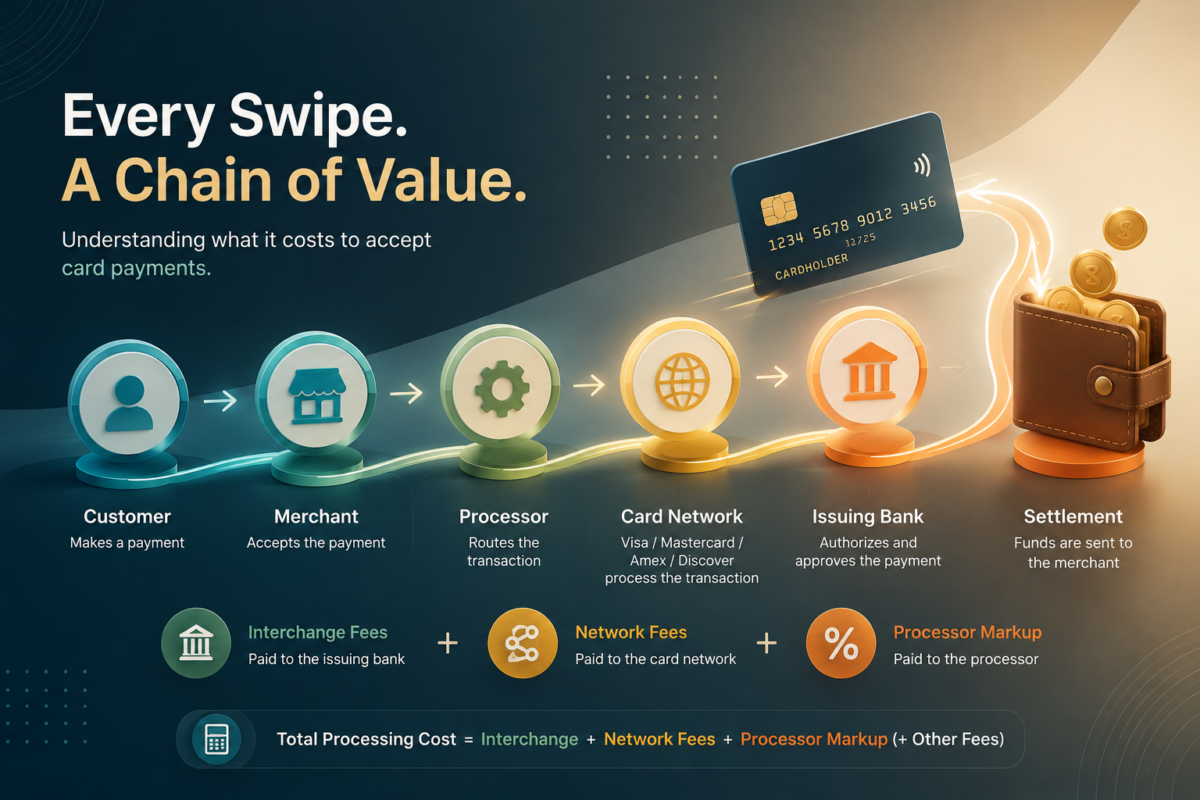
Accepting card payments makes it easier for customers to buy from a business, but every transaction comes with a cost. The amount a business actually pays is rarely just one simple “Card Processing Fee”. Instead, the total cost can include interchange, card-network fees, processor markup, and other account or transaction charges.
For many businesses, total credit card processing costs commonly fall somewhere around 1.5% to 3.5% of transaction volume, although the actual rate varies significantly based on the card used, transaction type, business, pricing model, and processor.
Understanding where those costs come from is more useful than simply comparing advertised rates. A processor quoting 2.6% may not necessarily be more expensive than one advertising 2.3%, because the pricing structures and additional fees may be different. The real question is:
How much does the business actually pay to accept each card transaction?
What Are Card Payment Processing Fees?
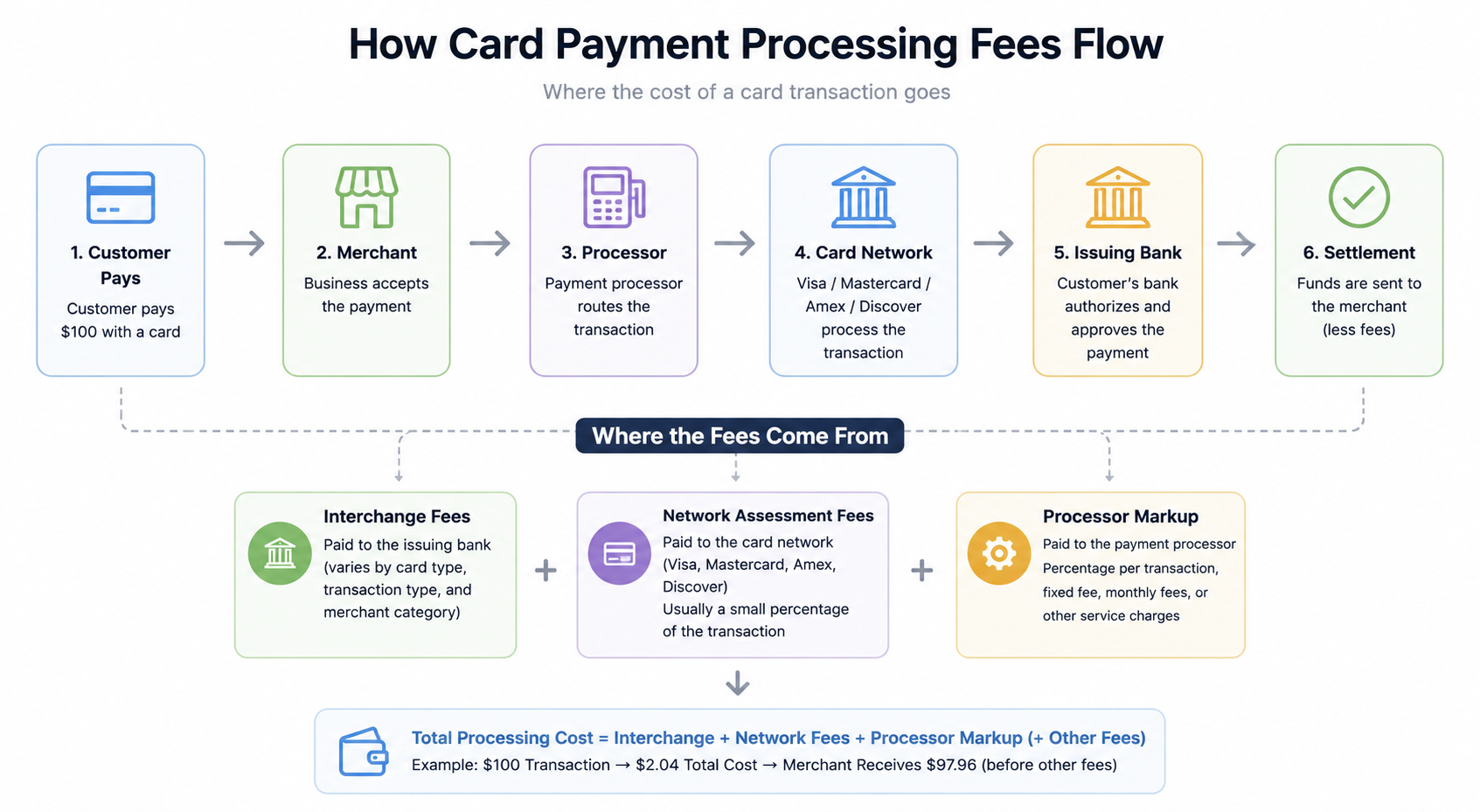
Card payment processing fees are the costs a business incurs when accepting a card transaction. When a customer pays $100 by card, the merchant does not necessarily receive the full $100. Different participants in the payment ecosystem receive fees for their role in processing the transaction.
The three major components are interchange, card-network assessment fees, and processor markup.
Interchange generally goes to the customer’s card-issuing bank. Network or assessment fees go to the card network. The processor then charges its own markup for providing processing and related services.
There can also be additional charges, such as monthly fees, statement fees, gateway-related charges, or other account costs, depending on the provider and pricing agreement. This is why looking at only the advertised percentage can give an incomplete picture.
The Three Main Components of Card Processing Costs
Interchange Fees
Interchange is usually the largest component of the cost of accepting a card.
It is associated with the issuing bank – the financial institution that provided the customer’s card. Interchange rates vary according to factors such as the card type, transaction method, merchant category, and other transaction characteristics.
For example, a business accepting a rewards credit card online may incur a different interchange cost from a business accepting a standard card in person. This is one reason two $100 transactions can have different processing costs even when they are processed by the same merchant. Interchange can also include both a percentage and a fixed amount. A hypothetical rate of 1.50% + $0.10 on a $100 transaction would produce an interchange cost of $1.60. That does not mean the merchant’s total processing cost is $1.60. Network fees and processor charges still need to be considered.
Card Network Assessment Fees
Card networks such as Visa, Mastercard, Discover, and American Express also charge fees associated with operating their payment networks.
These are generally much smaller than interchange, but they still contribute to the merchant’s overall processing cost. Current industry explanations commonly place assessment fees at a small percentage of transaction volume, with the exact structure varying by network. Think of this as a separate layer:
- Issuing bank → Interchange
- Card network → Assessment/network fees
- Processor → Processor markup
The three charges may ultimately appear together in the merchant’s overall processing cost, even though they go to different participants.
Processor Markup
The processor’s markup is the part of the cost charged by the payment processor or merchant-services provider for handling the processing relationship. Depending on the agreement, this can include a percentage of each transaction, a fixed amount per transaction, monthly charges, or fees for additional services.
Unlike interchange and network assessments, the processor’s markup is generally the portion over which a merchant has the most room to negotiate.
That does not mean the cheapest markup is automatically the best option. A provider charging a slightly higher markup may include tools or services that reduce other operational costs. The important thing is to understand exactly what the quoted price includes.
How Much Does a $100 Card Transaction Really Cost?
Suppose a business processes a hypothetical $100 card transaction. Assume the transaction generates:
- Interchange: $1.60
- Network assessment: $0.14
- Processor markup: $0.30
The total processing cost would be $2.04, leaving the merchant with approximately $97.96 before considering any other applicable fees. The exact numbers will vary by card, network, transaction type, and processor. The example is useful because it demonstrates why a single advertised percentage does not tell the whole story.
A processor could advertise a low markup while the underlying interchange varies considerably from transaction to transaction. This is also why businesses should compare their total effective processing cost, rather than focusing on one line of a pricing proposal.
Why Card Processing Costs Differ Between Transactions?
There is no universal card processing fee that applies identically to every transaction. The cost can change depending on several characteristics of the payment.
For example, card-present and card-not-present transactions can have different costs because the transaction environments involve different risk and processing conditions. Online payments can also have different pricing from in-person transactions. The card itself can also matter. Consumer credit cards, rewards cards, commercial cards, debit cards, and different network products can have different underlying fee structures.
The merchant’s industry and transaction characteristics can also influence the applicable interchange category. This is why a business that processes mostly in-person transactions should not assume that an advertised online processing rate will represent its actual costs – and vice versa.
Why Online Card Payments Can Cost More?
Online transactions are generally considered card-not-present transactions because the physical card is not presented to the merchant.
The additional fraud and authentication considerations associated with these transactions can affect the applicable processing costs. Current industry benchmarks show higher average effective rates for online or keyed transactions than for many in-person transactions.
For example, imagine two businesses each process $100,000 per month.
A local store might receive most payments through customers physically tapping or inserting their cards.
An ecommerce business might receive almost all payments through online checkout.
Even if both businesses have similar sales volumes, their average processing costs can differ because the transaction environments and card mix are different. Understanding this distinction is also important when comparing the economics of different ways of accepting cards.
Flat-Rate vs. Interchange-Plus Pricing
Businesses commonly encounter different pricing models when comparing payment providers.
With flat-rate pricing, the provider charges a predetermined rate, often expressed as a percentage plus a fixed transaction fee. The simplicity can make costs easier to predict, especially for smaller businesses with relatively straightforward payment volumes.
With interchange-plus pricing, the merchant pays the applicable interchange and network costs plus a separate processor markup.
For example, a hypothetical agreement might be:
Interchange + 0.30% + $0.08
The underlying interchange can change depending on the transaction, while the processor’s markup remains defined by the agreement. Neither model is automatically better for every business.
A small business with modest volume may value simplicity and predictable pricing. A larger merchant with substantial transaction volume may benefit from greater visibility into the underlying costs and processor markup. The right comparison depends on the business’s transaction volume, average ticket size, transaction mix, and tolerance for pricing complexity.
What Other Fees Can Appear on a Processing Statement?
The transaction rate is only part of the potential cost.
Depending on the provider and agreement, a merchant may also encounter account or service-related charges. These can include monthly fees, statement fees, gateway charges, PCI-related fees, chargeback fees, or other service costs. Not every provider charges every fee, and some may bundle certain services into their pricing.
This is why a merchant should examine the complete pricing structure rather than asking only, “What percentage do you charge?”
A quote that looks inexpensive at first can become considerably more expensive once fixed fees and other charges are included.
How to Compare Card Processing Costs Properly?
When comparing payment processing options, businesses should look beyond the headline rate. Three questions are particularly useful:
- What are the underlying interchange and network costs?
- What markup and fixed fees does the provider add?
- What would the total effective rate be based on my actual transaction volume and mix?
For example, imagine Provider A advertises 2.5% + $0.10, while Provider B offers interchange + 0.25% + $0.08.
Provider A may initially look easier to understand, but Provider B’s actual cost depends on the interchange categories generated by the merchant’s transactions. The better option cannot be determined from those advertised numbers alone. The business needs to model its expected transaction mix and calculate the total cost.
How Processing Fees Affect a Business’s Margins?
Processing fees can look small when viewed against a single transaction, but they become significant at scale.
Consider a business processing $1 million in card payments annually.
At an effective rate of 2%, total processing costs would be approximately $20,000. At 3%, the cost would be approximately $30,000. That one-percentage-point difference represents $10,000 per year. For businesses operating on narrow margins, this can materially affect profitability.
The goal, however, should not simply be to find the lowest advertised rate. A reliable payment setup must also support the business’s transaction environment, security requirements, customer experience, and operational needs.
The Bottom Line
Card payment processing fees are not one single charge. They are the combined cost of several layers within the card payment ecosystem.
Interchange represents a major portion of the underlying cost. Network assessment fees compensate the card networks for their role in processing transactions. Processor markup and other provider fees cover the services and infrastructure supplied to the merchant. The actual cost depends on the card, transaction type, business, pricing model, and transaction volume.
For that reason, the most useful number for a business to track is often its effective processing rate – the total amount paid in processing fees compared with the card sales volume that generated those fees.
Once businesses understand what sits behind the percentage on their processing statement, they can make much more informed decisions about payment costs, pricing models, and the overall economics of accepting cards.

Categories
- ACH Payments (10)
- adult payment processing (11)
- AI (9)
- Altcoins (10)
- Banking (10)
- Bitcoin (133)
- Bitcoin ETF (11)
- Bitcoin Price (30)
- Blockchain (50)
- Brokering World Hunger Away (16)
- Business (17)
- card payment processing (10)
- CBD (11)
- CBDC (11)
- Chargeback (8)
- coaching business (11)
- COVID-19 (3)
- Crypto ATMs (1)
- Crypto Banking (17)
- Crypto Bill (1)
- Crypto business owner platform (31)
- Crypto Investment (3)
- Crypto Markets (5)
- Crypto Payment (35)
- Crypto Payment Processor (4)
- Crypto Prices (1)
- Crypto Trading (92)
- Cryptocurrency (402)
- Cryptocurrency Exchange (108)
- Data Visualization (2)
- dating platforms (11)
- debt collection payment processing (10)
- Decentralized Finance (7)
- DeFi Payment (9)
- DEX (3)
- Digital Currency (23)
- dropshipping payment processing (12)
- Ethereum (2)
- FAQ (7)
- file sharing payment processing (11)
- Finance (25)
- Financial Equality (4)
- Financial Freedom (8)
- Forex (35)
- hemp (1)
- ICO (2)
- Investment (11)
- IPTV (11)
- Merchant Account (10)
- Mining (3)
- News (66)
- NFTs (2)
- online gambling (11)
- P2P (1)
- Paybito (147)
- PayBitoPro (693)
- PayBitoPro Coin Listing (6)
- PayBitoPro Exchange (2)
- Payment Gateway (48)
- peptide (10)
- Post COVID Digital Transformation (1)
- Press Release (130)
- Privacy & Security (3)
- Real Estate (1)
- Stablecoin (5)
- Technology (15)
- Travel (11)
- Uncategorized (10)
- US Presidential Election (2)
- Utility Coin (1)
- Web3 business (4)
- Web3 Wallets (2)
- White Label Crypto Exchange (8)
Recent Posts
- Payment Gateway vs. Payment Orchestration: What’s the Difference?
- What Is Smart Payment Routing? Strategies to Optimize Payment Performance
- How to Improve Payment Approval Rates for High-Risk Businesses?
- Why Are Online Payments Failing? Common Causes and How to Fix Them
- How to Use Multiple Payment Processors to Reduce Business Disruptions?