What Is Card Payment Processing? How It Works for Businesses?
- August 18, 2026
- Soham Guchait
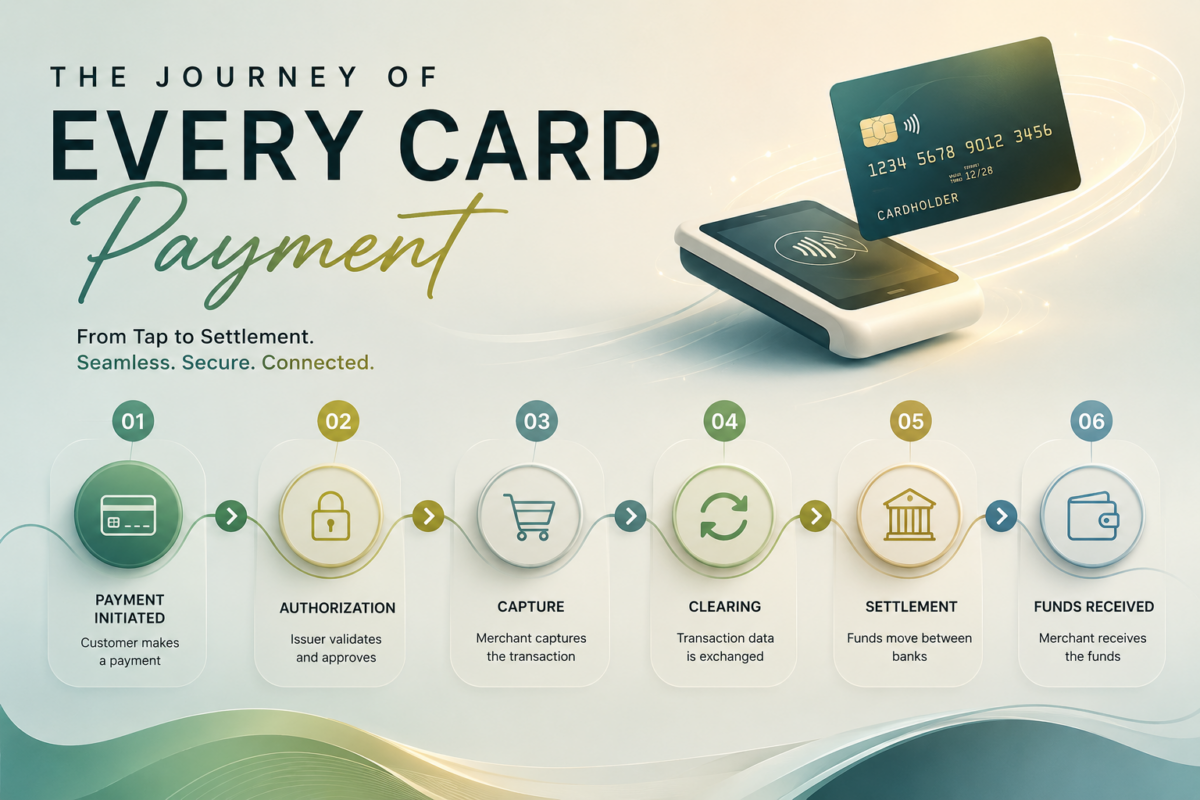
A customer taps a card at a checkout terminal, enters card details on a website, or uses a digital wallet linked to a card. Seconds later, the payment may show as approved. What the customer does not see is the network of systems working behind that approval.
A card payment passes through several parties and stages before the transaction is completed and the merchant receives the corresponding funds. Card payment processing is the infrastructure and sequence of activities that makes this possible – from submitting a payment and checking whether it can be approved to capture the transaction, clearing the records, and settling the funds.
Understanding this process helps businesses make sense of payment costs, declined transactions, settlement times, and the different technologies involved in accepting cards.
What Is Card Payment Processing?
Card payment processing is the process through which a card transaction is submitted, authorized, recorded, and ultimately settled between the parties involved in the payment.
The process connects several participants. A typical transaction involves the cardholder, merchant, card issuer, acquirer, and card network. Depending on how the payment is made, additional technology such as a payment gateway may also be involved.
The cardholder is the person making the purchase, while the merchant is the business accepting the payment. The issuer is the financial institution that issued the customer’s card. The acquirer operates on the merchant side of the card-payment ecosystem and facilitates acceptance and settlement. Card networks provide the infrastructure and rules that allow transactions to move between the relevant institutions.
For online payments, a payment gateway can provide the technology needed to securely transmit payment information from the checkout environment into the processing infrastructure. Its role is important, but it is only one component of the broader card-payment ecosystem. This is why card payment processing should not be viewed simply as money moving directly from a customer’s card to a business. Multiple systems coordinate to determine whether the transaction can proceed and how it is ultimately completed.
How Does a Card Payments Actually Work?
The easiest way to understand card payment processing is to follow a single transaction.
Imagine a customer purchases a $150 product from an online store. The customer enters their card information and clicks the payment button. The merchant’s checkout system sends the relevant transaction information into the payment infrastructure.
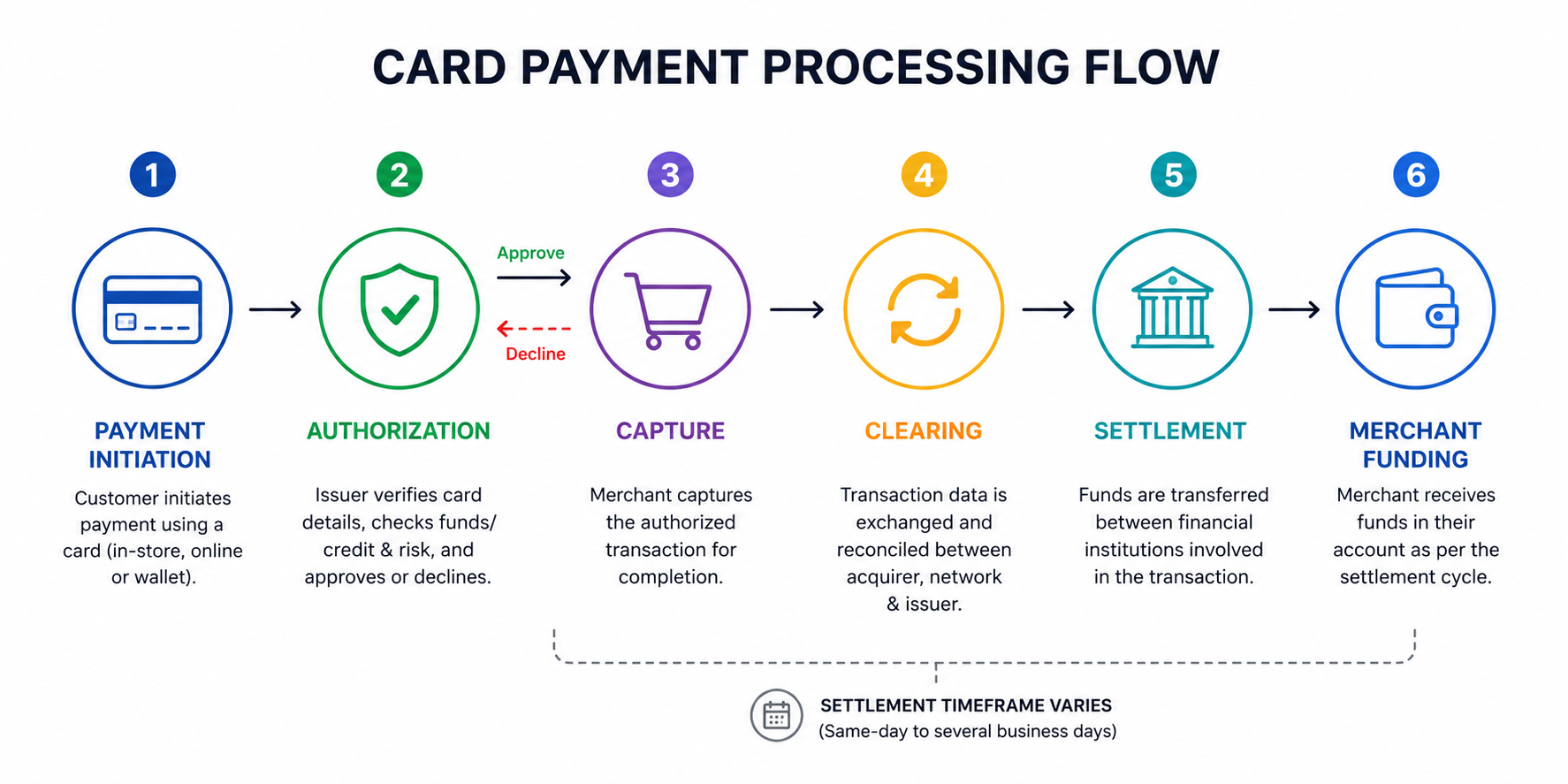
The first major decision is authorization. An authorization request is routed through the appropriate processing infrastructure and card network to the card issuer. The issuer evaluates the transaction and determines whether it can be approved. This assessment can involve factors such as the account status, available funds or credit, transaction information, and risk controls.
The issuer then sends an approval or decline response back through the transaction path. An important distinction is that authorization does not mean the merchant has already received the money. It means the transaction has received approval to proceed under the applicable conditions.
For businesses trying to understand why an apparently valid payment can be rejected, the authorization stage is particularly important. A closer look at card payment authorization explains what happens during this decision and how an approval differs from a completed payment.
Once an authorized transaction is ready to be completed, the merchant can proceed with capture. Capture communicates that the merchant intends to complete the transaction. Depending on the business model and transaction, capture may happen immediately or at a later point.
The transaction then enters the processes generally referred to as clearing and settlement. Transaction records are exchanged and reconciled between the relevant parties, while settlement involves the movement of funds between financial institutions.
Only after these stages does the merchant receive the funds according to its applicable settlement and funding arrangements. So, what looks like one action at checkout is actually a sequence:
Payment initiated → Authorization → Capture → Clearing → Settlement → Merchant funding
The exact flow can vary according to the transaction type, payment environment, market, and arrangements between the parties involved.
Who Is Involved in Processing a Card Payment?
The terminology can seem complicated at first, but each participant has a distinct role.
|
Participant |
Role in the transaction |
|
Cardholder |
Initiates the payment |
|
Merchant |
Sells the product or service and accepts the payment |
|
Card issuer |
Issues the card and makes the authorization decision |
|
Acquirer |
Supports the merchant side of card acceptance and settlement |
|
Card network |
Provides transaction-routing infrastructure and network rules |
| Payment Gateway |
Transmits payment information between the checkout environment and payment infrastructure where applicable |
These parties do not necessarily interact in exactly the same way for every transaction. Card-present and card-not-present payments, for example, can involve different technologies and authentication processes.
This distinction becomes especially important when comparing card-present and card-not-present transactions because the way customers provide their card details can affect how the payment is processed, verified, and secured.
Why Does Card Payment Processing Matter to Businesses?
For a business, accepting cards is not simply a matter of providing customers with another way to pay. The underlying processing infrastructure affects several parts of payment operations.
One consideration is cost. Card transactions can involve multiple fee components rather than one universal charge. Interchange-related costs, network fees, and other processing charges can contribute to the merchant’s overall expense. Understanding card payment processing fees therefore gives a business a better picture of what it is actually paying to accept cards.
Another consideration is reliability. A customer can have a valid card and still encounter a failed transaction. The reason could originate with the issuer, transaction information, risk controls, or a technical component of the payment process. Knowing where different failures occur makes troubleshooting considerably easier.
Security is another essential part of the system. Card payments involve financial information and potential fraud risks, so different technologies and standards are used to protect transactions and payment data. These mechanisms do not all perform the same function; some address authentication, others protect sensitive information, and others establish security requirements for organizations handling card data.
Finally, businesses need to understand when money actually becomes available. An approved transaction is not necessarily the same thing as a settled transaction or funds that are already available for the merchant to use.
A Simple Card Payment Processing Example
Consider a customer buying a $150 pair of shoes.
The customer presents their card or submits their card details online. The transaction information enters the payment infrastructure and an authorization request is sent toward the card issuer. The issuer approves the transaction.
The customer sees a successful payment message and the merchant can treat the transaction as authorized. However, the merchant has not necessarily received the $150 at this moment.
The transaction is then captured. Its information moves through the relevant clearing process, followed by settlement between the financial institutions involved. The merchant eventually receives the applicable funds according to its funding arrangement.
The customer experiences this in a few seconds at checkout. The payment system experiences it as a multi-stage transaction lifecycle. That difference is central to understanding card payment processing.
What Can Cause a Card Payment to Fail?
A card payment can fail for different reasons, and identifying the stage at which it failed is often the first step toward understanding the problem.
An issuer may decline an authorization because of circumstances associated with the account or transaction. A card payment may also fail because the customer entered incorrect payment information, a fraud or security control blocked the transaction, or a technical issue disrupted communication between payment systems.
This means that a declined card payment and a technical payment failure are not necessarily the same thing.
For example, if the issuer declines an authorization, changing a technical setting may not resolve the issue. Conversely, if the issuer is willing to authorize the transaction but a technical problem prevents the response from being completed, the solution lies elsewhere. Understanding the transaction lifecycle therefore gives businesses a framework for diagnosing payment problems rather than treating every unsuccessful transaction as the same type of failure.
Card Payment Processing: The Bigger Picture
Card payment processing can be summarized as a connected lifecycle:
- Payment initiation: The customer submits a card payment.
- Authorization: The issuer evaluates the transaction and returns an approval or decline.
- Capture: The approved transaction is submitted for completion.
- Clearing: Transaction information is exchanged and reconciled between the relevant parties.
- Settlement: Funds are transferred between the participating financial institutions.
- Merchant funding: The merchant receives the applicable funds according to its settlement and funding arrangements.
Each stage serves a different purpose. Authorization determines whether a transaction can proceed; capture confirms the merchant’s intent to complete it; clearing handles transaction records; and settlement moves the funds.
Once businesses understand these distinctions, they can better understand why card payments get declined, why card processing costs vary, and why an approved payment does not always make funds immediately available.
Card payment processing covers the complete infrastructure and transaction lifecycle that enables businesses to accept card payments. It moves each transaction from the customer’s payment initiation through authorization, completion, clearing, settlement, and final funding.

Categories
- ACH Payments (10)
- adult payment processing (11)
- AI (9)
- Altcoins (10)
- Banking (10)
- Bitcoin (133)
- Bitcoin ETF (11)
- Bitcoin Price (30)
- Blockchain (50)
- Brokering World Hunger Away (16)
- Business (17)
- card payment processing (10)
- CBD (11)
- CBDC (11)
- Chargeback (8)
- coaching business (11)
- COVID-19 (3)
- Crypto ATMs (1)
- Crypto Banking (17)
- Crypto Bill (1)
- Crypto business owner platform (31)
- Crypto Investment (3)
- Crypto Markets (5)
- Crypto Payment (35)
- Crypto Payment Processor (4)
- Crypto Prices (1)
- Crypto Trading (92)
- Cryptocurrency (402)
- Cryptocurrency Exchange (108)
- Data Visualization (2)
- dating platforms (11)
- debt collection payment processing (10)
- Decentralized Finance (7)
- DeFi Payment (9)
- DEX (3)
- Digital Currency (23)
- dropshipping payment processing (12)
- Ethereum (2)
- FAQ (7)
- file sharing payment processing (11)
- Finance (25)
- Financial Equality (4)
- Financial Freedom (8)
- Forex (35)
- hemp (1)
- ICO (2)
- Investment (11)
- IPTV (11)
- Merchant Account (10)
- Mining (3)
- News (66)
- NFTs (2)
- online gambling (11)
- P2P (1)
- Paybito (147)
- PayBitoPro (693)
- PayBitoPro Coin Listing (6)
- PayBitoPro Exchange (2)
- Payment Gateway (48)
- peptide (10)
- Post COVID Digital Transformation (1)
- Press Release (130)
- Privacy & Security (3)
- Real Estate (1)
- Stablecoin (5)
- Technology (15)
- Travel (11)
- Uncategorized (10)
- US Presidential Election (2)
- Utility Coin (1)
- Web3 business (4)
- Web3 Wallets (2)
- White Label Crypto Exchange (8)
Recent Posts
- Payment Gateway vs. Payment Orchestration: What’s the Difference?
- What Is Smart Payment Routing? Strategies to Optimize Payment Performance
- How to Improve Payment Approval Rates for High-Risk Businesses?
- Why Are Online Payments Failing? Common Causes and How to Fix Them
- How to Use Multiple Payment Processors to Reduce Business Disruptions?