Card Present vs Card Not Present: What’s the Difference?
- August 18, 2026
- Soham Guchait
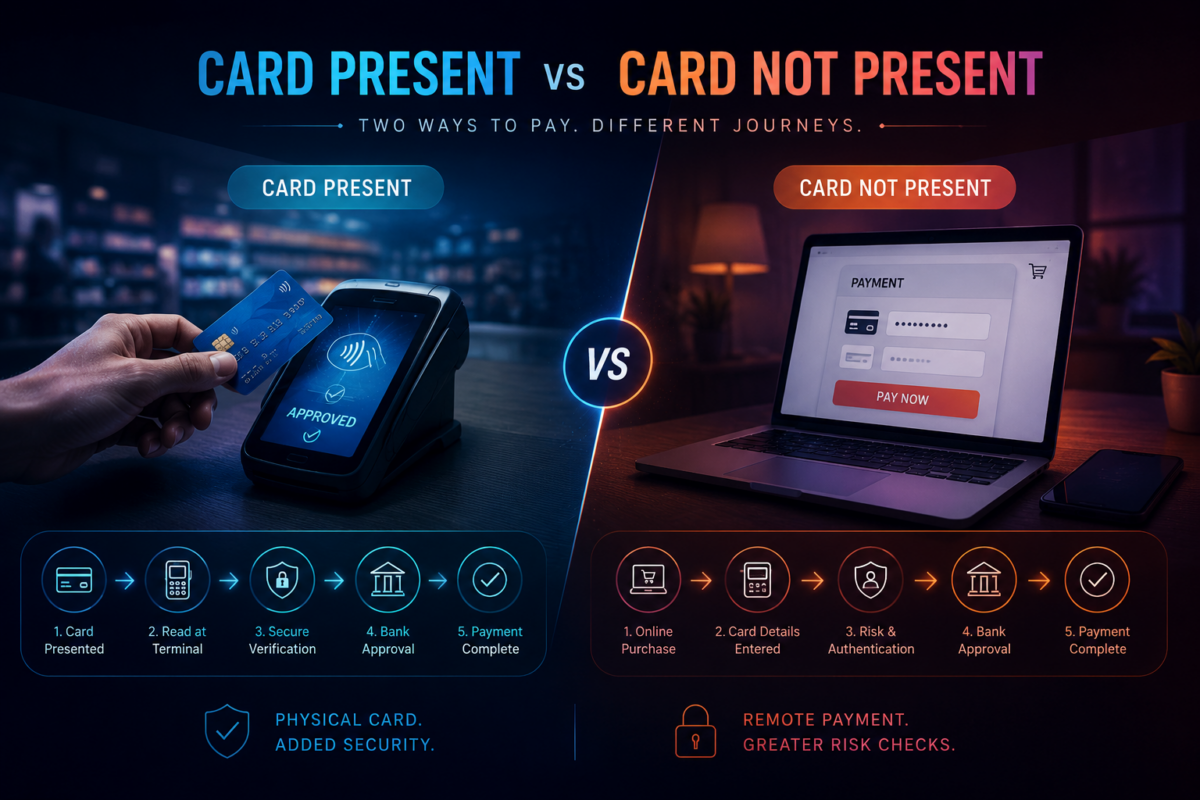
A customer taps a card at a store and the payment goes through in seconds. The same customer later uses that card to buy something online. Both transactions use a card, but from a payment-processing perspective, they are not treated the same way. The difference comes down to how the card transaction takes place.
A card-present (CP) transaction generally occurs when the cardholder and payment card are physically present and the card’s payment credentials are captured through a point-of-sale device. A card-not-present (CNP) transaction occurs when the physical card is not presented to the merchant, such as during an online purchase or phone order.
This distinction affects more than terminology. It can influence fraud risk, authentication, processing costs, chargeback considerations, and the way a business designs its payment experience.
What Is a Card-Present Transaction?
A card-present transaction happens when the customer is physically present at the point of sale and the payment card, or an eligible contactless device representing it, is read by the payment terminal.
The most familiar examples are purchases made at physical stores, restaurants, supermarkets, hotels, and other locations with a point-of-sale terminal. A customer might insert a chip card, tap a contactless card, or use a mobile wallet at an NFC-enabled terminal. These are generally treated as card-present transactions because the payment credentials are captured through the physical point-of-sale environment.
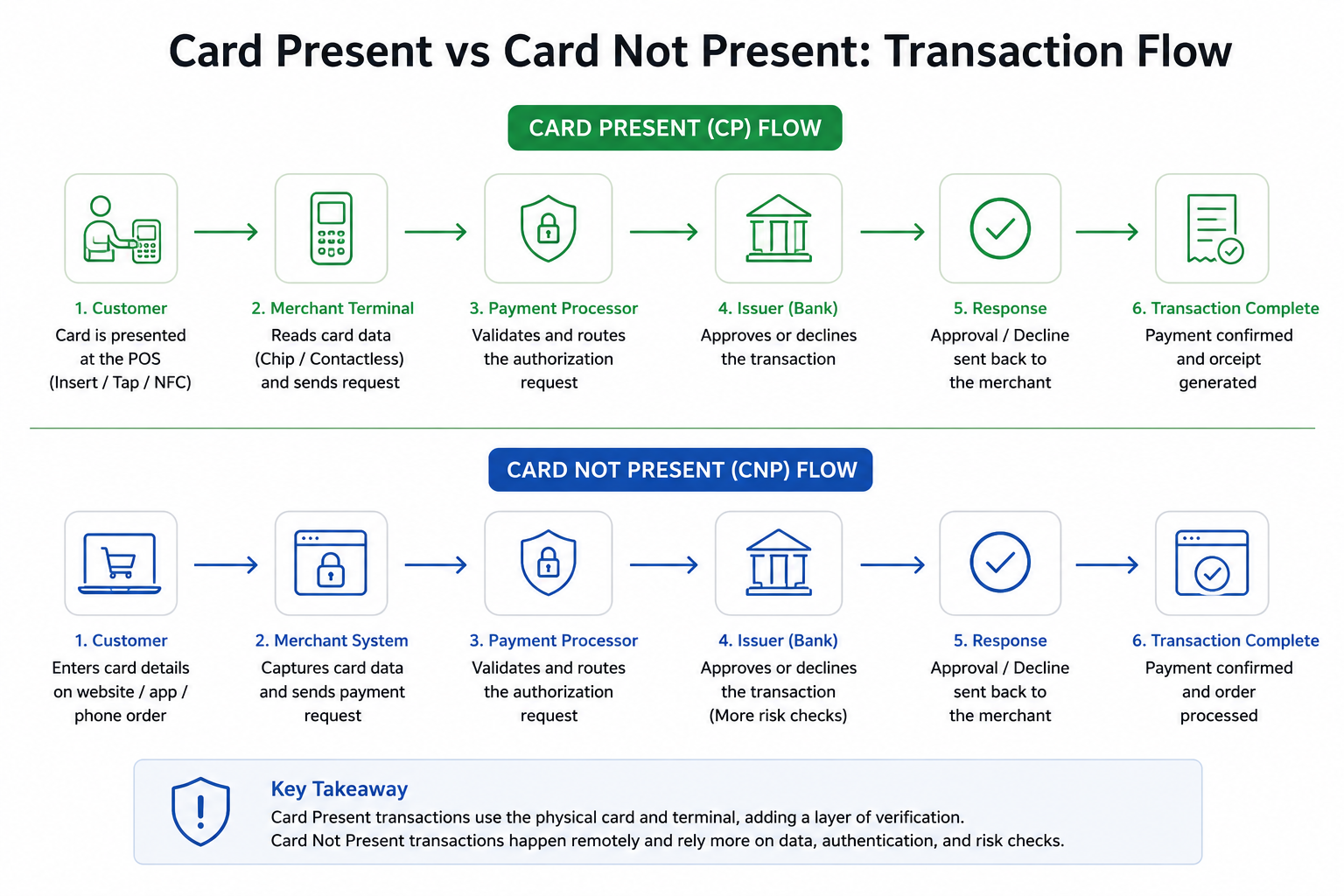
For example, imagine someone buys a $75 jacket from a clothing store. They take the jacket to the counter, tap their card on the terminal, and receive an approved payment notification. The terminal captures the necessary transaction information and sends the authorization request through the card payment system. The physical interaction provides the transaction with information that would not normally be available during a remote purchase.
What Is a Card-Not-Present Transaction?
A card-not-present transaction occurs when the customer does not present the physical card to the merchant’s payment terminal during the transaction.
Online shopping is the most obvious example.
A customer visits an ecommerce website, enters their card details, and clicks Pay. The merchant receives the payment information electronically rather than reading the card through a physical point-of-sale terminal. CNP transactions can also include payments made over the phone, recurring card payments, certain invoice or payment-link transactions, and other remote payment situations.
Imagine a customer buying the same $75 jacket from the retailer’s website. The customer enters their card number, expiration date, and other required information. The merchant has no physical interaction with the card. The payment is therefore processed as card-not-present.
The customer may physically have the card in their wallet while making the purchase, but that does not make the transaction card-present. What matters is the transaction method and how the payment credentials are captured. This distinction is important because “the customer has the card” and “the transaction is card-present” are not necessarily the same thing.
Card Present vs Card Not Present: The Main Difference
At first, the difference seems simple:
Card-present = The Payment is Made Through a Physical Point-of-Sale Interaction.
Card-not-present = The Payment is Made Remotely Without the Card Being Read by the Merchant’s Terminal.
But the consequences of that distinction are more significant.
When a card is physically used at a terminal, the transaction can benefit from card-reading technologies such as EMV chip or contactless NFC. With an online transaction, the merchant does not have that same physical interaction and therefore relies more heavily on other transaction data and security controls. That difference affects how payment providers and issuers evaluate transaction risk.
Why Card-Not-Present Transactions Generally Carry More Risk?
The physical card provides an additional layer of information during an in-person transaction.
With a chip or contactless payment, the terminal can interact directly with the card or device. Depending on the transaction, the customer may also complete additional verification such as entering a PIN.
An online merchant does not have the same opportunity to inspect or read the physical card. Instead, the payment system may use information such as card credentials, billing information, security codes, device signals, transaction history, and authentication mechanisms to help evaluate the payment.
This does not mean every online transaction is risky or every in-person transaction is safe. Rather, card-not-present transactions generally require different methods of establishing that the person making the payment is authorized to use the card.
For example, a customer might purchase a $1,000 product online. The merchant cannot physically inspect the card or observe the customer using it at a terminal. Additional authentication or fraud-screening measures may therefore become important.
How Authentication Differs Between CP and CNP Payments?
Authentication plays an important role in both environments, but the available signals can differ.
In a physical store, the transaction may involve an EMV chip, contactless technology, a PIN, or other point-of-sale verification.
Online, the merchant may instead rely on mechanisms such as CVV verification, address checks, device information, behavioral signals, or 3D Secure authentication where applicable.
For instance, an ecommerce customer could be asked to complete an additional verification step after entering their card details. That step helps establish that the person attempting the transaction is likely the legitimate cardholder. This is one reason card payment security is not based on a single technology. Different controls address different parts of the transaction and work together according to the payment environment.
Does Card-Present Mean a Payment Is More Secure?
Generally, card-present transactions have an advantage because the payment environment provides stronger physical signals. The terminal can interact with the card or contactless device, and certain transactions can use chip-based or other authentication mechanisms. This can make it more difficult for someone who only has stolen card details to replicate the same transaction environment.
Card-not-present payments lack that physical layer, so businesses typically need additional fraud and authentication controls.
However, card-present does not mean fraud-proof.
A stolen card, compromised account, fraudulent device, or other attack can still result in unauthorized transactions. Similarly, modern ecommerce payment systems can use sophisticated authentication and fraud tools to identify suspicious activity.
The correct conclusion is not that one environment is completely safe and the other is unsafe. The risks are different, so the controls need to be different.
How Card-Present and Card-Not-Present Affect Processing Costs?
Transaction type can also influence payment processing costs.
Card-present transactions can qualify for different interchange categories from card-not-present transactions because the transaction environments carry different levels of risk and provide different verification data. Industry payment guidance generally notes that CNP transactions can carry higher processing costs than comparable CP transactions.
Consider two businesses that each process $100,000 in monthly card sales.
A physical retailer may receive most payments through chip or contactless terminals. An ecommerce business may process almost all of its payments through an online checkout. Even if their sales volumes are identical, their average processing costs can differ because their transaction environments and risk profiles are different.
The exact cost depends on the card type, network, merchant category, pricing arrangement, and other transaction characteristics, so there is no universal CP or CNP rate. The broader components behind these costs include interchange, network fees, and processor markup.
Card-Present vs Card-Not-Present and Chargeback Risk
The distinction also matters when a transaction is later disputed.
Because a card-present transaction can provide stronger evidence that the payment credentials were used in a physical transaction environment, the liability considerations can differ from those associated with card-not-present payments.
For CNP transactions, a merchant cannot simply point to the fact that a card was used because the card itself was never presented to the merchant. That is why online businesses often place greater emphasis on authentication, transaction monitoring, fraud screening, and maintaining appropriate records.
For example, if an ecommerce merchant receives an order from a new customer using a card and the transaction shows several unusual characteristics, the merchant may use additional verification before fulfilling the order.
The objective is not necessarily to reject the transaction. It is to gather enough information to make a more informed risk decision.
What About Recurring and Subscription Payments?
Recurring card payments are another common example of card-not-present processing.
Imagine a customer signs up for a $30 monthly subscription. The first payment may involve an online checkout and authentication. Future payments are then initiated according to the subscription agreement without the customer physically presenting the card each month. These subsequent transactions are generally handled as card-not-present payments.
This distinction matters for subscription businesses because the merchant needs to consider fraud controls, recurring-payment rules, expired credentials, account updates, and failed-payment management.
Which Is Better: Card-Present or Card-Not-Present?
There is no universal winner because the two transaction types serve different business models.
A grocery store needs card-present acceptance because customers physically visit the store.
An ecommerce company needs card-not-present acceptance because customers purchase remotely.
A business with both physical and online sales may need both.
The important question is not “Which transaction type is better?” but rather “Which transaction environment matches the way customers buy from the business?”
A retailer that sells exclusively through a physical location may prioritize reliable POS terminals and contactless acceptance. An ecommerce company may place greater emphasis on checkout security, authentication, fraud detection, and a smooth online payment experience. Businesses operating across multiple channels need to understand how these environments differ rather than treating every card transaction as identical.
The Bottom Line
The difference between card-present vs card-not-present transactions is more than whether a customer happens to have a physical card nearby.
A card-present transaction generally involves the card or eligible contactless device being read at a physical point of sale. A card-not-present transaction occurs remotely, such as through ecommerce, phone orders, recurring billing, or other situations where the payment credentials are not captured through a physical card-reading interaction. That difference influences fraud risk, authentication, processing costs, and dispute considerations.
For businesses, the key is to build payment processes around the environment in which customers actually make purchases. Physical stores need strong point-of-sale acceptance, while online and remote businesses need appropriate authentication and fraud controls.
Many modern businesses operate in both environments. In those cases, understanding the distinction allows them to evaluate their transaction costs, security measures, and payment performance more accurately – without assuming that every card transaction follows the same path.

Categories
- ACH Payments (10)
- adult payment processing (11)
- AI (9)
- Altcoins (10)
- Banking (10)
- Bitcoin (133)
- Bitcoin ETF (11)
- Bitcoin Price (30)
- Blockchain (50)
- Brokering World Hunger Away (16)
- Business (17)
- card payment processing (10)
- CBD (11)
- CBDC (11)
- Chargeback (8)
- coaching business (11)
- COVID-19 (3)
- Crypto ATMs (1)
- Crypto Banking (17)
- Crypto Bill (1)
- Crypto business owner platform (31)
- Crypto Investment (3)
- Crypto Markets (5)
- Crypto Payment (35)
- Crypto Payment Processor (4)
- Crypto Prices (1)
- Crypto Trading (92)
- Cryptocurrency (402)
- Cryptocurrency Exchange (108)
- Data Visualization (2)
- dating platforms (11)
- debt collection payment processing (10)
- Decentralized Finance (7)
- DeFi Payment (9)
- DEX (3)
- Digital Currency (23)
- dropshipping payment processing (12)
- Ethereum (2)
- FAQ (7)
- file sharing payment processing (11)
- Finance (25)
- Financial Equality (4)
- Financial Freedom (8)
- Forex (35)
- hemp (1)
- ICO (2)
- Investment (11)
- IPTV (11)
- Merchant Account (10)
- Mining (3)
- News (66)
- NFTs (2)
- online gambling (11)
- P2P (1)
- Paybito (147)
- PayBitoPro (693)
- PayBitoPro Coin Listing (6)
- PayBitoPro Exchange (2)
- Payment Gateway (48)
- peptide (10)
- Post COVID Digital Transformation (1)
- Press Release (130)
- Privacy & Security (3)
- Real Estate (1)
- Stablecoin (5)
- Technology (15)
- Travel (11)
- Uncategorized (10)
- US Presidential Election (2)
- Utility Coin (1)
- Web3 business (4)
- Web3 Wallets (2)
- White Label Crypto Exchange (8)
Recent Posts
- Payment Gateway vs. Payment Orchestration: What’s the Difference?
- What Is Smart Payment Routing? Strategies to Optimize Payment Performance
- How to Improve Payment Approval Rates for High-Risk Businesses?
- Why Are Online Payments Failing? Common Causes and How to Fix Them
- How to Use Multiple Payment Processors to Reduce Business Disruptions?