Best Payment Methods for Online Gambling Websites: A Complete Guide for iGaming Operators
- July 31, 2026
- Soham Guchait
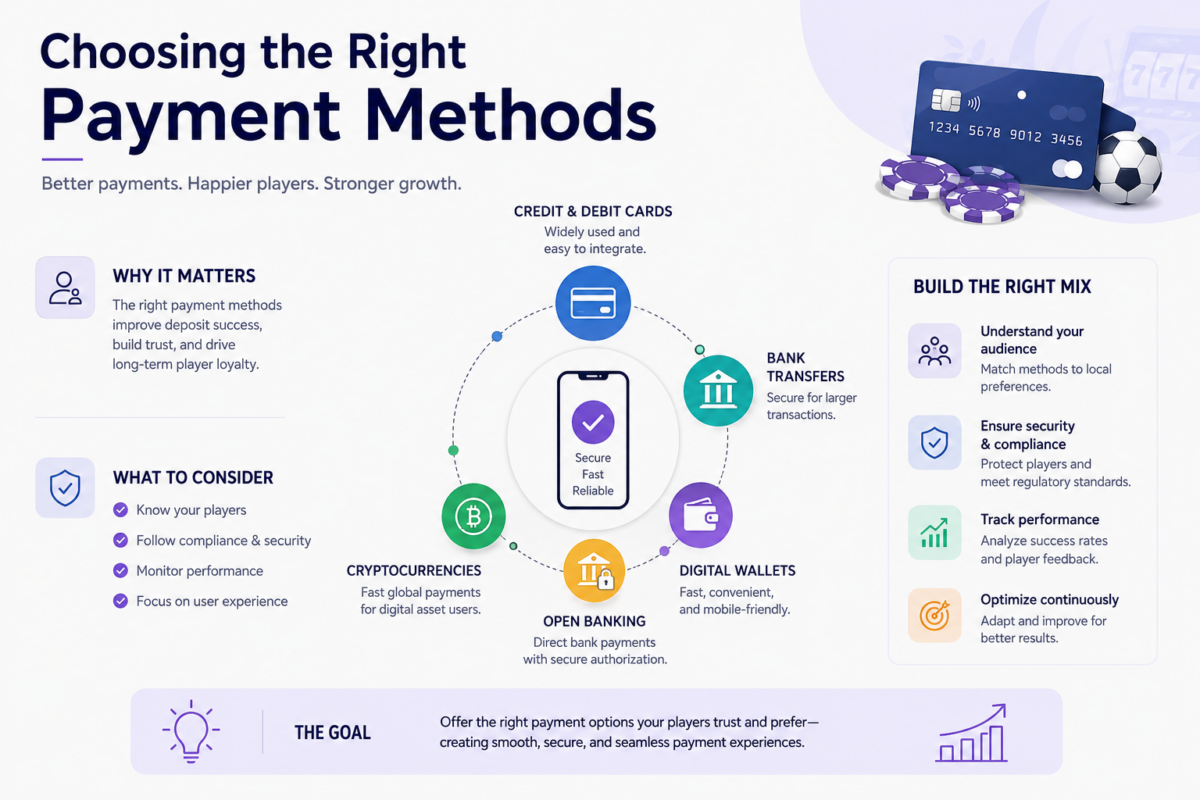
Choosing the right payment methods is one of the most important decisions for any online casino or sportsbook. A payment option that works well in one market may not perform the same way in another because player preferences, regulations, banking systems, and local payment infrastructure vary significantly across regions.
For gambling businesses, payment methods are not only about allowing players to deposit and withdraw funds. They can directly affect player experience, transaction success rates, trust, and overall platform performance. A well-planned payment strategy can help operators reduce abandoned deposits, improve customer satisfaction, and support growth across different markets.
Why Do Payment Methods Matter for Online Gambling Businesses?
Players expect online gambling platforms to provide convenient, secure, and reliable ways to manage their funds. A player who cannot use a familiar payment method may decide not to complete a deposit, even if they are interested in using the platform.
For example, a sportsbook targeting customers in Europe may find strong demand for bank-based payment options, while another market may have greater adoption of digital wallets or local payment solutions.
This is why understanding online gambling payment processing is important before selecting payment methods. Operators need to consider how each payment option connects with their broader payment infrastructure, compliance processes, and deposit and withdrawal experience.
Common Payment Methods Used by Online Gambling Websites
Different payment methods serve different customer needs. Successful operators often combine several options instead of depending on a single payment channel.
However, the availability of a payment method does not mean it is suitable for every gambling market. Operators should consider local regulations, payment-provider requirements, customer preferences, transaction costs, and withdrawal functionality before adding an option.
Credit and Debit Cards
Debit cards are widely used for online payments, but card acceptance for gambling transactions varies by market and issuer.
Credit cards require particular attention because some jurisdictions prohibit or restrict their use for gambling. For example, the UK prohibits gambling businesses from accepting credit-card payments, including payments made through certain money service businesses such as e-wallets. Where card payments are permitted, potential advantages include:
- Familiar user experience
- Fast payment processing
- Wide customer recognition
- Integration with many payment platforms
However, a card that works for everyday purchases may still be declined for gambling transactions because of issuer restrictions, merchant-category controls, or other risk checks.
Knowing the reason behind online gambling payments getting declined helps operators understand why legitimate deposits may fail and where alternative payment options could improve transaction success.
Bank Transfers
Bank transfers allow players to move funds directly between their bank account and the gambling platform. They can be useful for customers who prefer direct bank-based transactions and may be suitable for larger deposits or withdrawals. Potential advantages include:
- Direct connection with banking systems
- Familiar payment experience
- Suitability for certain higher-value transactions
- No need to enter card details
The main limitation is that processing speed can vary. A bank transfer may not provide the same instant confirmation that players expect from some digital payment methods.
Digital Wallets
Digital wallets allow customers to store payment information and make transactions without entering card or bank details each time. They can provide:
- Convenient checkout
- Faster payment experiences
- Reduced need to share card details directly with the merchant
- Strong mobile usability
Digital wallets can be useful for players who prefer quick deposits and familiar digital payment experiences.
However, operators should check whether a wallet is permitted for gambling transactions in their target market and whether it applies appropriate restrictions to gambling-related funds. In regulated markets, wallet funding sources can also have compliance implications.
Open Banking Payments
Open Banking payments allow customers to authorize payments directly through their bank account using secure banking authentication.
Potential benefits include:
- Direct bank connectivity
- Fast payment confirmation
- Reduced reliance on traditional card payments
- Convenient account-to-account payment experiences
Open Banking can be particularly relevant in markets where bank-based payment infrastructure is well established.
Operators should nevertheless evaluate the availability, reliability, customer journey, and regulatory requirements of Open Banking in each target market rather than assuming that it will perform equally well everywhere.
Cryptocurrency Payments
Some online gambling businesses offer cryptocurrency or other crypto asset-based payment options. Potential advantages can include:
- Access to an alternative payment method
- International transaction capabilities
- Appeal to customers who already use digital assets
However, cryptocurrency payments introduce additional regulatory, compliance, transaction-monitoring, and customer-protection considerations. Gambling operators should assess local laws and licensing requirements before offering crypto-asset payments.
How to Choose the Right Payment Mix for an Online Gambling Website?
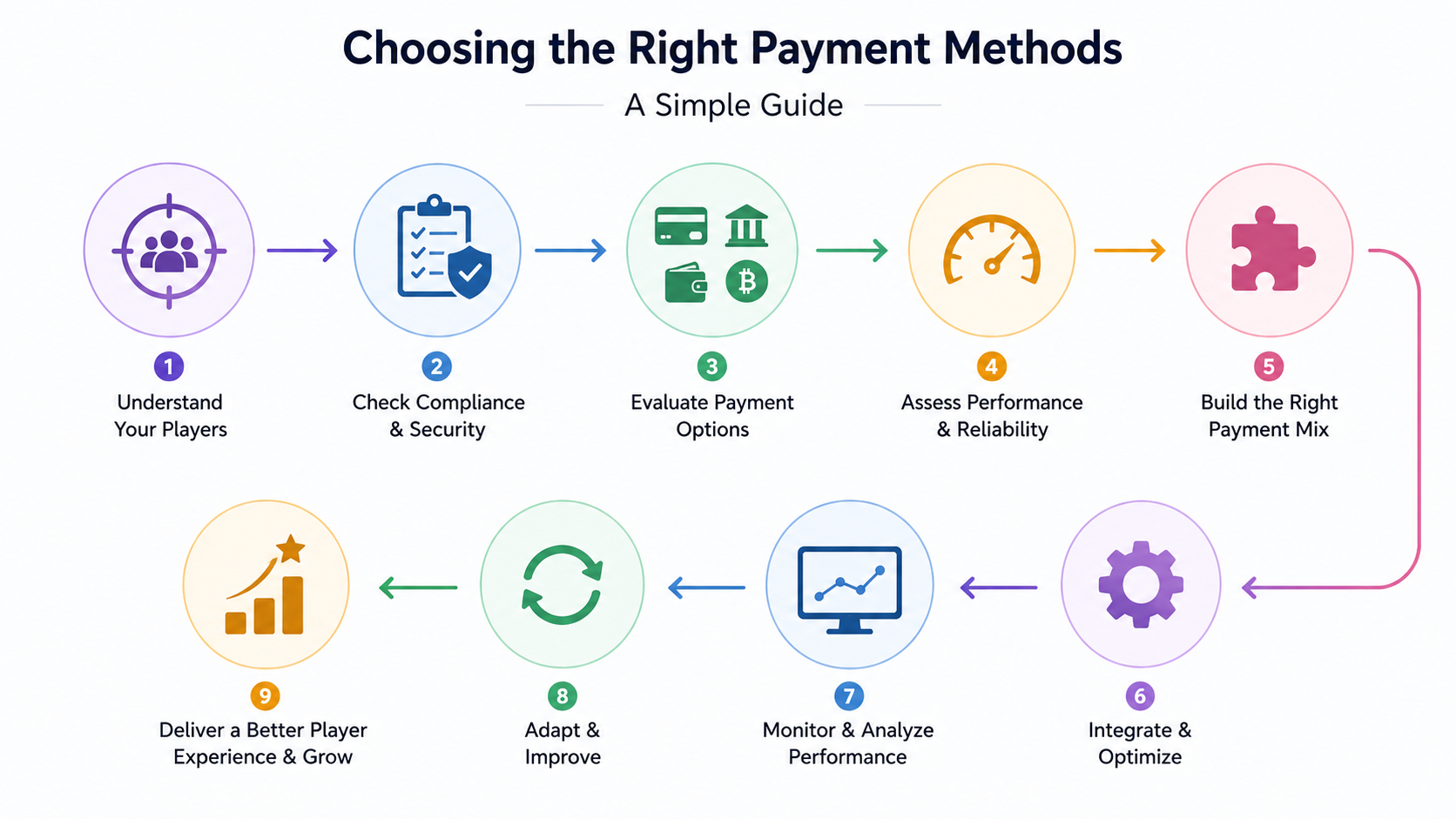
There is no single payment method that works best for every high risk business like a gambling business. The right combination depends on the operator’s target market, customers, regulations, and payment infrastructure.
Understand Your Target Players
The most important factor is understanding where your customers are located and how they prefer to pay. Operators should analyze:
- Player locations
- Local payment preferences
- Average deposit amounts
- Typical withdrawal amounts
- Preferred transaction speed
- Mobile versus desktop usage
For example, a casino operating across several countries may need different payment options for different regions rather than offering exactly the same methods everywhere.
Consider Security and Compliance
Every payment method introduces different security and compliance considerations.
Operators may need systems that support:
- Customer verification
- Transaction monitoring
- Fraud detection
- Payment authentication
- Regulatory compliance
- Appropriate handling of deposits and withdrawals
Understanding how KYC and AML work in online gambling payment processing helps operators create safer payment experiences while meeting applicable compliance requirements.
Evaluate Payment Performance
The number of available payment methods does not automatically guarantee better results.
Operators should monitor:
- Successful deposit rates
- Failed transactions
- Processing times
- Withdrawal completion rates
- Payment-related complaints
- Player feedback
- Usage by payment method
A payment option that has low adoption but creates operational complexity may not provide much value. Conversely, removing a highly preferred local payment option could increase abandoned deposits.
Deposit and Withdrawal Experience Matters
Choosing payment methods should not focus only on deposits. Players also want predictable and convenient withdrawals. An operator may have a highly optimized deposit process but still create frustration if withdrawals take significantly longer or require unnecessary steps. Operators should therefore evaluate:
- Deposit speed
- Withdrawal speed
- Minimum and maximum transaction limits
- Fees
- Verification requirements
- Availability in target markets
- Whether the same payment method can support both deposits and withdrawals
Payment design can also have compliance implications. For example, the UK Gambling Commission identifies closed-loop payment systems – where withdrawals and winnings are generally returned through the payment method used for deposits – as best practice for reducing money-laundering risks.
Common Mistakes When Selecting Payment Methods
Many new gambling operators make payment decisions based mainly on availability rather than player experience and market requirements.
Common mistakes include:
- Offering payment methods unavailable in target regions
- Ignoring withdrawal preferences
- Choosing options without considering transaction reliability
- Adding too many methods without monitoring performance
- Failing to consider local regulatory restrictions
- Focusing only on deposits instead of the complete deposit-to-withdrawal journey
For example, a platform may offer ten different deposit methods but still lose customers if the most commonly preferred option in its target market is missing. The goal should not be to offer the largest possible number of payment methods. It should be to offer the right combination of reliable, appropriate, and well-supported options.
The Role of Payment Infrastructure
Payment methods work together with the underlying technology that processes transactions. A strong payment setup requires reliable connections between payment methods, payment gateways, transaction systems, financial institutions, and other relevant providers.
When evaluating payment solutions, operators should understand how to choose the right payment gateway for an online casino or sportsbook because gateway capabilities can affect payment availability, transaction reliability, routing, and overall payment performance.
A well-designed infrastructure can also make it easier to monitor transaction outcomes and identify which payment methods perform best in different markets.
How to Compare Payment Methods?
Before adding a payment method, operators can compare each option using several practical criteria:
| Factor | What to Consider |
|---|---|
| Market coverage | Is the method available where the target players are located? |
| Customer adoption | Do target players already use it? |
| Deposit speed | How quickly can deposits be confirmed? |
| Withdrawal support | Can customers use it for withdrawals where permitted? |
| Reliability | How frequently do transactions fail? |
| Fees | What are the processing and transaction costs? |
| Compliance | Does it meet applicable gambling and payment requirements? |
| Security | What authentication and fraud controls are available? |
| Mobile experience | Is the payment process convenient on mobile devices? |
This comparison can help operators avoid selecting payment methods simply because they are popular in other markets.
Final Thoughts
The best payment methods for online gambling websites are not necessarily the ones with the highest global adoption. They are the options that match player expectations, regional preferences, regulatory requirements, transaction needs, and the operator’s payment infrastructure.
Successful operators typically combine several payment options while focusing on security, reliability, customer convenience, and withdrawal performance.
Choosing the right payment mix is therefore not about offering every available option. It is about understanding the target audience, reducing payment friction, monitoring transaction performance, and creating a smooth experience from deposit to withdrawal.

Categories
- ACH Payments (10)
- adult payment processing (11)
- AI (9)
- Altcoins (10)
- Banking (10)
- Bitcoin (133)
- Bitcoin ETF (11)
- Bitcoin Price (30)
- Blockchain (50)
- Brokering World Hunger Away (16)
- Business (17)
- card payment processing (10)
- CBD (11)
- CBDC (11)
- Chargeback (8)
- coaching business (11)
- COVID-19 (3)
- Crypto ATMs (1)
- Crypto Banking (17)
- Crypto Bill (1)
- Crypto business owner platform (31)
- Crypto Investment (3)
- Crypto Markets (5)
- Crypto Payment (35)
- Crypto Payment Processor (4)
- Crypto Prices (1)
- Crypto Trading (92)
- Cryptocurrency (402)
- Cryptocurrency Exchange (108)
- Data Visualization (2)
- dating platforms (11)
- debt collection payment processing (10)
- Decentralized Finance (7)
- DeFi Payment (9)
- DEX (3)
- Digital Currency (23)
- dropshipping payment processing (12)
- Ethereum (2)
- FAQ (7)
- file sharing payment processing (11)
- Finance (25)
- Financial Equality (4)
- Financial Freedom (8)
- Forex (35)
- hemp (1)
- ICO (2)
- Investment (11)
- IPTV (11)
- Merchant Account (10)
- Mining (3)
- News (66)
- NFTs (2)
- online gambling (11)
- P2P (1)
- Paybito (147)
- PayBitoPro (693)
- PayBitoPro Coin Listing (6)
- PayBitoPro Exchange (2)
- Payment Gateway (48)
- peptide (10)
- Post COVID Digital Transformation (1)
- Press Release (130)
- Privacy & Security (3)
- Real Estate (1)
- Stablecoin (5)
- Technology (15)
- Travel (11)
- Uncategorized (10)
- US Presidential Election (2)
- Utility Coin (1)
- Web3 business (4)
- Web3 Wallets (2)
- White Label Crypto Exchange (8)
Recent Posts
- Payment Gateway vs. Payment Orchestration: What’s the Difference?
- What Is Smart Payment Routing? Strategies to Optimize Payment Performance
- How to Improve Payment Approval Rates for High-Risk Businesses?
- Why Are Online Payments Failing? Common Causes and How to Fix Them
- How to Use Multiple Payment Processors to Reduce Business Disruptions?