Payment Processing for Dating Websites: Challenges Dating Platforms Face When Accepting Payments
- August 4, 2026
- Soham Guchait
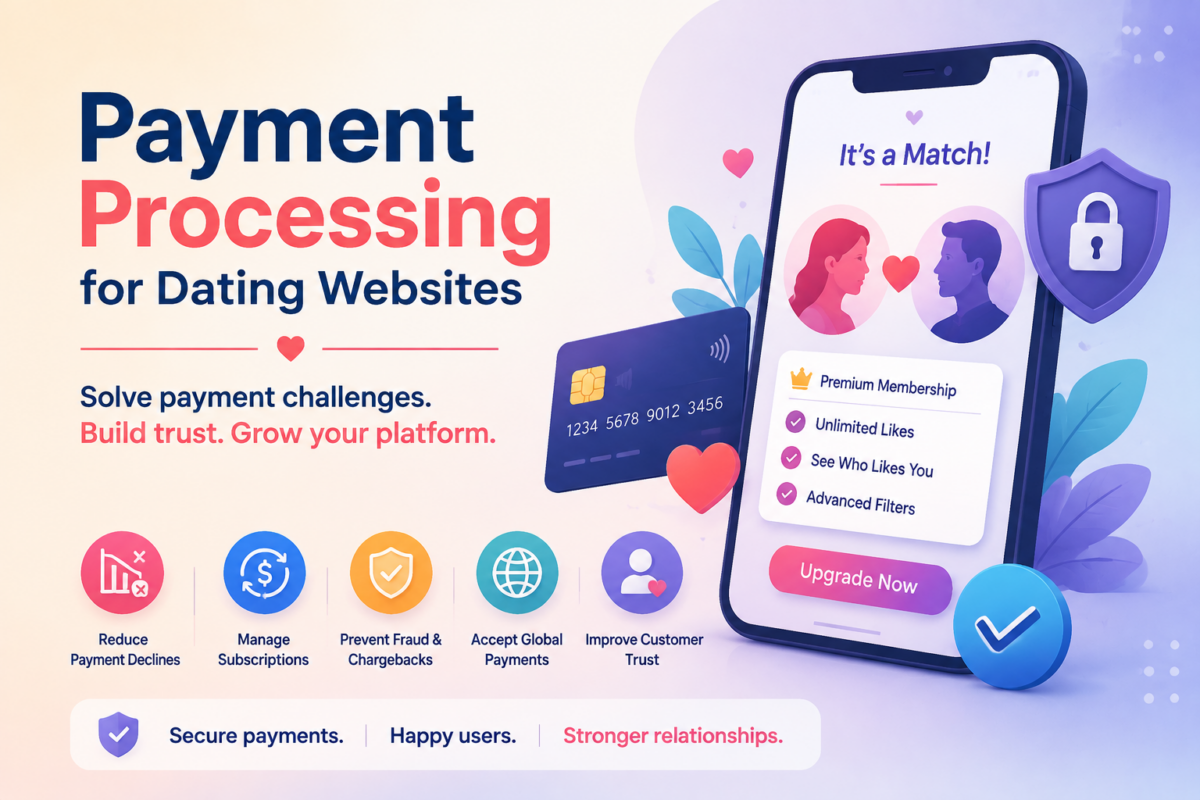
Running a successful dating website involves much more than attracting users and building meaningful connections. Behind every premium membership, profile upgrade, or paid feature is a payment system responsible for converting user activity into revenue.
However, payment processing for dating websites comes with challenges that many businesses do not anticipate in the early stages. As a dating platform grows, payment operations become increasingly complex due to recurring subscriptions, international customers, fraud risks, payment failures, and customer disputes.
A dating website may have thousands of users willing to purchase premium features, but if payments fail, subscriptions are interrupted, or transactions are frequently disputed, the business can lose revenue and customer trust. Understanding how these challenges occur helps dating companies build payment systems that support long-term growth instead of becoming a barrier to expansion.
Why Dating Website Payments Require a Different Approach?
Dating platforms operate differently from traditional ecommerce businesses. An ecommerce store usually has a straightforward payment journey. A customer selects a product, completes a transaction, and receives what they purchased.
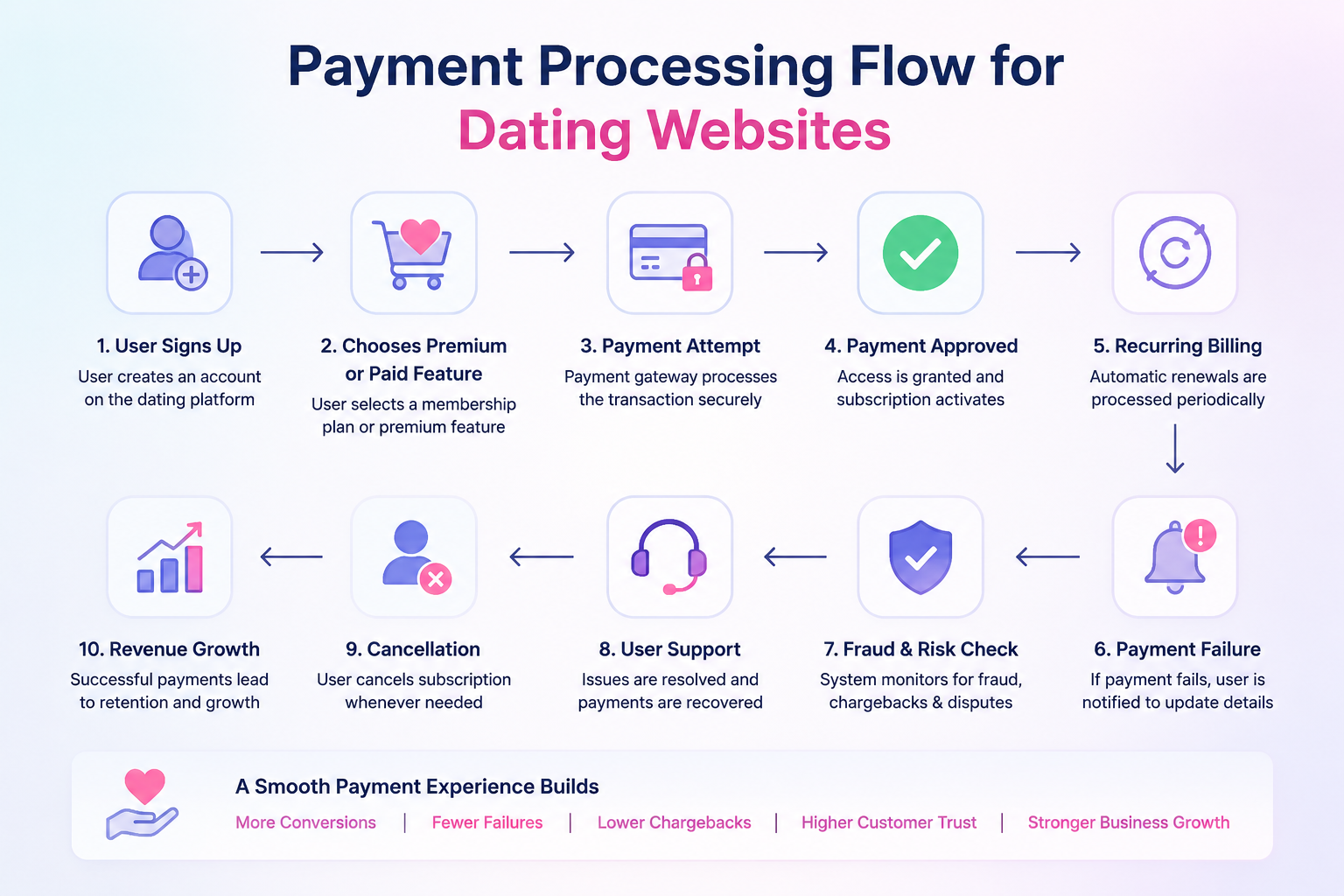
Dating websites often have an ongoing relationship with users. A person may create a free account, explore the platform, upgrade to a premium membership, renew that subscription every month, and purchase additional features over time.
This means payment processing must support an entire customer lifecycle rather than a single transaction.
For example, a dating platform offering a monthly premium membership must successfully manage the initial payment, future renewals, subscription changes, failed transactions, and cancellations. A problem at any stage can affect both revenue and user experience. This is why dating businesses require payment systems designed for digital services with recurring revenue models.
The Biggest Payment Processing Challenges for Dating Platforms
Getting Payment Approval for a Dating Business
One of the first challenges dating companies encounter is finding payment solutions that properly understand their business model.
Before processing payments, businesses often go through a review process where their operations, revenue model, website experience, and customer policies are evaluated. Dating platforms may receive additional attention because payment providers consider factors such as subscription-based billing, customer disputes, fraud exposure, and user-generated activity.
For example, a new dating website launching a premium membership model may need to clearly explain how users are charged, how subscriptions renew, and how customers can manage their accounts.
The more transparent the payment experience is, the easier it becomes for businesses to establish trust with payment partners and customers.
Declined Payments and Lost Revenue Opportunities
Payment declines are one of the most frustrating problems for dating platforms because they often happen when users are ready to spend money.
A user may decide to purchase premium access after finding new matches or wanting to unlock additional features. If the transaction fails during checkout, the business may lose a valuable conversion. Payment failures can happen for several reasons, including:
- Bank restrictions or card declines
- Expired or outdated payment information
- Fraud detection systems blocking legitimate users
- International transaction limitations
The challenge is that not every failed payment represents a problem with the customer. Sometimes legitimate transactions are declined because payment systems identify unusual patterns or additional verification is required. Dating platforms need to understand why payments fail and create processes that recover legitimate transactions without increasing unnecessary friction.
Managing Subscription Payments and Recurring Revenue
Most dating businesses rely heavily on recurring revenue through memberships and premium plans. This creates a unique payment challenge because revenue depends not only on acquiring new subscribers but also on successfully maintaining existing ones.
A subscription payment system must manage:
- Automatic renewals
- Payment updates
- Failed billing attempts
- Subscription upgrades or cancellations
For example, if a user subscribes to a premium dating plan and their card expires before the next billing cycle, the platform needs a process to notify the customer and help recover the payment.
Without proper subscription management, businesses can experience revenue leakage even when customers still want to use the service.
Fraud Risks Unique to Dating Platforms
Fraud prevention is one of the most important parts of payment processing for dating websites.
Dating platforms face a combination of payment fraud and user-related risks because transactions happen inside communities built around personal interactions. A fraudulent user may create an account, use stolen payment details to purchase premium features, and disappear before the business identifies the problem. Common risks include:
- Stolen payment methods
- Fake accounts
- Automated activity
- Account takeover attempts
- Unauthorized purchases
Unlike many online businesses, dating platforms must protect both financial transactions and the overall trust of their community. A secure payment environment helps ensure that genuine users can interact confidently while reducing financial losses caused by suspicious activity.
Chargebacks and Subscription Disputes
Chargebacks are another major concern for dating websites, especially those offering recurring memberships. A customer may dispute a payment because they did not recognize a recurring charge, forgot about a subscription renewal, or were dissatisfied with a purchased feature. Many disputes can be reduced through better communication. A clear billing experience should explain:
- What the user is purchasing?
- When subscriptions renew?
- How cancellations work?
- How customers can request support?
For example, a user who clearly understands that a premium membership automatically renews every month is less likely to mistake a legitimate charge for an unauthorized transaction. Reducing disputes is not only about preventing financial losses. It also improves the overall relationship between the platform and its users.
Supporting International Dating Communities
Many dating platforms are designed for global audiences, which creates additional payment challenges. A website serving users across multiple countries must consider different currencies, banking systems, and payment preferences. A payment method that works well in one market may not provide the same experience in another.
For example, a dating platform expanding internationally may discover that users in different regions prefer different ways to pay. Supporting a wider range of payment options can improve transaction success rates and reduce abandoned purchases.
International growth requires payment systems that can handle different markets without creating unnecessary complexity for users.
Creating a Reliable Payment Experience for Dating Businesses
Successful payment processing for dating websites is not only about accepting transactions. It is about creating a system that supports the complete relationship between the platform and its users.
A strong payment foundation helps businesses:
- Convert more premium users
- Maintain subscription revenue
- Reduce payment failures
- Improve trust and security
- Support international growth
The best payment systems operate quietly in the background. Users should be able to upgrade memberships, purchase features, and manage subscriptions without unnecessary friction.
For dating businesses, payment infrastructure is not just a financial tool. It is a critical part of the user experience and the foundation for sustainable growth.
Frequently Asked Questions
Why is payment processing challenging for dating websites?
Dating websites often combine subscriptions, premium features, international users, and fraud risks, making payment operations more complex than standard online purchases.
Why do dating app payments decline?
Payments may fail because of bank restrictions, expired cards, fraud screening, authentication issues, or limitations with international transactions.
How can dating websites reduce payment problems?
Businesses can improve payment performance by creating transparent subscription processes, improving transaction security, supporting reliable payment methods, and managing failed payments effectively.
Do dating websites need specialized payment systems?
Dating platforms often require payment systems that support recurring billing, fraud prevention, subscription management, and global transactions.
Conclusion
Payment processing for dating websites requires careful planning because dating businesses operate around recurring revenue, digital services, and long-term user relationships.
From subscription failures and payment declines to fraud prevention and international transactions, every part of the payment journey affects business growth.
By understanding these challenges and building the right payment approach, dating platforms can create smoother customer experiences while protecting their revenue and scaling more effectively.
Categories
- ACH Payments (10)
- adult payment processing (11)
- AI (9)
- Altcoins (10)
- Banking (10)
- Bitcoin (133)
- Bitcoin ETF (11)
- Bitcoin Price (30)
- Blockchain (50)
- Brokering World Hunger Away (16)
- Business (17)
- card payment processing (10)
- CBD (11)
- CBDC (11)
- Chargeback (8)
- coaching business (11)
- COVID-19 (3)
- Crypto ATMs (1)
- Crypto Banking (17)
- Crypto Bill (1)
- Crypto business owner platform (31)
- Crypto Investment (3)
- Crypto Markets (5)
- Crypto Payment (35)
- Crypto Payment Processor (4)
- Crypto Prices (1)
- Crypto Trading (92)
- Cryptocurrency (402)
- Cryptocurrency Exchange (108)
- Data Visualization (2)
- dating platforms (11)
- debt collection payment processing (10)
- Decentralized Finance (7)
- DeFi Payment (9)
- DEX (3)
- Digital Currency (23)
- dropshipping payment processing (12)
- Ethereum (2)
- FAQ (7)
- file sharing payment processing (11)
- Finance (25)
- Financial Equality (4)
- Financial Freedom (8)
- Forex (35)
- hemp (1)
- ICO (2)
- Investment (11)
- IPTV (11)
- Merchant Account (10)
- Mining (3)
- News (66)
- NFTs (2)
- online gambling (11)
- P2P (1)
- Paybito (147)
- PayBitoPro (693)
- PayBitoPro Coin Listing (6)
- PayBitoPro Exchange (2)
- Payment Gateway (48)
- peptide (10)
- Post COVID Digital Transformation (1)
- Press Release (130)
- Privacy & Security (3)
- Real Estate (1)
- Stablecoin (5)
- Technology (15)
- Travel (11)
- Uncategorized (10)
- US Presidential Election (2)
- Utility Coin (1)
- Web3 business (4)
- Web3 Wallets (2)
- White Label Crypto Exchange (8)
Recent Posts
- Payment Gateway vs. Payment Orchestration: What’s the Difference?
- What Is Smart Payment Routing? Strategies to Optimize Payment Performance
- How to Improve Payment Approval Rates for High-Risk Businesses?
- Why Are Online Payments Failing? Common Causes and How to Fix Them
- How to Use Multiple Payment Processors to Reduce Business Disruptions?