Best Payment Methods for Forex Brokers and Trading Platforms
- August 13, 2026
- Soham Guchait
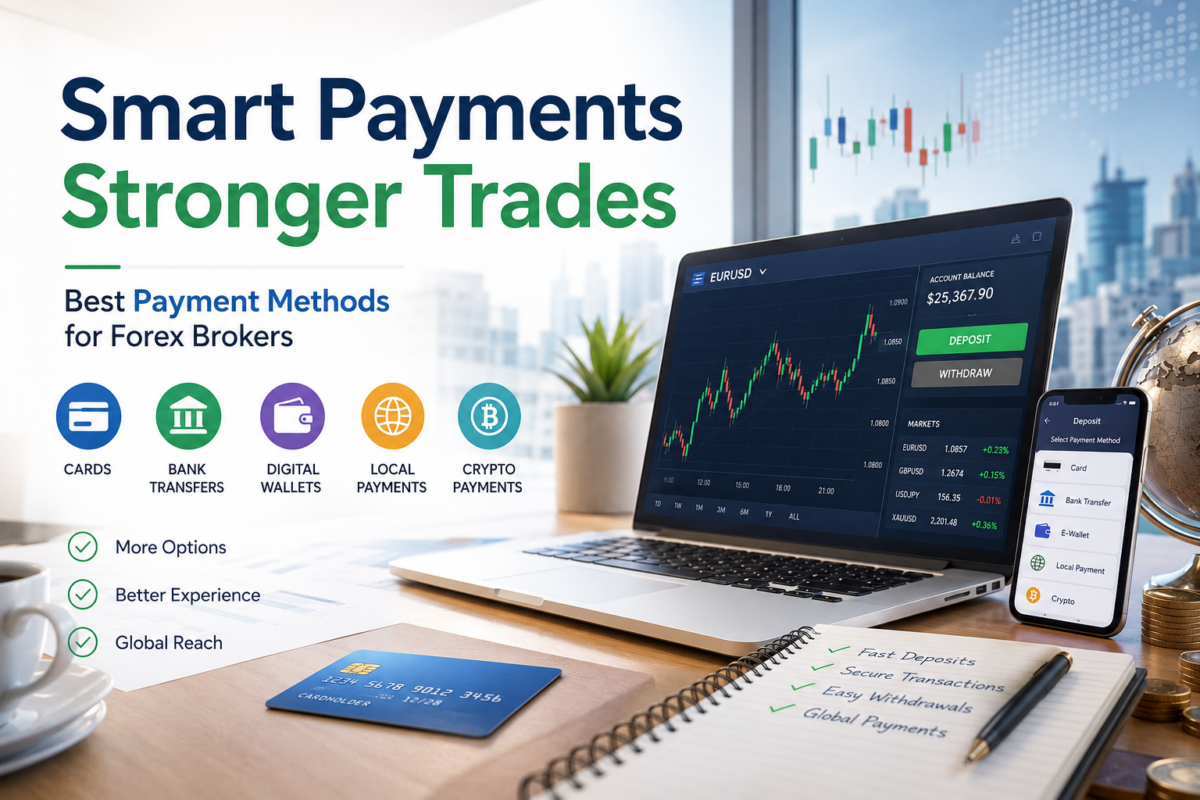
A trader may be ready to fund a Forex account, but the payment experience can determine whether the deposit is completed smoothly or abandoned. A card may be declined, a bank transfer may take longer than expected, or a customer may prefer a local payment method that the broker does not support.
For a Forex broker, choosing payment methods is therefore not simply about offering as many options as possible. The right payment mix depends on the broker’s target markets, customer preferences, transaction values, currencies, deposit and withdrawal requirements, and payment-processing infrastructure.
This guide explains the main Forex broker payment methods, how they work, where each is most useful, and what brokers should consider when building a practical payment strategy.
What Are Forex Broker Payment Methods?
Forex broker payment methods are the channels traders use to deposit funds into and withdraw money from their brokerage accounts.
Unlike a conventional e-commerce checkout, Forex payment operations support an ongoing financial relationship. A trader may deposit money before trading, make additional deposits later, request a withdrawal, or use different payment channels depending on location and transaction size.
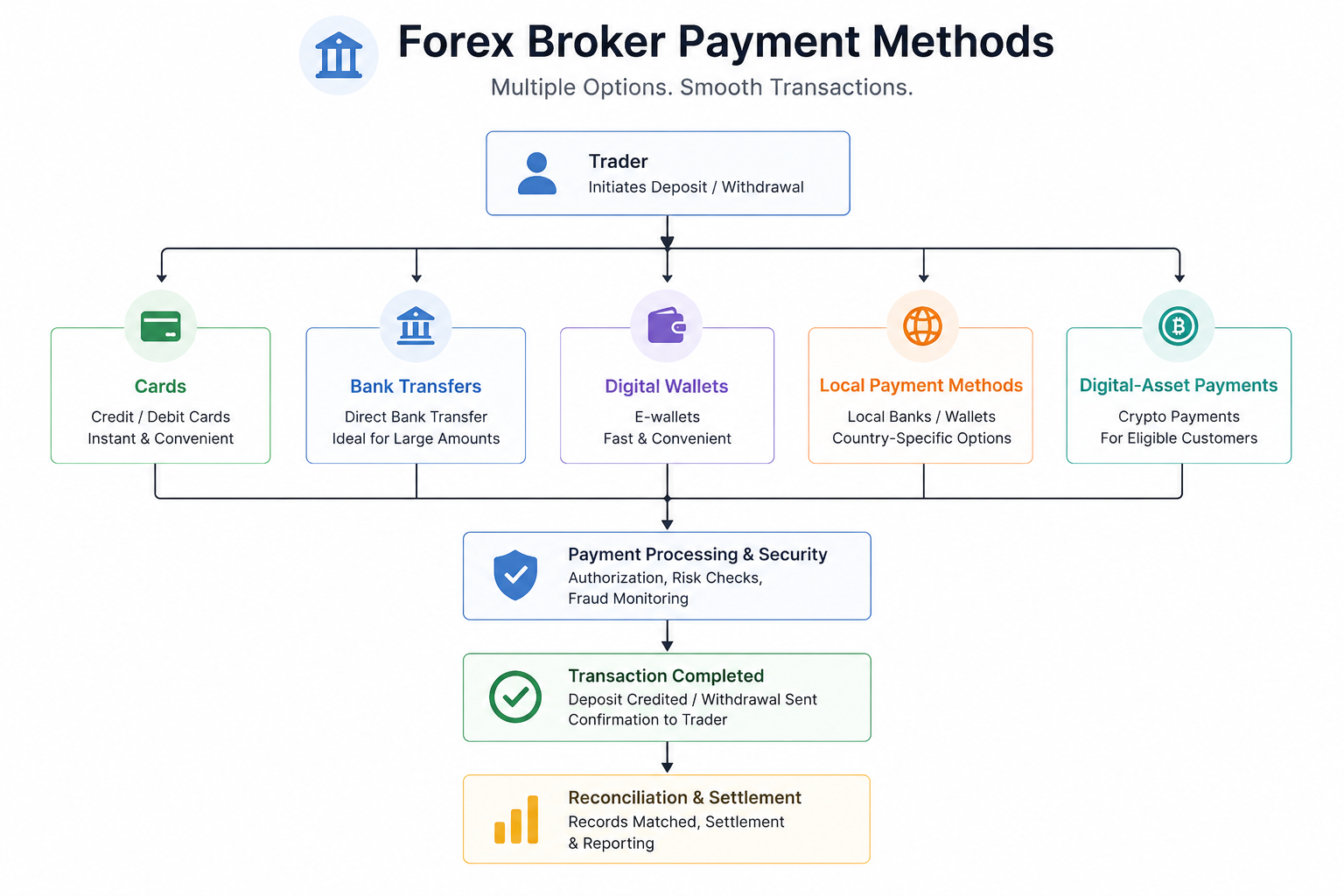
Common methods include cards, bank transfers, digital wallets, and local payment methods. Some brokers also support digital-asset payments where permitted and operationally appropriate. Industry data published in 2026 shows bank transfers and cards remain widely supported among brokers, while e-wallets are also common and crypto availability varies considerably.
The objective is not to find one universally “best” payment method. It is to create a payment mix that works for the broker’s actual customers and markets.
Credit and Debit Cards
Credit and debit cards are among the most familiar online payment methods and can be useful for retail Forex deposits.
A trader can typically enter card information during the funding process, after which the transaction passes through the relevant payment infrastructure for authorization and risk checks.
Cards are particularly useful when a broker wants to make smaller or routine deposits convenient for retail customers. They can also provide a relatively familiar checkout experience for customers who do not want to initiate a bank transfer. However, card payments can also involve issuer declines, authentication failures, geographic restrictions, fraud screening, and disputes. Consequently, simply accepting cards does not guarantee high payment-success rates.
For example, a broker may notice that customers from one country experience substantially more card declines than customers from another. Instead of assuming that the payment gateway is malfunctioning, the broker may need to investigate issuer behavior, authentication requirements, local restrictions, or the particular payment route.
Bank Transfers
Bank transfers remain an important Forex payment method, particularly for customers making larger deposits.
A bank transfer can be appropriate when a trader prefers to move funds directly from a bank account or when the transaction value makes a card less convenient. Bank transfers can also be useful for withdrawals, depending on the broker’s operating model and the payment infrastructure available in the customer’s market.
Consider a trader depositing $25,000 into a brokerage account. A bank transfer may be more practical than a card transaction because the customer is already accustomed to using their bank for larger-value transfers. The broker, however, still needs accurate payment references and reconciliation processes so that incoming funds can be correctly associated with the customer’s trading account.
Digital Wallets
Digital wallets can provide another convenient route for Forex deposits and withdrawals.
They can reduce the need for customers to repeatedly enter card or bank details and may provide authentication and account-management features through the wallet provider. E-wallets such as Apple Pay and Google Wallet are widely associated with online trading payments, although availability and suitability depend on the relevant market and provider terms.
For a broker serving internationally distributed retail traders, wallets can be useful when they complement rather than replace cards and bank transfers.
For example, a customer who regularly funds a trading account may prefer an established digital wallet because the payment process is familiar and does not require entering card information for every deposit. The broker still needs to evaluate withdrawal support, fees, transaction limits, geographic availability, settlement, and reconciliation before adding a wallet.
Local Payment Methods
International Forex brokers cannot always rely on global payment methods alone.
Customers often prefer payment methods that are familiar in their own country. These can include local bank-payment systems, domestic wallets, account-to-account payment methods, and regional payment networks. This becomes particularly important when a broker enters a new market. A payment method that performs well in one country may have little relevance in another.
Suppose a broker primarily accepts international cards but expands into a market where customers strongly prefer a domestic bank-payment system. The broker may technically offer online deposits, yet still create unnecessary friction by failing to support the payment method customers already use.
Local payment methods can therefore contribute to market accessibility, but they also increase operational complexity because each method may have different settlement processes, currencies, integration requirements, and availability rules.
Digital-Asset Payments
Some Forex and trading platforms also support cryptocurrency or other digital-asset payment options.
These can provide a different funding mechanism, particularly for customers who already hold digital assets. However, digital-asset payments should not automatically be treated as the best option simply because they can operate across borders.
A broker needs to consider blockchain transaction handling, asset support, wallet management, conversion, compliance obligations, accounting, transaction monitoring, and the regulatory environment applicable to its business.
Availability also varies significantly between brokers and markets. Current industry data suggests that crypto is supported by a substantial minority of brokers rather than being a universal payment option.
Which Payment Methods Should a Forex Broker Offer?
There is no universal combination that works for every brokerage. A broker should begin with its customers rather than the payment technology. The most useful payment mix usually reflects three questions:
Where are the customers?
A broker serving several countries may need different local payment options rather than a single global method.
How do customers fund accounts?
Retail customers making smaller, frequent deposits may value convenient online methods, while customers making larger deposits may prefer bank transfers.
How do customers withdraw funds?
A payment method that works well for deposits is not necessarily equally suitable for withdrawals. Brokers should evaluate both sides of the payment lifecycle before selecting a method.
The payment mix should also be consistent with the broker’s compliance, risk, settlement, and reconciliation requirements.
Deposit Methods vs. Withdrawal Methods
One common mistake is to evaluate payment methods only from the deposit perspective.
A trader’s experience continues after the initial funding transaction. If depositing is easy but withdrawing is slow, confusing, or restricted, confidence in the brokerage can suffer.
For example, a broker could offer instant card deposits but process withdrawals through a slower bank route. The broker needs to communicate this distinction clearly and ensure that its internal payment workflow can track the withdrawal from request through approval, processing, settlement, and reconciliation.
Withdrawal policies can also depend on payment-provider rules, customer verification, transaction history, and applicable compliance procedures.
How Payment Methods Affect Failed Transactions?
Adding more payment methods does not automatically solve payment declines.
Every payment channel has its own transaction flow and potential failure points. Cards can face issuer declines or authentication problems. Bank transfers can contain incorrect beneficiary or reference information. Wallet transactions can fail because of account or regional restrictions. Local methods may have availability limitations. This is why brokers should measure payment performance by method and market.
Suppose a broker processes 10,000 monthly deposit attempts. If one payment method has a much higher failure rate than another, the business can investigate whether the cause is technical, geographic, customer-related, issuer-related, or associated with risk controls.
For a deeper look at this problem, brokers should understand why Forex payments get declined and how failed transactions can be managed.
How to Choose the Right Forex Payment Methods?
The cheapest payment method is not necessarily the most valuable, and the method with the fastest deposit confirmation may not provide the best withdrawal experience. When evaluating payment options, brokers should consider:
- Geographic coverage: Can customers in the intended markets actually use the method?
- Transaction performance: How reliably are legitimate deposits and withdrawals completed?
- Currency support: Does the method support the currencies relevant to the broker’s customer base?
- Fees and settlement: What costs and settlement arrangements apply?
- Risk controls: What authentication, fraud monitoring, and transaction controls are available?
- Integration: Can the method connect cleanly with the broker’s website, cashier, trading platform, and back-office systems?
- Reconciliation: Can transactions be accurately matched with customer accounts and internal records?
These factors are particularly important when a broker is choosing a payment processor for its Forex business, because the processor can influence which payment methods are available and how they operate.
Building a Multi-Method Payment Strategy
A mature Forex payment operation will often use multiple payment channels rather than depending entirely on one.
For example, a broker might use cards for convenient retail deposits, bank transfers for larger transactions, digital wallets for customers who prefer wallet-based funding, and selected local methods for specific geographic markets.
The objective is not to maximize the number of logos displayed on the cashier page. Every additional payment method introduces another operational relationship that may require integration, monitoring, reconciliation, customer support, and compliance oversight.
As payment operations become more complex, some brokers explore white label payment processing platforms to simplify infrastructure management while supporting multiple payment methods through a more unified system.
A smaller broker may therefore benefit from a focused payment mix, while an internationally expanding platform may need broader coverage.
Final Thoughts
The best payment methods for Forex brokers and trading platforms are determined by the business’s customers, markets, transaction profile, and operational capabilities – not by the number of payment options available.
Cards can provide familiar retail funding, bank transfers can suit larger transactions, digital wallets can offer convenience, local methods can improve market relevance, and digital-asset payments may serve specific customer segments where appropriate.
The strongest payment strategy connects these methods to the complete customer journey: Account Funding, Authorization, Deposit Confirmation, Trading, Withdrawals, Fraud Monitoring, Settlement, and Reconciliation.
Once a broker has determined which payment methods fit its customers, the next challenge is ensuring those transactions work reliably. That makes Forex payment declines and failed transactions the next critical part of optimizing the payment lifecycle.
Categories
- ACH Payments (10)
- adult payment processing (11)
- AI (9)
- Altcoins (10)
- Banking (10)
- Bitcoin (133)
- Bitcoin ETF (11)
- Bitcoin Price (30)
- Blockchain (50)
- Brokering World Hunger Away (16)
- Business (17)
- card payment processing (10)
- CBD (11)
- CBDC (11)
- coaching business (11)
- COVID-19 (3)
- Crypto ATMs (1)
- Crypto Banking (17)
- Crypto Bill (1)
- Crypto business owner platform (31)
- Crypto Investment (3)
- Crypto Markets (5)
- Crypto Payment (35)
- Crypto Payment Processor (4)
- Crypto Prices (1)
- Crypto Trading (92)
- Cryptocurrency (402)
- Cryptocurrency Exchange (108)
- Data Visualization (2)
- dating platforms (11)
- debt collection payment processing (10)
- Decentralized Finance (7)
- DeFi Payment (9)
- DEX (3)
- Digital Currency (23)
- dropshipping payment processing (12)
- Ethereum (2)
- FAQ (7)
- file sharing payment processing (11)
- Finance (25)
- Financial Equality (4)
- Financial Freedom (8)
- Forex (35)
- hemp (1)
- ICO (2)
- Investment (11)
- IPTV (11)
- Merchant Account (10)
- Mining (3)
- News (66)
- NFTs (2)
- online gambling (11)
- P2P (1)
- Paybito (139)
- PayBitoPro (693)
- PayBitoPro Coin Listing (6)
- PayBitoPro Exchange (2)
- Payment Gateway (40)
- peptide (10)
- Post COVID Digital Transformation (1)
- Press Release (130)
- Privacy & Security (3)
- Real Estate (1)
- Stablecoin (5)
- Technology (15)
- Travel (11)
- Uncategorized (9)
- US Presidential Election (2)
- Utility Coin (1)
- Web3 business (4)
- Web3 Wallets (2)
- White Label Crypto Exchange (8)
Recent Posts
- ACH vs Wire Transfer: Which Payment Method Is Better for Businesses?
- ACH Fraud Prevention: How Businesses Can Secure Bank Account Payments?
- ACH Credit vs ACH Debit: What’s the Difference? With Real Examples
- ACH vs Credit Card: Which Payment Method Is Better for Businesses?
- How Long Do ACH Payments Take? Processing Times, Settlement, and Same Day ACH