Common Payment Processing Challenges for CBD Businesses (And How to Solve Them)
- August 3, 2026
- Soham Guchait
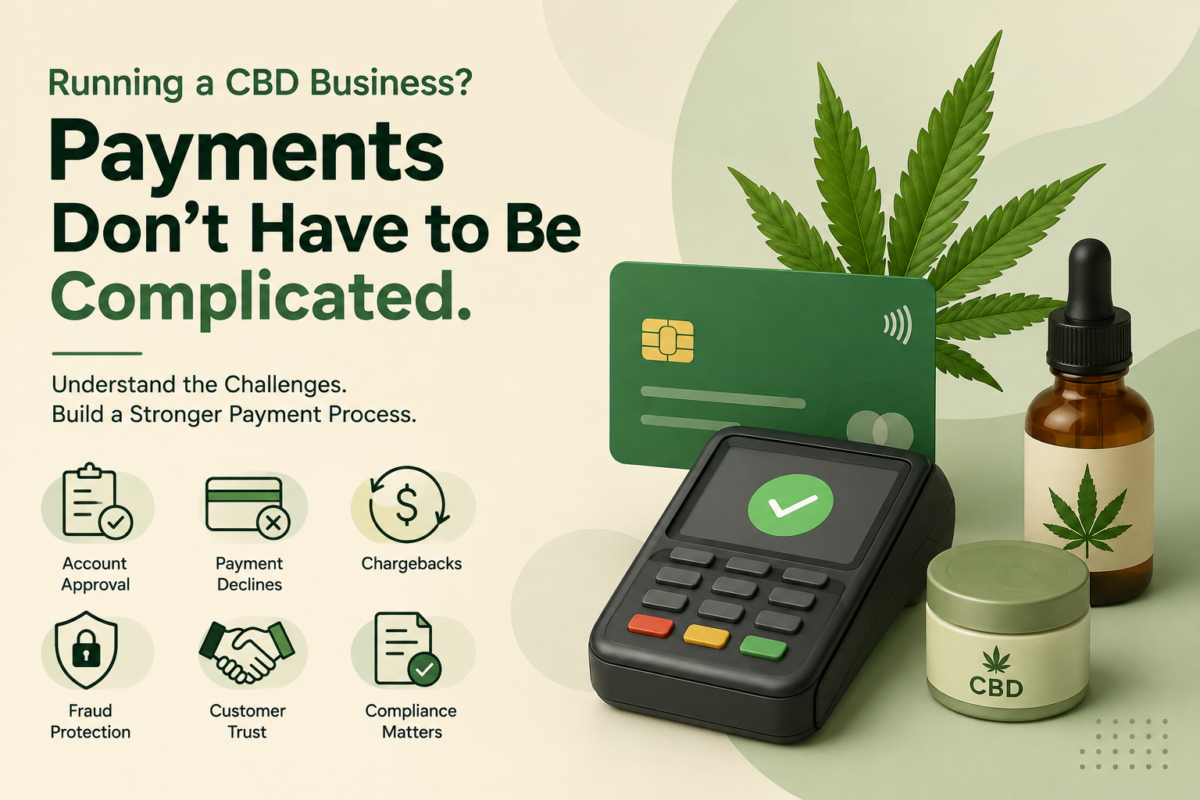
Launching a CBD, hemp, or cannabis-related business involves much more than creating quality products and attracting customers. Once sales begin, many business owners discover that accepting and managing payments is one of the most complex parts of running the business.
Unlike many traditional industries, CBD businesses often encounter payment-related challenges that can affect customer experience, cash flow, and long-term growth. These challenges range from merchant account approvals and payment declines to fraud, chargebacks, and changing compliance requirements.
The good news is that most of these problems can be managed with the right preparation. Understanding the most common payment processing challenges – and how to respond to them – can help businesses build a more reliable payment operation from the start.
Challenge 1: Getting Approved for Payment Processing
One of the first obstacles many CBD businesses face is obtaining a merchant account.
Because the industry is often considered higher risk, payment providers usually conduct a more detailed underwriting process than they would for many other businesses. Applications may require additional documentation, website reviews, and product verification before approval.
For example, imagine a company launching an online CBD wellness store. The products are compliant, but the website is missing refund policies, business contact information, and clear product descriptions. Even though the products themselves are legitimate, the incomplete website may delay the approval process.
Preparing business documents, maintaining a professional website, and understanding how to get approved for a CBD merchant account can significantly improve the chances of a successful application.
Challenge 2: Payment Declines
Nothing is more frustrating than a customer reaching checkout only to discover that their payment has been declined. Declined transactions can occur for many reasons, including bank restrictions, incorrect payment information, fraud screening, or technical issues.
For instance, a returning customer attempts to purchase their usual CBD supplements, but their bank automatically blocks the transaction because of internal risk policies. The customer has available funds, yet the payment still fails.
Businesses should monitor decline patterns instead of assuming every failed payment is caused by insufficient funds. Learning why CBD payments get declined and how to fix them helps merchants identify recurring problems and improve checkout success rates.
Challenge 3: Chargebacks
Chargebacks remain one of the most expensive payment issues for online businesses.
Many disputes occur because customers misunderstand recurring billing, do not recognize a transaction on their statement, or experience delivery problems.
Consider a customer who subscribes to a monthly CBD tincture delivery. Weeks later, they forget they enrolled in automatic renewals and dispute the charge instead of contacting customer support.
Reducing chargebacks often starts with better communication. Clear billing descriptions, transparent subscription terms, accurate shipping information, and responsive customer service all help prevent avoidable disputes. Businesses looking to strengthen this area should also understand how to prevent chargebacks for CBD businesses, since preventing disputes is far easier than responding to them later.
Challenge 4: Fraud and Unauthorized Transactions
As online sales increase, fraud becomes a growing concern. Criminals may use stolen payment cards, compromised customer accounts, or fake identities to place fraudulent orders.
Imagine someone using stolen card details to purchase several expensive CBD wellness kits with overnight shipping. The order appears legitimate until the real cardholder reports unauthorized activity, leaving the merchant responsible for the loss.
Reducing fraud requires more than simply blocking suspicious orders. Businesses should combine transaction monitoring, customer verification, and secure payment practices to identify unusual activity without creating unnecessary friction for genuine shoppers.
Challenge 5: Maintaining Customer Trust
Payment processing isn’t only about technology – it also influences how customers perceive your business. Customers expect payments to work smoothly. If they experience failed transactions, confusing checkout pages, or unclear billing information, they may lose confidence and abandon future purchases.
Simple improvements can strengthen trust:
- Display clear refund and shipping policies.
- Make customer support easy to contact.
- Use recognizable billing descriptors.
- Send prompt order and payment confirmations.
- Communicate proactively about delays or subscription renewals.
For example, a customer whose shipment is delayed is far more likely to remain satisfied if they receive timely updates instead of having to contact support for information.
Challenge 6: Keeping Up With Compliance
The payment landscape for CBD, hemp, and cannabis businesses continues to evolve. Businesses may need to update documentation, maintain product records, or provide additional information as payment providers review their operations.
For example, a CBD company expanding into new product categories may be asked to provide updated product documentation or revised business information during periodic account reviews. Keeping business records organized and understanding KYC and AML requirements for CBD payment processing helps merchants respond more efficiently when additional verification is requested.
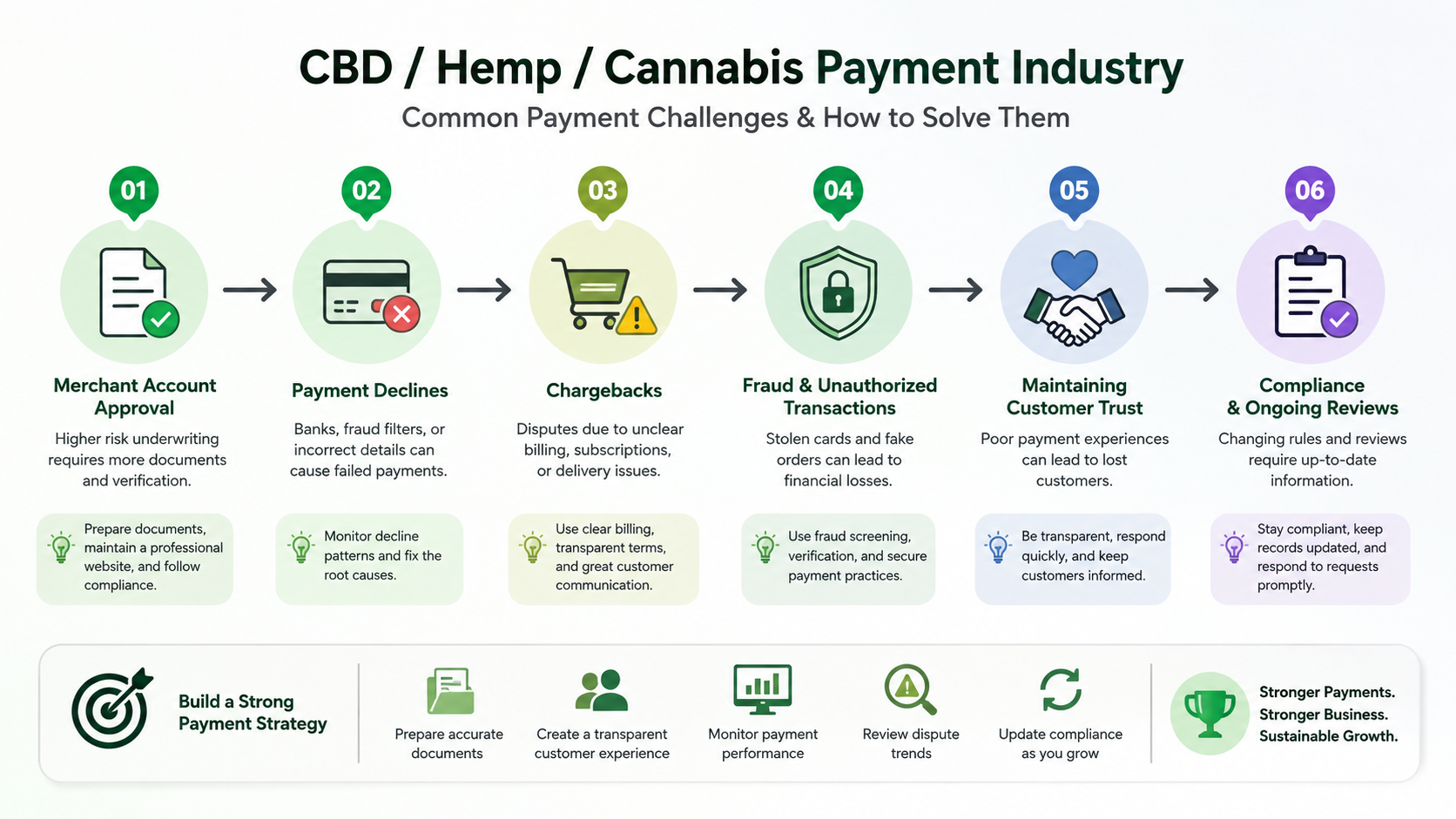
Building a Strong Payment Strategy
Many payment challenges are connected rather than isolated. A business with unclear policies may experience more chargebacks. Frequent chargebacks can increase payment risk. Higher payment risk may result in closer monitoring or additional reviews by payment providers.
Instead of addressing each issue separately, businesses should view payment operations as an ongoing process that includes:
- Preparing accurate business documentation
- Creating a transparent customer experience
- Monitoring payment performance
- Reviewing dispute trends
- Updating compliance information as the business grows
Taking a proactive approach reduces the likelihood of small payment issues becoming larger operational problems.
Final Thoughts
Payment processing is one of the most important operational areas for any CBD, hemp, or cannabis business. While challenges such as merchant account approvals, payment declines, fraud, chargebacks, and compliance requirements are common, they are not impossible to manage.
Businesses that understand these challenges early are better prepared to create smoother checkout experiences, maintain customer trust, and build stable payment operations over time.
Rather than treating payment processing as a one-time setup, successful businesses continually review their payment performance, improve customer communication, and adapt to changing industry requirements. That long-term approach helps create a stronger foundation for sustainable growth.

Categories
- ACH Payments (10)
- adult payment processing (11)
- AI (9)
- Altcoins (10)
- Banking (10)
- Bitcoin (133)
- Bitcoin ETF (11)
- Bitcoin Price (30)
- Blockchain (50)
- Brokering World Hunger Away (16)
- Business (17)
- card payment processing (10)
- CBD (11)
- CBDC (11)
- Chargeback (8)
- coaching business (11)
- COVID-19 (3)
- Crypto ATMs (1)
- Crypto Banking (17)
- Crypto Bill (1)
- Crypto business owner platform (31)
- Crypto Investment (3)
- Crypto Markets (5)
- Crypto Payment (35)
- Crypto Payment Processor (4)
- Crypto Prices (1)
- Crypto Trading (92)
- Cryptocurrency (402)
- Cryptocurrency Exchange (108)
- Data Visualization (2)
- dating platforms (11)
- debt collection payment processing (10)
- Decentralized Finance (7)
- DeFi Payment (9)
- DEX (3)
- Digital Currency (23)
- dropshipping payment processing (12)
- Ethereum (2)
- FAQ (7)
- file sharing payment processing (11)
- Finance (25)
- Financial Equality (4)
- Financial Freedom (8)
- Forex (35)
- hemp (1)
- ICO (2)
- Investment (11)
- IPTV (11)
- Merchant Account (10)
- Mining (3)
- News (66)
- NFTs (2)
- online gambling (11)
- P2P (1)
- Paybito (147)
- PayBitoPro (693)
- PayBitoPro Coin Listing (6)
- PayBitoPro Exchange (2)
- Payment Gateway (48)
- peptide (10)
- Post COVID Digital Transformation (1)
- Press Release (130)
- Privacy & Security (3)
- Real Estate (1)
- Stablecoin (5)
- Technology (15)
- Travel (11)
- Uncategorized (10)
- US Presidential Election (2)
- Utility Coin (1)
- Web3 business (4)
- Web3 Wallets (2)
- White Label Crypto Exchange (8)
Recent Posts
- Payment Gateway vs. Payment Orchestration: What’s the Difference?
- What Is Smart Payment Routing? Strategies to Optimize Payment Performance
- How to Improve Payment Approval Rates for High-Risk Businesses?
- Why Are Online Payments Failing? Common Causes and How to Fix Them
- How to Use Multiple Payment Processors to Reduce Business Disruptions?