How Long Does It Take to Get a Merchant Account? From Application to First Transaction
- August 14, 2026
- Soham Guchait
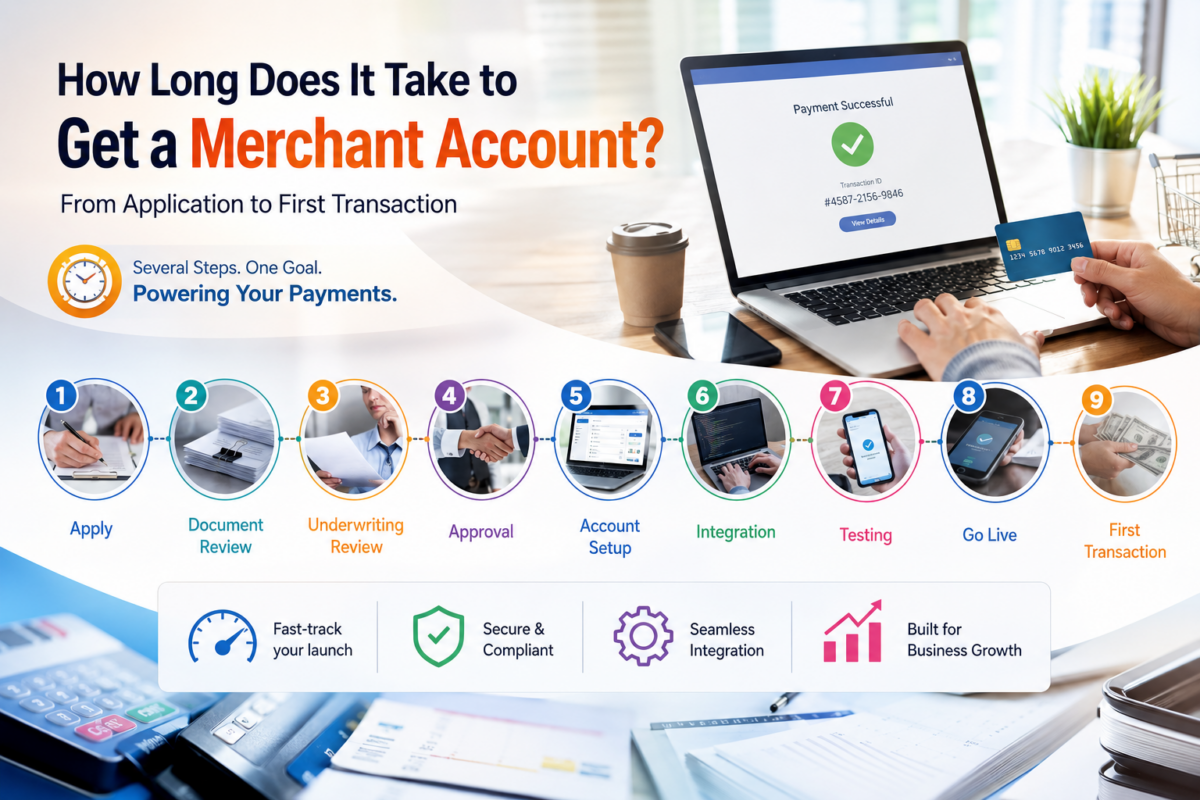
For a straightforward business with complete documentation, the underwriting decision can often take a few business days. However, approval is only one step in the process.
A business still needs to submit its application, provide supporting documents, complete underwriting, establish the account, connect its payment technology, test transactions, and activate live processing. That means the time from starting an application to completing the first live transaction can be longer than the approval period itself.
There is no universal timeline. Business type, transaction profile, documentation, underwriting requirements, technical integration, and settlement arrangements can all affect how quickly a merchant becomes ready to accept payments.
How Long Does It Take to Get a Merchant Account?
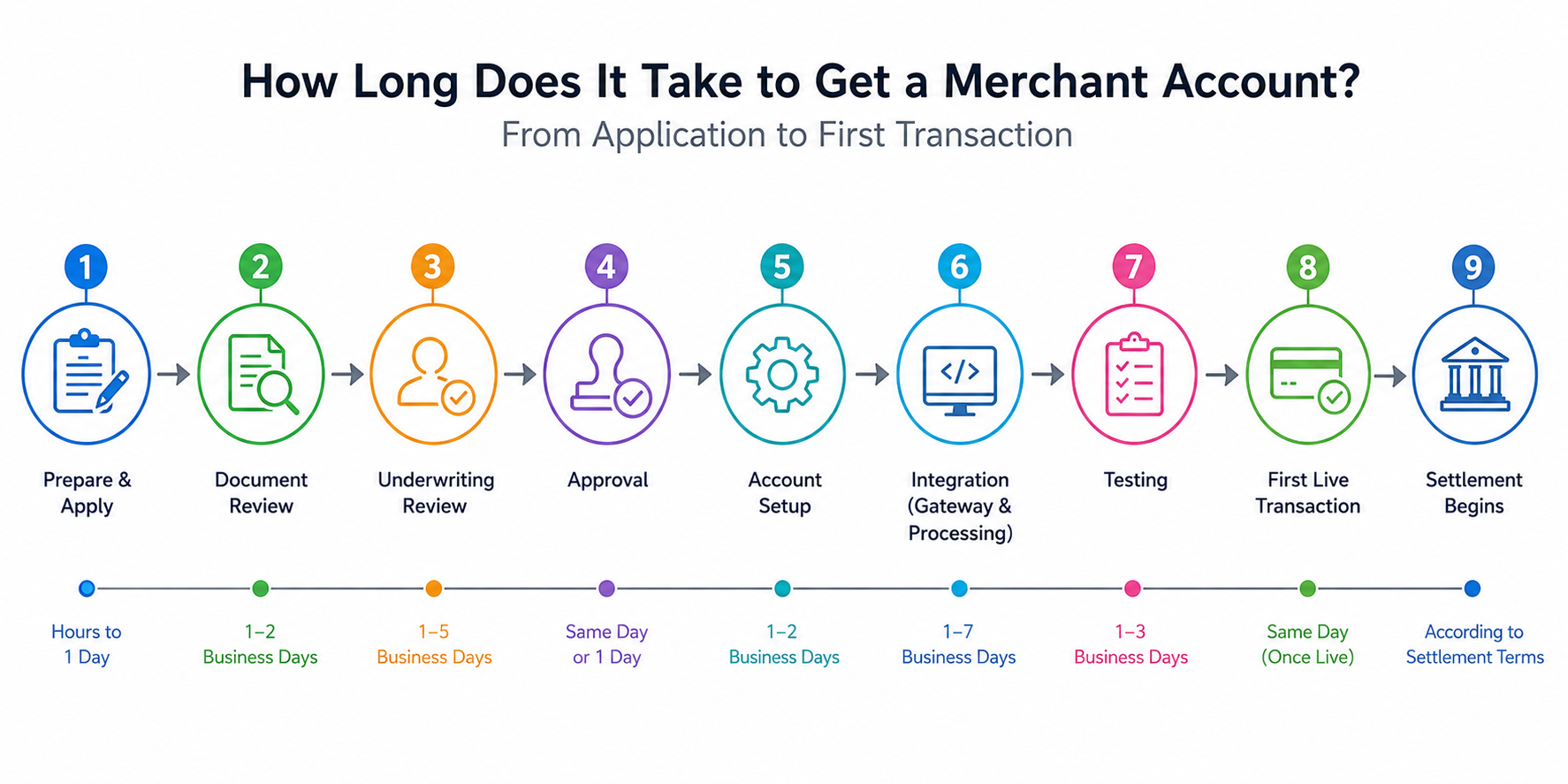
For many standard applications, the underwriting decision can take roughly 1–5 business days once a complete application and required documentation have been submitted. Some applications may move faster, while those requiring additional review can take longer. The important distinction is between approval time and time to start accepting payments.
A typical journey looks like:
Application → Document Review → Underwriting → Approval → Account Setup → Integration → Testing → First Live Transaction
If the business has its documents prepared and its payment integration ready, the process can be relatively quick. If information is missing or the payment environment still needs to be built, the overall timeline can extend considerably.
Stage 1: Preparing the Merchant Account Application
The application itself may take only a few hours, but gathering the necessary information can take longer.
A business may need to provide information about its legal structure, ownership, banking arrangements, products or services, expected transaction volume, and previous payment activity. Before submitting an application, businesses should make sure:
- Legal business and ownership information is consistent across documents.
- Banking information matches the account intended for settlement.
- Expected monthly volume and average transaction size are realistic.
- Website, product, refund, billing, and fulfillment information accurately reflects the business.
This preparation matters because underwriting is based on the information provided. Incomplete or contradictory information can lead to additional questions and extend the review.
Stage 2: Verification and Merchant Account Underwriting
Once submitted, the application enters underwriting. Underwriting is more than checking whether a business exists. The provider is trying to understand the potential financial exposure created by the merchant’s transactions.
The review may consider:
- Business model and products or services
- Ownership and business structure
- Financial condition
- Expected processing volume
- Average and maximum transaction size
- Previous processing history
- Refund, dispute, and fulfillment patterns
For example, imagine two businesses that each expect to process $100,000 per month.
Business A sells $20 consumer products and expects thousands of transactions.
Business B collects $10,000 upfront for services that customers will receive over several months.
Although both businesses expect the same monthly volume, their risk profiles can be different because the timing of payment, fulfillment, refunds, and potential disputes is different. That is why merchant-account approval is not determined by revenue or processing volume alone.
Stage 3: Additional Information Requests
An application does not always move directly from “under review” to “approved.” An underwriter may request additional information when the original application does not provide enough evidence to understand the business.
For instance, suppose a new company expects to process $500,000 per month despite having no previous processing history. The provider may ask how the business expects to generate that volume, what its average transaction will be, how customers are acquired, or when products and services are delivered.
The additional review does not necessarily mean the application will be rejected. It means the provider needs more information before determining the appropriate processing arrangement. The timeline at this stage depends heavily on how quickly the merchant responds and whether the additional information resolves the outstanding questions.
Stage 4: Merchant Account Approval and Setup
Once underwriting is completed and the application is approved, the merchant account still needs to be configured for processing. This can involve establishing the merchant relationship, assigning the relevant merchant identification information, confirming settlement details, and configuring transaction-processing settings.
This is where businesses sometimes misunderstand the word Approved.
Approval does not necessarily mean a customer can immediately visit the website and complete a live transaction. The technical payment environment still needs to be connected.
Stage 5: Payment Gateway and Processing Integration
For an online business, payment technology must be connected to the merchant’s website or application. Depending on the setup, this could involve a hosted checkout, payment gateway, API integration, ecommerce integration, or another payment interface.
The technical timeline varies considerably. A business using an existing ecommerce integration may be ready relatively quickly. A company building a customized payment experience may need additional development and testing. It is therefore useful to prepare the technical side while the application is progressing rather than waiting until the merchant account has been approved.
The goal is to have the payment environment ready when the account becomes active.
Stage 6: Testing Before Going Live
Testing confirms that the complete payment journey works correctly before real customers begin submitting transactions. A business should verify not only successful payments but also how its system responds to different transaction outcomes.
Testing may cover:
- Successful authorization and order confirmation
- Declined transactions
- Refunds and cancellations
- Transaction records and reporting
For an ecommerce business, the basic journey should work from checkout → payment submission → authorization response → order confirmation → transaction record.
Testing is particularly important because an approved merchant account does not guarantee that the website, payment gateway, order-management system, and back-office processes are correctly connected.
Stage 7: The First Live Transaction
The first live transaction is when the entire payment environment begins operating with real customer activity.
Imagine an online retailer selling a $500 product. A customer submits their card payment. The transaction moves through the configured payment infrastructure and receives an authorization response from the card issuer. If approved, the retailer can proceed with the order. But the transaction is not necessarily finished financially at that moment.
Authorization is not the same as settlement.
The transaction may still go through capture, clearing, and settlement before the funds become available to the merchant according to its settlement arrangement. This distinction is important when planning cash flow during the launch of a new payment account.
Why Some Merchant Accounts Take Longer Than Others?
Two businesses applying on the same day can have very different approval timelines.
Common reasons for delays include:
- Missing or inconsistent documentation
- Additional ownership or business verification
- Transaction volumes that differ significantly from expected activity
- Complex products or fulfillment arrangements
- Limited or nonexistent processing history
- Additional review related to the business model
- Payment integration that has not been completed
A new business may require more explanation because there is no historical transaction data to demonstrate how it operates. An established business can also face additional review if its proposed processing activity is substantially different from its previous history.
For example, a company that historically processed $30,000 per month but suddenly expects $300,000 may need to explain the reason for the increase.
Example: Two Businesses, Two Different Timelines
Consider two companies applying for merchant accounts on Monday.
Business A is an established retailer with three years of payment-processing history. Its documents are complete, its transaction patterns are stable, and its ecommerce integration is already prepared.
Business B is a newly launched subscription company. It has no processing history, collects payments before delivering a long-term service, and is still finalizing its website.
Even though both applications were submitted on the same day, there is no reason to expect identical timelines. Business A gives the underwriter historical evidence of its transaction behavior. Business B may require more questions about billing, cancellations, fulfillment, expected volume, and customer obligations. The difference is not necessarily administrative speed. It reflects how much information is available to assess the proposed merchant relationship.
How Businesses Can Avoid Unnecessary Delays?
Businesses cannot control every part of underwriting, but they can eliminate many avoidable delays. The best approach is to treat merchant-account setup as both a financial and technical process. Before applying, businesses should:
- Prepare financial and business documents in advance.
- Make sure information is consistent across the application and supporting records.
- Know expected monthly volume, average ticket, and maximum transaction size.
- Ensure the website clearly explains products, pricing, billing, fulfillment, and refund policies.
- Begin preparing the payment integration while underwriting is underway, where possible.
Businesses should also understand the account terms before processing begins. Approval alone does not explain how quickly funds will settle, whether reserves may apply, or what transaction limits and fees may exist.
Approval Is Only One Part of the Timeline
So, how long does it take to get a merchant account?
For a straightforward application, the underwriting decision may take only a few business days. But getting from application to the first live transaction involves several separate stages.
The complete journey is better understood as:
Prepare → Apply → Verify → Underwrite → Approve → Configure → Integrate → Test → Process → Settle
Understanding this sequence helps businesses set realistic launch expectations. Most importantly, businesses should not confuse merchant-account approval with being fully ready to accept payments. A successful launch requires the financial relationship, payment technology, transaction flow, and settlement process to work together correctly.

Categories
- ACH Payments (10)
- adult payment processing (11)
- AI (9)
- Altcoins (10)
- Banking (10)
- Bitcoin (133)
- Bitcoin ETF (11)
- Bitcoin Price (30)
- Blockchain (50)
- Brokering World Hunger Away (16)
- Business (17)
- card payment processing (10)
- CBD (11)
- CBDC (11)
- Chargeback (8)
- coaching business (11)
- COVID-19 (3)
- Crypto ATMs (1)
- Crypto Banking (17)
- Crypto Bill (1)
- Crypto business owner platform (31)
- Crypto Investment (3)
- Crypto Markets (5)
- Crypto Payment (35)
- Crypto Payment Processor (4)
- Crypto Prices (1)
- Crypto Trading (92)
- Cryptocurrency (402)
- Cryptocurrency Exchange (108)
- Data Visualization (2)
- dating platforms (11)
- debt collection payment processing (10)
- Decentralized Finance (7)
- DeFi Payment (9)
- DEX (3)
- Digital Currency (23)
- dropshipping payment processing (12)
- Ethereum (2)
- FAQ (7)
- file sharing payment processing (11)
- Finance (25)
- Financial Equality (4)
- Financial Freedom (8)
- Forex (35)
- hemp (1)
- ICO (2)
- Investment (11)
- IPTV (11)
- Merchant Account (10)
- Mining (3)
- News (66)
- NFTs (2)
- online gambling (11)
- P2P (1)
- Paybito (147)
- PayBitoPro (693)
- PayBitoPro Coin Listing (6)
- PayBitoPro Exchange (2)
- Payment Gateway (48)
- peptide (10)
- Post COVID Digital Transformation (1)
- Press Release (130)
- Privacy & Security (3)
- Real Estate (1)
- Stablecoin (5)
- Technology (15)
- Travel (11)
- Uncategorized (10)
- US Presidential Election (2)
- Utility Coin (1)
- Web3 business (4)
- Web3 Wallets (2)
- White Label Crypto Exchange (8)
Recent Posts
- Payment Gateway vs. Payment Orchestration: What’s the Difference?
- What Is Smart Payment Routing? Strategies to Optimize Payment Performance
- How to Improve Payment Approval Rates for High-Risk Businesses?
- Why Are Online Payments Failing? Common Causes and How to Fix Them
- How to Use Multiple Payment Processors to Reduce Business Disruptions?