Merchant Account vs Payment Gateway: What’s the Difference and How Do They Work Together?
- August 14, 2026
- Soham Guchait
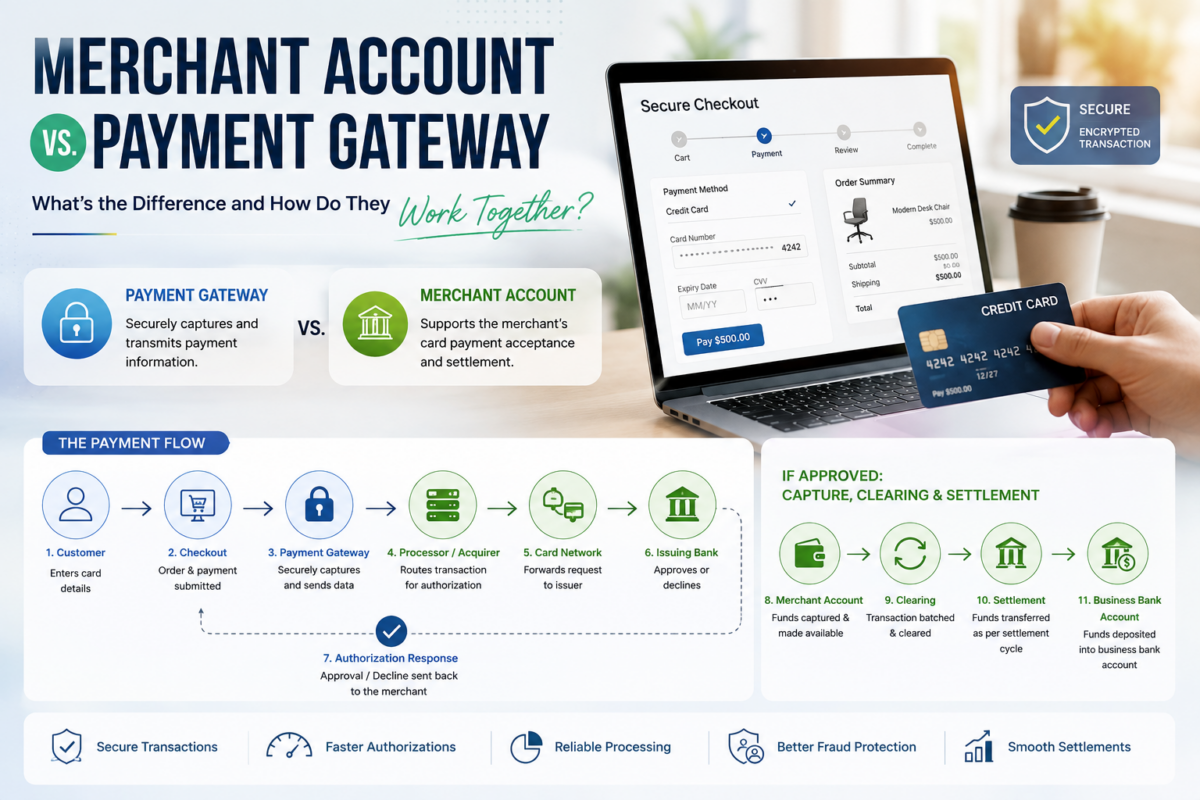
A customer can enter card details on an ecommerce checkout, receive an approval message within seconds, and still have the merchant’s money move through several different systems before it reaches the business bank account.
That is because a merchant account and a payment gateway perform different jobs. The gateway handles the technology involved in securely transmitting payment information, while the merchant account is part of the financial infrastructure used to receive and settle card-payment funds. Understanding the difference matters because businesses often encounter both terms when setting up payment acceptance. They are connected, but they are not interchangeable.
What Is a Merchant Account?
A merchant account is a specialized account used in card-payment acceptance. It is associated with the acquiring side of the payment system and provides the infrastructure through which funds from card transactions can be received and settled to the merchant.
A merchant account is a specialized account used in card-payment acceptance. It is associated with the acquiring side of the payment system and provides the infrastructure through which funds from card transactions can be received and settled to the merchant. The merchant account is typically associated with a Merchant ID (MID), a unique identifier used to identify the merchant within the payment-processing ecosystem.
It is important not to confuse a merchant account with a normal business checking account.
A business bank account is used for everyday financial activities such as paying suppliers, employees, taxes, and other expenses. A merchant account exists specifically within the card-payment ecosystem. After a card transaction is successfully processed, funds can be made available through the merchant account before being settled to the merchant’s designated bank account. The exact arrangement and settlement timing depend on the acquiring and processing setup.
For example, suppose an online furniture store sells a $500 desk by credit card. The $500 does not simply move directly from the customer’s bank account into the retailer’s checking account at the moment the customer clicks Pay. The transaction must first be authorized, processed, cleared, and settled through the payment ecosystem.
This is where the merchant account becomes relevant.
What Is a Payment Gateway?
A payment gateway is a technology that securely captures and transmits payment information between the merchant’s checkout environment and the payment-processing infrastructure.
For an online business, the gateway may be integrated into a hosted checkout page, website, mobile application, or payment form. In a physical environment, gateway functionality can be associated with the systems connecting a point-of-sale device to payment-processing infrastructure. The gateway’s job is primarily about payment data and transaction communication, not serving as the merchant’s ordinary bank account.
When a customer enters card information online, the gateway can securely transmit the transaction information onward for authorization. The resulting response is then communicated back to the merchant’s checkout system. This distinction is important because a gateway does not replace the financial relationships required for card acceptance.
A useful way to think about the difference is:
|
Component |
Primary role |
|
Payment gateway |
Securely captures and transmits transaction information |
| Merchant account |
Supports the merchant’s card-payment acceptance and settlement relationship |
| Business bank account |
Receives settled funds for normal business use |
Modern payment providers may bundle several of these functions together, which can make the underlying architecture less visible to the merchant. The fact that they appear inside one dashboard does not mean they perform the same function.
Merchant Account vs Payment Gateway: The Core Difference
The simplest distinction is:
The payment gateway is primarily the technology layer that moves payment information. The merchant account is part of the financial layer through which card-payment funds are received and settled.
They therefore solve different problems. A gateway answers questions such as:
- How does the checkout securely transmit card information?
- Where does the transaction request go?
- How does the merchant receive the authorization response?
The merchant-account relationship addresses questions such as:
- Where are card-payment funds made available for settlement?
- Which acquiring relationship supports the merchant?
- Under what terms can the business accept card transactions?
The distinction becomes clearer when looking at an actual transaction.
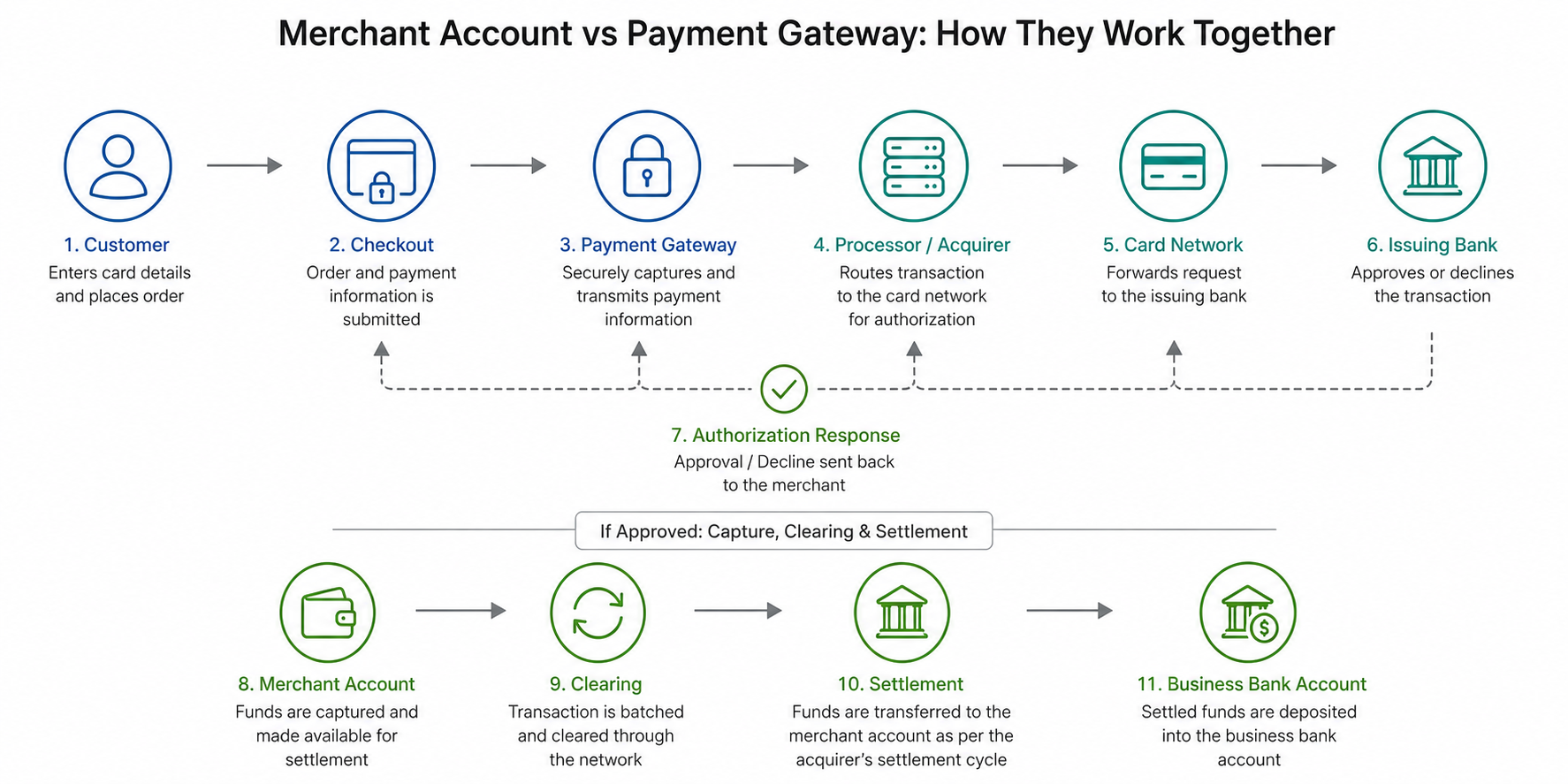
How a Merchant Account and Payment Gateway Work Together?
Consider an ecommerce company selling a $500 product. The customer enters their card details and submits the order. A simplified payment flow looks like this:
Customer → Checkout → Payment Gateway → Processor/Acquirer → Card Network → Issuing Bank → Authorization Response → Merchant
If the transaction is approved, the payment does not necessarily mean the merchant has already received spendable cash. The transaction can proceed through capture, clearing, and settlement before the resulting funds become available to the merchant according to its settlement arrangement.
The gateway therefore participates heavily in the communication and transaction-data side of the process, while the merchant account sits within the merchant acceptance and settlement side.
A $500 transaction in practice
Imagine a customer purchases a $500 laptop online.
- Checkout begins:
The customer enters their card details and submits the order. - Gateway receives the transaction:
The payment gateway securely captures and transmits the necessary transaction information. - Processing infrastructure routes the request:
The transaction moves through the relevant acquiring and card-network infrastructure toward the customer’s card issuer. - Issuer responds:
The issuing bank evaluates the authorization request and returns an approval or decline response. - Merchant receives the result:
The gateway and connected payment systems communicate the response back to the merchant’s checkout. - Capture and settlement follow:
If the transaction is captured, it enters the subsequent clearing and settlement processes. Funds are ultimately made available to the merchant according to its acquiring and settlement arrangement.
This is why a payment confirmation should not automatically be interpreted as “The money is already in the business bank account“.
Do You Need Both a Merchant Account and a Payment Gateway?
For businesses accepting card payments online through a traditional merchant-account arrangement, both functions are generally required, although they may not appear as separate products. A business might have:
Separate providers:
One relationship provides the merchant account and processing arrangement, while another supplies the gateway technology.
An integrated provider:
A single provider may bundle gateway, processing, acquiring, and merchant-account functionality into one experience.
The second arrangement can make setup simpler because the business may have one integration and one administrative interface. However, businesses should still understand what functions are actually being provided behind that interface.
Why Does the Difference Matters to a Business?
The distinction is more than technical terminology. Suppose an ecommerce business experiences a payment problem. A customer says their card was declined, for example. The issue could involve authorization, transaction routing, fraud controls, card information, the acquiring relationship, or another part of the payment chain.
Knowing which component performs which function makes troubleshooting much easier.
It also helps businesses evaluate payment infrastructure more intelligently. Instead of asking only whether a provider “has a payment gateway,” a business can ask:
What happens to the transaction data? Where is the merchant relationship held? Who handles processing? How are funds settled? Which party manages risk and chargeback-related processes?
These questions reveal how the payment system actually operates.
Businesses should also consider security responsibilities. Outsourcing payment processing does not automatically eliminate every payment-security responsibility. PCI Security Standards Council guidance states that merchants can retain responsibilities even when payment processing is outsourced, including understanding shared responsibilities and verifying that service providers maintain appropriate compliance.
What Businesses Should Check Before Setting Up Payment Infrastructure?
Before integrating a payment gateway or establishing a merchant-account relationship, businesses should understand how the components fit together rather than evaluating each product in isolation. Important areas include:
- Transaction flow: Know where payment information travels from checkout through authorization and settlement.
- Settlement: Understand when and where funds become available and which account receives the payout.
- Pricing: Identify gateway, processing, network, account, chargeback, and other applicable costs rather than looking only at one advertised rate.
- Security responsibilities: Determine which payment-data and PCI DSS responsibilities remain with the business and which are handled by service providers.
These considerations can become particularly important as transaction volume, average ticket size, sales channels, or geographic coverage changes.
For example, a company processing $100,000 per month through 10,000 transactions has a very different transaction profile from a company processing the same $100,000 through 20 transactions. The payment infrastructure may need to accommodate very different transaction patterns, risk controls, and operational requirements.
Merchant Account and Payment Gateway: One System, Different Functions
A merchant account and payment gateway are often discussed together because they work together, but they should not be treated as synonyms.
The gateway is primarily concerned with secure transaction-data communication and the payment experience at the point where a payment is initiated. The merchant account is part of the financial and acquiring infrastructure that enables the merchant to accept card payments and receive funds through settlement.
Once the difference is understood, the broader payment system becomes easier to follow. The gateway, processor, acquirer, card network, issuer, merchant account, and business bank account each have distinct roles, even when a modern payment provider combines several of them behind a single interface.
That understanding gives businesses a better foundation for evaluating payment infrastructure – not simply by asking which product to buy, but by understanding what each component actually does and how the pieces work together.
Categories
- ACH Payments (10)
- adult payment processing (11)
- AI (9)
- Altcoins (10)
- Banking (10)
- Bitcoin (133)
- Bitcoin ETF (11)
- Bitcoin Price (30)
- Blockchain (50)
- Brokering World Hunger Away (16)
- Business (17)
- card payment processing (10)
- CBD (11)
- CBDC (11)
- Chargeback (8)
- coaching business (11)
- COVID-19 (3)
- Crypto ATMs (1)
- Crypto Banking (17)
- Crypto Bill (1)
- Crypto business owner platform (31)
- Crypto Investment (3)
- Crypto Markets (5)
- Crypto Payment (35)
- Crypto Payment Processor (4)
- Crypto Prices (1)
- Crypto Trading (92)
- Cryptocurrency (402)
- Cryptocurrency Exchange (108)
- Data Visualization (2)
- dating platforms (11)
- debt collection payment processing (10)
- Decentralized Finance (7)
- DeFi Payment (9)
- DEX (3)
- Digital Currency (23)
- dropshipping payment processing (12)
- Ethereum (2)
- FAQ (7)
- file sharing payment processing (11)
- Finance (25)
- Financial Equality (4)
- Financial Freedom (8)
- Forex (35)
- hemp (1)
- ICO (2)
- Investment (11)
- IPTV (11)
- Merchant Account (10)
- Mining (3)
- News (66)
- NFTs (2)
- online gambling (11)
- P2P (1)
- Paybito (147)
- PayBitoPro (693)
- PayBitoPro Coin Listing (6)
- PayBitoPro Exchange (2)
- Payment Gateway (48)
- peptide (10)
- Post COVID Digital Transformation (1)
- Press Release (130)
- Privacy & Security (3)
- Real Estate (1)
- Stablecoin (5)
- Technology (15)
- Travel (11)
- Uncategorized (10)
- US Presidential Election (2)
- Utility Coin (1)
- Web3 business (4)
- Web3 Wallets (2)
- White Label Crypto Exchange (8)
Recent Posts
- Payment Gateway vs. Payment Orchestration: What’s the Difference?
- What Is Smart Payment Routing? Strategies to Optimize Payment Performance
- How to Improve Payment Approval Rates for High-Risk Businesses?
- Why Are Online Payments Failing? Common Causes and How to Fix Them
- How to Use Multiple Payment Processors to Reduce Business Disruptions?