What Documents Do You Need for a Merchant Account? Application and Underwriting Requirements Explained
- August 14, 2026
- Soham Guchait
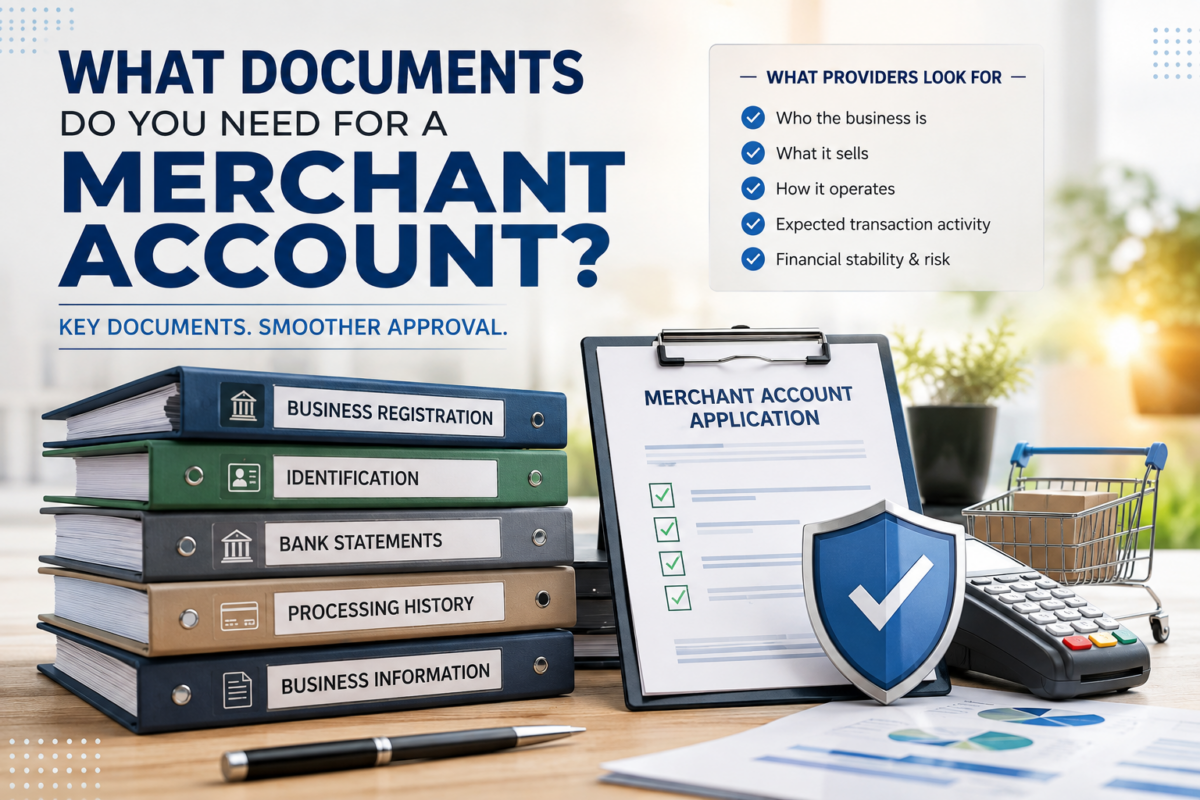
A merchant account application can look straightforward until a provider asks for bank statements, identification, business records, processing history, or information about the products being sold.
These requests are not simply paperwork. Each document helps the acquiring or processing side understand who the business is, what it sells, how it operates, how much it expects to process, and what financial risk could arise from its transactions.
Knowing what documents are commonly requested – and why they matter – can make the application process more predictable and help businesses prepare accurate information before underwriting begins.
Why Do Merchant Accounts Require Documentation?
A customer may pay today, but a refund, dispute, or chargeback can occur later. In some cases, providers may also use a merchant account reserve to help cover potential future losses or payment obligations. A business may also process significantly more volume than originally expected, change its business model, or begin accepting unusually large transactions.
Because of this, a merchant account provider needs enough information to assess the business and determine appropriate processing arrangements. Documentation helps answer several basic questions:
Who is the merchant?
The provider needs to verify the legal identity of the business and the people responsible for it.
What does the merchant sell?
The products, services, delivery model, pricing, and sales channels can influence the risk associated with processing transactions.
How does the business perform financially?
Financial statements and bank records can provide evidence of revenue, cash flow, and the company’s ability to meet its obligations.
What transaction activity should be expected?
Expected processing volume and average transaction size help establish whether the proposed account activity is consistent with the business model.
Common Documents Needed for a Merchant Account
There is no universal document list that applies to every business. Requirements vary depending on the provider, business structure, industry, transaction profile, location, and risk assessment. However, many applications may involve several categories of information.
Business Registration and Identity Documents
A provider generally needs to establish that the business actually exists and identify the legal entity responsible for accepting payments. Once approved, the merchant is typically assigned a unique Merchant ID (MID) that identifies its processing account. Depending on the business structure and jurisdiction, this may include:
- Business registration or incorporation documents
- Tax identification information
- Business license, where applicable
- Ownership and beneficial-owner information
For a sole proprietor, the documentation may look very different from that of a corporation or limited liability company.
The important issue is consistency. The legal business name, tax information, ownership details, and information submitted on the application should correspond with the underlying business records. If the business operates under a trading name or DBA (Doing Business As), the provider may also request documentation connecting that name to the legal entity.
Personal Identification for Owners and Representatives
Merchant-account applications can require identification for business owners, directors, authorized representatives, or beneficial owners.
Common examples include government-issued identification and information needed to verify the individuals associated with the business. This serves an important purpose: A provider is not only assessing the company but also verifying the people legally responsible for the merchant relationship. The exact individuals subject to verification depend on the provider’s procedures and applicable legal or compliance requirements.
Business Bank Statements
Bank statements can help demonstrate the business’s financial activity and cash-flow patterns.
A provider may request recent statements to understand whether the company’s actual financial activity is consistent with the information supplied in the application.
For example, imagine a business states that it expects to process $150,000 per month but its financial records show a very different scale of operations. That discrepancy does not automatically mean the application will be rejected. It may simply prompt additional questions. The provider may want to understand whether the business is launching a new product, expanding rapidly, entering a new market, or otherwise changing its expected transaction profile.
Processing Statements From a Previous Provider
An established merchant may be asked for previous processing statements.
These can be particularly useful because they provide historical evidence of actual payment activity rather than projections. A processing statement may help show:
- Historical processing volume
- Average transaction patterns
- Refund activity
- Chargebacks or disputes
- Processing fees and other transaction information
For example, a business that has consistently processed $80,000 per month for two years provides a different underwriting picture from a new business projecting $80,000 per month without processing history. Previous statements do not guarantee approval, but they can give an underwriter more evidence with which to assess the proposed account.
Financial Statements and Revenue Evidence
Depending on the business and the level of risk involved, a provider may request additional financial information. This can include income statements, balance sheets, tax returns, or other evidence of business revenue. The reason is relatively straightforward: transaction volume can create potential future liabilities.
Consider a company that sells $10,000 annual memberships and collects the full amount upfront. If the company processes $500,000 in one month but services those customers over the following twelve months, the provider may have a different risk perspective than if another company processes $500,000 in products that are shipped within two days.
The revenue figure is the same. The timing of fulfillment and potential customer liability is not. Financial documents can therefore help put payment volume into context.
Business Model and Product Information
Documentation is not always limited to formal financial records. A provider may need to understand what the business actually sells and how customers purchase it.
An ecommerce company might provide its website URL, product descriptions, pricing information, refund policy, terms and conditions, and details about its fulfillment process.
A subscription business may need to explain its recurring billing structure, cancellation process, and customer terms.
This information helps connect the business model to the proposed transaction activity. For example, suppose a company says it expects an average transaction of $2,000 but its website primarily advertises $20 consumer products. An underwriter may reasonably ask for clarification. Again, the issue is not necessarily that the business is doing something wrong. The provider simply needs accurate information about how transactions are expected to occur.
Website and Customer-Facing Information
For online businesses, the website can effectively become part of the underwriting evidence. The provider may review whether customers can understand what they are buying, how much it costs, how fulfillment works, and what happens if they request a refund.
Depending on the business and provider, this may involve reviewing:
- Product or service descriptions: What exactly is being sold?
- Pricing: What will customers actually be charged?
- Terms and conditions: What contractual terms govern the purchase?
- Refund and cancellation policies: What happens when a customer wants to reverse a purchase?
- Contact information: How can customers reach the business?
The purpose is to understand the customer journey and potential payment-related exposure.
Why Processing Volume and Average Ticket Size Matter?
One of the most important pieces of information in a merchant-account application is expected transaction activity.
Consider two businesses that each expect to process $100,000 per month.
Business A expects 10,000 transactions at approximately $10 each.
Business B expects 20 transactions at approximately $5,000 each.
The monthly volume is identical, but the transaction profiles are dramatically different.
A provider may therefore want information about expected monthly volume, average ticket size, maximum transaction size, and sales patterns. These figures help establish whether the requested processing capacity makes sense for the underlying business.
Businesses should avoid inflating projections simply to appear larger. Unrealistic estimates can create discrepancies later if actual transaction activity differs significantly from the information provided during underwriting.
What If You Are a New Business With No Processing History?
A new business may not have previous processing statements because it has never accepted card payments before. That does not mean it cannot apply for a merchant account. Instead, underwriting may rely more heavily on other available evidence, such as:
- Business formation and ownership information
- Financial records
- Bank statements
- Business model and website
- Expected transaction volume
- Product or service details
A new business should therefore focus on providing accurate, internally consistent information rather than trying to manufacture a processing history it does not have.
What Happens If a Provider Requests More Documents?
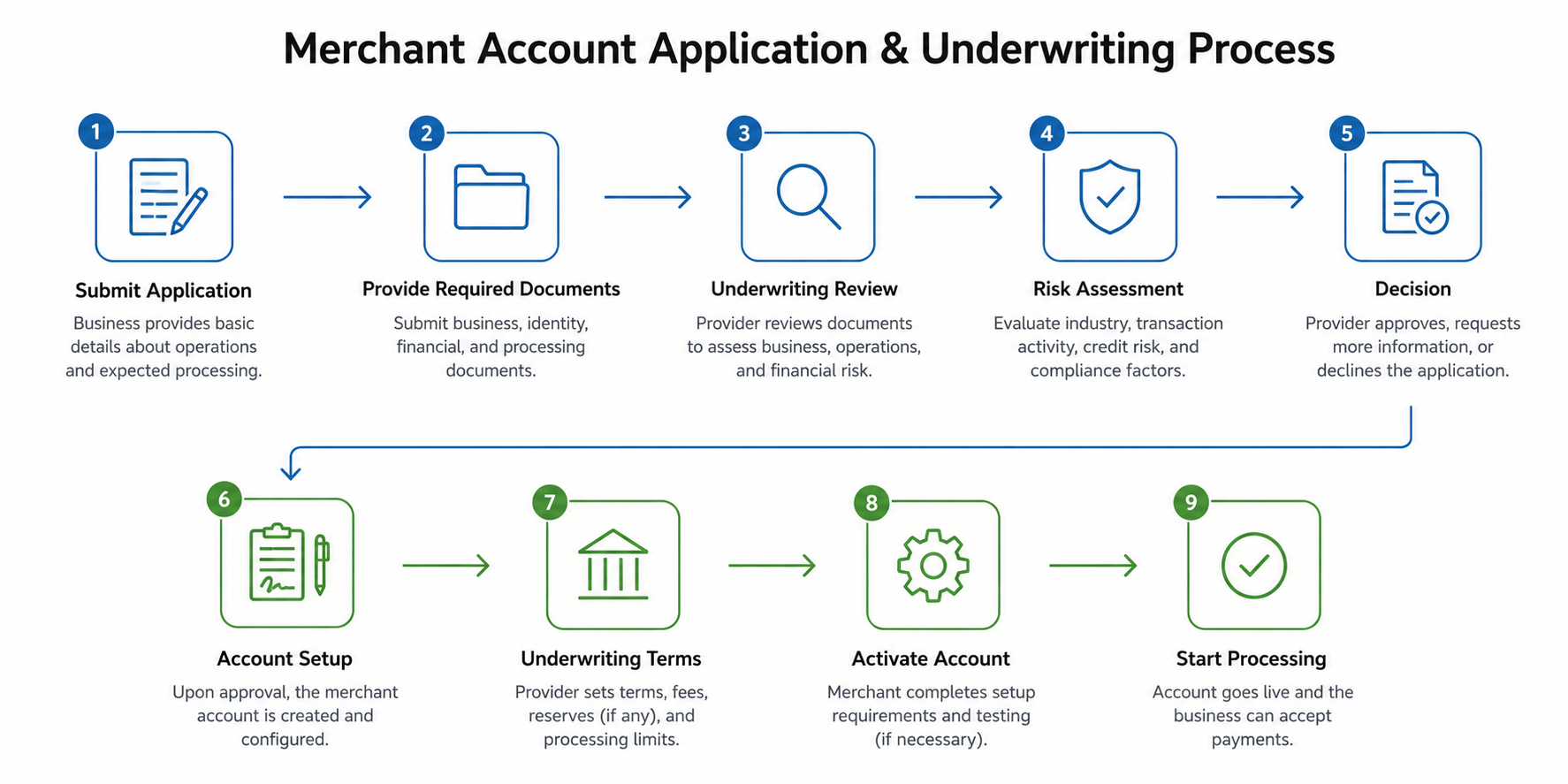
Additional documentation requests are not necessarily a sign that something has gone wrong. Underwriting is an assessment process, and the initial application may not contain enough information to resolve every question.
For example, an underwriter might see that a merchant expects $250,000 in monthly card volume but has only recently launched. The provider could request bank statements, supplier information, financial statements, or additional details about fulfillment to better understand the projected activity. The most useful response is usually accurate and complete documentation. Delays often occur when documents are inconsistent, outdated, incomplete, or difficult to verify.
How to Prepare Your Merchant Account Application?
Preparation is largely about consistency.
Before submitting an application, businesses should make sure their core information tells the same story across the application, website, financial records, and supporting documents.
A practical preparation process is:
- Confirm legal information: Verify the business name, registration details, tax information, ownership, and authorized representatives.
- Review financial records: Gather current bank statements and other financial documents that may be requested.
- Document the business model: Clearly explain products, services, pricing, fulfillment, refunds, and customer billing.
- Prepare transaction estimates: Know the expected monthly volume, average ticket, maximum ticket, and sales channels. These details can also help businesses understand what may influence merchant account cost.
- Keep supporting records organized: Have relevant documents ready if underwriting requests clarification.
The goal is not to provide the largest possible collection of paperwork. It is to provide accurate evidence that allows the provider to understand the business and its expected payment activity.
The Documents Tell the Story Behind the Transactions
A merchant-account application is ultimately an attempt to connect a business’s identity, financial condition, business model, and expected payment activity into one understandable picture.
Business registration documents establish who the merchant is. Financial records show how the business operates financially. Processing history demonstrates past payment activity. Website and product information explain what customers are buying. Transaction projections indicate what future processing may look like.
No single document provides the complete picture. The stronger approach is to ensure that all of the information is accurate, consistent, and representative of how the business actually operates. For businesses preparing to accept card payments, knowing what providers require can make getting a merchant account much easier. That makes the underwriting process easier to understand – and gives businesses a clearer idea of what information may be needed before card-payment processing can begin.
Categories
- ACH Payments (10)
- adult payment processing (11)
- AI (9)
- Altcoins (10)
- Banking (10)
- Bitcoin (133)
- Bitcoin ETF (11)
- Bitcoin Price (30)
- Blockchain (50)
- Brokering World Hunger Away (16)
- Business (17)
- card payment processing (10)
- CBD (11)
- CBDC (11)
- Chargeback (8)
- coaching business (11)
- COVID-19 (3)
- Crypto ATMs (1)
- Crypto Banking (17)
- Crypto Bill (1)
- Crypto business owner platform (31)
- Crypto Investment (3)
- Crypto Markets (5)
- Crypto Payment (35)
- Crypto Payment Processor (4)
- Crypto Prices (1)
- Crypto Trading (92)
- Cryptocurrency (402)
- Cryptocurrency Exchange (108)
- Data Visualization (2)
- dating platforms (11)
- debt collection payment processing (10)
- Decentralized Finance (7)
- DeFi Payment (9)
- DEX (3)
- Digital Currency (23)
- dropshipping payment processing (12)
- Ethereum (2)
- FAQ (7)
- file sharing payment processing (11)
- Finance (25)
- Financial Equality (4)
- Financial Freedom (8)
- Forex (35)
- hemp (1)
- ICO (2)
- Investment (11)
- IPTV (11)
- Merchant Account (10)
- Mining (3)
- News (66)
- NFTs (2)
- online gambling (11)
- P2P (1)
- Paybito (147)
- PayBitoPro (693)
- PayBitoPro Coin Listing (6)
- PayBitoPro Exchange (2)
- Payment Gateway (48)
- peptide (10)
- Post COVID Digital Transformation (1)
- Press Release (130)
- Privacy & Security (3)
- Real Estate (1)
- Stablecoin (5)
- Technology (15)
- Travel (11)
- Uncategorized (10)
- US Presidential Election (2)
- Utility Coin (1)
- Web3 business (4)
- Web3 Wallets (2)
- White Label Crypto Exchange (8)
Recent Posts
- Payment Gateway vs. Payment Orchestration: What’s the Difference?
- What Is Smart Payment Routing? Strategies to Optimize Payment Performance
- How to Improve Payment Approval Rates for High-Risk Businesses?
- Why Are Online Payments Failing? Common Causes and How to Fix Them
- How to Use Multiple Payment Processors to Reduce Business Disruptions?