KYC and AML Requirements for File Sharing Businesses
- August 12, 2026
- Soham Guchait
When a file-sharing business applies for payment processing, the payment provider needs to know more than what the company sells. It also needs to understand who owns and controls the business, how the business operates, who its customers are, and whether its expected payment activity makes sense.
This is where KYC and AML requirements become relevant.
KYC, or Know Your Customer, focuses on identifying and verifying customers or businesses. AML, or Anti-Money Laundering, focuses on identifying and managing activity that may indicate money laundering or other financial crime.
The exact requirements depend on the payment provider, jurisdiction, business structure, services offered, and risk profile. KYC and AML should therefore not be treated as a single universal checklist.
For a file-sharing business, the practical objective is to provide accurate information, maintain appropriate records, and make sure actual payment activity remains consistent with the business that was originally reviewed.
What Do KYC and AML Mean for a File Sharing Business?
KYC is primarily about identity.
When a file-sharing company applies for a merchant account or payment service, the provider may need to verify the company and the individuals behind it. This can include information about the legal entity, owners, directors, beneficial owners, and business operations.
AML goes further by considering whether the business and its transactions present risks associated with financial crime.
For covered financial institutions in the United States, customer due diligence includes understanding the nature and purpose of a customer relationship, developing a customer risk profile, identifying and verifying beneficial owners where applicable, and conducting ongoing monitoring based on risk.
For a file-sharing platform, this means the provider may want to understand not only who owns the company but also what type of service it provides and what payment activity it expects to generate.
What Information May a File Sharing Business Need to Provide?
There is no single document list that applies to every payment provider. Requirements can differ based on location, business structure, provider policies, and risk level. A business may be asked for information such as:
- Company registration and legal entity information
- Owner and beneficial-owner identification
- Business address and contact information
- Business bank-account information
- Description of products or services
- Website and customer terms
- Expected transaction volume
- Customer locations
- Processing history, if available
The important principle is consistency.
Suppose a company is registered as a cloud-storage business but describes itself differently during payment onboarding. Its website shows monthly storage subscriptions, while the application describes only software consulting.
That inconsistency can create questions during verification. The business should describe its actual operations clearly and accurately.
Beneficial Ownership Verification
Payment providers may need to establish who ultimately owns or controls a company.
A beneficial owner is generally an individual who meets applicable ownership or control criteria. In the U.S., FinCEN’s customer-due-diligence framework has traditionally included individuals who directly or indirectly own 25% or more of a legal entity, along with an individual who exercises significant control. However, requirements can change and may vary depending on the institution and jurisdiction.
For example, imagine a file-sharing company owned by four individuals. Two founders each own 30%, while two other investors each own 20%.
The provider may need information about the individuals who meet the applicable beneficial-ownership criteria and about the person responsible for controlling the company. This information helps the payment provider understand who is actually behind the business rather than relying only on the company name.
Why Business Verification Matters?
A payment provider is taking on a relationship with the business, not simply processing individual transactions. It therefore needs to understand what the company does and whether its expected activity makes sense.
Consider a file-sharing platform that tells a provider it expects to process $20,000 per month from 2,000 subscribers. Six months later, the business suddenly begins processing $500,000 per month.
Rapid growth is not automatically a compliance problem. A successful marketing campaign, new enterprise customers, or international expansion could explain the increase. However, the difference between expected and actual activity may lead to additional questions or monitoring.
This is one reason businesses should provide realistic information during onboarding rather than making assumptions about future transaction volume.
What Is AML Transaction Monitoring?
AML monitoring involves looking for transaction activity or patterns that may be inconsistent with the customer’s known business profile or may indicate suspicious activity.
For a file-sharing company, monitoring may involve factors such as transaction volume, transaction patterns, customer geography, unusual activity, or significant changes from expected behavior.
For example, a platform normally processes small monthly subscriptions from customers across several countries. It suddenly begins receiving a large number of unusually high-value transactions from accounts with limited history.
That change does not automatically mean the transactions are illegal. It may, however, warrant additional review depending on the provider’s risk framework.
Financial institutions generally use a risk-based approach rather than assuming that every customer presents the same level of risk. FinCEN guidance describes ongoing monitoring and updating customer information based on risk.
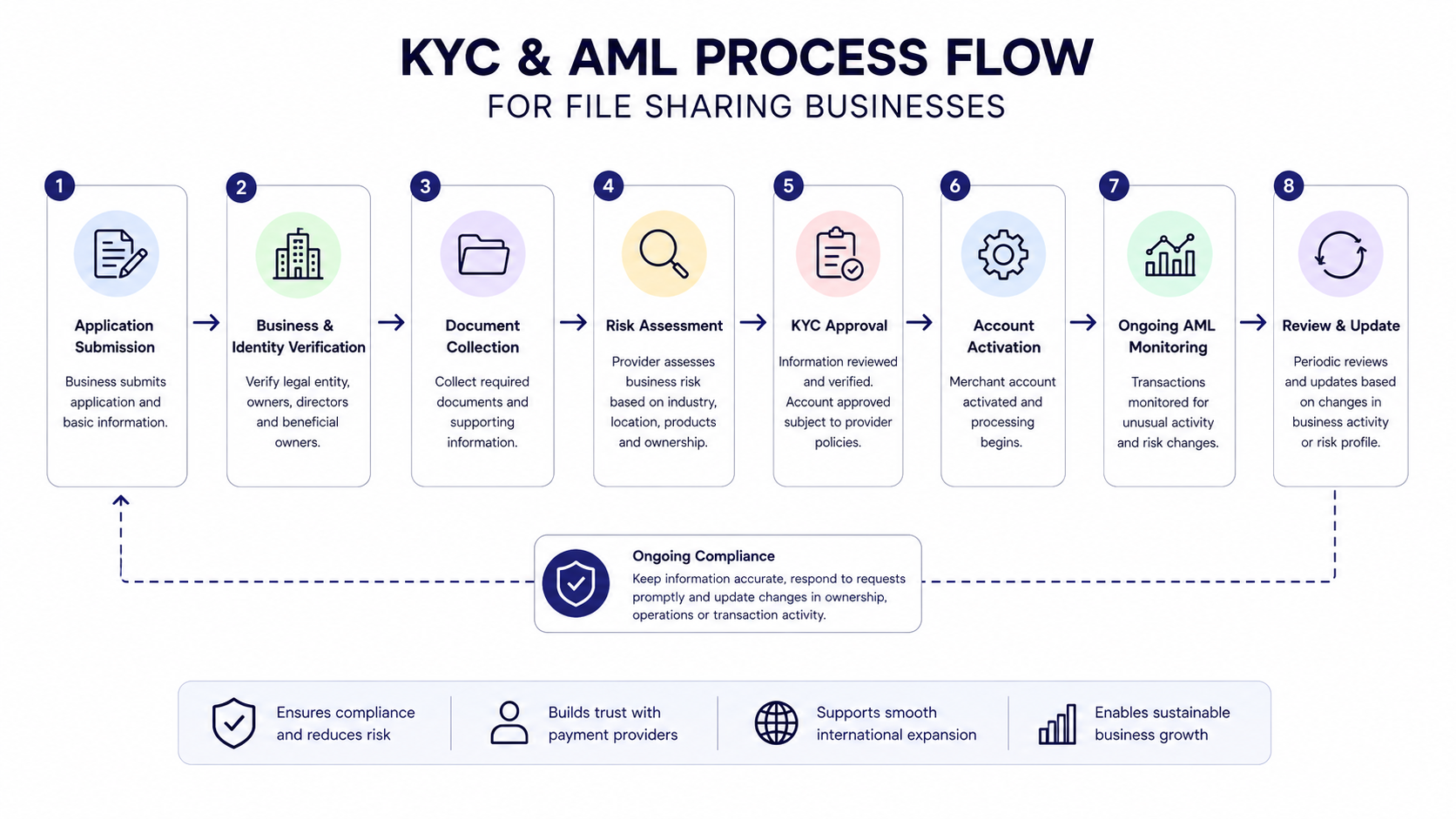
KYC Is Not Only About the Business Owner
Although business verification is important, KYC can also involve customers depending on the payment service, transaction type, jurisdiction, and applicable requirements.
A file-sharing platform may have ordinary consumers paying for storage subscriptions and may not need to perform the same type of customer verification that a regulated financial business would. However, certain payment activities, products, jurisdictions, or risk situations can introduce additional verification requirements.
The business should therefore avoid assuming that one KYC process applies to every customer and every payment. The payment provider’s requirements should determine what information needs to be collected.
What Happens During a Compliance Review?
A compliance review can happen during initial onboarding or later in the relationship. During onboarding, the provider may ask for business and ownership documentation. Later, a review may be triggered by changes in transaction volume, ownership, business activity, customer geography, processing patterns, or other risk factors.
For example, a file-sharing company initially processes only domestic subscriptions. Two years later, it expands into multiple international markets and introduces higher-value business plans.
The provider may want updated information about the company’s operations, expected transaction activity, or ownership. This does not necessarily mean the business has done anything wrong. Ongoing due diligence is part of maintaining an accurate understanding of a business relationship.
Keep Business Information Consistent
One of the simplest ways to make compliance reviews easier is to keep important business information accurate and current.
The legal company name, business address, ownership information, website, subscription model, and expected payment activity should not contradict one another.
If something significant changes, such as ownership or the business model, the company should follow the applicable process for updating its payment provider.
For example, a business that originally offered personal cloud storage may later introduce enterprise file management and large corporate accounts. That change can affect its transaction profile and should be reflected accurately where the provider requests updated business information.
A Practical Example
Imagine a file-sharing company applying for payment processing.
The company provides its registration documents, identifies its owners, explains that it sells monthly and annual storage plans, provides its website, and estimates its expected transaction volume.
During review, the provider asks for additional information about ownership and the company’s customer base. The company responds with consistent documentation and explains that it expects most transactions to come from individual customers in three countries.
Several months later, the business expands into ten additional markets and begins processing significantly higher volumes.
The provider may then request updated information because the actual activity has changed substantially from the original profile. The important lesson is that KYC and AML are not simply onboarding exercises. They can continue throughout the payment relationship.
What Should File Sharing Businesses Do to Stay Prepared?
A file-sharing business should approach KYC and AML as an ongoing operational responsibility rather than something to complete once and forget.
It should maintain accurate company and ownership records, understand its own payment activity, respond promptly to legitimate information requests, and avoid providing incomplete or misleading information.
It should also keep supporting business records organized so that changes in ownership, operations, transaction volume, or customer markets can be explained when necessary.
Requirements are jurisdiction-specific, and a payment provider may impose additional controls beyond minimum legal requirements. Businesses should therefore confirm the applicable requirements with their payment provider and qualified compliance or legal professionals when necessary.
KYC, AML, and the Broader Payment Operation
KYC and AML are only one part of running a reliable payment operation.
A file-sharing business also needs to manage payment declines, recurring billing, refunds, chargebacks, fraud, and international transactions. A compliance review may examine some of these areas because transaction activity can help a provider understand the business’s actual risk profile. For this reason, compliance should be connected to the wider payment strategy rather than treated as a separate administrative task.
As a file-sharing business grows, maintaining accurate customer, transaction, and business information becomes increasingly important. Larger transaction volumes and international expansion can also create more complex monitoring and reporting requirements. For businesses that want to build or operate their own payment infrastructure, a white-label payment platform can provide a more structured way to manage payment acceptance, processing, and related payment operations.
The goal is not to create unnecessary friction for legitimate customers. It is to maintain a transparent payment operation where the business, its ownership, its services, and its transaction activity can be accurately understood and appropriately monitored.

Categories
- ACH Payments (10)
- adult payment processing (11)
- AI (9)
- Altcoins (10)
- Banking (10)
- Bitcoin (133)
- Bitcoin ETF (11)
- Bitcoin Price (30)
- Blockchain (50)
- Brokering World Hunger Away (16)
- Business (17)
- card payment processing (10)
- CBD (11)
- CBDC (11)
- Chargeback (8)
- coaching business (11)
- COVID-19 (3)
- Crypto ATMs (1)
- Crypto Banking (17)
- Crypto Bill (1)
- Crypto business owner platform (31)
- Crypto Investment (3)
- Crypto Markets (5)
- Crypto Payment (35)
- Crypto Payment Processor (4)
- Crypto Prices (1)
- Crypto Trading (92)
- Cryptocurrency (402)
- Cryptocurrency Exchange (108)
- Data Visualization (2)
- dating platforms (11)
- debt collection payment processing (10)
- Decentralized Finance (7)
- DeFi Payment (9)
- DEX (3)
- Digital Currency (23)
- dropshipping payment processing (12)
- Ethereum (2)
- FAQ (7)
- file sharing payment processing (11)
- Finance (25)
- Financial Equality (4)
- Financial Freedom (8)
- Forex (35)
- hemp (1)
- ICO (2)
- Investment (11)
- IPTV (11)
- Merchant Account (10)
- Mining (3)
- News (66)
- NFTs (2)
- online gambling (11)
- P2P (1)
- Paybito (147)
- PayBitoPro (693)
- PayBitoPro Coin Listing (6)
- PayBitoPro Exchange (2)
- Payment Gateway (48)
- peptide (10)
- Post COVID Digital Transformation (1)
- Press Release (130)
- Privacy & Security (3)
- Real Estate (1)
- Stablecoin (5)
- Technology (15)
- Travel (11)
- Uncategorized (10)
- US Presidential Election (2)
- Utility Coin (1)
- Web3 business (4)
- Web3 Wallets (2)
- White Label Crypto Exchange (8)
Recent Posts
- Payment Gateway vs. Payment Orchestration: What’s the Difference?
- What Is Smart Payment Routing? Strategies to Optimize Payment Performance
- How to Improve Payment Approval Rates for High-Risk Businesses?
- Why Are Online Payments Failing? Common Causes and How to Fix Them
- How to Use Multiple Payment Processors to Reduce Business Disruptions?