Why Is File Sharing Payment Processing Considered High Risk?
- August 12, 2026
- Soham Guchait
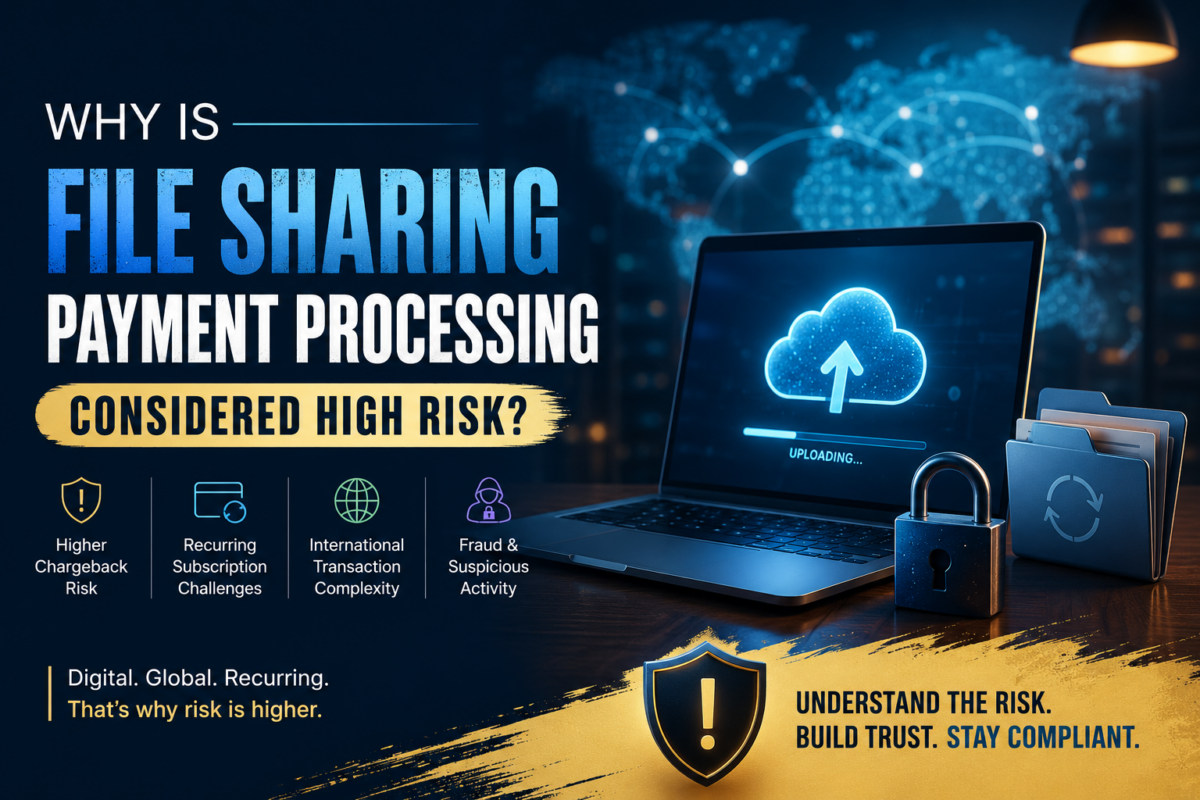
A file-sharing business can have a legitimate product, paying customers, and a straightforward subscription model, yet still receive greater scrutiny from payment providers than a conventional online retailer.
This does not necessarily mean that file sharing itself is an illegitimate or prohibited business activity. Payment providers generally assess risk based on how a business processes transactions, the products or services it provides, its customer base, transaction patterns, dispute history, fraud exposure, regulatory obligations, and how easily the provider can verify the service being sold.
Being considered higher risk does not automatically mean a file-sharing business cannot accept card payments or obtain a merchant account. It generally means the business may face additional underwriting requirements and may need stronger controls around transactions, subscriptions, customer disputes, fraud prevention, business verification, and payment monitoring.
What Makes a File Sharing Business Higher Risk?
Payment providers and acquiring banks assess merchant risk because they can have financial exposure when transactions are disputed, reversed, fraudulent, or associated with activity that falls outside the merchant’s approved business profile.
The level of scrutiny can therefore depend on the characteristics of the business rather than simply its industry name. For a file-sharing business, several operational and payment-related characteristics can contribute to a higher-risk assessment.
Recurring Subscription Payments
Many file-sharing platforms operate on a subscription model. Customers may pay monthly or annually for cloud storage, file-transfer limits, team accounts, collaboration tools, enhanced security features, or other premium services.
Recurring billing creates an ongoing payment relationship between the customer and the business. A customer may initially approve a subscription and later forget about it, fail to update an expired payment card, or dispute a renewal they no longer recognize. This is particularly relevant to digital subscription businesses because recurring transactions can generate disputes when customers do not clearly understand the renewal terms, do not recognize the billing descriptor, or experience difficulty cancelling a subscription.
For example, imagine a customer signs up for a $19.99 monthly storage plan. The first few payments are successful, but six months later, the customer notices another renewal on their bank statement and no longer remembers the service. If the billing descriptor is unclear or the cancellation process is difficult to find, the customer may contact their bank and dispute the transaction rather than contacting the file-sharing company directly.
That type of situation can contribute to payment disputes even when the original transaction and service were legitimate. For this reason, file-sharing businesses using recurring billing should clearly communicate the subscription price, billing frequency, renewal conditions, and cancellation process before and after a customer completes a purchase.
Digital Service Delivery
A physical product generally provides a relatively straightforward fulfillment trail. A merchant can demonstrate that an item was ordered, shipped, delivered, or received.
A file-sharing service works differently. The customer may be paying for access to digital functionality, storage capacity, file transfers, collaboration tools, security features, or another online service.
When a transaction is disputed, the business may need to rely on digital evidence rather than physical delivery records. Depending on the circumstances, useful records may include account creation details, login activity, service activation records, accepted terms, subscription history, file-transfer activity, or other evidence showing that the customer received access to the service.
This makes accurate recordkeeping an important part of payment operations. A file-sharing platform should be able to clearly establish what service was purchased, when access was provided, and how the customer interacted with the account where appropriate.
Chargeback Exposure
Chargebacks occur when a customer disputes a completed transaction through their bank or card issuer. Depending on the reason for the dispute and the payment network’s process, the merchant may need to provide evidence supporting the transaction. Subscription-based digital businesses can be exposed to disputes involving:
- Forgotten subscription renewals
- Unrecognized billing descriptors
- Unclear cancellation procedures
- Refund requests
- Claims that a service was not provided
- Unauthorized payment allegations
- Confusion about pricing or billing frequency
For a file-sharing business, an increasing number of disputes can become a payment-processing concern because payment providers monitor factors such as chargeback activity, transaction patterns, and the merchant’s overall risk profile.
This is why chargeback prevention for file-sharing businesses should be treated as an ongoing operational process rather than something addressed only after disputes begin to accumulate. Clear customer communication, recognizable billing descriptors, accessible cancellation options, responsive customer support, and accurate transaction records can all help reduce avoidable disputes.
Fraud and Suspicious Transaction Activity
Digital services can also attract fraudulent activity because an account can often be created and a service activated online without physical delivery.
For example, someone using stolen payment credentials may create multiple accounts, purchase premium storage or other paid services, and begin using the accounts before the legitimate cardholder discovers the unauthorized transactions. The business may not become aware of the issue until the transactions are disputed.
Payment providers may therefore review transaction patterns, repeated payment attempts, unusual purchase behavior, account activity, geographic inconsistencies, and other risk signals when evaluating the merchant.
However, fraud prevention should be balanced with the customer experience. Overly aggressive fraud controls can incorrectly block legitimate customers and create unnecessary payment declines.
International Customers
A file-sharing platform can serve customers across multiple countries without having physical locations in every market. This creates opportunities for international growth, but it can also introduce additional payment complexity. Different markets can involve different:
- Payment methods
- Currencies
- Customer authentication requirements
- Banking practices
- Transaction patterns
- Refund expectations
- Regulatory and compliance considerations
Cross-border payments may also look different from the transaction profile originally provided to a payment processor during underwriting.
For example, a business that initially serves customers primarily in one country may later begin receiving a significant percentage of its transactions from international markets. That does not automatically indicate a problem, but the change may lead the payment provider to reassess the merchant’s risk profile and expected processing activity.
Rapid Growth Can Change the Risk Profile
A payment risk assessment is not necessarily permanent. A business’s risk profile can change as its transaction volume, customer base, products, markets, or payment activity changes.
Consider a file-sharing platform that initially processes $20,000 per month from several hundred subscribers. After launching a successful marketing campaign, the platform grows to thousands of customers and begins processing several times that amount.
The growth itself may be positive, but the payment profile has changed. A payment provider may want to understand:
- Why did the transaction volume increase so quickly?
- Do the new customers match the original business model?
- Have refund and chargeback levels changed?
- Has the percentage of international transactions increased?
- Are transaction sizes or purchase patterns changing?
- Does the business have sufficient systems and controls to manage the higher volume?
A sudden increase in transaction activity does not automatically indicate a problem. However, significant changes can give a payment provider a reason to reassess the merchant’s risk exposure.
For this reason, businesses should communicate accurately about expected transaction volumes during underwriting and be prepared to explain major changes in their processing activity.
Business Verification Also Matters
Payment providers generally need to understand who owns a business, what it sells, where it operates, how customers are acquired, and how transactions are generated. Depending on the provider, jurisdiction, and business model, verification may involve information such as:
- Business registration details
- Ownership and control information
- Banking information
- Website and product information
- Expected processing volume
- Customer locations
- Pricing and subscription details
- Refund and cancellation policies
- Other business documentation
Requirements can vary between providers and jurisdictions. For this reason, a file-sharing company should make sure its website and business documentation clearly explain the service being offered. A payment provider should be able to understand what the customer is purchasing, how the service works, how the business charges customers, and how customers can request support, cancellations, or refunds.
Businesses should also prepare for the possibility that additional information will be requested during or after the initial review. Understanding file sharing merchant account requirements before applying can help prevent avoidable delays.
Does High Risk Mean a File Sharing Business Cannot Get Payment Processing?
No.
A higher-risk classification does not automatically mean payment processing is unavailable. It generally means that the provider may apply greater underwriting scrutiny or require additional information and controls based on the specific circumstances of the business. The actual assessment can depend on factors such as:
- Business model and ownership
- Nature of the file-sharing service
- Transaction history and expected processing volume
- Subscription and recurring billing practices
- Refund and cancellation procedures
- Chargeback and fraud exposure
- Customer locations
- International transaction activity
- Website transparency
- Compliance and verification requirements
Not every file-sharing business will have the same risk profile. A platform with transparent pricing, established operations, low dispute levels, clear customer policies, and consistent transaction activity may be assessed differently from a new business with limited processing history and rapidly changing transaction patterns.
The goal for a legitimate file-sharing business should not be to hide or misrepresent its business model to obtain approval. The better approach is to describe the business accurately, maintain clear customer policies, and build payment operations that can support its actual transaction activity.
How Can File Sharing Businesses Reduce Payment Risk?
The most effective approach is to address the factors that create uncertainty for customers and payment providers. Clear subscription terms should explain the price, billing frequency, renewal conditions, cancellation procedures, and what customers receive in exchange for payment.
Billing descriptors should help customers recognize charges on their bank or card statements. Refund and cancellation processes should also be easy to understand and reasonably accessible. A file-sharing business should also monitor payment activity rather than waiting for problems to accumulate. Important operational areas can include:
- Failed payment rates
- Payment declines
- Chargebacks and dispute reasons
- Refund patterns
- Suspicious transaction activity
- Changes in transaction volume
- Unusual customer or account behavior
Maintaining accurate business information and keeping payment providers informed about significant operational changes can also reduce unnecessary confusion during account reviews.
As the subscription model becomes more important, understanding how to accept recurring payments for a file-sharing business becomes equally important because recurring billing introduces its own payment lifecycle, customer communication requirements, and potential failure points.
The Real Issue Is Payment Risk Management
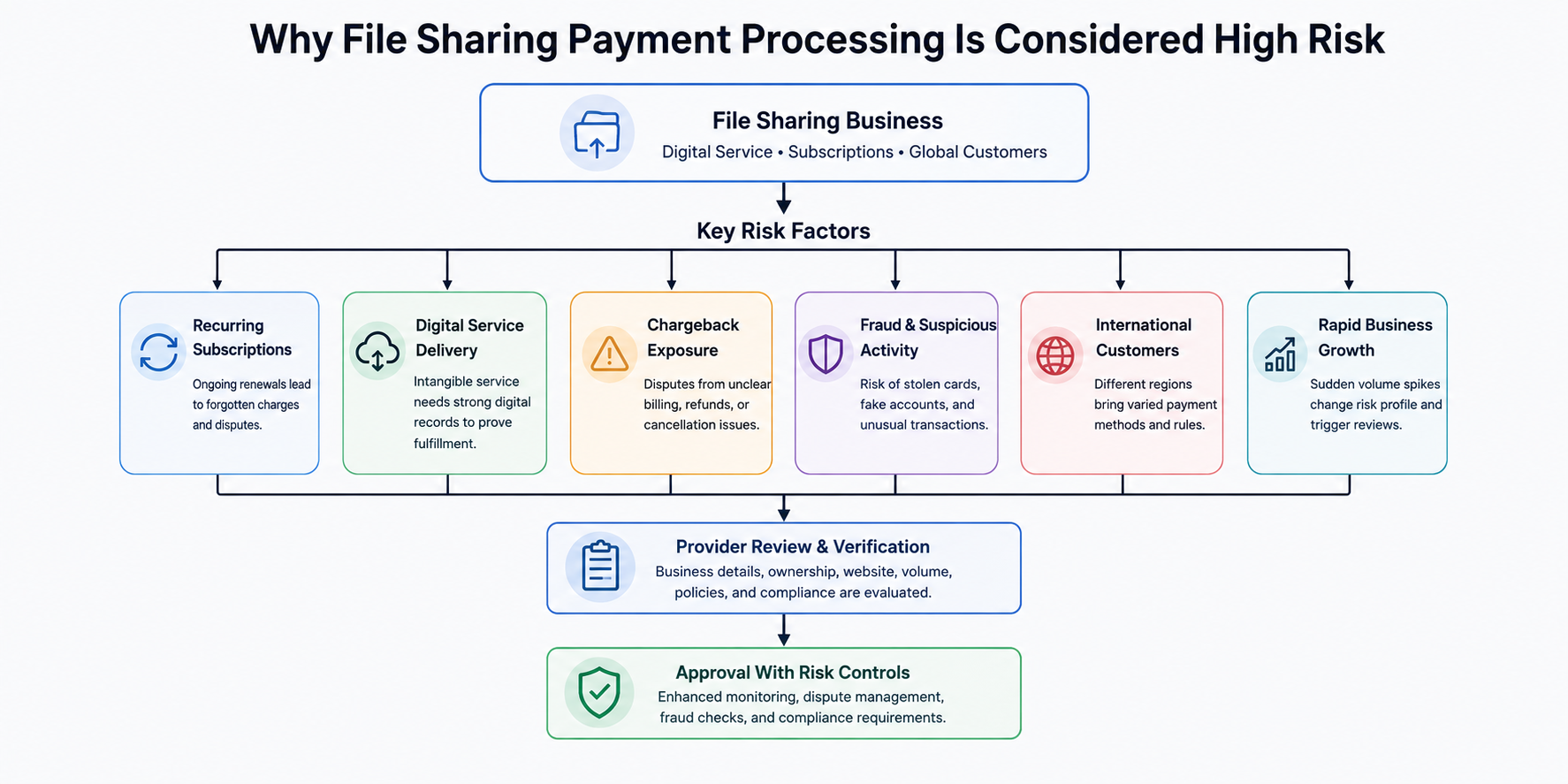
A file-sharing business may be considered higher risk because several characteristics can overlap: recurring billing, digital service delivery, potential chargebacks, fraud exposure, international transactions, business verification requirements, and changing transaction volumes.
None of these factors automatically means that a legitimate file-sharing business is problematic or unable to accept payments. Instead, they indicate that payment processing may require more careful risk management and closer attention to how transactions are handled.
For a business owner, the important question is therefore not simply:
“Is file sharing high risk?”
A more useful question is:
“What characteristics of my file-sharing business create payment risk, and how can I manage those risks responsibly?”
Once that is understood, the next stage is preparing the business for underwriting, maintaining the required documentation, reducing avoidable disputes and fraud, and building payment operations that can support subscriptions and growth without creating unnecessary payment problems.

Categories
- ACH Payments (10)
- adult payment processing (11)
- AI (9)
- Altcoins (10)
- Banking (10)
- Bitcoin (133)
- Bitcoin ETF (11)
- Bitcoin Price (30)
- Blockchain (50)
- Brokering World Hunger Away (16)
- Business (17)
- card payment processing (10)
- CBD (11)
- CBDC (11)
- Chargeback (8)
- coaching business (11)
- COVID-19 (3)
- Crypto ATMs (1)
- Crypto Banking (17)
- Crypto Bill (1)
- Crypto business owner platform (31)
- Crypto Investment (3)
- Crypto Markets (5)
- Crypto Payment (35)
- Crypto Payment Processor (4)
- Crypto Prices (1)
- Crypto Trading (92)
- Cryptocurrency (402)
- Cryptocurrency Exchange (108)
- Data Visualization (2)
- dating platforms (11)
- debt collection payment processing (10)
- Decentralized Finance (7)
- DeFi Payment (9)
- DEX (3)
- Digital Currency (23)
- dropshipping payment processing (12)
- Ethereum (2)
- FAQ (7)
- file sharing payment processing (11)
- Finance (25)
- Financial Equality (4)
- Financial Freedom (8)
- Forex (35)
- hemp (1)
- ICO (2)
- Investment (11)
- IPTV (11)
- Merchant Account (10)
- Mining (3)
- News (66)
- NFTs (2)
- online gambling (11)
- P2P (1)
- Paybito (147)
- PayBitoPro (693)
- PayBitoPro Coin Listing (6)
- PayBitoPro Exchange (2)
- Payment Gateway (48)
- peptide (10)
- Post COVID Digital Transformation (1)
- Press Release (130)
- Privacy & Security (3)
- Real Estate (1)
- Stablecoin (5)
- Technology (15)
- Travel (11)
- Uncategorized (10)
- US Presidential Election (2)
- Utility Coin (1)
- Web3 business (4)
- Web3 Wallets (2)
- White Label Crypto Exchange (8)
Recent Posts
- Payment Gateway vs. Payment Orchestration: What’s the Difference?
- What Is Smart Payment Routing? Strategies to Optimize Payment Performance
- How to Improve Payment Approval Rates for High-Risk Businesses?
- Why Are Online Payments Failing? Common Causes and How to Fix Them
- How to Use Multiple Payment Processors to Reduce Business Disruptions?