Fraud Prevention for File Sharing Businesses: How to Protect Online Payments
- August 12, 2026
- Soham Guchait
A file-sharing platform can have thousands of legitimate customers, yet a relatively small number of fraudulent payment attempts can create significant financial and operational problems. Stolen card details may be used to purchase subscriptions, criminals may take control of existing customer accounts, or automated scripts may test stolen payment credentials through the checkout process.
Because file-sharing businesses deliver digital services without a physical product or shipping address, they have fewer traditional transaction signals available for verification. This makes payment fraud one of the broader payment processing challenges that file-sharing platforms need to manage as they grow.
The objective is not to block every transaction that appears unusual. An overly aggressive fraud prevention system can decline legitimate customers and create unnecessary payment friction. The goal is to identify suspicious activity, apply proportionate verification or review, and allow genuine customers to complete payments with as little unnecessary friction as possible.
What Is Payment Fraud for a File Sharing Business?
Payment fraud occurs when someone uses stolen, unauthorized, manipulated, or fraudulently obtained payment information to access a service or complete a transaction without legitimate authorization. For a file-sharing business, payment fraud can occur at different stages of the customer and payment lifecycle. Common examples include:
- Stolen card fraud: Someone uses another person’s card details to purchase a storage or file-sharing subscription.
- Account takeover: A criminal gains unauthorized access to a legitimate customer account and uses a stored payment method or changes account information.
- Card testing: Automated payment attempts are used to determine which stolen card credentials are still active.
- Identity-related fraud: Someone creates or attempts to verify an account using false, stolen, or manipulated identity information.
- Payment abuse: A user creates multiple accounts, repeatedly changes payment information, or exploits promotions, free trials, or other account features.
These problems should not be confused with chargebacks. Fraud is the underlying unauthorized or deceptive activity, while a chargeback is a payment dispute that may occur after a completed transaction.
Why Are File Sharing Businesses Vulnerable to Payment Fraud?
File-sharing platforms often operate entirely online. Customers can create accounts, select storage plans, enter payment information, and receive access to digital services without a physical delivery event or face-to-face interaction.
This means the business may have fewer opportunities to verify whether the person making the payment is the legitimate account holder or payment-method owner. Subscriptions can create an additional layer of exposure. A stolen card may be used to purchase a recurring service, while an attacker who gains access to an existing account may attempt to use stored payment information, change subscription details, or make unauthorized purchases.
The scale of online transactions also matters. A platform processing thousands of payment attempts may not be able to manually investigate every transaction. Automated fraud detection and prevention controls are therefore important for identifying suspicious patterns that would otherwise be difficult to detect.
How Does Payment Fraud Detection Work?
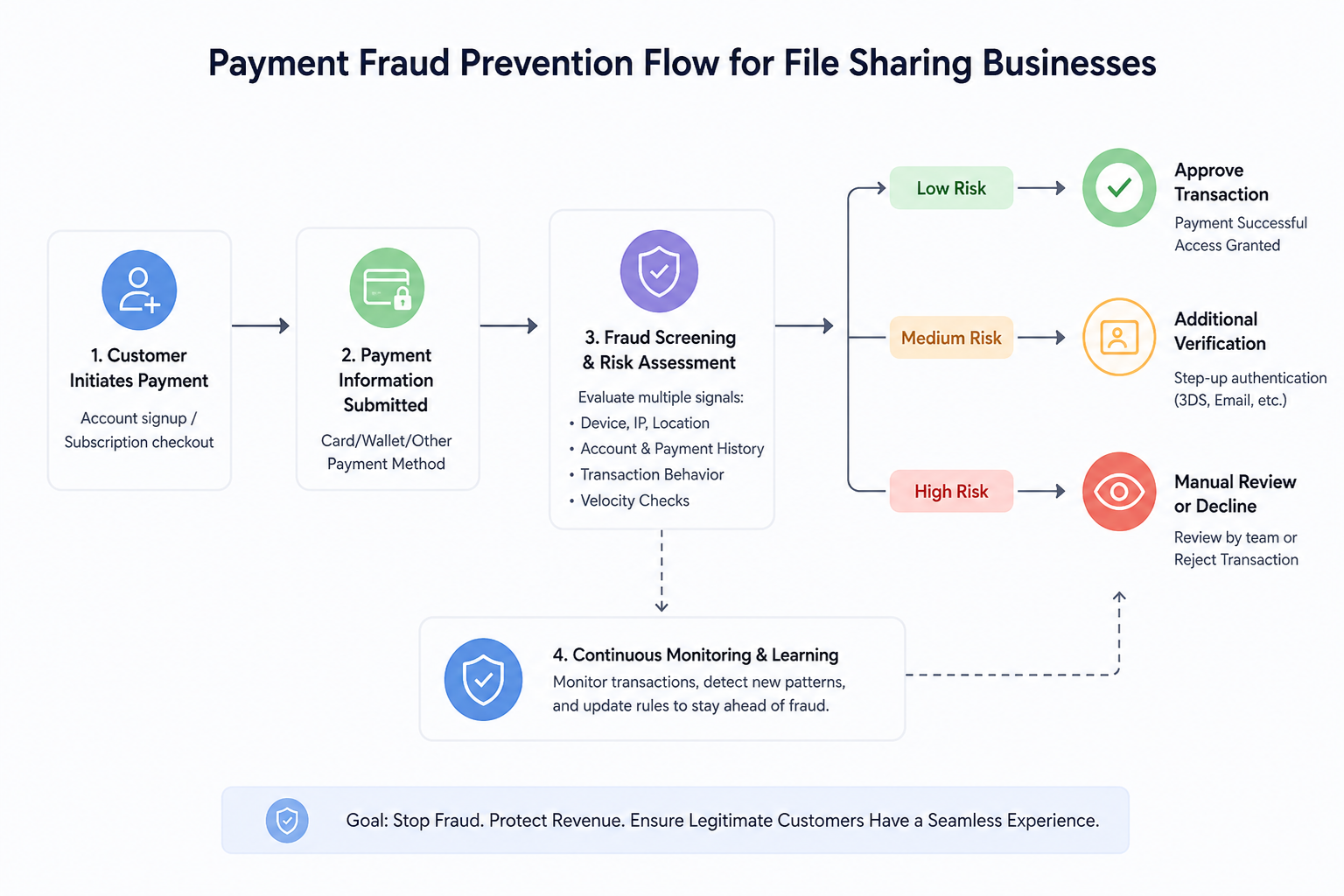
Modern payment fraud detection generally works by evaluating multiple signals rather than relying on a single piece of information. When a customer attempts to pay, a fraud detection system may evaluate available transaction and account signals such as:
- Transaction amount and frequency
- Payment method information
- Account history
- IP address and approximate network location
- Device or browser information
- Billing information
- Previous payment activity
- Failed and successful transaction patterns
- Account creation and login behavior
- Other available behavioral or transaction-related signals
The transaction or account activity can then receive a risk assessment. Depending on the risk level and the business’s fraud controls, the activity may be:
Approved → Sent for additional verification → Sent for manual review → Declined
Risk assessment can combine transaction, device, account, and behavioral signals to identify activity that differs significantly from normal customer behavior.
For example, a customer who has used the same file-sharing account for two years and normally pays $15 per month may suddenly attempt an unusually large transaction from an unfamiliar device and network environment. That does not automatically prove fraud. However, the combination of unusual signals may justify additional verification.
Use Velocity Checks to Identify Unusual Activity
Velocity checks measure how frequently certain actions occur within a defined period. They are useful because fraudulent activity, particularly automated fraud, can occur much faster than normal customer behavior.
Consider a file-sharing checkout that normally receives a limited number of payment attempts per minute. Suddenly, hundreds of payment attempts arrive from a small number of IP addresses or devices within several minutes. The individual transactions may appear ordinary when viewed separately. The overall pattern, however, may indicate unusual or automated activity.
Velocity controls can monitor activity associated with:
- Customer accounts
- IP addresses
- Devices
- Payment methods
- Transaction amounts
- Payment attempts
- Account creation events
- Failed authorization attempts
These controls can help identify automated attacks, card testing, and other abnormal transaction patterns. However, thresholds should be appropriate for the business. If they are too restrictive, legitimate customers may be affected during periods of genuine demand.
Protect the Checkout From Card Testing
Card testing is particularly relevant to online businesses that accept digital payments. In a card-testing attack, criminals use automated systems to submit multiple payment attempts with stolen payment credentials. The objective is often to identify which cards or payment credentials are still valid before attempting larger fraudulent transactions.
A file-sharing platform may notice warning signs such as:
- An unusual increase in low-value payment attempts
- A high number of failed authorizations
- Repeated payment attempts within a short period
- Large numbers of accounts being created rapidly
- Multiple payment methods being tested from the same device or network environment
Several controls can help reduce exposure. Depending on the business and payment setup, these may include CAPTCHA, rate limiting, account or session validation, payment-attempt restrictions, and controls designed to identify automated activity.
For example, if one IP address creates dozens of new file-sharing accounts within a few minutes and attaches a different payment card to each account, the platform should not treat every attempt as an independent customer. The overall pattern is itself a significant risk signal. These controls are part of the broader payment processing environment and should work alongside the business’s normal payment infrastructure.
Protect Customer Accounts From Takeover
Payment fraud does not always begin at checkout. An attacker may first gain unauthorized access to a legitimate customer’s account and then attempt to make changes that enable fraudulent transactions.
For a file-sharing platform, suspicious activity might include an unfamiliar login followed by a password change, email change, payment-method update, or unusual subscription upgrade. Account security should therefore work alongside transaction-level fraud controls.
Useful measures can include strong authentication, email verification, multi-factor authentication where appropriate, monitoring for unusual login behavior, and additional verification when sensitive account information changes. A payment system that only examines the transaction itself may miss important context indicating that the account was recently compromised.
Use Multiple Fraud Signals Instead of One Rule
No single fraud indicator is reliable enough to make every payment decision.
An IP address from another country does not automatically mean a transaction is fraudulent. An unfamiliar device does not automatically mean the customer is a criminal. A high-value subscription is not automatically suspicious. The stronger approach is to evaluate multiple signals together and assess the overall pattern.
For example: A customer normally accesses their account from India, uses the same device, and pays $10 each month. One day, the account is accessed from another country, the password is changed, a new payment method is added, and a significantly more expensive plan is purchased within minutes.
Each event could have a legitimate explanation. Together, however, they create a stronger reason for additional verification. Layered fraud prevention systems can combine rules, risk scoring, device or behavioral signals, authentication controls, and transaction monitoring to improve detection while reducing unnecessary declines.
Don’t Make Fraud Controls Too Aggressive
Fraud prevention involves an important balance between security and customer experience. If a system blocks too many transactions, legitimate customers may experience unnecessary payment declines. If it allows too much suspicious activity to proceed without verification, fraudulent transactions may be approved. This is particularly important for subscription businesses because a legitimate customer who repeatedly encounters payment problems may abandon the service.
Suppose a file-sharing platform automatically blocks every transaction from a new device. A genuine customer who buys a new laptop or accesses their account while travelling could unnecessarily lose access to the normal payment flow.
A better approach may be to request additional verification or apply further risk assessment when multiple unusual signals appear rather than automatically declining every unfamiliar transaction.
A Practical Example
Imagine a file-sharing platform receives 2,000 subscription payment attempts each day. One afternoon, the number of payment attempts suddenly increases to 10,000. Many involve small transactions, a high percentage fail, and hundreds of new customer accounts are created from a relatively small group of IP addresses.
The business investigates the pattern rather than treating every transaction independently. The combination of unusual transaction velocity, rapid account creation, and high payment-decline activity may indicate automated card testing.
Then it applies appropriate rate limits, CAPTCHA or session controls, review suspicious activity, and coordinate with its payment provider to investigate the incident.
Now consider a different situation. A long-standing customer logs in from a new device, changes their password, adds a new payment method, and immediately upgrades from a $20 plan to a $300 business plan. The activity may be legitimate, but the sequence justifies additional verification because several account and payment signals changed within a short period.
Monitor Fraud Patterns Over Time
Fraud prevention should not stop after a transaction is approved or declined.
A file-sharing business should regularly review payment and account activity to identify emerging patterns and changes in fraud behavior. Useful questions include:
- Are suspicious payment attempts concentrated around particular accounts, devices, or IP addresses?
- Are certain transactions or payment flows producing unusually high decline rates?
- Are fraud attempts increasing after a marketing campaign, pricing change, or product launch?
- Are compromised accounts showing similar behavior before unauthorized transactions occur?
- Are customers reporting unauthorized transactions after specific account events?
- Have fraud patterns changed after the introduction of a new payment method or subscription plan?
The answers can help the business adjust fraud controls without unnecessarily affecting legitimate customers.
Fraud Prevention Should Work With Chargeback Prevention
Fraud and chargebacks require different responses, but they are closely connected.
A fraudulent card transaction may eventually result in a chargeback when the legitimate cardholder discovers the unauthorized payment. However, not every chargeback is caused by payment fraud. Customers may also dispute transactions because of billing confusion, subscription issues, cancellation problems, or other service-related concerns.
This is why chargeback prevention for file-sharing businesses should address billing clarity, subscription terms, recognizable payment descriptors, cancellation procedures, and transaction records. Fraud prevention, meanwhile, focuses primarily on identifying suspicious, unauthorized, or deceptive activity before or during the transaction process. Treating these issues separately makes it easier to identify the correct source of the problem and apply the appropriate controls.
Building a Layered Fraud Prevention Strategy
A reliable payment fraud prevention strategy for a file-sharing business should not depend on a single tool, rule, or data point. It should combine appropriate account security, checkout controls, transaction monitoring, risk assessment, velocity checks, authentication, and customer verification.
The exact controls will depend on the business model, payment setup, customer base, transaction volume, geographic markets, payment methods, and overall risk profile.
The objective is to create multiple layers of protection so that one missed signal does not automatically result in a fraudulent transaction being approved. As a file-sharing business grows, these requirements can become more complex. Higher transaction volumes, additional customers, international payments, new payment methods, and multiple subscription plans can create more activity to monitor and more fraud scenarios to consider.
At that stage, a business may require more advanced payment reporting, fraud-management tools, automated risk assessment, transaction monitoring, and stronger payment infrastructure. Fraud prevention is therefore not simply about blocking suspicious payments. It is about creating a payment environment where legitimate customers can complete transactions normally while unusual activity receives an appropriate level of verification and scrutiny.

Categories
- ACH Payments (10)
- adult payment processing (11)
- AI (9)
- Altcoins (10)
- Banking (10)
- Bitcoin (133)
- Bitcoin ETF (11)
- Bitcoin Price (30)
- Blockchain (50)
- Brokering World Hunger Away (16)
- Business (17)
- card payment processing (10)
- CBD (11)
- CBDC (11)
- Chargeback (8)
- coaching business (11)
- COVID-19 (3)
- Crypto ATMs (1)
- Crypto Banking (17)
- Crypto Bill (1)
- Crypto business owner platform (31)
- Crypto Investment (3)
- Crypto Markets (5)
- Crypto Payment (35)
- Crypto Payment Processor (4)
- Crypto Prices (1)
- Crypto Trading (92)
- Cryptocurrency (402)
- Cryptocurrency Exchange (108)
- Data Visualization (2)
- dating platforms (11)
- debt collection payment processing (10)
- Decentralized Finance (7)
- DeFi Payment (9)
- DEX (3)
- Digital Currency (23)
- dropshipping payment processing (12)
- Ethereum (2)
- FAQ (7)
- file sharing payment processing (11)
- Finance (25)
- Financial Equality (4)
- Financial Freedom (8)
- Forex (35)
- hemp (1)
- ICO (2)
- Investment (11)
- IPTV (11)
- Merchant Account (10)
- Mining (3)
- News (66)
- NFTs (2)
- online gambling (11)
- P2P (1)
- Paybito (147)
- PayBitoPro (693)
- PayBitoPro Coin Listing (6)
- PayBitoPro Exchange (2)
- Payment Gateway (48)
- peptide (10)
- Post COVID Digital Transformation (1)
- Press Release (130)
- Privacy & Security (3)
- Real Estate (1)
- Stablecoin (5)
- Technology (15)
- Travel (11)
- Uncategorized (10)
- US Presidential Election (2)
- Utility Coin (1)
- Web3 business (4)
- Web3 Wallets (2)
- White Label Crypto Exchange (8)
Recent Posts
- Payment Gateway vs. Payment Orchestration: What’s the Difference?
- What Is Smart Payment Routing? Strategies to Optimize Payment Performance
- How to Improve Payment Approval Rates for High-Risk Businesses?
- Why Are Online Payments Failing? Common Causes and How to Fix Them
- How to Use Multiple Payment Processors to Reduce Business Disruptions?